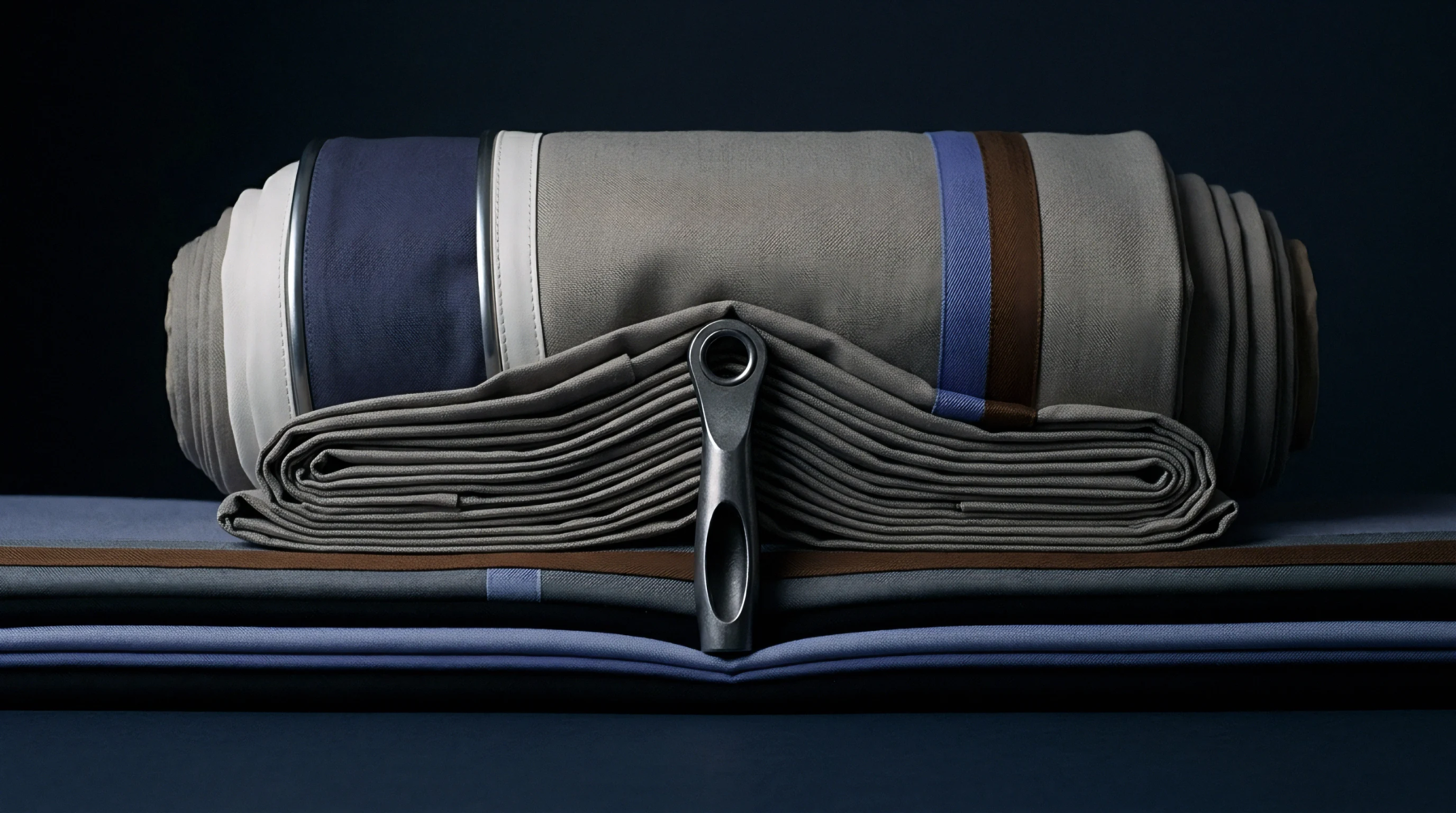
Finishing Deformation
Mechanical thermo-bonding processes apply sustained compressive force and elevated temperatures to alter the cross-sectional geometry of woven or knitted webs. Applied calendering compaction alters the spatial volume of the fabric substrate by flattening constituent yarns and driving adjacent filaments into open inter-yarn gaps. This physical transformation establishes permanent thickness reduction up to the thermal softening limit of synthetic polymers or the mechanical crushing point of natural cellulosic fibres.
Roller Force
Nip pressure between heated steel rolls and softer elastic bowls forces filaments to deform laterally under shear loads. Higher calendering compaction reduces fabric thickness while increasing surface smoothness and specular gloss.
Thickness Compression
Precision dial gauges and optical micrometers verify dimensional reduction by measuring substrate thickness before and after nip passage. Mill quality control protocols track thickness changes across the full usable width of the roll. Non-uniform hydraulic pressure along the roll face produces differential density gradients that cause diagonal skewing during subsequent garment cutting operations.
Structural Stabilization
Downstream laminate adhesion improves when web surfaces achieve consistent calendering compaction through uniform heat distribution. Lower air permeability results when compacted yarn structures restrict void volume across the fabric plane. Insufficient roll temperature causes elastic recovery in cotton weaves, reversing target compaction levels after laundering.