Colorimetric Variation
Longitudinal chromatic divergence describes continuous color drift occurring along the running length of an unbroken fabric roll or dyed production lot. Commercial grading marks end to end shading as a critical defect that disrupts cutting room panel matching across long garment marker layouts. The defect category applies exclusively along the machine direction of production yardage, distinct from edge-to-edge or edge-to-center shade variances across the fabric width.
Continuous Dye Dynamics
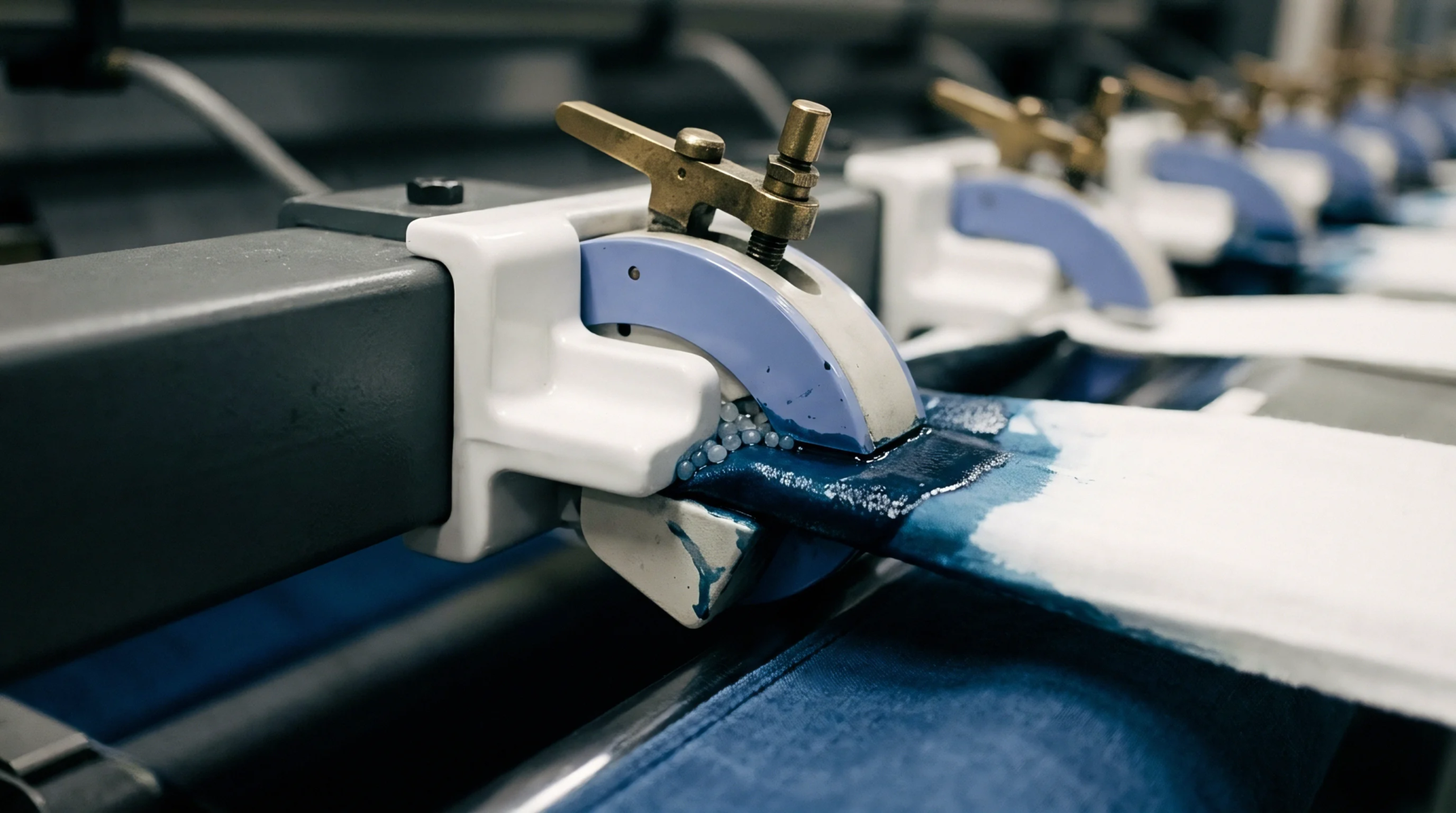
Imbalance between dye affinity and bath depletion across long production runs drives progressive shade migration. In continuous pad operations, dye liquor undergoes selective substantivity shifts if replenishing feeds fail to balance dynamic pickup rates. The pad trough volume acts as a variable reservoir where high-affinity dye components exhaust faster than the replenishing liquid enters, causing gradual tailing toward lighter tones.
Conversely, improper dye fixation temperatures down stenter lengths cause differential migration during early drying zones. Infrared predrying panels must supply uniform radiant output to immobilize wet dye boundaries before high-velocity convective airflow contacts the damp substrate. Tension fluctuations across continuous washing ranges generate differential rinsing efficiency, altering residual hydrolysed dye concentrations from roll start to roll end.
Shade Banding Risk
Garment manufacturing lines suffer severe panel mismatching when markers group adjacent pattern pieces cut from distant linear sections of an uninspected roll. Cutting tickets mandate linear roll sequence tracking to prevent assembling front panels from the start of a dye lot with back panels from the roll finish. Visual sorting systems group yardage into tight shade bands under standard D65 and tungsten lighting enclosures.
Spectrophotometric verification according to ISO 105-J03 measures CIELAB delta E color differences across continuous fifty-meter increments. Batches exceeding an agreed delta E limit, often set at 0.8, undergo shade rejection before dispatch to sewing lines.
Lot Verification
Roll mapping protocols mandate laboratory reflectance checks on samples drawn from both the outer head and the interior roll tail. Automated inline spectrophotometers monitor machine-direction reflectance during inspection to detect creeping delta E trends before shipment. Sorting yardage into dedicated shade groups remains the sole remediation when continuous corrective stripping proves commercially unfeasible.
Production contracts penalize uncontrolled longitudinal drift because it fragments cutting schedules and increases fabric consumption.