Spatial Non Uniformity in Continuous Textile Wet Processing
Spatial non-uniformity stems from roll deflection, drying airflow gradients, and thermal drift, requiring multi-point spectrophotometry to enforce debit remedies.
Nip
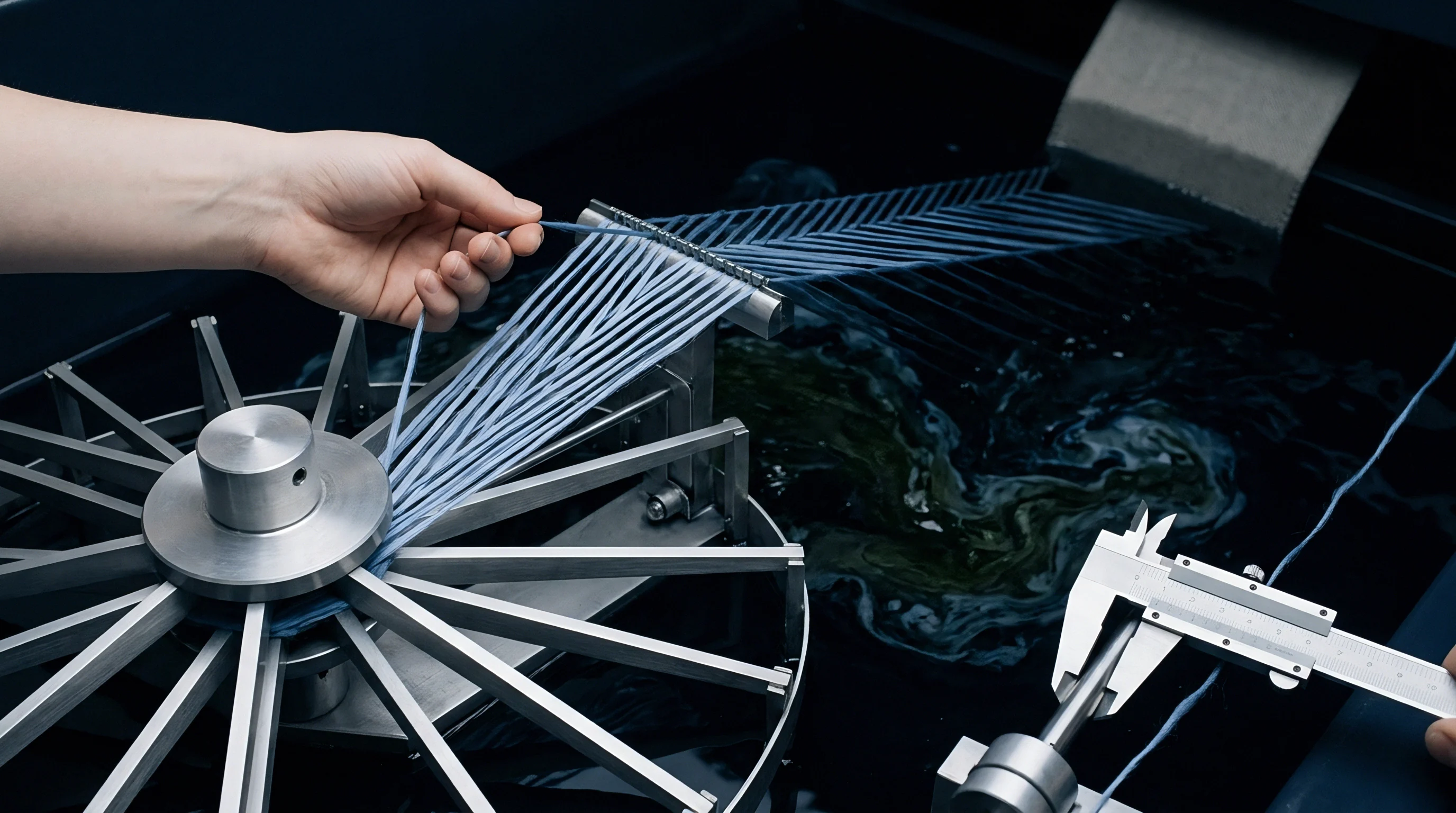
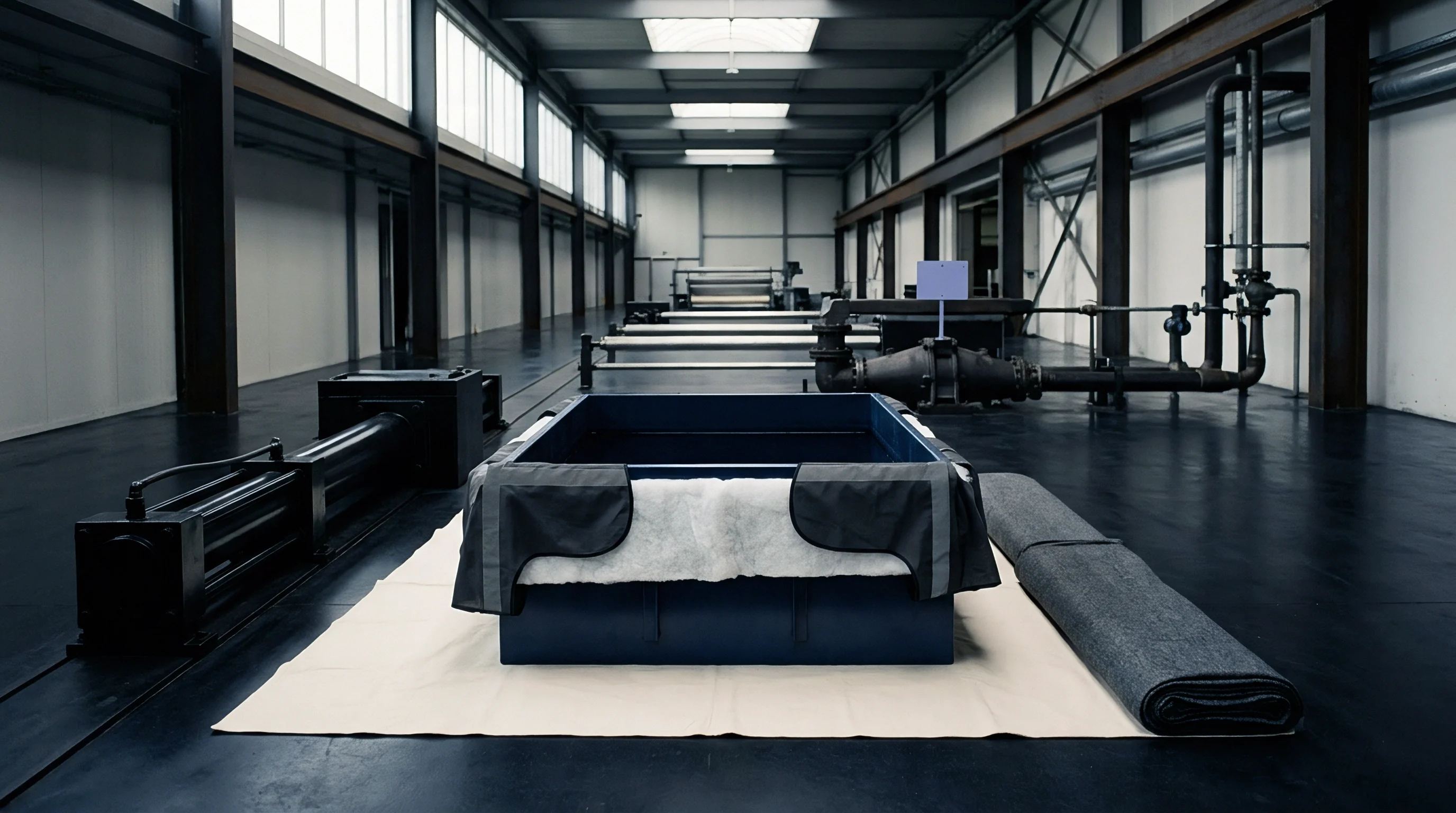
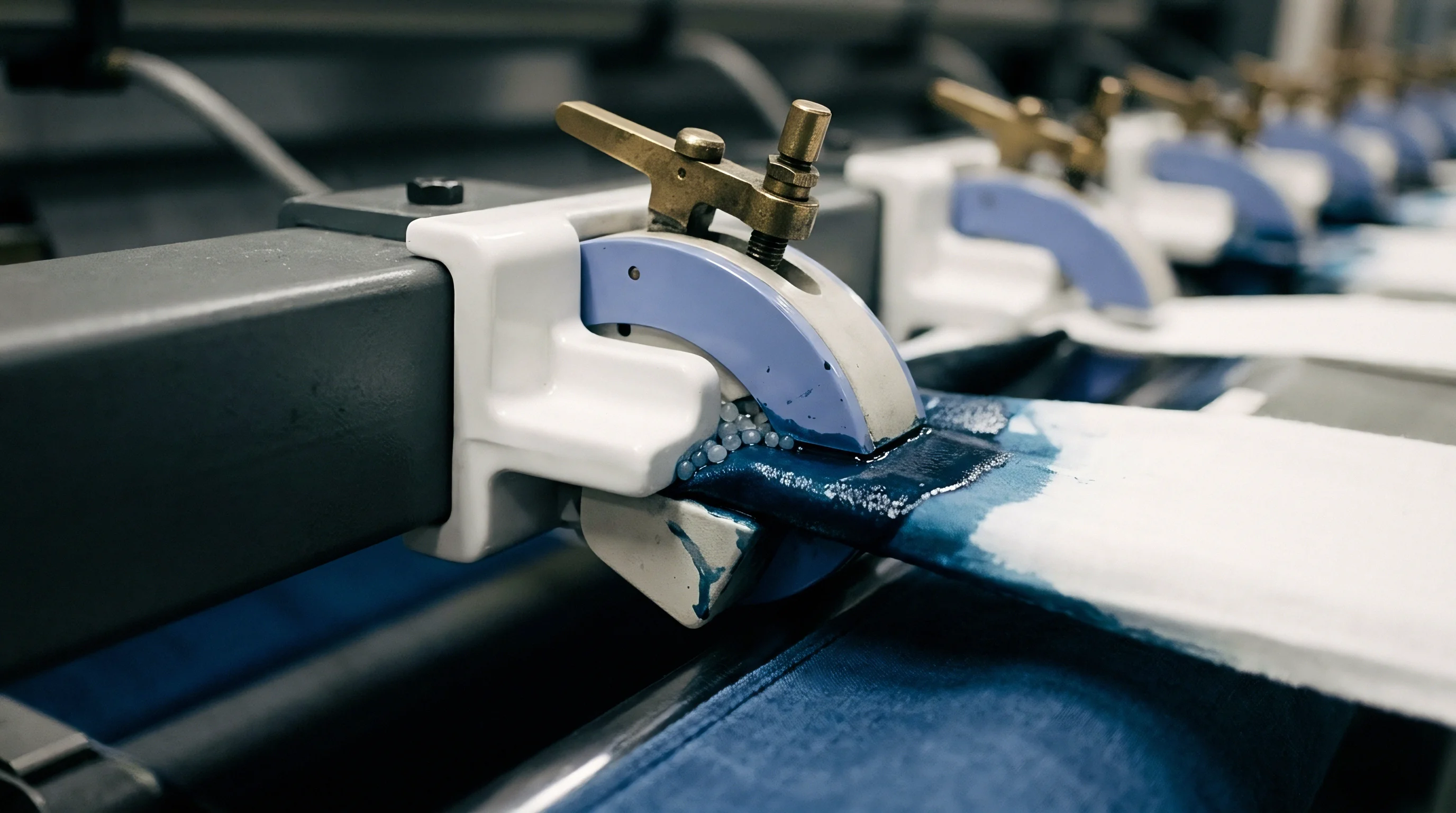
Pressure profiles across a continuous dye padder deviate from centerline setpoints within four hundred running meters of roll rotation. A rubber-covered bowl ground to an exact cylindrical profile sags under end-journal loading, depressing fluid expression at the web center relative to the selvages. When wet pick-up climbs by five percentage points on a heavy cotton twill, color depth shifts immediately past commercial tolerance thresholds.
The resulting shade listing remains undetectable to human operators until dried yardage exits the thermofixation tunnel. Mill mechanics attempt manual compensation through pneumatic cylinder adjustment, yet mechanical deflection follows beam deflection laws rather than linear pressure transfers.
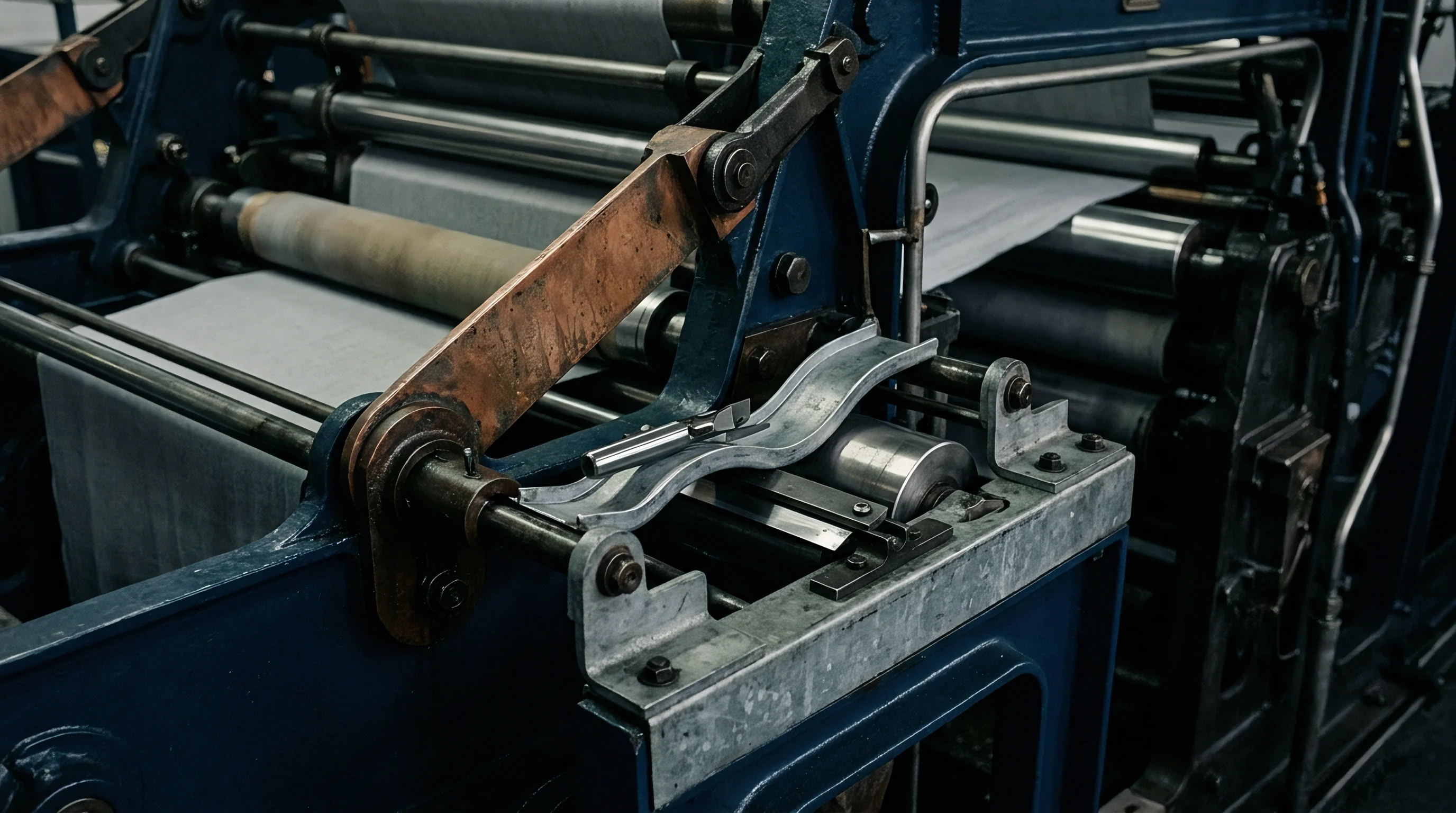
Crown compensation systems address this deflection pattern by curving the roll core or generating internal hydraulic pressure distributions. A swimming roll utilizes internal hydraulic compartments to exert outward force directly against the inner shell wall, countering the natural bending moment caused by bearing loads. Controlled deflection rolls adjust regional pressure zones across thirty-millimeter segments to equalize the physical gap across two hundred centimeters of roll face.
Minor mechanical wear on polyurethane roll covers degrades this force balance within weeks of continuous chemical exposure.
Roll shore hardness shifts continuously across chemical bath temperatures. A cover rated at seventy Shore A at twenty degrees Celsius softens to sixty-two Shore A under an eighty-degree pad bath, altering the footprint width of the contact area. Wider contact footprints reduce peak hydraulic pressure at the center line, decreasing liquor expulsion and leaving surplus moisture in the web core.
Roll deflection exceeding sixty micrometers produces an uncorrectable wet pick-up variance across two meters of fabric width.
Corrective padder alignment follows an exact sequence to verify contact uniformity across the working width.
- Carbon impression indexing records the static contact area footprint across left, center, and right quadrants at target production pneumatic pressures.
- Electronic roller profiling logs dynamic mechanical deflection down the full cylinder length while turning rolls at creeping line speeds under zero bath volume.
- Gravimetric swatch extraction measures differential liquor absorption across nine cross-direction positions immediately behind the squeegee nip before evaporation starts. A dry weight subtraction isolates local solution retention.
- Hydrostatic balance verification confirms equal fluid replenishment flow into the pad trough across both inlet ports during steady continuous running.
When mechanical deflection goes uncorrected at the padder, uneven chemistry propagates into every downstream thermal unit, compounding initial pick-up variations into unmerchantable side-center-side shade lists that force garment cutters to reject whole fabric lots at the spreading table.
Migration
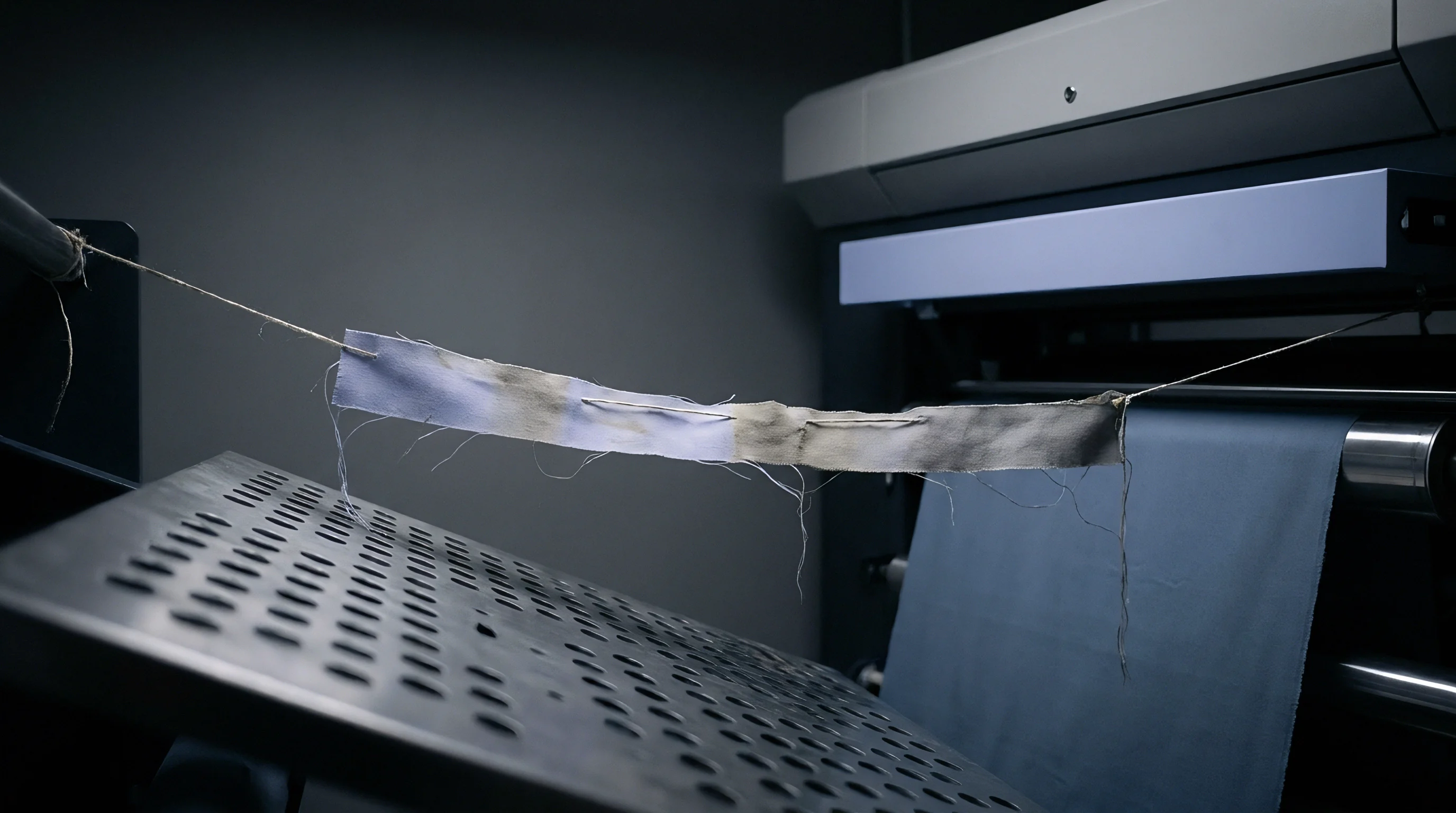
Liquid phase dyes and functional auxiliaries travel toward drying surfaces along capillary channels established by evaporating water. When hot air strikes a saturated textile, water vaporizes at the yarn surface, generating a moisture deficit relative to the fiber interior. Capillary forces draw fluid from saturated internal zones outward to replenish the evaporating boundary layer.
Soluble dyestuff molecules follow this hydrodynamic convective current, concentrating heavily on exposed face yarns while depleting fiber cores. Intermediate dryers running unbalanced air nozzles trigger severe shade discrepancies between fabric face and fabric back.
Unequal evaporation rates down the cross-direction generate lateral fluid drift toward rapidly drying selvages. Edge curl on tenter clips accelerates boundary layer airflow, evaporating water along the fabric boundaries faster than at the web center. Dissolved dyestuffs and fluorochemical repellents move laterally toward these accelerated evaporation zones.
The resulting shade disparity across the working width resists chemical clearing or post-scouring adjustments.
Evaporating water carries dissolved chemicals outward to the highest heat zones until fabric moisture drops below thirty percent.
Infrared pre-drying units suppress particulate movement by immobilizing liquor within the fibrous structure prior to high-velocity convective exposure. Gas-fired infrared heaters transfer radiative energy directly into water molecules throughout the substrate thickness without generating air currents. Lowering web moisture content from eighty percent wet pick-up down to thirty-five percent halts capillary flow before hot flue entry.
Operating infrared heaters below critical radiation densities permits moisture gradients to persist, failing to lock dye particles into yarn interstices.
Drying units exhibit specific operational failures that generate non-uniform chemical deposition patterns across treated running goods.
- Nozzle boundary stagnation traps saturated vapor pockets along the center fabric path, decelerating local drying while dry selvage air strips moisture rapidly.
- Burner chamber thermal drift creates a persistent temperature slope across the machine width from gas burner manifold pressure drops. Center-to-selvage shade lists emerge within minutes.
- Turbulent eddy formation dislodges wet pigment particles from open weave structures before binder crosslinking solidifies.
- Exhaust damper imbalances pull heated atmosphere toward one exhaust port, establishing an asymmetrical velocity profile across the passing substrate face.
Uncontrolled drying always pushes chemistries toward the highest energy delivery point on the passing cloth.
Fixation
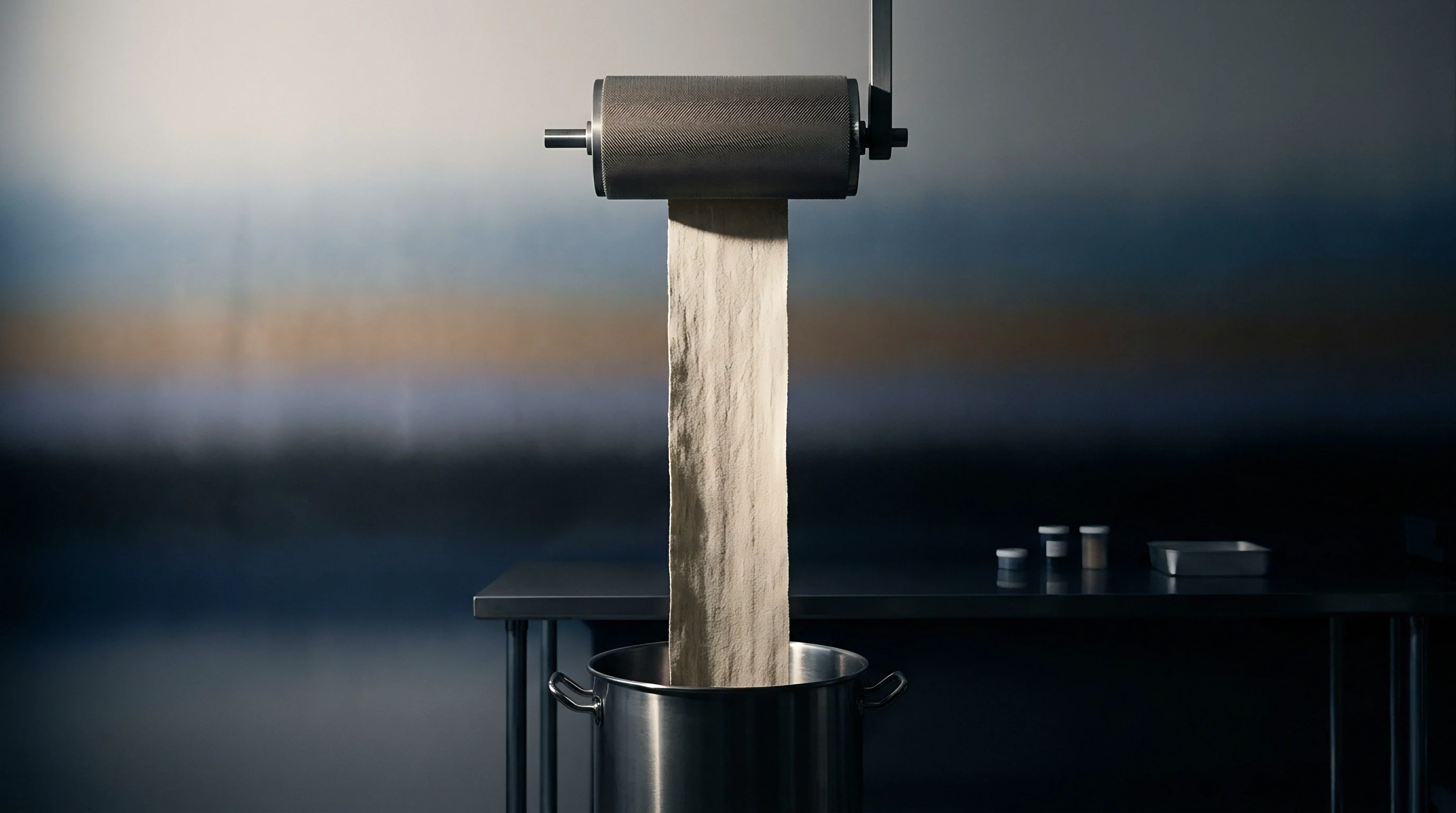
Thermal energy input governs chemical reaction rates during thermosol dye development, pad-steam processing, and resin crosslinking stages. In continuous pad-steam lines for vat and reactive dyes, atmospheric steam purity determines dye reduction and fiber bonding kinetics. Saturated steam entering the steamer chamber at one hundred and two degrees Celsius must remain free of entrained air.
Oxygen contamination levels as low as one half percent oxidize sodium dithionite prematurely, suppressing reactive dye yield across the web boundaries where air ingress occurs through slit seals.
Continuous stenter frames rely on multi-zone circulation fans to deliver heated air uniformly through slotted nozzle boxes above and below the moving fabric. Thermal gradients within these chambers inevitably develop when air filters clog or burner controls drift out of calibration. A four-degree Celsius temperature variation between left and right duct runs alters the dye diffusion coefficient within polyester yarns, producing an uncorrectable chromatic deviation along the warp direction.
Continuous galvanizing lines in sheet steel manufacturing experience analogous thermal boundary layer challenges, where localized zinc thickness shifts occur if cooling air knives deviate across the metal sheet. In textile finishing, hot air nozzles generate localized boundary layer resistance that impedes uniform heat transfer into the moving structure. This physical dynamic restricts chemical fixation rates in low-velocity zones.
Moisture retention during steaming requires precise balance between dry bulb and wet bulb temperatures. Superheated steam dries the fabric out, halting dye migration into the fiber matrix, while wet steam causes droplet condensation that generates wash-out spots and pale blotches. Saturated steam provides the precise latent heat transfer necessary for reactive dye fixation without disturbing surface distribution.
| Chamber Zone | Target Temperature (°C) | Actual Temperature (°C) | Air Velocity (m/s) | Color Yield Variance (ΔE CMC) |
|---|---|---|---|---|
| Zone 1 Left | 210 | 209 | 14.8 | 0.22 |
| Zone 1 Center | 210 | 206 | 12.1 | 0.78 |
| Zone 1 Right | 210 | 211 | 15.2 | 0.31 |
| Zone 3 Left | 215 | 215 | 15.0 | 0.15 |
| Zone 3 Center | 215 | 208 | 11.9 | 1.14 |
| Zone 3 Right | 215 | 216 | 15.4 | 0.28 |
Dyehouse managers frequently assert that minor shade variances across the goods will visually blend together once garments are cut and assembled across standard retail production runs.
Variance
Spectrophotometric evaluation measures non-uniformity through numerical color space differences across defined geometric web coordinates. Standard testing protocols demand measurements across nine points: left, center, and right sectors repeated at the beginning, middle, and end of each processed roll. Calculating color variance requires the CIEDE2000 or CMC (2:1) color difference equations to establish commercial accept or reject decisions against master lot standards.
Which Sampling Array Separates Padder Deflection from Dryer Airflow?
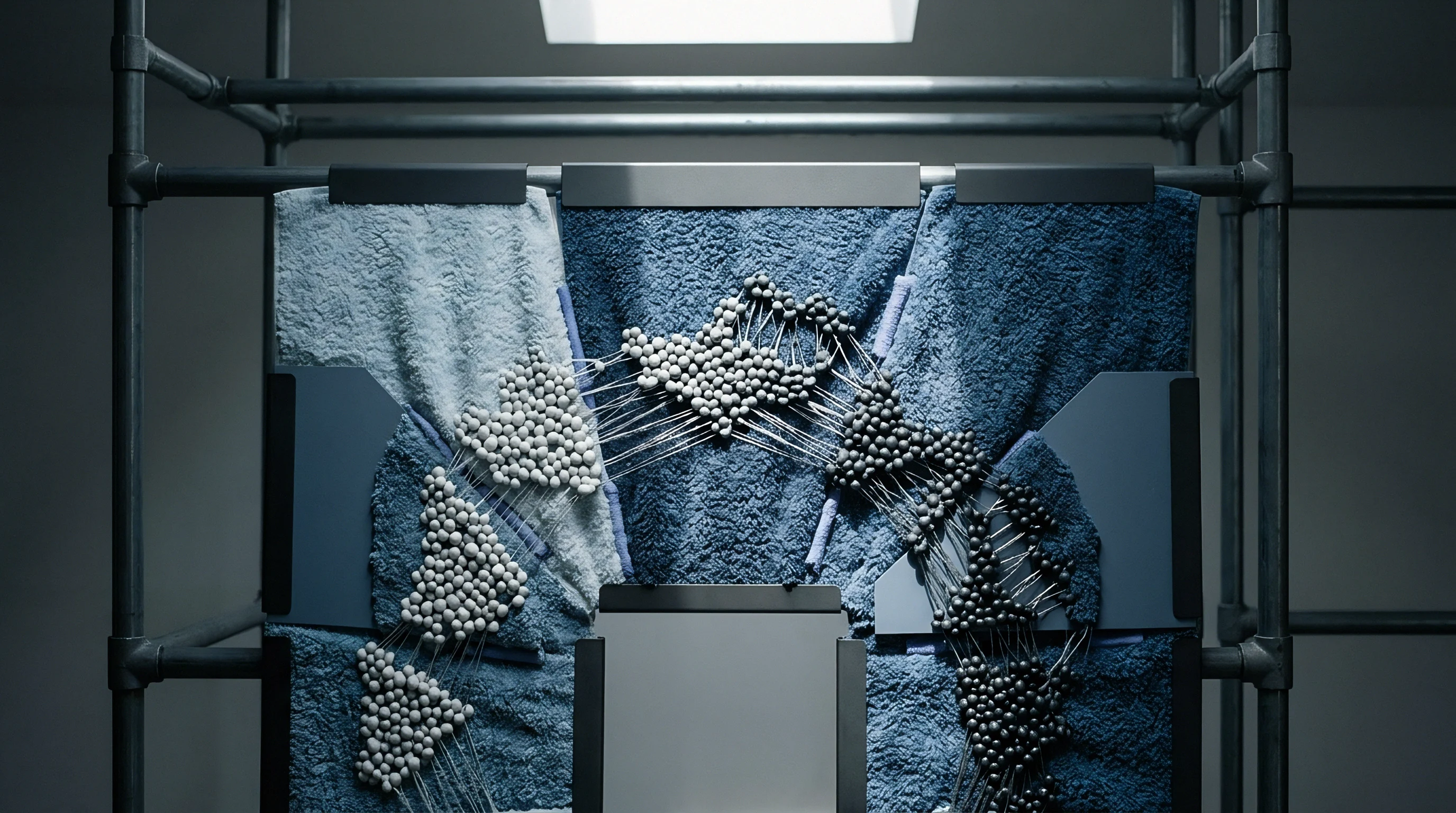
Distinguishing padder deflection from uneven airflow demands targeted diagnostic sampling across the entire cross-direction. Mechanical bowl deflection produces a symmetrical convex or concave color profile, where both selvages match each other while the center deviates. Asymmetric thermal flow in hot flues generates a linear slope, where the left selvage departs completely from the right selvage.
A nine-point diagnostic grid isolates these distinct physical failure signatures.
| Lateral Position | Distance From Left Edge (cm) | L (Lightness) | a (Red-Green) | b (Yellow-Blue) | Total Variance (ΔE00) |
|---|---|---|---|---|---|
| Left Selvage | 10 | 42.15 | 12.30 | -18.40 | 0.18 |
| Left Center | 50 | 41.80 | 12.45 | -18.15 | 0.45 |
| True Center | 90 | 41.10 | 12.80 | -17.60 | 1.28 |
| Right Center | 130 | 41.75 | 12.50 | -18.20 | 0.51 |
| Right Selvage | 170 | 42.20 | 12.28 | -18.45 | 0.12 |
A typical production lot illustrates the commercial impact of this spatial divergence. Take a twenty thousand meter lot of olive woven poplin valued at three dollars and fifty cents per linear meter. Assume inspection reveals a center-to-selvage color variance averaging 1.28 ΔE00 across forty percent of the processed rolls.
Standard retail brand specifications establish an absolute rejection ceiling at 0.80 ΔE00 for panel-to-panel compatibility.
Garment cutting operations cannot interlock pattern markers across varying shade zones without producing two-tone sleeves, front panels, and collars. The converter must re-sort rolls into narrow sub-lots or execute an edge-trimming program that narrows the usable cuttable width from one hundred and eighty centimeters to one hundred and forty centimeters. Trimming twenty-two percent of physical yardage turns a projected eight percent gross margin into a fourteen thousand dollar direct production loss on scrap waste alone.
ASTM D5430 point allocations mandate complete roll rejection when lateral shading defects persist across more than ten consecutive meters.
The desk tracks laboratory trials evaluating cross-directional moisture sensing arrays, yet existing inline microwave sensor suites cannot reliably segregate bound chemical salts from unbound capillary moisture at line speeds above sixty meters per minute. When inline instruments deliver ambiguous moisture signals, verification falls back to destructive bench extraction methods.
Industrial chemists still dispute whether surface-active migration inhibitors can fully compensate for mechanical airflow imbalances without lowering dye fixation efficiency or altering finished fabric hand.

Settlement
Commercial claims arising from spatial non-uniformity depend on test documentation validity, accredited sampling sequences, and purchase order tolerance definitions. Textile buyers routinely face deliveries certified as fully conforming by mill test sheets, only to discover severe shading defects when fabric rolls unroll on cutting tables. Standard mill certificates frequently sample only the outer layer of a master roll, completely omitting internal running variance generated during thermal stabilization cycles.
A defensible quality dossier requires strict separation between lot qualification swatches and continuous shipment rolls. Purchase contracts should incorporate ISO 105-J03 color calculation methods alongside ASTM D5430 four-point defect scoring limits. Under the four-point system, continuous side-to-side shading running along length dimensions incurs four penalty points per linear meter, rapidly exceeding maximum allowable score thresholds of twenty-eight points per one hundred square meters.
When audits expose systemic spatial variations across multiple containers, commercial liability passes directly to the entity identified on the bill of lading. Mills facing formal debit claims attempt to categorize shading as inherent commercial tolerance rather than non-conforming manufacturing. Establishing explicit contractual language removes this defense, converting qualitative arguments into liquidated commercial damage claims.
| Color Variance Range (ΔE00) | Commercial Usability Classification | Applied Invoice Discount (%) | Contractual Remedy |
|---|---|---|---|
| 0.00 to 0.60 | Full First Quality | 0.0 | Standard Acceptance |
| 0.61 to 0.90 | Secondary Tolerance Band | 5.0 to 10.0 | Shade Group Sorting |
| 0.91 to 1.30 | Non-Conforming Goods | 25.0 to 40.0 | Width Trimming Allowance |
| Above 1.30 | Complete Commercial Rejection | 100.0 | Full Debit Note And Return |
A properly structured purchase contract incorporates an explicit technical clause stipulating that any continuous roll demonstrating lateral or longitudinal color deviations exceeding 0.85 ΔE00 under CIE D65 illumination grants the buyer the legal right to immediate debit note issuance and vendor-funded replacement.