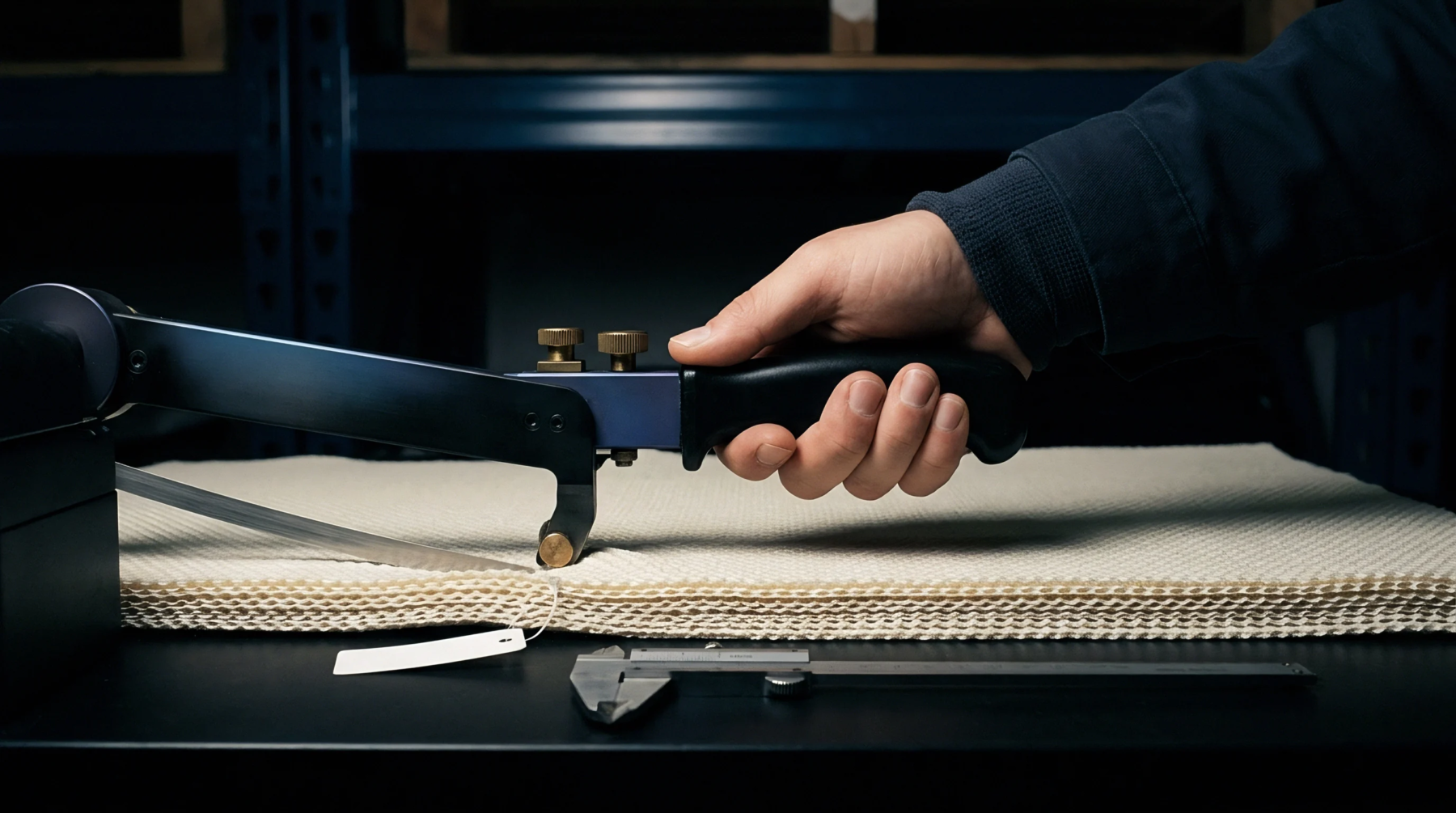
Swatch Sampling Position Deciding Whether a Batch Passes
Physical swatch position across fabric width and length determines chemical compliance, requiring three-point cross-web sampling to validate batch pass status.
A structural measurement quantifying the difference in physical properties between the middle and the edges of a fabric roll during continuous processing. The term center web variance identifies the deviation in density, thickness, or moisture content between the central path of the machinery and its periphery. In a mill environment, this phenomenon occurs when tensions or temperatures are not uniform across the rollers.
Technicians measure these values to ensure that the finished product maintains a consistent hand feel across the entire width. If the variation exceeds a specific tolerance, the fabric might fail quality inspections during garment assembly. This metric specifically describes the cross-directional profile of the material rather than longitudinal changes.
Measurement cycles happen during both the initial coating and the final drying to locate the exact source of the error.
Tension differences across the rollers of a stenter or pad mangle frequently create this physical inconsistency. When the center of a roller experiences more deflection than the ends, the nip pressure becomes uneven, resulting in center web variance. Such a mechanical defect forces more liquid into the central portion of the fabric compared to the edges.
This leads to a higher concentration of chemicals or dyes in the middle, which alters the performance of the textile in those specific areas. Correcting this requires the adjustment of crowning on the rollers or the recalibration of the tensioning system. Rollers that lack sufficient support or those that have worn bearings tend to exhibit this bowing effect more prominently.
The physical gap created by the deflection allows for a thicker layer of finish to reside in the center of the web.
Differences in moisture retention or chemical loading create challenges during the drying and curing stages of production. Because center web variance results in more mass in the middle of the roll, the center takes longer to dry than the edges. This creates a temperature gradient where the edges might become over-cured or scorched while the center remains damp or under-fixed.
The resulting fabric often displays shade variations known as listing or center-to-edge shading. Garment factories cannot cut patterns across these zones without risking visible color mismatches in the final apparel. When the variance involves moisture, the fabric may also suffer from dimensional instability, causing it to shrink or twist unevenly when washed.
This inconsistency forces the mill to slow down the entire line to ensure the wettest part is sufficiently dried. Such a reduction in speed increases energy consumption and lowers the overall throughput of the facility.
Modern production lines utilize infrared or beta-gauge sensors to monitor these lateral profiles in real time. These instruments detect center web variance by scanning the moving fabric and feeding data back to a central processor. The automated system then adjusts the pressure or heat application to compensate for the detected discrepancy.
By maintaining a flat profile, the mill ensures that every meter of fabric meets the narrow specifications required for high-end clothing. Consistent monitoring prevents the accumulation of waste and reduces the risk of bulk rejections at the inspection table. These sensors operate using a scanning head that traverses the width of the machine, taking hundreds of measurements per second.
The resulting heat map or thickness profile allows operators to see the exact state of the web. Continuous data logging provides a history of the machine performance for future maintenance scheduling.
Physical swatch position across fabric width and length determines chemical compliance, requiring three-point cross-web sampling to validate batch pass status.
Expertise is a utility, not a secret. sentiention™ publishes its working knowledge as open reference: intelligence layer covering the materials it sources, the markets it enters, and the reference that serves both.