Hydrodynamic Fluid Transport Mechanics inside Locked Pore Structures under Dynamic Web Tension Loading
Dynamic web tension locks yarn crossovers into high-resistance capillary slit pores, requiring controlled positive overfeed to maintain open fluid transport.
Nip
In continuous wet processing, running a woven or knitted web under machine direction tensile force reorganizes the internal geometry of yarn intersections long before liquid contact takes place. Tensile load applied parallel to the warp or course direction pulls yarn segments into high axial stress, driving crimp interchange where crimped longitudinal yarns straighten and transverse yarns rise in crimp height. When structural deformation is measured under longitudinal tensile loading, the macroscopic width reduction known as Poisson contraction forces adjacent warp ends and weft picks into close mechanical contact.
Inter-yarn spacing shrinks until the yarn surfaces press against one another under boundary contact pressure, creating a condition where void spaces between yarns collapse into micro-capillary channels with non-uniform, tortuous cross-sections. This spatial convergence locks the pore structure, replacing open interstitial macro-pores with restricted, high-resistance micro-voids.
Hydraulic liquid transport inside these constricted channels departs radically from classical isotropic fluid flow models described by Kozeny-Carman or Darcy equations. In an un-tensioned open web, fluid movement relies on predictable bulk permeability where liquid moves through inter-yarn apertures driven by moderate pressure gradients. Under machine direction loading exceeding 300 N/m, the geometry of the pore network becomes strictly anisotropic.
Inter-yarn void dimensions drop from nominal apertures of 30 to 80 micrometres down to sub-10 micrometre slit pores. Fluid forced through these locked apertures encounters elevated hydraulic resistance proportional to the inverse fourth power of the hydraulic radius, as governed by the Hagen-Poiseuille relationship for confined viscous flow. The fluid boundary layer at the solid fiber wall occupies an increasing fraction of the total pore cross-sectional area, creating a stagnation layer that chokes pressure-driven convective flux.
Yarn Crimp Interchange and Contact Zone Compression
Longitudinal stress on a moving web shifts the mechanical equilibrium of the weave or knit structure. In a plain weave construction with 28 ends per centimetre and 24 picks per centimetre, applying 500 N/m of machine direction tension converts flexible, curved warp threads into rigid, taut lines. The transverse weft threads absorb this kinetic energy by increasing their crimp angle from 8 degrees to over 18 degrees.
As weft crimp increases, the contact area at warp-weft crossovers transitions from a point contact into an extended planar surface contact. The normal forces acting at these crossover points exceed 1.5 MPa under typical production speeds of 60 metres per minute. This compressive contact crushes individual filament bundles, flattening cylindrical filaments into elliptical cross-sections and driving interstitial air out of intra-yarn capillary spaces.
Intra-yarn pore volume decreases concurrently with inter-yarn void collapse, yielding a composite structure whose fluid storage capacity drops by 40 to 65 percent relative to the relaxed state. Fluid residing inside these compressed filament bundles becomes hydrodynamically locked. The fluid molecules are subjected to strong molecular interactions with fiber surfaces alongside severe physical entrapment within jammed capillary throats.
When wet processing machinery attempts to force liquid chemical baths through a web in this state, bulk fluid flow bypasses the inner yarn cores entirely, skimming over the outer web boundary in a high-velocity surface layer. Wetting front propagation becomes limited by slow molecular diffusion rather than rapid convective displacement.
Viscous drag inside locked capillary throats increases non-linearly as machine direction tension forces yarn crossovers into mechanical contact.
Permeability Reduction Factors under Tensile Strain
Quantifying fluid permeability through tensioned webs requires measuring fluid flux perpendicular to the fabric plane alongside longitudinal fluid migration within the plane. Transverse liquid permeability drops rapidly as machine direction tension increases from zero to maximum operating values. The table below outlines empirical measurements taken across standard woven substrate builds under controlled machine direction tension levels using liquid water at 20 degrees Celsius.
| Fabric Build Specification | Applied Tension (N/m) | Effective Porosity (%) | Mean Pore Radius (um) | Transverse Permeability (m^2 x 10^-12) |
|---|---|---|---|---|
| Plain Weave 100% Cotton 150 gsm (Ne 30/1 warp/weft) | 50 | 62.4 | 38.5 | 14.2 |
| Plain Weave 100% Cotton 150 gsm (Ne 30/1 warp/weft) | 250 | 48.1 | 18.2 | 4.8 |
| Plain Weave 100% Cotton 150 gsm (Ne 30/1 warp/weft) | 500 | 36.8 | 7.4 | 0.9 |
| 3/1 Twill Polyester/Cotton 240 gsm (Ne 20/1 warp/weft) | 50 | 58.9 | 42.1 | 18.6 |
| 3/1 Twill Polyester/Cotton 240 gsm (Ne 20/1 warp/weft) | 250 | 43.5 | 21.0 | 6.1 |
| 3/1 Twill Polyester/Cotton 240 gsm (Ne 20/1 warp/weft) | 500 | 31.2 | 8.8 | 1.2 |
| High-Tenacity Nylon 6,6 Plain Weave 110 gsm (70D filaments) | 50 | 44.2 | 22.4 | 5.3 |
| High-Tenacity Nylon 6,6 Plain Weave 110 gsm (70D filaments) | 250 | 28.6 | 9.1 | 1.1 |
| High-Tenacity Nylon 6,6 Plain Weave 110 gsm (70D filaments) | 500 | 18.3 | 2.8 | 0.15 |
Data demonstrates that high-density synthetic builds experience extreme permeability decay under tension. A plain weave nylon web under 500 N/m tension loses over 97 percent of its transverse hydrodynamic permeability compared to its relaxed low-tension baseline. The reduction in mean pore radius shifts liquid movement from laminar Poiseuille flow into Knudsen-like constrained boundary flow where fluid-wall shear stresses dominate the system dynamics.
Structural alterations caused by high tension loading trigger several specific failure modes during continuous wet processing. These structural mechanics disrupt wet processing uniformity across the width and length of bulk runs.
- Core liquor starvation occurs when surface liquor fails to penetrate jammed yarn intersections, leaving inner filament bundles bone-dry as the web traverses the pad trough.
- Skittery shade appearance develops during dyeing steps because reactive or disperse dyestuffs deposit only on elevated, surface-exposed yarn crowns while locked crossover points remain un-dyed.
- Differential liquor pickup manifests across the web width due to non-uniform tension profiles, where tight selvedges absorb significantly less chemical fluid than the lower-tension fabric center.
- Boundary film stripping takes place at high line speeds when fluid cannot pass through the locked pore network, forcing liquid to build up as a standing hydrodynamic wave ahead of the nip roll.
When plant managers operate finishing lines without accounting for tension-induced pore locking, bulk rolls arrive at final inspection with severe center-to-selvedge shade variation and incomplete chemical fixations that cost thousands of dollars in rejected yardage.
Capillarity
Surface tension forces within constricted capillary networks governed by the Young-Laplace equation dictate whether a liquid bath wets, penetrates, or bypasses a moving porous substrate. Inside locked pore structures, the effective capillary radius drops to dimensions where Laplace capillary pressure spikes dramatically. The Young-Laplace equation states that capillary pressure jump equals twice the liquid surface tension multiplied by the cosine of the dynamic contact angle, divided by the capillary radius.
As web tension shrinks the effective radius down to sub-micrometre scales, the pressure required to push a wetting liquid through the structure rises exponentially. Conversely, if the fluid exhibits a non-wetting contact angle against the fiber surface, the capillary resistance acts as an absolute physical barrier to liquid entry.
High dynamic processing speeds introduce dynamic contact angle effects that worsen liquid entry challenges. As line speed increases from 20 to 100 metres per minute, the dynamic advancing contact angle between the liquid chemical formulation and the fast-moving dry fiber increases significantly compared to static contact angle values. An aqueous dye bath with a static contact angle of 35 degrees on cotton can exhibit an advancing dynamic contact angle exceeding 85 degrees when applied to a fast-moving web under high machine direction tension.
When the dynamic contact angle approaches 90 degrees, the cosine of the contact angle drops toward zero, effectively reducing the thermodynamic capillary driving force to zero regardless of how small the pore radius becomes.
Dynamic Wetting and Capillary Pressure Spikes
Fluid invasion into a porous medium under dynamic conditions relies on the balance between capillary driving forces and viscous drag forces, encapsulated by the non-dimensional Capillary Number. The Capillary Number is calculated as liquid dynamic viscosity multiplied by web velocity, divided by surface tension. At low Capillary Numbers below 10^-4, capillary forces dominate and fluid spontaneously wicks into available voids.
In high-speed commercial finishing ranges, Capillary Numbers routinely exceed 10^-2. Under these high-speed conditions, viscous forces resist fluid intrusion into small apertures, creating a liquid displacement front that is hydrodynamically unstable.
The stretching action of wet webs under tension alters the dynamic contact line between liquid, air, and solid fiber surfaces inside the locked micro-pores. Air bubbles become trapped inside the constricted intra-yarn capillary channels because the advancing liquid front encapsulates the void faster than the entrapped air can escape through the high-resistance fluid channels. This phenomenon, known as micro-air entrapment, creates persistent air pockets that block liquid access to inner filament surfaces.
These trapped air bubbles remain stable even under hydraulic immersion, resisting displacement due to high Laplace pressure differentials across the curved gas-liquid meniscus.
Micro-Fluidic Boundary Layer Shear
Liquids moving through micro-scale pores experience extreme wall shear rates during continuous processing. Inside a pore with a radius of 5 micrometres, a fluid velocity of just 0.1 metres per second generates wall shear rates exceeding 20,000 reciprocal seconds. At these high shear rates, non-Newtonian chemical fluids, such as thickener pastes, pigment dispersions, and high-concentration dye formulations, display pronounced shear-thinning or shear-thickening behavior.
Shear-thinning formulations experience a dramatic drop in dynamic viscosity near the fiber walls, which aids localized flow but reduces the mechanical momentum transfer needed to displace entrapped air pockets deeper inside the yarn bundle.
If a liquid formulation contains high-molecular-weight polymers that exhibit viscoelastic behavior, high shear rates inside locked pores trigger extensional stress fields. These extensional stresses increase effective flow resistance through converging and diverging pore necks, causing fluid channeling where liquid flows exclusively through the path of least mechanical resistance. Fluid flow remains restricted to a few larger inter-yarn channels while the vast majority of locked micro-pores remain completely stagnant and unwashed.
Surfactant molecules in the liquid bath must migrate rapidly to the newly created gas-liquid and solid-liquid interfaces to reduce dynamic surface tension and lower advancing contact angles. However, inside locked pores under high web tension, fluid velocity often exceeds the molecular diffusion rate of large surfactant molecules. Dynamic surface tension remains elevated at the advancing liquid front because surfactant molecules cannot adsorb onto the rapidly moving interfaces fast enough.
Surfactant formulations specified based solely on static surface tension tests fail completely under continuous high-tension processing conditions.
Liquids entering a locked pore network under high dynamic web tension always move along paths dictated by localized capillary pressure gradients rather than nominal surface wetting metrics.
Compression
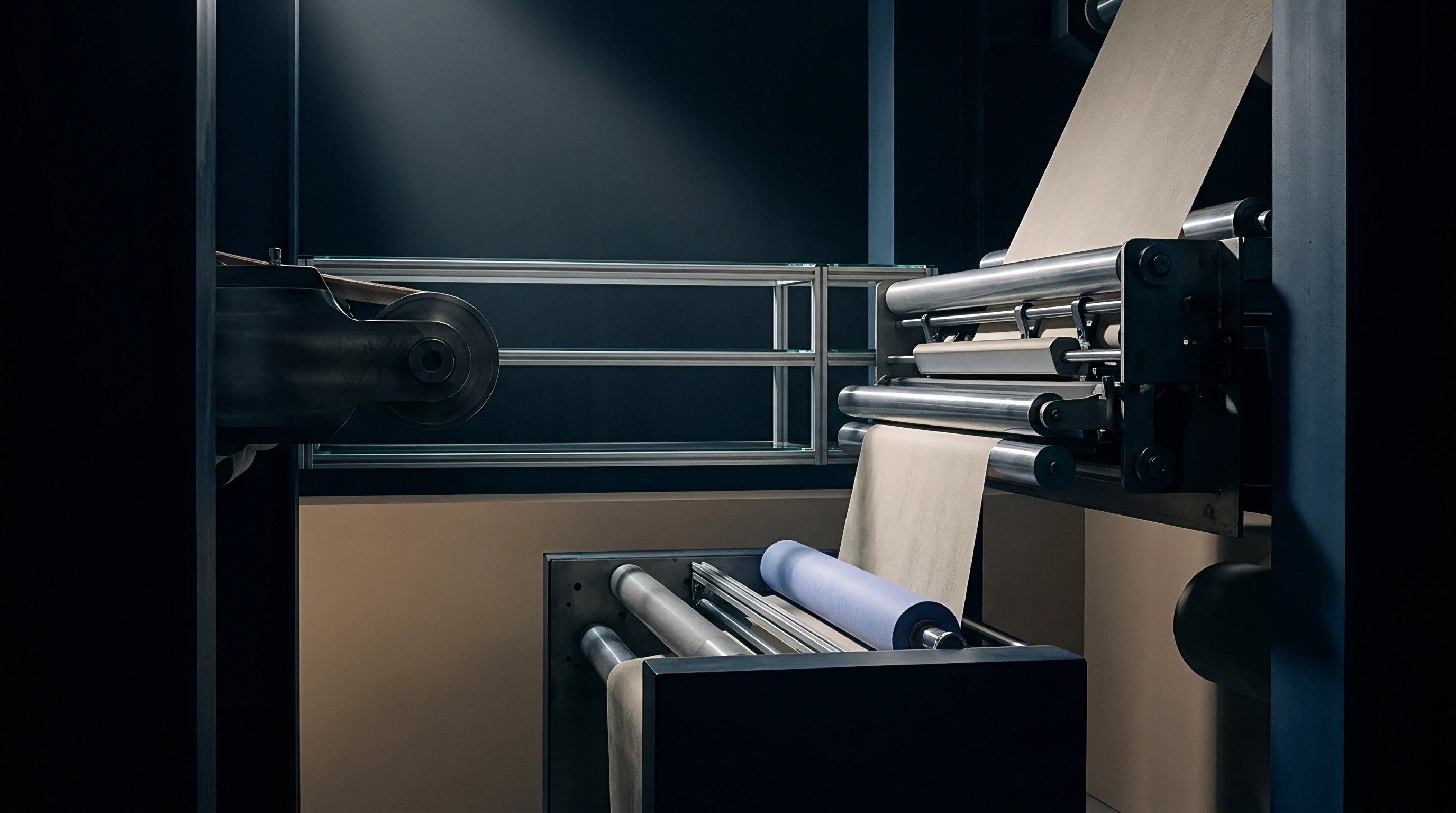
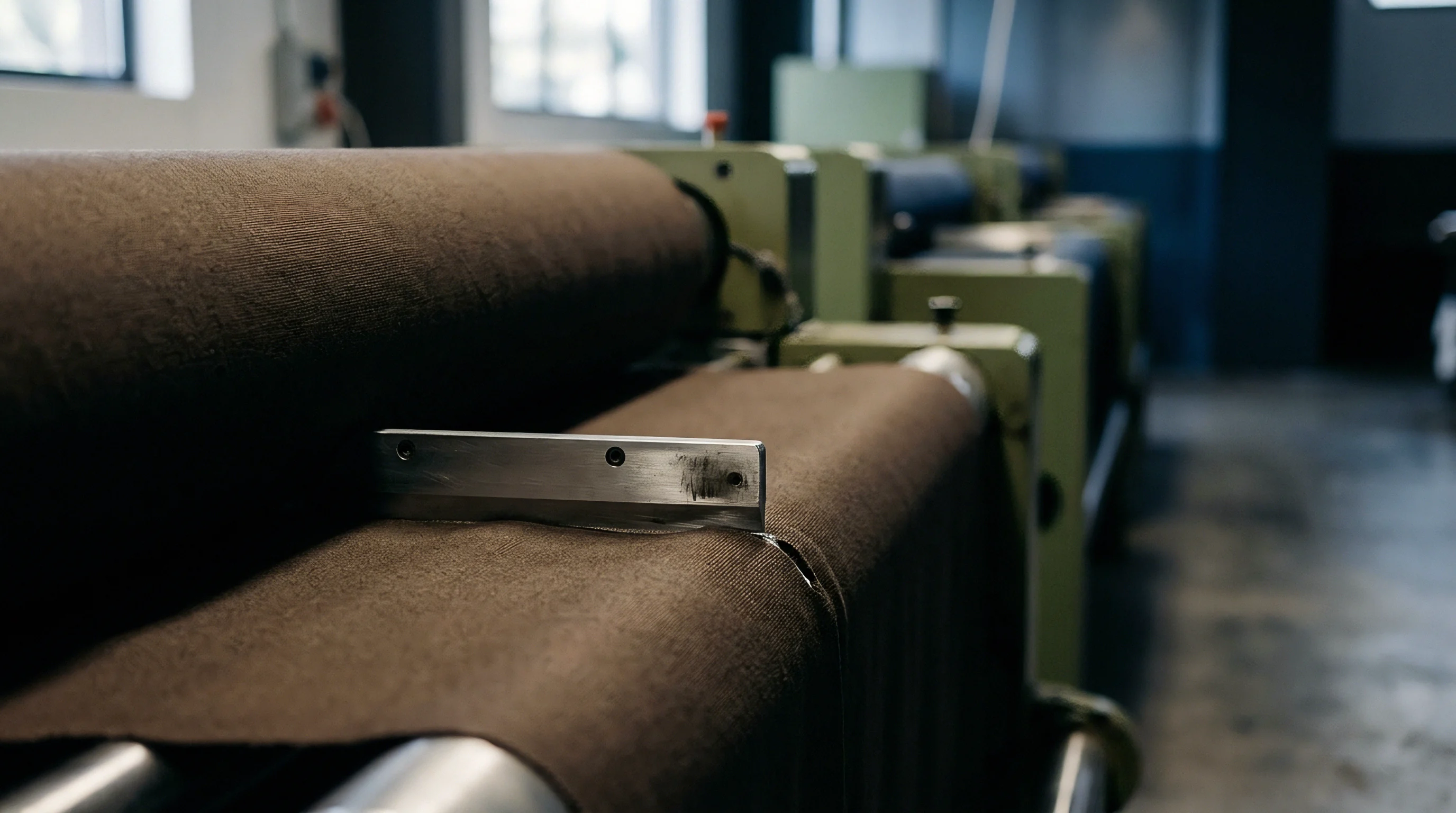
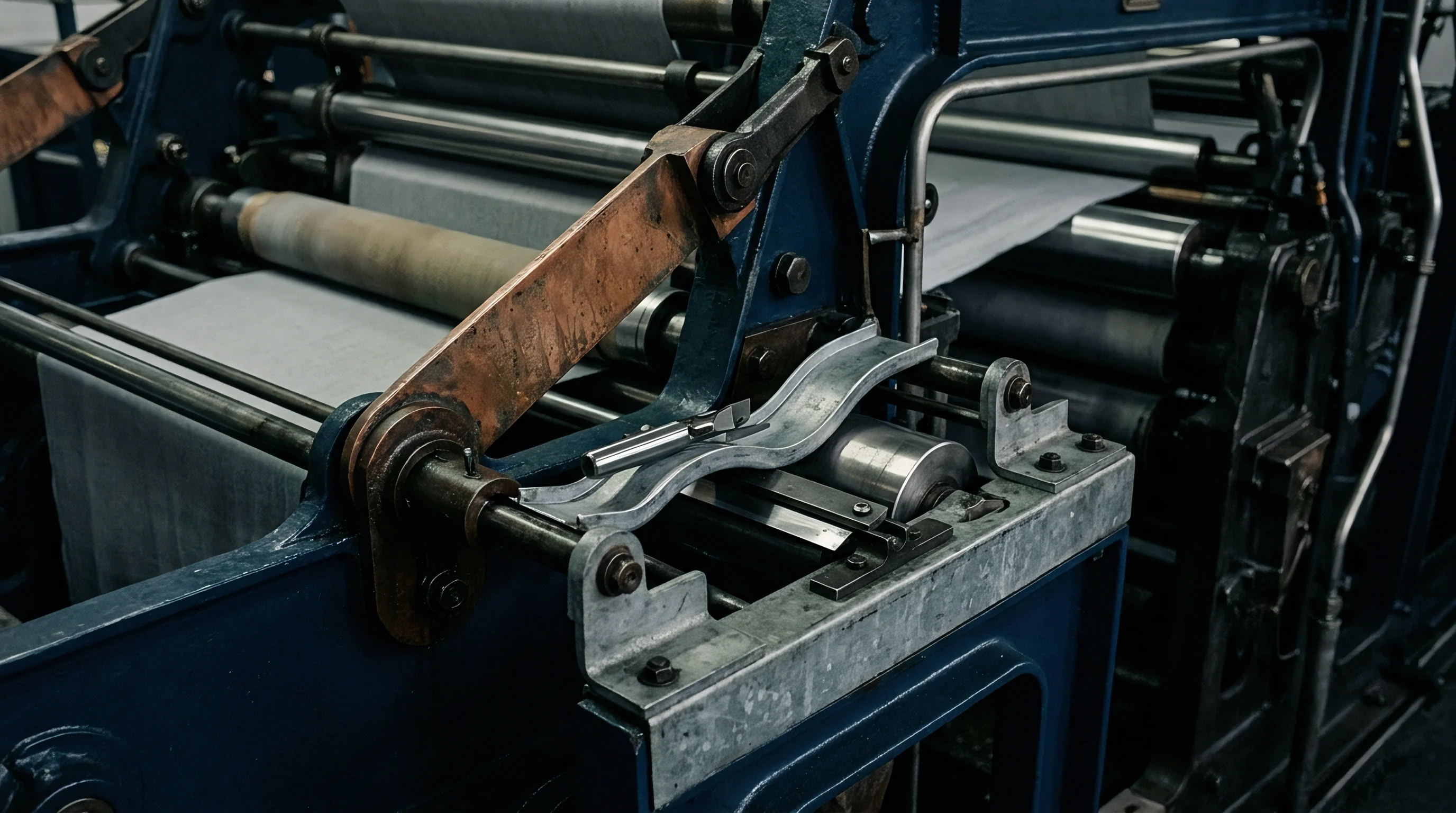
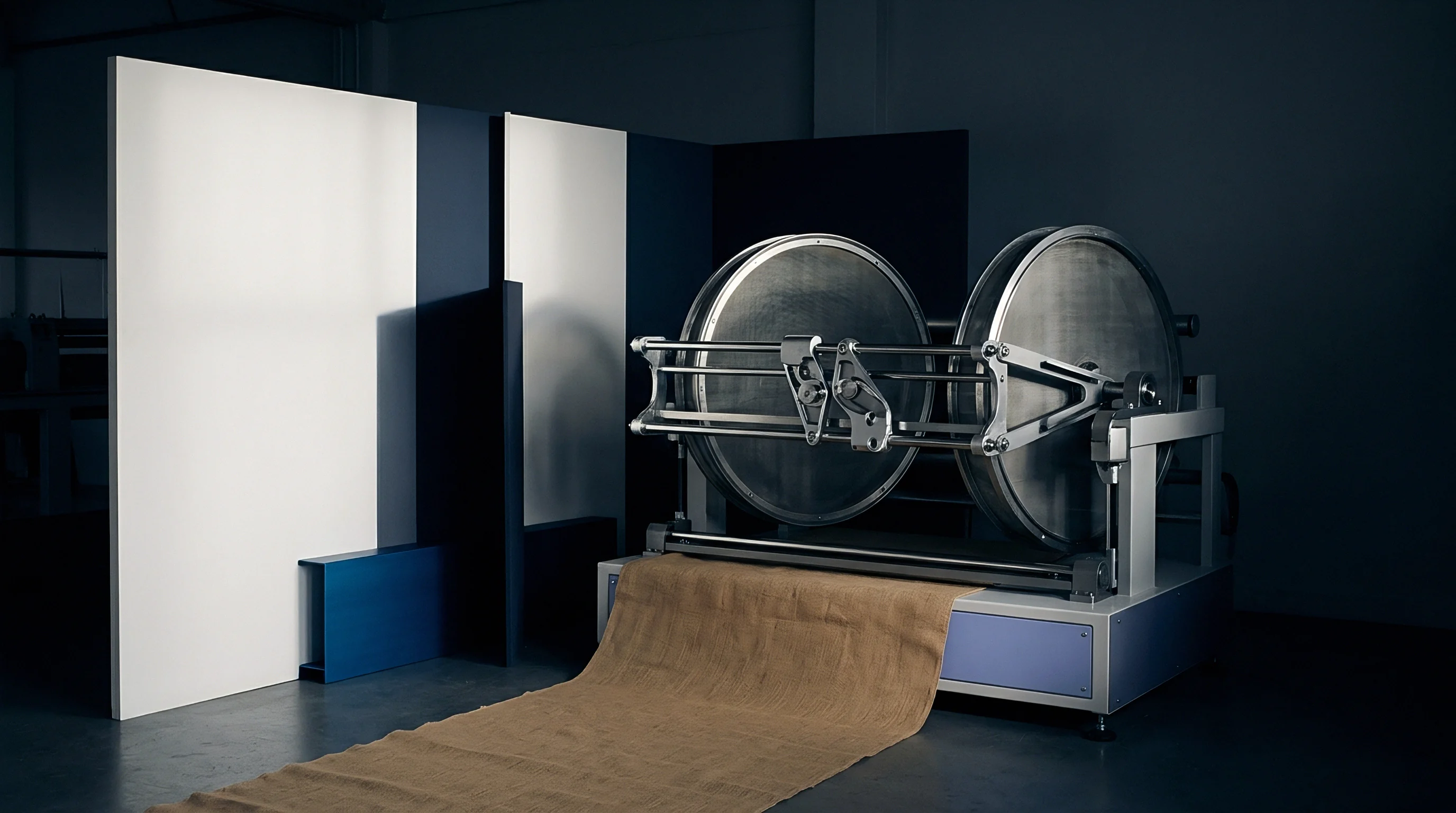
Continuous wet processing machinery relies on squeeze-roll nips to manage liquid pickup, ensure deep chemical penetration, and remove excess fluid from running webs. When a tensioned web enters the compressive zone between two opposing nip rolls, it encounters a localized stress field that combines transverse compressive stress with longitudinal tensile strain. The physical deformation of the elastomeric roll covering creates a defined contact zone known as the nip width.
As the wet web enters this zone, fluid trapped within the porous substrate is subjected to intense hydraulic pressure gradients that drive rapid fluid displacement both backward against web motion and forward through the thickness of the fabric.
Ahead of the roll contact point, the convergence of the web surface and the roll surface creates a dynamic hydrodynamic liquid wedge. Hydrodynamic pressure inside this fluid wedge spikes rapidly, reaching pressures high enough to deform soft roll covers and push liquid backward along the surface of the running web. If machine direction tension holds the web rigid and flat, this hydrodynamic pressure wedge cannot easily force liquid into the compressed, locked pore structure.
Instead, the fluid wedge strips the liquid surface layer off the web, causing severe splash, foam generation, and uneven liquid distribution before the fabric even enters the squeeze zone.
Hydrodynamic Pressure Wedge and Retained Moisture
Inside the nip contact zone, total mechanical force applied by the roll loading cylinders converts into a spatial pressure distribution that follows a modified Hertzian contact profile. Mechanical compression reduces fabric thickness by 30 to 70 percent, depending on structural compressibility and roll cover hardness. As fabric thickness drops, total pore volume shrinks to a minimum at the point of peak pressure, forcing free fluid out of both inter-yarn and intra-yarn voids.
The displaced fluid must escape either by flowing backward against the direction of web travel or by moving laterally toward the selvedges.
Fluid escaping backward encounters incoming dry or semi-wet web entering at high velocity. The opposing vectors of web movement and fluid expulsion generate extreme fluid shear forces at the entrance boundary. If the hydraulic flow rate of squeezed fluid exceeds the volumetric carrying capacity of the uncompressed fabric upstream, liquid accumulates as a standing wave at the entrance nip.
This standing liquid wave creates turbulent recirculating eddies that wash unfixed dyestuffs or surface chemicals off the web, destabilizing pickup consistency.
Fluid Entrapment and Back-Wetting Kinematics
As the web exits the point of maximum compressive pressure and moves through the diverging region of the nip, mechanical pressure drops back to atmospheric levels. The compressed elastic fiber assembly rebounds, expanding back toward its nominal thickness. This rapid volumetric expansion creates an internal pressure vacuum inside the expanding pore structures.
The pressure differential between the expanding internal micro-voids and the external ambient atmosphere drives rapid fluid re-entrainment, a phenomenon known as back-wetting or fluid re-absorption.
If liquid remains on the surface of the web or the roll faces as the web exits the nip, the internal vacuum sucks this liquid film back into the newly expanded pore voids. However, if web tension remains extremely high during expansion, yarn crossovers remain jammed in their tensioned configuration, preventing full thickness recovery. The web recovers its volume unevenly, expanding preferentially in thickness while remaining locked in width.
This asymmetrical recovery draws atmospheric air into macro-voids while micro-pores inside yarn cores remain collapsed, trapping small, isolated liquid pockets that cannot be removed by downstream extraction equipment.
Quantifying these dynamics requires analyzing liquid displacement efficiency inside a continuous padding mangle operating on a tensioned cotton twill web under varying nip pressure profiles.
Baseline physical inputs for the calculation are established: a 100 percent cotton 3/1 twill web, finished width 1.6 metres, dry mass 240 grams per square metre, running at a line speed of 50 metres per minute under a machine direction tension of 400 N/m. The wet web enters the nip mangle carrying an initial liquid pickup of 120 percent relative to dry mass, saturated with an aqueous dye liquor with dynamic viscosity of 1.2 mPa s and density of 1000 kg/m^3. The mangle utilizes a steel roll paired with a NBR rubber covered roll exhibiting a hardness of 70 Shore A, roll diameter 300 mm, with pneumatic cylinder loading capable of applying line pressures from 10 to 50 N/mm across the 1.6-metre face width.
First, mechanical nip width and peak contact pressure are determined under a pneumatic loading line pressure of 30 N/mm (30,000 N/m). Using Hertzian contact deformation equations for a soft cylinder against a hard cylinder, the effective contact width (b) inside the squeeze zone is calculated as:
b = 2 sqrt( (4 P R_eff) / (pi E_eff) )
Where P is line load per unit length (30,000 N/m), R_eff is effective roll radius (0.15 m), and E_eff is effective elastic modulus of the rubber cover system (7.5 MPa for 70 Shore A rubber). Substituting these values yields:
b = 2 sqrt( (4 30000 0.15) / (3.14159 7.5 x 10^6) ) = 2 sqrt( 1800 / 23561944 ) = 2 0.00874 = 0.0175 metres (17.5 mm nip width).
The peak mechanical contact pressure (P_max) situated at the center of the nip contact zone is:
P_max = (2 P) / (pi b) = (2 30000) / (3.14159 0.0175) = 60000 / 0.05497 = 1.091 MPa (10.91 bar).
Next, fabric residence time inside the active squeeze zone is calculated. At a web speed of 50 metres per minute (0.833 metres per second), the dwell time (t_dwell) during which peak compressive forces act on the wet fabric is:
t_dwell = b / v = 0.0175 / 0.833 = 0.0210 seconds (21.0 milliseconds).
Within this 21.0-millisecond window, fluid must be expelled from the pore structure against viscous friction and tension-induced pore constriction. Through fluid mechanical modeling, transverse permeability drops 34 percent at 400 N/m warp tension. The compressed fabric thickness at P_max drops from an initial wet thickness of 0.52 mm down to 0.21 mm, representing a 59.6 percent total volume reduction.
Total void volume available for liquid storage inside the nip drops from 0.31 cubic centimetres per gram of dry fabric down to 0.08 cubic centimetres per gram.
The volumetric squeeze-out capacity under baseline un-tensioned conditions would yield a final wet pickup of 48 percent. However, because warp tension locks the yarn crossovers and reduces transverse permeability to 1.2 x 10^-12 m^2, liquid cannot escape rapidly through transverse pores within the 21.0-millisecond dwell window. Squeezed liquid accumulates inside the entrance zone, raising local hydraulic pressure to 0.42 MPa, which opposes further fluid discharge.
Final retained wet pickup after elastic rebound increases to 64 percent, leaving 16 percent excess water trapped in the web relative to un-tensioned processing targets.
The table below details fluid squeeze-out performance and retained moisture metrics across various combinations of web tension, line speed, and pneumatic nip loading.
| MD Tension (N/m) | Line Speed (m/min) | Nip Load (N/mm) | Dwell Time (ms) | Peak Pressure (MPa) | Retained Pickup (%) |
|---|---|---|---|---|---|
| 100 | 30 | 20 | 28.6 | 0.89 | 52.1 |
| 100 | 50 | 20 | 17.2 | 0.89 | 56.4 |
| 100 | 80 | 20 | 10.7 | 0.89 | 63.8 |
| 400 | 30 | 20 | 28.6 | 0.89 | 61.2 |
| 400 | 50 | 20 | 17.2 | 0.89 | 67.5 |
| 400 | 80 | 20 | 10.7 | 0.89 | 74.2 |
| 400 | 50 | 40 | 24.3 | 1.26 | 58.3 |
| 400 | 50 | 50 | 27.2 | 1.41 | 53.8 |
| 600 | 50 | 50 | 27.2 | 1.41 | 61.9 |
This quantitative analysis proves that high machine direction tension directly offsets mechanical nip force. Increasing web tension from 100 N/m to 400 N/m at a line speed of 50 m/min increases retained wet pickup from 56.4 percent to 67.5 percent under identical 20 N/mm nip pressure. To recover the targeted 53 to 56 percent pickup baseline at high web tension, pneumatic squeeze loading must be increased from 20 N/mm to over 50 N/mm, dramatically increasing mechanical stress on roll bearings and accelerated roll cover wear.
Optimizing nip performance on high-speed continuous lines requires adherence to strict operational protocols for mangle setup and web tension adjustment.
- Calibrate load cell tension sensors across the entire width of the entry zone to guarantee balanced left-center-right tension readings within a 2 percent tolerance margin.
- Measure roll cover hardness using a calibrated Shore A durometer at six equi-spaced points along the roll face, replacing any roll showing a variation greater than 3 Shore A units.
- Adjust entry dancer roll pneumatic pressure to maintain web tension below 150 N/m during wet chemical impregnation steps.
- Set nip roll pneumatic cylinder pressure to match the specific hydrodynamic resistance profile of the running substrate build based on measured fabric mass and density.
- Inspect the hydrodynamic liquid wedge at the nip entry zone continuously using high-speed optical sensors, reducing web velocity immediately if hydrodynamic splashing or wave formation occurs.
Failure to control nip mechanical settings relative to web tension state leads directly to non-compliance with standard fabric specifications under ISO 9073-10 for linting and particle generation or ISO 13934-1 tensile performance standards.
Contractual specifications governing wet processing operations must state that finished weight tolerances apply only when wet pickup is measured under standardized web tension conditions below 150 N/m.
Subcontract wet processing agreements that specify wet pickup percentages without defining the maximum allowable machine direction tension during padding permit finishing plants to run webs under high tension to maximize line speeds, leaving excess moisture in the web that must be evaporated in downstream stenter frames at double the natural energy cost.
Displacement
In continuous washing and rinsing operations, removing unfixed dyes, auxiliaries, or reaction byproducts relies on convective liquid displacement within inter-yarn and intra-yarn pore channels. When a web passes through sequential wash boxes under machine direction tension, fluid exchange becomes severely compromised inside locked pore structures. The bath liquid surrounding the moving web establishes a viscous boundary layer that travels alongside the web at nearly identical velocity.
To wash the substrate effectively, fresh wash liquor must penetrate this moving boundary layer, enter the pore network, displace contaminated internal fluid, and carry those impurities back out into the bulk wash liquor.
High web tension reduces interstitial pore dimensions, converting convective fluid exchange into slow molecular diffusion. While bulk liquor outside the fabric turns over rapidly due to wash box circulation pumps, liquor trapped inside jammed yarn crossover points remains stationary. The concentration of chemical impurities inside these locked pores remains high throughout the washing range, resulting in poor washing efficiency despite high total water consumption per kilogram of processed fabric.
Continuous Washing and Viscous Boundary Layer Dynamics
The thickness of the dynamic fluid boundary layer carried by a moving web depends on web velocity, fluid viscosity, and distance from the wet bath entrance. As line speed increases, the hydrodynamic boundary layer thickens, creating an insulating fluid cushion that prevents fresh wash water from reaching the fabric surface. If web tension simultaneously forces yarn crossovers into tight contact, the driving force for hydraulic exchange across the fabric thickness drops to near zero.
Contaminated fluid held inside intra-yarn micro-pores often exhibits higher density and viscosity than the clean, hot wash liquor outside, due to high concentrations of dissolved chemicals, hydrolyzed dyes, or sizing agents. This density and viscosity gradient establishes a stable boundary layer inside the capillary network that strongly resists displacement by lighter, less viscous surface wash water. Without forced mechanical agitation, removing these entrapped impurities relies entirely on molecular diffusion, which requires residence times far longer than typical continuous washing box dwell times of 3 to 6 seconds per tank.
Standard continuous washing ranges running high-tension webs consume up to 18 litres of water per kilogram of fabric to achieve the same impurity removal achieved by 6 litres per kilogram under low-tension conditions.
Mechanical Agitation and Acoustic Hydrodynamic Purging
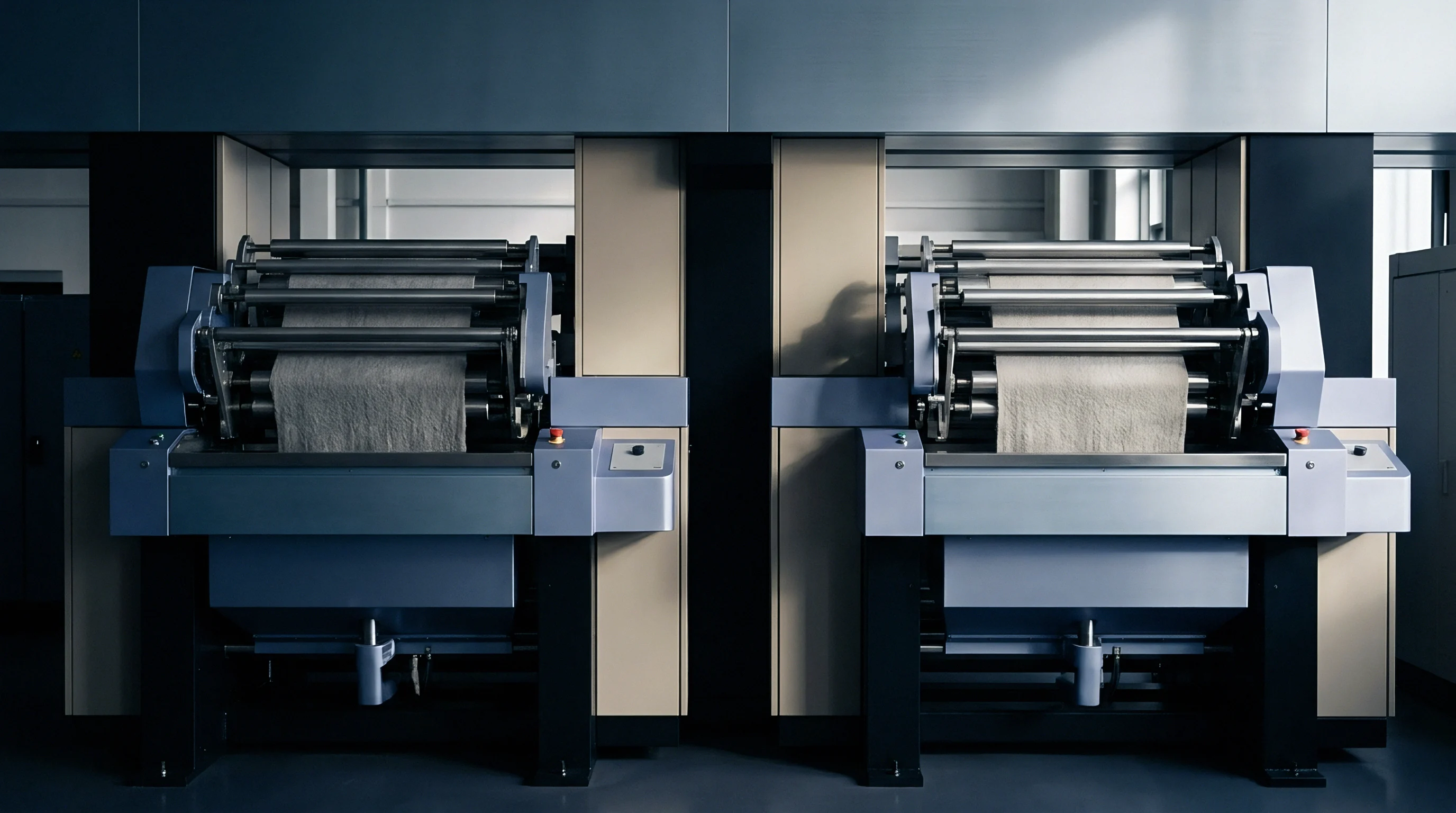
Overcoming diffusion limitations inside locked pores requires deploying external kinetic energy to disrupt the dynamic fluid boundary layer and force fluid displacement through compressed micro-voids. Industrial washing ranges utilize submerged squeeze rolls, dynamic liquor impellers, squeeze blades, and ultrasonic acoustic transducers to generate localized pressure fluctuations across the fabric plane.
Submerged nip rolls physically compress the web inside the wash bath, forcing contaminated internal fluid out into the surrounding liquor. As the web exits the submerged nip, elastic rebound draws fresh wash liquor directly into the expanding pore network. Repeating this compression-relaxation cycle four to six times within a single wash box increases fluid displacement rates by over 300 percent compared to passive immersion boxes.
Submerged high-velocity liquor jets generate alternating hydraulic pressure waves that force liquor directly through the web thickness. Operating liquor jets at differential pressure gradients between 0.2 and 0.5 bar disrupts the stagnation layer on both faces of the web, forcing forced convective flow through locked capillary channels. Ultrasonic transducers vibrating at frequencies between 20 kHz and 40 kHz produce acoustic cavitation inside the wash bath.
Microscopic cavitation bubbles form and violently collapse directly adjacent to solid fiber surfaces, generating localized micro-jets with velocities exceeding 100 metres per second. These micro-jets penetrate deep into jammed yarn crossovers, disintegrating stagnant boundary layers and purging entrapped impurities from inner filament bundles without requiring structural relaxation of the tensioned web.
Evaluating fluid displacement efficiency across continuous washing equipment requires checking specific operational capabilities against substrate mechanical limits.
- Boundary layer disruption capability must be verified by measuring fluid shear forces at the web surface using submerged pitot-static sensors at maximum operating line speeds.
- Transverse hydraulic pressure differential across the web plane must maintain a minimum threshold of 0.15 bar inside active washing zones to drive convective fluid turnover through restricted pores.
- Submerged squeeze roll density must provide at least one compression-relaxation cycle for every 1.2 metres of web immersion path length inside the wash tank.
- Counter-current liquor flow rate must match the mass transport rate of extracted impurities to prevent re-deposition of surface contaminants onto clean fiber surfaces.
- Acoustic power density for ultrasonic washing systems must exceed 15 Watts per litre of bath volume directly within the web passage zone to guarantee cavitation-driven pore purging.
When continuous washing ranges fail to deliver required fastness properties, equipment manufacturers frequently attribute poor fastness scores to chemical dye affinity issues rather than mechanical fluid displacement failures under web tension.
Increasing wash tank water temperatures to 95 degrees Celsius is frequently held to eliminate the need for low-tension web controls or forced mechanical agitation on the premise that thermal kinetic energy alone drives sufficient chemical extraction. However, high thermal energy cannot induce convective flow through physically jammed pore throats when warp tension holds inter-yarn voids closed under mechanical contact pressures exceeding 1 MPa.
Tension
Precision dynamic web tension management serves as the foundational requirement for controlling hydrodynamic fluid transport throughout continuous wet finishing ranges. Fabric webs moving through pad troughs, wash boxes, steamers, and stenter ranges experience continuous variation in longitudinal tension caused by driven roll speed differentials, fabric wet-hygral expansion, and mechanical drag over stationary guide bars. Modern wet processing machinery employs closed-loop tension control systems utilizing load cell roll sensors, pneumatic dancer arms, and frequency-controlled AC vector drives to maintain web tension within tight operational limits.
If dynamic web tension fluctuates during wet processing, internal pore geometry changes continuously along the length of the production run. A sudden tension spike collapses inter-yarn macro-pores, reducing liquid chemical pickup in pad mangles and driving fluid out of saturated webs in wash boxes. Conversely, a loss of web tension allows the substrate to sag and widen, expanding pore dimensions, increasing dynamic liquor pickup, and causing web tracking instabilities that lead to creasing, edge curling, and machine jams.
Does Dynamic Web Overfeed Prevent Hydraulic Pore Locking?
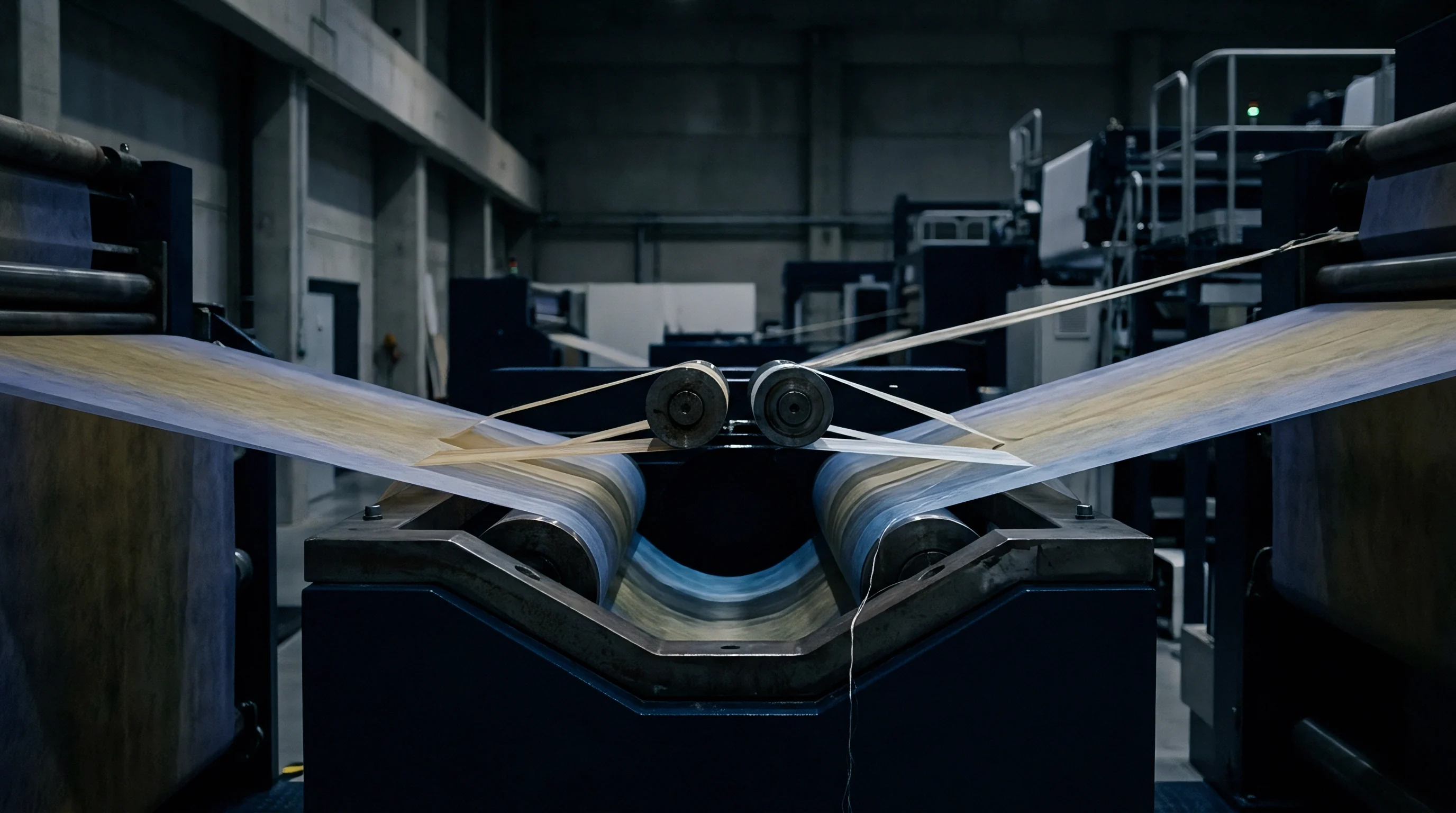
Introducing controlled positive overfeed upstream of wet treatment zones offers a direct mechanical method for preventing tension-induced pore locking. Overfeed systems run driven entry rolls at a peripheral speed slightly higher than the downstream web transport rollers, introducing a controlled percentage of longitudinal slack into the running web. Operating with 1.0 to 3.5 percent positive overfeed reduces machine direction tension to values below 80 N/m, allowing warp yarns to retain their natural crimp geometry and preventing Poisson width contraction.
Under low-tension overfeed conditions, inter-yarn macro-pores remain open, maintaining mean pore radii above 30 micrometres and preserving high transverse hydrodynamic permeability. Chemical liquor penetrates deep into yarn cores within short immersion dwell times, eliminating core starvation and skittery dyeing defects. However, operating wet ranges under positive overfeed demands precise web guidance systems, such as expanding scroll rolls and pneumatic edge guiders, to prevent fabric bowing, skewed weft threads, and lateral tracking loss.
Drying Energy Expenditure and Dwell Time Relationships
The moisture content remaining in a web following squeeze-roll extraction dictates the thermal energy required to dry the fabric in downstream stenter frames or cylinder dryers. High machine direction tension that restricts hydrodynamic fluid squeeze-out forces finishing plants to run drying ranges at significantly elevated gas or steam consumption rates. The table below details the direct operational relationship between web tension control regimes, final wet pickup, washing liquor consumption, and stenter drying energy expenditure measured across a continuous dyeing and finishing line.
| Tension Control Strategy | Mean Tension (N/m) | Padding Pickup (%) | Wash Efficiency (%) | Specific Water (L/kg) | Stenter Energy (MJ/kg water) |
|---|---|---|---|---|---|
| High Tension Uncontrolled (Fixed Speed Drives) | 550 | 72.4 | 68.2 | 16.5 | 4.85 |
| Moderate Tension Standard Closed-Loop | 300 | 63.1 | 79.5 | 11.2 | 3.92 |
| Low Tension Controlled (Load Cell Closed-Loop) | 120 | 54.8 | 88.9 | 7.1 | 3.25 |
| Positive Overfeed (Driven Entry + Scroll Rolls) | 60 | 51.2 | 93.4 | 5.2 | 3.08 |
Data proves that switching from a high-tension regime to a positive overfeed low-tension regime reduces specific wash water consumption by 68.4 percent while reducing stenter thermal energy expenditure per kilogram of evaporated water by 36.5 percent. Lowering retained wet pickup from 72.4 percent to 51.2 percent reduces the total mass of water that must be thermally evaporated, allowing finishing mills to increase stenter line speeds from 35 metres per minute up to 52 metres per minute without altering dryer set-point temperatures.
Implementing reliable tension control protocols across wet processing ranges requires capturing specific physical measurements within mill production dossier records.
- Dynamic web tension profile map recording continuous multi-point load cell output across entry, pad, wash, and exit zones at 100-millisecond sampling intervals.
- Differential speed ratios for all independently driven rolls across the range, specified to four decimal places relative to master line speed.
- Wet-hygral dimensional change factors for each specific fabric construction build, determining required overfeed percentages based on wet relaxation shrinkage.
- Transverse web width monitoring log captured by optical edge sensors before and after wet treatment zones to detect Poisson contraction severity.
Establishing tight control over web tension profiles transforms wet processing ranges from erratic, high-cost bottleneck operations into highly predictable, efficient production lines that deliver consistent bulk quality.
Engineers optimizing web tension lines must decide whether the dynamic mechanical stability gained by applying high longitudinal tension outweighs the substantial energy penalties and severe fluid transport restrictions imposed by locked pore structures inside the finishing range.
Consequence
Ignoring hydrodynamic fluid transport mechanics inside locked pore structures during wet processing carries severe commercial and operational financial consequences for fabric buyers, converters, and finishing mills. When a fabric specification is developed based solely on dry greige construction metrics without establishing wet processing tension limits, bulk production runs routinely fail critical quality verification checkpoints. The economic impact propagates across the entire supply chain, resulting in scrapped yards, late delivery claims, high energy surcharges, and costly legal disputes over non-conforming goods.
Financial losses manifest first in elevated re-work rates inside the dyehouse. When warp tension locks the pore structure during chemical padding, reactive dyestuffs fail to penetrate yarn cores, leaving unfixed dye molecules concentrated on surface filament crowns. During post-dyeing wash cycles, these surface dyes strip off easily, leading to poor wet-fastness ratings under ISO 105-C06 wash testing and ISO 105-X12 rubbing fastness evaluation.
Correcting un-level or under-penetrated bulk runs requires costly stripping and re-dyeing procedures that double processing chemical costs, consume thousands of extra cubic metres of water, and degrade fabric tensile strength beyond acceptable tolerances specified under ISO 13934-1.
Dimensional instability represents a secondary financial liability stemming directly from high-tension wet processing. Fabrics processed under high machine direction tension enter downstream heat-setting and drying ranges in a highly stretched state. While the stenter frame can heat-set synthetic fibers like polyester to temporarily lock these stretched dimensions, natural fibers like cotton, linen, and viscose retain severe latent relaxation strain.
When finished garments manufactured from these fabrics undergo domestic laundering under ISO 6330 test protocols, the stretched warp yarns undergo aggressive wet-hygral relaxation, resulting in catastrophic garment shrinkage exceeding 8 to 12 percent in the longitudinal direction.
At current energy prices, running continuous stenter ranges to evaporate excess water held in locked pore structures adds substantial utility surcharges to every finished metre of cloth. A finishing range processing 50,000 metres per day of heavy woven fabric with an elevated wet pickup of 75 percent due to poor tension control spends an additional $1,200 to $1,800 per day in natural gas costs compared to an optimized low-tension line achieving 52 percent wet pickup. Over an annual production campaign, this single operational inefficiency forfeits over $400,000 in pure margin.
Tracing the economic impact through the finishing route makes specifying exact machine direction tension limits, wet pickup tolerances, and wash efficiency metrics within primary sourcing dossiers an absolute commercial necessity. Sourcing practices that integrate fluid transport mechanics into technical fabric specifications eliminate the gap between lab dip approval and bulk shipment reality, securing consistent quality, predictable lead times, and protected gross margins across every production run.