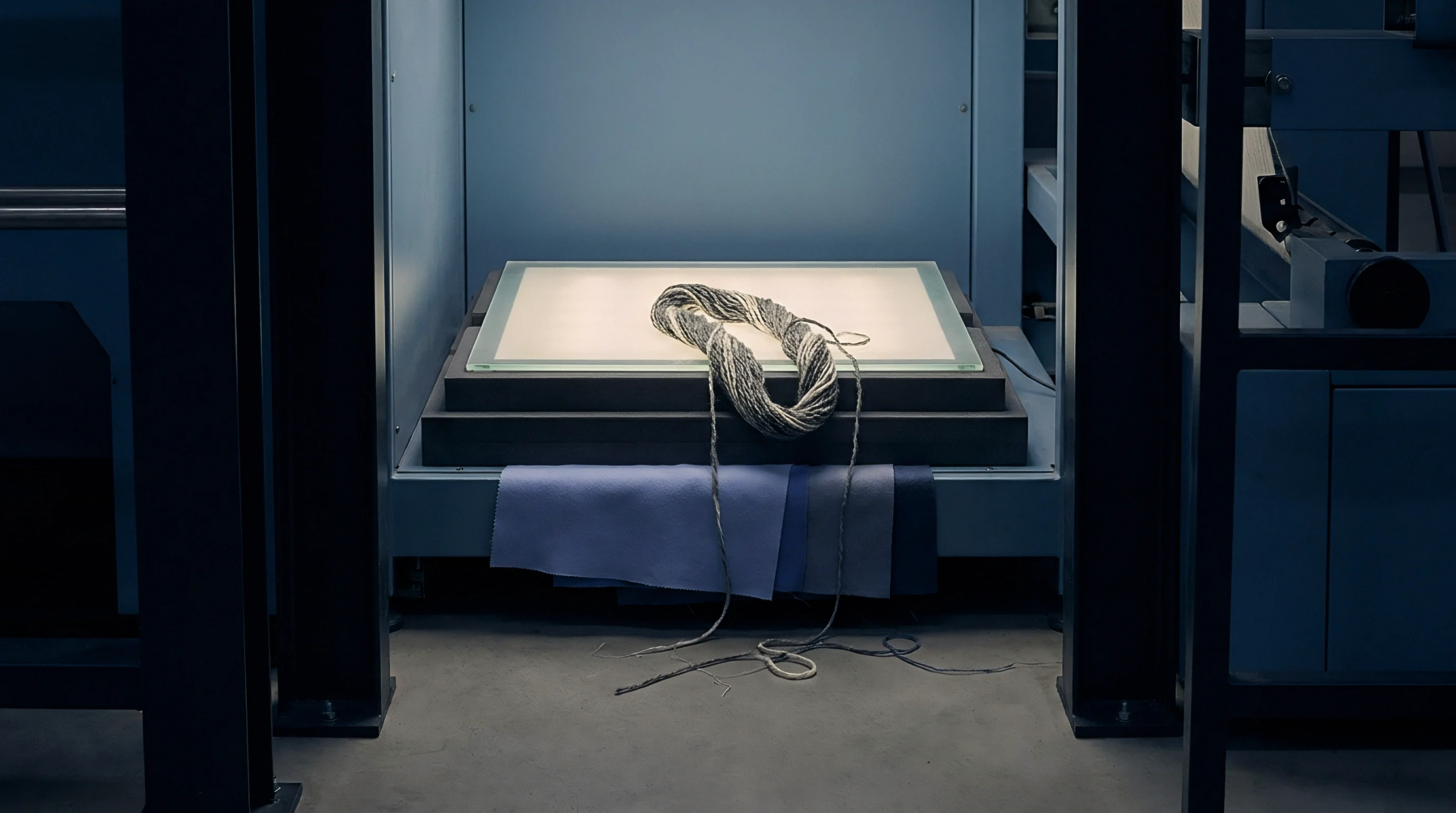
Minimum Colour Quantity Deciding a Range Plan before Design Does
Minimum colour quantities set dye vessel efficiency and enforce range plan fabric allocations long before garment sketches reach the pattern desk.
Objective numerical systems quantify the perceived distance between a production fabric color and its approved master standard within a controlled color space. Utilizing delta e cmc 2 1 allows labs to account for the elliptical shape of human color perception, where sensitivity to hue and chroma shifts varies across the spectrum. This metric standardizes the commercial tolerance for color matching in high speed production environments where mill lots must remain visually consistent.
It provides a single pass fail number based on three coordinates which describe vertical lightness and horizontal hue positioning. The ratio applied here prioritizes luminosity and saturation stability over subtle hue drift to match consumer expectations for apparel quality.
Establishing the difference between samples requires a spectrophotometer to scan the spectral reflectance across visible light wavelengths from four hundred to seven hundred nanometers. The math behind delta e cmc 2 1 assigns heavier weight to lightness differences compared to shifts in color intensity based on common textile use. Ellipsoid volumes are calculated around the target standard, and values below 1.0 are typically accepted as a near perfect commercial match.
Smaller numbers represent more successful replications while results above 2.0 generally trigger immediate rejection of the dyed batch. Measurements typically involve folding fabric to four thicknesses to ensure that the light from the device does not pass through the sample to the background. This ensures that the reading solely captures the reflectance of the dyes applied to the textile surface.
Negotiating the allowable variance between buyer and mill usually leads to a fixed numerical limit recorded inside the quality contract. Because delta e cmc 2 1 incorporates perception scaling, it prevents manufacturers from being unfairly penalized for invisible shifts in deep colors while ensuring tight control over sensitive pastel shades. Acceptable ranges typically hover between 0.8 and 1.2 for major fashion pieces where multiple garment components must look identical under retail store lighting.
Results often change depending on the chosen illuminant, such as daylight d65 or fluorescent tl84, which must be specified in the contract. Verification happens at the greige stage and again after finishing to confirm that heat or chemical additives did not shift the achieved tone. Accurate data logs provide the basis for batch approval without waiting for physical swatches to travel via courier across international borders.
Maintaining a historical archive of spectral data allows mills to improve their batch to batch reliability over long production runs. If the reading for delta e cmc 2 1 stays consistently within the low variance range, the dye cycle is considered stable for continuous bulk processing. If it fluctuates, technicians adjust dye concentrations or water ratios to bring subsequent containers back into range.
Records of these measurements help suppliers defend their output against subjective visual complaints from quality inspectors using human eyes alone. Third party labs frequently double check these readings to ensure the mill is not using uncalibrated spectrophotometers. Success in color matching is ultimately proven when garments from different rolls are sewn into a single piece without visible shading at the seams.
Minimum colour quantities set dye vessel efficiency and enforce range plan fabric allocations long before garment sketches reach the pattern desk.
Expertise is a utility, not a secret. sentiention™ publishes its working knowledge as open reference: intelligence layer covering the materials it sources, the markets it enters, and the reference that serves both.