Blend Ratio Drift across a Season from One Blending Room
Blend ratio drift stems from uncompensated raw bale moisture changes and pneumatic sorting; control requires ISO 1833 dry-mass specs and real-time weigh-hopper NIR updates.
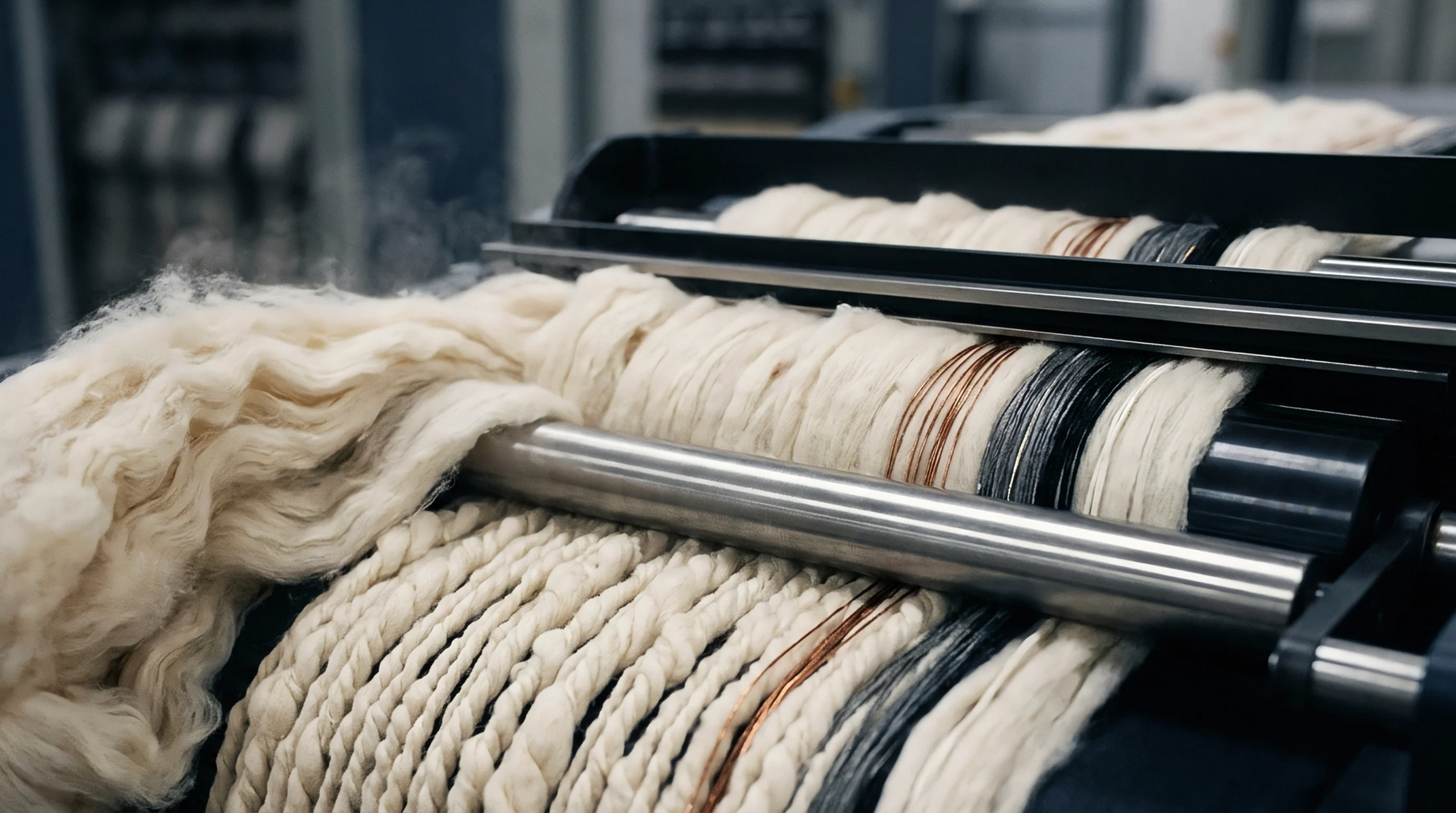
Mechanical instability within the drafting zone of a sliver processing machine produces localized variations in linear density that deviate from the targeted mass per unit length. Drawframe drafting waves appear as rhythmic fluctuations in cross-sectional thickness along the longitudinal axis of the processed material. These disturbances originate when mechanical components like rollers or drafting aprons fail to grip the fibre strand with total uniformity.
Slippage occurs at the nip point because fibre clusters shift during the transition from the slower feed speed to the higher delivery speed. Control over these fluctuations represents the primary performance benchmark for high-speed textile machinery during the preparation stage of yarn production.
Sophisticated electronic testing equipment quantifies the intensity of these periodic mass defects through the application of fast Fourier transform calculations. Laboratory technicians feed lengths of sliver through a capacitive sensor that converts changes in dielectric properties into a signal representing weight per unit length. The resulting spectrogram displays peaks at specific wavelengths that correspond to the mechanical circumference of individual rollers or the periodic cycling of aprons.
If the software detects a spike at a wavelength matching the diameter of a bottom delivery roller multiplied by pi, the source of the defect rests clearly within that component. Maintenance teams consult these charts to identify worn bearings, eccentric rollers, or loose aprons that allow fibre movement to deviate from the intended path. Regular monitoring prevents the accumulation of these faults from impacting downstream spinning operations.
Variations in sliver thickness exert a negative pressure on the uniformity of the final yarn produced at the ring or rotor spinning frames. Excessive drawframe drafting waves cause uneven dyeing results because thicker sections of the strand absorb more liquid than thinner regions. Garment factories reject fabric rolls containing streaks caused by this periodic inconsistency in the base sliver.
Machine settings for total draft must remain within the recommended limits to minimize the force applied to the fibre mass as it passes through the drafting field. When the total draft exceeds the capacity of the clamping forces, the control over short fibres diminishes and the frequency of the waves increases. Adjusting the distance between the nip points compensates for fibre length distribution differences, which stabilizes the strand during high-speed acceleration.
High-speed delivery requirements create physical limits that prevent the elimination of all drafting irregularities in standard mill environments. Physics dictates that fibre friction and machine vibrations generate residual variation even when components remain in peak operating condition. Engineers accept a baseline level of unevenness as a necessary trade-off for the throughput speeds required in modern commercial textile facilities.
Spinning consistency depends on the reduction of these cycles to levels that stay beneath the threshold of human visual perception in the final finished fabric. Long-term reliability of the fibre strand depends on rigid adherence to component replacement schedules established by the equipment manufacturer. Precise mechanical synchronization keeps these deviations within tolerances that maintain downstream product quality.
Blend ratio drift stems from uncompensated raw bale moisture changes and pneumatic sorting; control requires ISO 1833 dry-mass specs and real-time weigh-hopper NIR updates.
Expertise is a utility, not a secret. sentiention™ publishes its working knowledge as open reference: intelligence layer covering the materials it sources, the markets it enters, and the reference that serves both.