Sample Fractionation
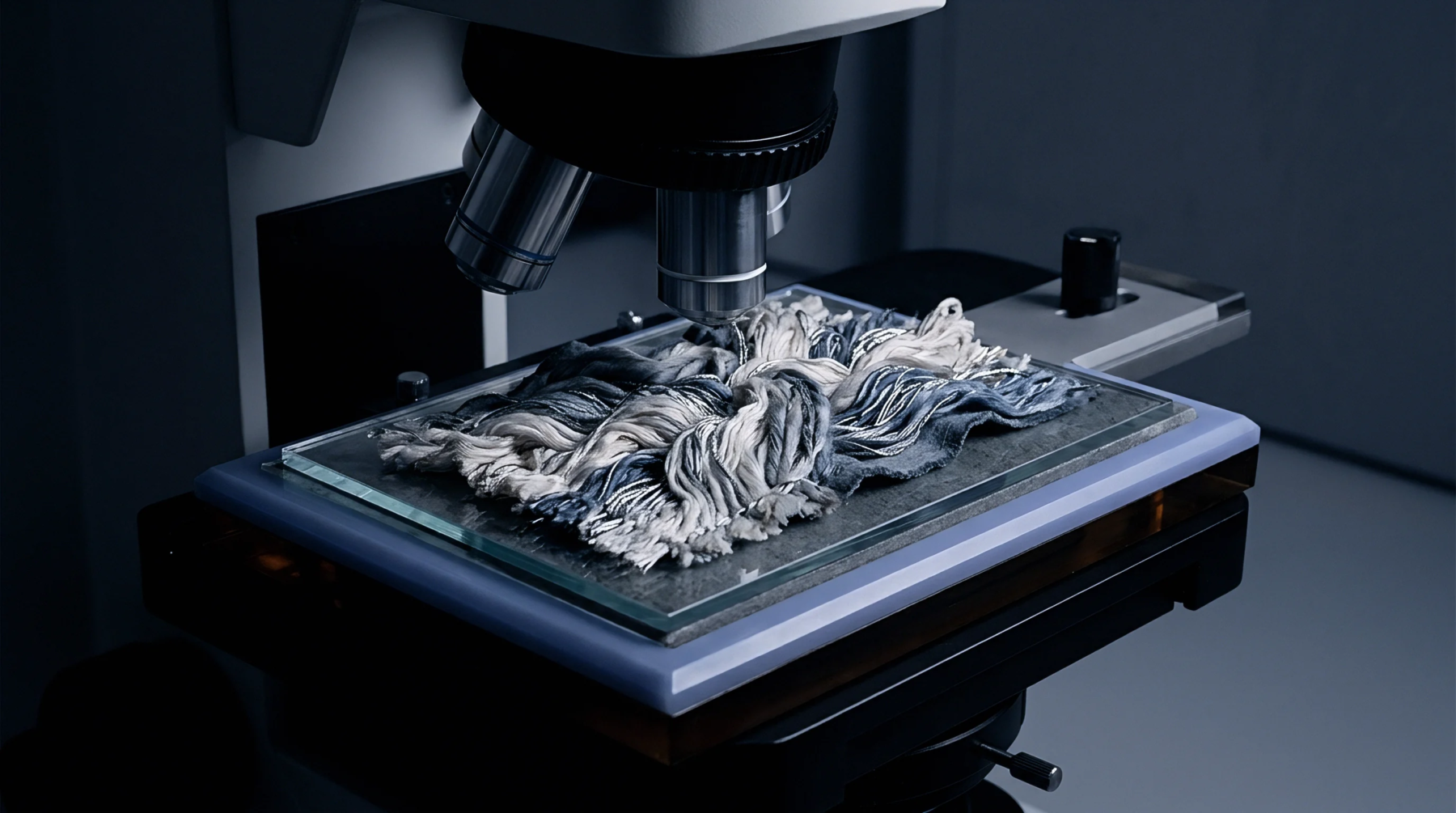
Mechanical sectioning techniques used to cut bulk fibres into uniform, microscopic segments between 0.4 and 0.8 millimetres in length create the standardized fragments required for optical diameter testing. Laboratory technicians cut these tiny snippets from conditioned fibre bundles using heavy-duty guillotine cutters, manual double-bladed cutters, or specialized cross-sectioning devices. The resulting segments allow hundreds of disconnected fibre pieces to lie flat on a slide surface without tangling, curling, or overlapping during microscopic measurement.
Preparing uniform snippets ensures representative sampling across the entire cross-section of raw wool tops, slivers, or yarn packages. The preparation method ceases to yield useful samples if dull blades crush the cut ends into flattened, distorted shapes that alter visual width boundaries.
Tooling Execution
Precision cutting tools dictate the edge quality and dimensional consistency of the resulting test fragments. Operators draw a combed, parallel bundle of conditioned fibres into the loading slot of a snippet microtome or between the paired steel blades of a hand-operated fiber cutter. The mechanical advance feeds the bundle outward by fractions of a millimetre, after which a sharp razor blade slices flush against the metal faceplate to shear the extended ends.
Technicians discard the initial cut to eliminate ragged ends, capturing the secondary cuts directly onto a clean glass slide or into a small dispersal beaker. Dull cutting edges crush the keratin core, creating splayed, mushroomed tips that skew optical width readings if the operator inadvertently measures the damaged ends.
Dispersion Balance
Distributing cut fragments evenly across the observation slide determines the accuracy of automated and manual image analysis. If snippets are packed too densely on the glass, adjacent fibres overlap, preventing automated image analysis software from identifying clean individual edges. Conversely, preparing an excessively sparse slide forces the operator to search wide surface fields, dramatically increasing testing time and stage travel.
Technicians disperse the cut pieces within a few drops of a matching immersion liquid, using a fine probe to tease apart tangled clusters before applying the cover glass. Automated optical fibre analyzers eliminate the glass slide entirely by circulating the cut snippets in an agitated liquid stream through a clear flow cell where high-speed digital cameras record each passing fragment.
Integrity Safeguards
Strict procedural compliance during snippet harvesting protects testing laboratories from reporting biased fineness distributions. Fibres within a bundle vary in diameter along their length, meaning operators must cut snippets systematically across multiple bundle zones to avoid localized sampling errors. Selecting only the tips or the bases of staples skews the reported mean diameter away from the true bulk average of the lot.
Furthermore, over-cutting fibres into ultra-short dust under 0.2 millimetres causes pieces to roll onto their cut cross-sectional faces rather than lying flat along their longitudinal axes, generating false width readings. Certified quality testing protocols require technicians to inspect snippet quality under low magnification before initiating official diameter and scale measurement routines.