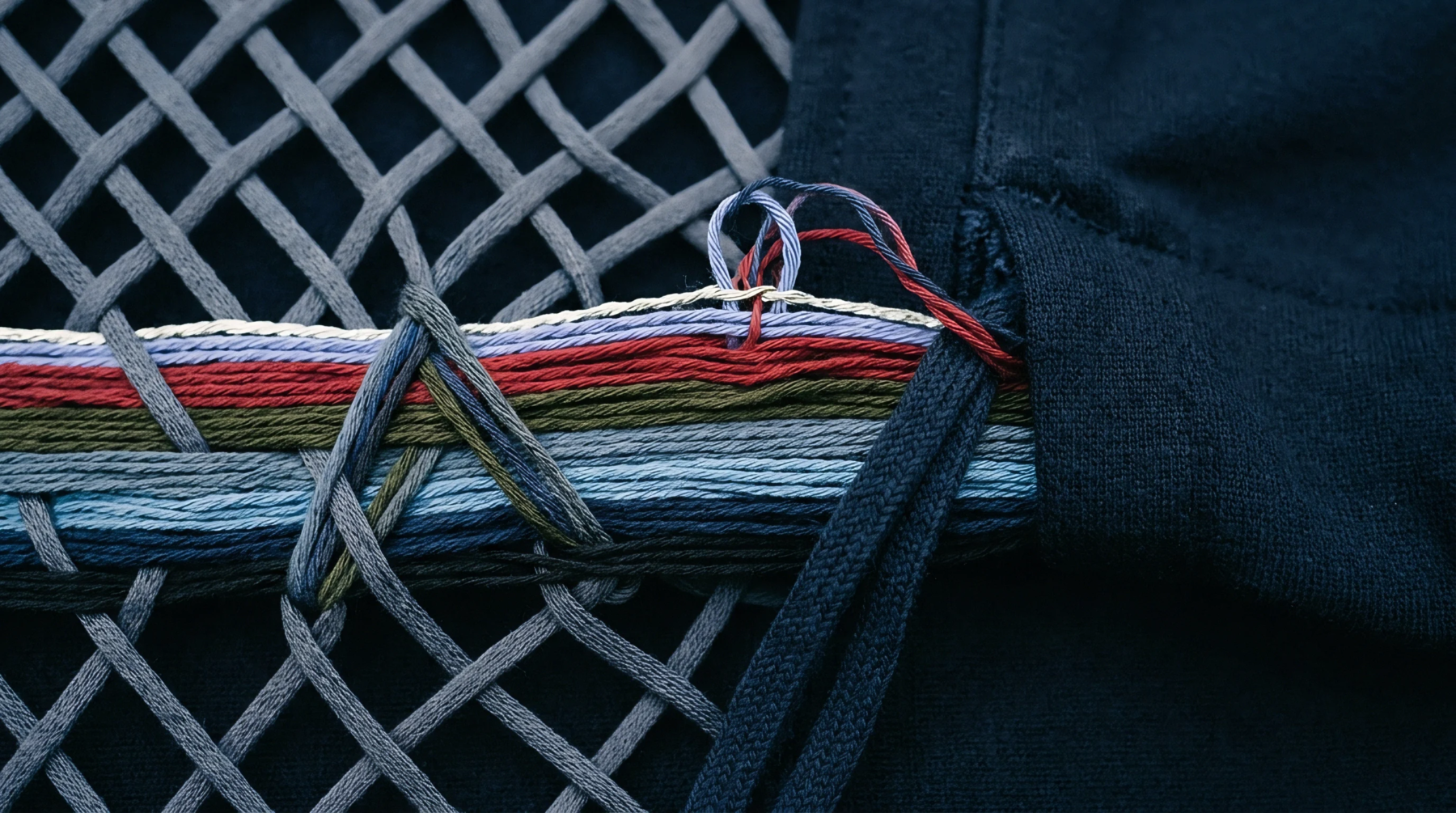
Fiber Twist
Residual rotation forces inside single strands generate persistent rotational moments that distort downstream processing unless neutralized during extrusion or spinning. Torque-balanced yarn suppresses these rotational tendencies by pairing plies with opposing twist directions or by setting the constituent filaments under controlled thermal conditions. Mill operators measure residual twist through free loop tests on sample lengths taken from creels prior to knitting or weaving.
Unbalanced strands curl back upon themselves when suspended freely, whereas properly stabilized constructions hang straight without generating looping or snarling in high speed feeders. Technical specifications demand zero rotational moment to prevent distorted stitch loops in single jersey circular knitting machines. Commercial delivery requires strict adherence to twist multiplier tolerances established for specific ring spun or rotor spun categories.
Stress Equilibrium
Internal mechanical tensions distribute evenly across the cross section when constituent filaments experience identical drafting and tensioning profiles throughout spinning operations. Torque-balanced yarn prevents skewed fabric architecture because balanced structural forces eliminate lateral bias during subsequent finishing and washing procedures. Garment manufacturers verify this structural stability by laundering cut panels and measuring angular distortion against baseline geometric coordinates.
Imbalanced configurations release stored rotational energy during wet processing, causing garments to twist out of shape along side seams. Quality control laboratories check this behavior through accelerated shrinkage tests that simulate industrial laundering environments. Fabric weight consistency depends heavily on this internal tension state because skewed yarns alter loop density and cover factor across finished piece goods.
Finishing Control
Thermal setting treatments stabilize internal filament arrangements by applying precise heat profiles inside pressurized autoclaves or continuous steam chambers. Torque-balanced yarn receives this thermal stabilization before dyeing to prevent uneven dye penetration caused by localized fiber compaction. Dyehouse technicians monitor steam temperature and dwell time continuously to avoid thermal degradation of synthetic polymer chains.
Inadequate heat setting permits residual rotational forces to reassert themselves during high temperature dyeing cycles, resulting in permanent creasing and surface streaking. Proper setting fixes the molecular orientation permanently, ensuring that finished textiles maintain dimensional stability through repeated commercial use.
Performance Metric
Residual rotation limits define the exact threshold where yarn behavior remains stable under heavy mechanical loads on high speed looms. Torque-balanced yarn undergoes routine laboratory verification using specialized tension meters that record rotational torque per unit length under standardized ambient conditions. Purchasing agents reject bulk shipments exceeding established torque variance limits because excessive rotation causes warp breakage and weft insertion failures on automated weaving equipment.
Weaving efficiency improves significantly when supply lots maintain uniform rotational neutrality from outer layers to core packages. Final inspection protocols establish strict rejection criteria for any lot displaying directional bias during standard untwisting evaluations.