Yarn Count Conversions and Direct Mass Calculations for Woven Goods
Accurate woven mass calculation requires modeling yarn counts, crimp percentages, sizing removal, and moisture regain across every step from loom shed to final invoice.
Skein
Linear density determination starts on a motorized wrap reel, where a set length of yarn unwinds under mechanical tension. In commercial testing, raw yarn packages arrive with nominal count labels that reflect target specs rather than actual physical mass per unit length. Technicians mount spools onto a creel and thread the ends through tensioners set between 0.5 and 1.0 centineutons per tex.
Pulling yarn without even tension stretches it, introducing elongation errors that skew final weight measurements by artificially inflating calculated length per unit mass. Standard test methods like ISO 2060 and ASTM D1907 require winding a fixed length of 100 meters for metric tests or 120 yards for indirect English cotton count systems. This continuous loop of thread, wrapped on a reel with a perimeter of exactly 1.000 or 1.500 yards, forms the physical sample used for all direct mass calculations.
Conditioning the sample before weighing determines how accurate the resulting count will be. Textile fibers absorb or release moisture until reaching equilibrium with the surrounding air. Under ISO 139 standard atmospheric conditions, test rooms stay at 20.0 degrees Celsius, plus or minus 2.0 degrees, and 65.0 percent relative humidity, plus or minus 4.0 percent.
A sample weighed right off a hot spinning frame shows a false low mass because it lost moisture, yielding an artificially fine count in direct systems like Tex or Denier. Material stored in damp transit containers does the opposite, absorbing excess water and coarsening the measured linear density. Operators spread wrapped samples on perforated trays inside the controlled room for at least 24 hours to reach equilibrium before weighing them on an analytical balance reading to 0.0001 grams.
Standard Laboratory Procedure for Linear Density Determination
Accurate count verification depends on following standard steps closely so the yarn is not deformed during sampling. Technicians process yarn packages arriving from spinning mills through a fixed sequence:
- Mount the yarn package on the wrap reel creel, passing the yarn tail through the primary tension disc assembly.
- Calibrate pre-tension controls to 0.5 centineutons per tex using a digital tension meter to prevent yarn stretching.
- Set the wrap reel counter to exactly 80 revolutions for a 120-yard sample or 100 revolutions for a 100-meter sample.
- Run the reel drive at a constant speed of 150 revolutions per minute until the counter hits zero.
- Cut the yarn cleanly at the traverse guide and tie the two free ends securely to keep the loop intact.
- Remove the wrapped loop carefully from the collapsible reel arm without adding twist or tension.
- Condition the sample in the standard atmosphere of 20 degrees Celsius and 65 percent relative humidity for 24 hours.
- Transfer the conditioned loop to an analytical balance with forceps, recording mass to four decimal places.
Oven-dry testing eliminates humidity variables altogether. Wrapped samples go into a ventilated drying oven set at 105 degrees Celsius, plus or minus 2 degrees, remaining there until successive weighings 15 minutes apart show less than 0.1 percent change in mass. Applying standard moisture regain allowances to this dry figure gives the commercial count.
Cotton carries an official commercial regain factor of 8.5 percent, polyester 0.4 percent, viscose rayon 13.0 percent, and nylon 6,6 4.5 percent. For a blend like 65 percent polyester and 35 percent cotton, the regain allowance is weighted according to its fiber ratio. Overlooking exact blend percentages during this calculation skews raw yarn ordering and leads to weight discrepancies on the loom.
Commercial laboratory testing under ISO 2060 requires yarn samples to condition at 20 degrees Celsius and 65 percent relative humidity for 24 hours before analytical mass measurement.
Twist contraction introduces another physical variable. Plied and cabled yarns measure shorter than the single strands used to make them, as twisting pulls the strands into a helix. Measuring single yarn count from an unraveled plied thread without removing that ply twist distorts the calculation.
Technicians check ply twist on a twist tester under a load set by fiber type, backing out the twist entirely before measuring single yarn length. A 2/40s English cotton count yarn, for instance, does not just double the mass of a 40s single; doubling twist demands 2.0 to 4.0 percent more yarn length per unit weight. Ignoring this take-up causes buyers to under-order raw material for heavy plied fabrics.
Mill sales departments often attribute weight variations to natural fiber fluctuations rather than mechanical drift. When off-spec yarn turns up, technical reps frequently argue that draft slippage on the spinning frame stayed within the standard trade tolerance of plus or minus 3 percent. Sourcing engineers cannot accept that explanation when those variations disrupt weaving preparation.
Excessive count variation creates distinct filling bars across finished fabric, ruining entire dye lots.

System
Converting between direct and indirect systems is fundamental to fabric design. Direct systems measure mass per unit length, so higher numbers mean thicker, heavier yarns. Indirect systems measure length per unit mass, meaning higher numbers indicate finer threads.
Moving between these frameworks requires exact conversion factors rather than rounded trade estimates. Sourcing engineers dealing with global supply chains have to move comfortably between European Tex units, Asian Denier standards, and traditional English Cotton Counts to ensure looms run on exact target specifications.
The Tex system is the official international metric standard under ISO 1144, defined as the mass in grams of 1,000 meters of yarn. Decitex (grams per 10,000 meters) dominates synthetic filament production, while Denier (grams per 9,000 meters) remains standard in silk and continuous filament trading. Indirect systems include English Cotton Count (Ne or NeC), defined as the number of 840-yard hanks per pound; Metric Count (Nm), the number of 1,000-meter lengths per kilogram; and Worsted Count (NeW), based on 560-yard hanks per pound.
Woolen systems divide further into Woolen Run (NeR, 1,600 yards per pound) and Woolen Cut (NeK, 300 yards per pound), alongside regional systems like Dewsbury and Galashiels still used in parts of Europe.
Mathematical Conversions across Yarn Measurement Frameworks
Accurate conversion between systems relies on equations linking units of mass and length. Table 1 outlines the mathematical relationships and constants used across global manufacturing to convert between direct and indirect yarn counts.
| Target Unit | From Direct (Tex) | From Direct (Denier) | From Indirect (Ne Cotton) | From Indirect (Nm Metric) |
|---|---|---|---|---|
| Tex (g/1,000 m) | Tex = Tex | Tex = Denier / 9 | Tex = 590.54 / Ne | Tex = 1,000 / Nm |
| Denier (g/9,000 m) | Denier = Tex × 9 | Denier = Denier | Denier = 5,314.87 / Ne | Denier = 9,000 / Nm |
| Ne (840 yd/lb) | Ne = 590.54 / Tex | Ne = 5,314.87 / Denier | Ne = Ne | Ne = Nm × 0.59054 |
| Nm (km/kg) | Nm = 1,000 / Tex | Nm = 9,000 / Denier | Nm = Ne × 1.69336 | Nm = Nm |
| Worsted NeW (560 yd/lb) | NeW = 885.81 / Tex | NeW = 7,972.3 / Denier | NeW = Ne × 1.5 | NeW = Nm × 0.88581 |
| Conversion constant 590.54 reflects standard cotton moisture regain of 8.5 percent; for zero regain dry conditions, constant shifts to 585.35. | ||||
Applying conversion constants without accounting for moisture regain introduces systematic errors. The standard factor between Tex and English Cotton Count is listed as 590.54, but that number assumes a standard cotton moisture regain of 8.5 percent. When converting dry fiber masses or synthetics with little moisture absorption, the constant changes.
For 100 percent bone-dry cotton yarn, the factor drops to 585.35. Sourcing managers calculating raw yarn orders must select the constant that matches the fiber blend and testing state. An error of just 0.8 percent on a 50,000-kilogram order leaves the mill short by 400 kilograms.
Converting direct linear density to indirect length per unit mass requires dividing the empirical system constant by the known count value.
Plied yarn designations can easily cause confusion in international purchasing. In direct systems like Tex or Denier, single-strand linear density comes first, followed by the number of plies. A designation of Tex 20 x 2 means two 20 Tex strands twisted together, yielding a nominal 40 Tex total before accounting for twist contraction.
Indirect systems do the reverse, listing the single-strand count followed by a slash and the ply count. A notation of 30/2 Ne describes two 30s single strands plied together, giving a resultant count of 15 Ne ~ half the length per unit mass of a single 30s strand. Reading 30/2 Ne as two 15 Ne strands doubles the fabric weight, overloading loom harnesses and ruining the intended hand.
Calculating the resultant count for plied yarns made from unequal single strands requires reciprocal addition. If you ply a 20 Ne cotton single with a 40 Ne single, adding the numbers directly gives a wrong answer. In indirect systems, resultant count (NeR) follows a harmonic sum: 1 / NeR = (1 / Ne1) + (1 / Ne2).
For 20 Ne and 40 Ne, 1 / NeR = (1 / 20) + (1 / 40) = 3 / 40, yielding 13.33 Ne. Converting to Tex first simplifies the math: 20 Ne is 29.53 Tex, and 40 Ne is 14.76 Tex. Adding those direct values gives 44.29 Tex, which converts back to 13.33 Ne. Because direct units avoid fractions, mill planners generally prefer Tex for internal calculations.
Linear density calculations have to reflect physical mass rather than rounded nominal numbers.
Crimp
Woven fabric interlaces warp and weft yarns at right angles, forcing both threads into wavy paths. Because of this geometry, individual yarns pulled from a woven sample measure longer than the fabric specimen itself. Crimp quantifies this waviness as the percentage difference between straightened yarn length and the distance it spans in the cloth.
Take-up, or weave contraction, measures the reverse: the length a flat yarn loses when woven into fabric relative to its unraveled length. Sourcing engineers treat warp and weft crimp separately, since warp yarns endure far more tension during sizing, beam preparation, and loom shed opening.
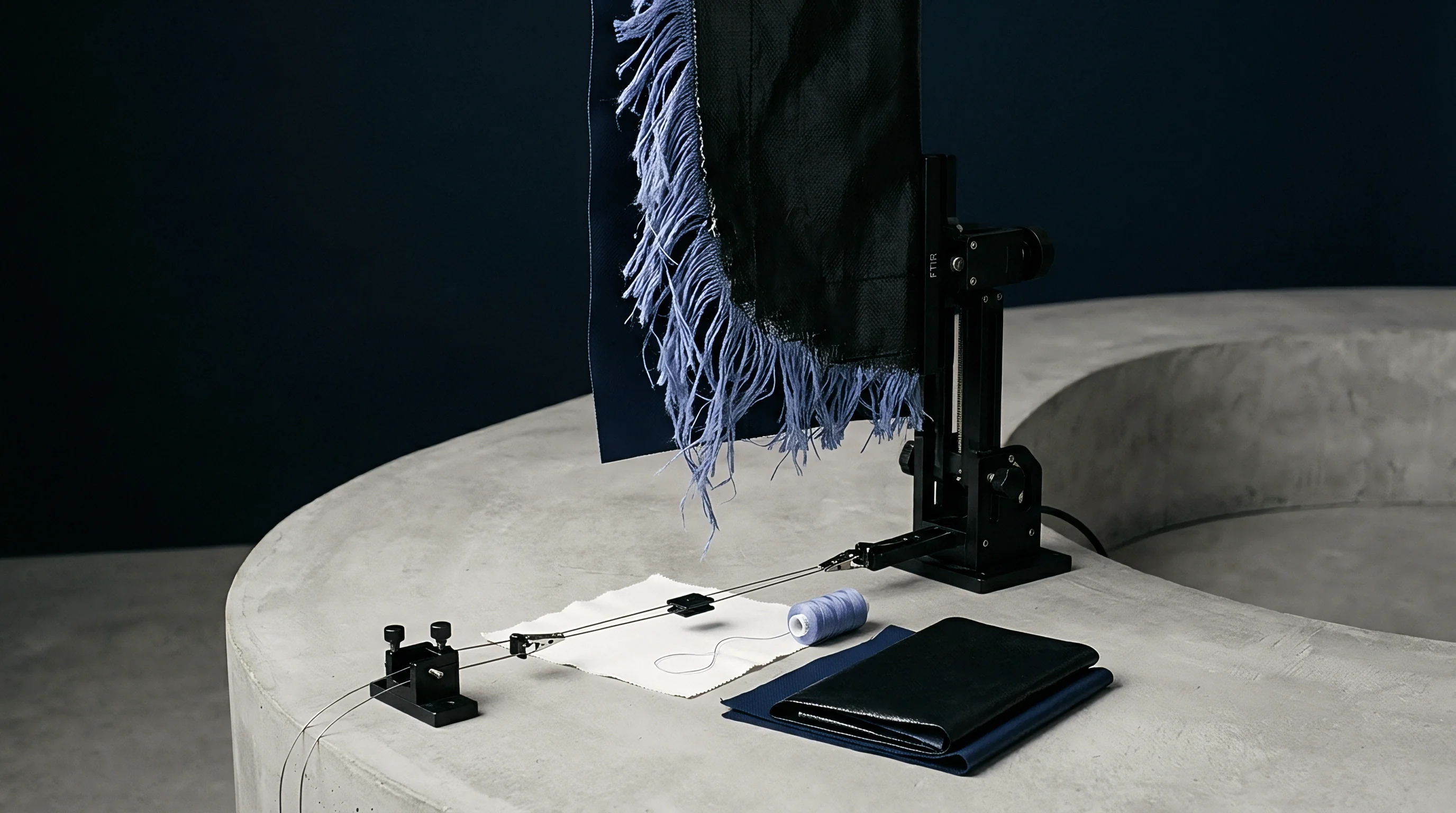
ISO 7211-3 outlines the standard method for measuring crimp directly. A technician cuts a sample to a set length ~ typically 500 millimeters ~ without disturbing the yarn structure, then removes individual warp or weft threads with a needle. One end of the yarn is fixed in a clamp while the free end is pulled across a scale under tension calibrated to its linear density.
Too little tension leaves bends in the yarn, understating crimp; too much stretches the strand, overstating it. Standard tension is 0.5 centineutons per tex, plus or minus 0.1 centineutons. Once extended, the length is recorded and crimp percentage (C) is calculated using C = ((L1 – L0) / L0) x 100, where L1 is the straightened length and L0 is the flat fabric length.

Crimp and Take-Up Behavior across Woven Weave Architectures
Weave pattern dictates how often threads cross per square centimeter, directly controlling crimp. Table 2 summarizes crimp percentages, take-up factors, and reed width calculations across common commercial fabric structures.
| Fabric Construction | Weave Pattern | Warp Crimp (%) | Weft Crimp (%) | Take-Up Factor | Reed Width Factor |
|---|---|---|---|---|---|
| Poplin (100% Cotton, 40s x 40s) | 1/1 Plain Weave | 10.5 – 13.0 | 3.5 – 5.0 | 0.890 | 1.045 |
| Canvas (100% Cotton, 10s/2 x 10s/2) | 1/1 Plain Weave | 14.0 – 16.5 | 5.5 – 7.0 | 0.865 | 1.065 |
| Denim (100% Cotton, 3/1 Right-Hand Twill) | 3/1 Warp-Face Twill | 7.0 – 9.0 | 8.5 – 11.0 | 0.920 | 1.100 |
| Chino (65/35 Poly-Cotton, 2/1 Twill) | 2/1 Twill | 8.0 – 10.0 | 4.0 – 5.5 | 0.915 | 1.050 |
| Satin Apparel (100% Polyester Filament) | 5-End Warp Satin | 3.0 – 4.5 | 2.0 – 3.0 | 0.965 | 1.025 |
| Cordura Industrial (1,000D Nylon) | 1/1 Plain Weave | 11.0 – 13.5 | 6.0 – 8.0 | 0.880 | 1.075 |
Calculating loom reed width from target finished width requires factoring in both weft crimp and finishing shrinkage. As the reed beats the weft into the fell of the cloth, the weft bends around the taut warp threads, pulling the off-loom fabric narrower than the width of the yarn in the reed. This inward draw is reed contraction.
If a finished fabric needs a 150-centimeter cuttable width, and finishing shrinkage takes off 5.0 percent alongside 6.0 percent weft crimp, setting the reed at 150 centimeters will produce an undersized roll. The required reed width calculation is: Reed Width = Finished Width / ((1 – Weft Crimp) x (1 – Wet Processing Width Shrinkage)). Here, Reed Width = 150 / ((1 – 0.06) x (1 – 0.05)) = 150 / (0.94 x 0.95) = 150 / 0.893 = 168.0 centimeters.
The loom bed needs a reed space of 168 centimeters.

Will Differential Warp Crimp Create Tension Streaks in Heavy Twills?
Unequal crimp across warp threads creates visible defects and running problems during weaving. Heavy twills like 3/1 denim or 2/2 cavalry twills feature asymmetric floats where warp threads skip several picks before interlacing. As beat-up drives the weft into the fell, warp threads experience different tension depending on whether they are floating on the face or binding on the back.
Tighter strands flatten out, shifting crimp into neighboring threads and causing wavy selvedges, skewed fill lines, and broken warp ends. Fixing differential crimp means adjusting drop-wire tension and fine-tuning harness frame timing during shed opening.
Crimp interchange alters yarn geometry when fabric is pulled under axial tension. Stretching a woven strip lengthwise flattens out the warp yarns, driving warp crimp down toward zero. Because internal path lengths are constrained, straightening the warp forces weft yarns to bend deeper around it, increasing weft crimp.
This shift pulls the fabric narrower, behaving according to Poisson’s ratio for woven structures. In industrial uses like conveyor belts or ballistic fabrics, evaluating material performance under load requires recalculating crimp at expected operational strain.
Whether predictive equations can entirely replace physical unraveling tests on complex dobby weaves remains an open question.

Mass
Calculating fabric mass per unit area in grams per square meter (GSM) connects raw yarn purchasing to finished fabric specifications. Estimating fabric weight strictly from target thread counts and nominal yarn sizes produces significant errors if sizing add-on, crimp, yarn waste, and selvedges are left out. A reliable weight calculation models each component separately ~ warp, weft, selvedge ends, and size solids ~ before factoring in finishing weight changes.
Calculating grey warp mass per square meter (Mwarp) requires ends per centimeter (Ecm), warp yarn count in Tex (Twarp), warp crimp percentage (Cwarp), sizing add-on percentage (Swarp), and warp waste percentage (Wwarp):
Mwarp = Ecm × 100 × left(fracTwarp1000right) × left(1 + fracCwarp100right) × left(1 + fracSwarp100right) × left(1 + fracWwarp100right)
Simplifying the equation yields: Mwarp = Ecm × Twarp × 0.1 × (1 + Cwarp/100) × (1 + Swarp/100) × (1 + Wwarp/100).
Likewise, grey weft mass per square meter (Mweft) uses picks per centimeter (Pcm), weft count in Tex (Tweft), weft crimp percentage (Cweft), and weft insertion waste percentage (Wweft). Since weft yarn is not sized, size add-on drops to zero:
Mweft = Pcm × 100 × left(fracTweft1000right) × left(1 + fracCweft100right) × left(1 + fracWweft100right)
Simplifying gives: Mweft = Pcm × Tweft × 0.1 × (1 + Cweft/100) × (1 + Wweft/100).

Worked Direct Mass Calculation for Heavy Workwear Twill
As an example, consider a heavy cotton/polyester workwear twill intended for industrial uniforms. The specification sheet sets the following target grey parameters:
- Warp Sett and Count ~ 42 ends per cm, 30 Tex (20s Ne equivalent) 65/35 poly-cotton staple yarn.
- Weft Sett and Count ~ 22 picks per cm, 36 Tex (16s Ne equivalent) 100% cotton ring-spun yarn.
- Warp Crimp and Size ~ Warp crimp measured at 9.5 percent; native starch sizing add-on at 8.0 percent; warp processing waste at 1.5 percent.
- Weft Crimp and Waste ~ Weft crimp measured at 4.5 percent; air-jet insertion waste allowance at 3.0 percent.
- Selvedge Construction ~ 60 dense selvedge ends per side using 30 Tex x 2 plied yarn across an overall fabric width of 160 cm.
Calculating the primary warp mass contribution per square meter:
Mwarp = 42 × 30 × 0.1 × (1 + 0.095) × (1 + 0.080) × (1 + 0.015)
Mwarp = 126 × 1.095 × 1.080 × 1.015 = 151.18 grams per square meter
Calculating the primary weft mass contribution per square meter:
Mweft = 22 × 36 × 0.1 × (1 + 0.045) × (1 + 0.030)
Mweft = 79.2 × 1.045 × 1.030 = 85.25 grams per square meter
To calculate the selvedge contribution spread across the 1.6-meter width: the selvedges use 120 total ends (60 ends x 2 sides) of 60 Tex (30 Tex x 2) plied yarn. Total selvedge warp length per meter of cloth equals 1.0 meter x (1 + 0.095 warp crimp) = 1.095 meters. Selvedge yarn mass per meter of fabric length = 120 ends x 1.095 meters x (60 grams / 1000 meters) = 7.88 grams per linear meter.
Dividing by the 1.6-meter total cloth width gives 4.93 grams per square meter. Adding sizing (8%) and waste (1.5%) brings the selvedge load to 5.41 grams per square meter.
Summing the individual mass components yields total grey fabric weight per square meter:
Total Grey Mass = 151.18 + 85.25 + 5.41 = 241.84 grams per square meter

Essential Verification Steps for Grey Mass Requisitions
Converting target grey weights into raw material purchasing orders requires checking several key factors to make sure yarn orders cover expected production losses:
- Yarn Regain Normalization ~ Adjust incoming yarn package weights to official commercial regain allowances before calculating linear density.
- Crimp Extraction Testing ~ Measure warp and weft crimp on physical sample loom runs under ISO 7211-3 mounting tension instead of relying on lookup tables.
- Size Refractometry Standard ~ Check sizing percentages on section beams through desize boil-off tests or refractometer solids checks on size box liquor.
- Loom Waste Allocation ~ Account for air-jet fringe waste and warp tying loss, adding dedicated percentage allowances to warp and weft orders.
- Cuttable Width Adjustment ~ Distribute selvedge thread mass across the full cuttable width so overall roll mass is not understated.
A standard sourcing contract clause penalizes mills delivering finished fabric weights more than 3 percent below approved specification by recalculating total invoice charges on a net dry weight basis.

Will Moisture Regain Variations Destabilize Direct Fabric Mass Calculations?
Humidity changes in storage and weaving change physical roll weight without altering the actual fiber content. A cotton fabric roll packaged in a humid weave room at 80 percent relative humidity can hold over 10 percent water by weight. Shipped to a dry cutting plant operating at 40 percent relative humidity, those rolls lose up to 4 percent of their gross weight simply through evaporation.
If yarn calculations do not separate dry fiber mass from water weight, buyers risk disputing fake weight shortages or accepting light, low-density cloth that fails tensile testing.
A dispute over a 40,000-meter delivery of 280 GSM canvas occurred when a receiving team weighed incoming rolls cold straight off an unheated freight dock, calculating off-spec mass deficits before conditioning samples in a climate lab.


Loss
Converting grey loomstate fabric into a finished, dyed material causes significant shifts in mass. Wet chemical treatments strip natural impurities, sizing polymers, and knitting lubricants while adding dyes, resins, and softeners. At the same time, stenter drying and heat setting cause fabric relaxation or stretch, altering its surface area.
Estimating final yield requires tracking both chemical weight changes and physical dimensional shifts through each finishing stage.
Desizing causes the largest single drop in weight during woven fabric finishing. Cotton warp yarns carry between 6.0 and 12.0 percent starch or polyvinyl alcohol (PVA) size to endure loom friction. Desizing baths break down these insoluble polymers into soluble fragments that wash out during hot rinsing.
Alkaline scouring under high heat and pressure then removes natural waxes, pectins, seed fragments, and ash, stripping another 1.5 to 3.0 percent of raw fiber mass. Hydrogen peroxide bleaching removes natural color, taking off another 0.5 percent. Across these preparation steps, 100 percent cotton grey cloth typically loses 8.0 to 15.0 percent of its starting weight.

Mass and Area Balance across Wet Processing Operations
Tracking fabric weight shifts requires separating actual material loss from area shrinkage. Table 3 outlines cumulative mass balance, width contraction, and weight per square meter changes across finishing steps for a 100% cotton woven fabric.
| Processing Stage | Stage Chemical Mass Delta (%) | Cumulative Chemical Mass (%) | Cumulative Area Change (%) | Resulting GSM (Base 200 Grey) |
|---|---|---|---|---|
| Grey Loomstate | Base Condition | 100.0 | 0.0 (Base 100% Area) | 200.0 |
| Enzymatic Desize | -8.0 (Size Removed) | 92.0 | -2.0 (Relaxation) | 187.8 |
| Alkaline Scour | -2.5 (Waxes Removed) | 89.7 | -1.5 (Relaxation) | 185.9 |
| Peroxide Bleach | -0.5 (Pigment Stripped) | 89.2 | -0.5 (Relaxation) | 185.8 |
| Caustic Mercerize | +1.0 (Caustic Swelling) | 90.1 | -8.0 (Contraction) | 201.3 |
| Jet Reactive Dye | +2.5 (Fixated Dye/Salt) | 92.4 | -2.0 (Contraction) | 210.9 |
| Stenter Frame Finish | +1.5 (Softener/Resin) | 93.8 | +5.0 (Heat Extension) | 197.0 |
Mercerization works in reverse: fiber swelling causes length and width contraction, raising fabric GSM even though chemical weight changes little. Immersing cotton cloth in concentrated sodium hydroxide (28 to 30 degrees Baumé) under tension swells the flat cotton fibers into rounded cylinders. Longitudinal shrinkage during mercerization compresses the structure, increasing ends and picks per centimeter by 5.0 to 10.0 percent.
While total batch mass stays roughly the same, fabric area contracts, boosting grams per square meter and masking earlier desizing losses.

Primary Mechanisms Driving Yield Discrepancies in Finishing
Calculating finished fabric yield without tracking step-by-step mass changes creates serious discrepancies when reconciling bulk orders:
- Uncounted Size Additive Removal ~ Failing to subtract size weight from initial yarn purchases creates shortages against target finished meterage.
- Stenter Overfeed Overestimation ~ Over-stretching fabric warp-wise on the stenter frame inflates linear yardage but drops finished GSM below specified limits.
- Caustic Mercerization Shrinkage Errors ~ Miscalculating width shrinkage during mercerization results in narrow cuttable widths and excessive selvedge trim waste.
- Mechanical Shearing Mass Losses ~ Ignoring fiber stripped during napping, raising, or shearing produces fabrics that fall short of burst strength standards.
- Solvent Extractable Omission ~ Overlooking spin oils on synthetic filaments leads to unexpected weight drops after hot scouring.
Mechanical finishing removes fiber through surface abrasion. Singeing passes fabric face across open gas flames at 80 to 120 meters per minute to burn away fuzz, reducing mass by 0.5 to 1.0 percent. Raising and napping pull fiber ends out of yarn cores using wire rollers to form a surface pile.
Shearing then runs spiral knives over the cloth to level the pile, removing up to 4.0 percent of total mass as waste fly. When ordering brushed fleece or double-napped flannel, sourcing managers have to increase yarn orders to cover this permanent material loss.
Finishing contracts must explicitly define whether target weight specifications apply to dry conditioned cloth or commercial regain fabric to prevent yield disputes.
Synthetic fibers behave differently than cellulosics during finishing. Polyester and nylon filaments carry spin finishes and lubricants applied during extrusion, making up 1.0 to 3.0 percent of raw yarn weight. High-temperature scouring strips these oils without affecting the fiber structure.
During heat setting on the stenter frame (180 to 210 degrees Celsius for polyester), volatile lubricants evaporate while thermoplastic filaments shrink. This heat contraction reduces fabric area, tightening thread density and raising finished GSM. Careful control of stenter temperature and overfeed balances width stretch against area shrinkage to hit targeted fabric weights.
Standard international purchase agreements stipulate that finished fabric weight is calculated on conditioned dry mass plus official regain, with any width shrinkage over 2.5 percent triggering an automatic credit against billed invoice value.

Invoice
Reconciling commercial invoices against fabric specifications means translating physical roll weights into financial charges. Conflicts crop up when mills bill based on off-loom grey weight while buyers issue purchase orders for net cuttable linear meters at a target conditioned GSM. Because finishing alters both overall weight and fabric width, simple unit-for-unit comparisons between grey meterage woven and finished meterage delivered rarely line up.
Clearing up billing disputes requires applying standard regain adjustment formulas and enforcing clear width allowance clauses on every shipment.
Calculating billed commercial mass (Mc) relies on official regain rates under ISO 1833 and ASTM D2495. When fabric ships straight from dyehouse stenters, fast heat drying leaves the material overly dry ~ sometimes under 2.0 percent moisture. Invoicing based on scale weight right off the line means the buyer pays for less fiber than ordered.
If rolls sit in a damp warehouse, absorbed water artificially inflates scale weight. The standard commercial mass formula adjusts scale mass (m) to reflect official moisture regain:
Mc = m × left(frac100 + Rc100 + Rmright)
Here, Rc is the standard commercial regain percentage for the fiber blend, and Rm is the actual moisture content measured by oven-dry testing of roll core samples. If a 10,000-kilogram lot of 100 percent cotton cloth (Rc = 8.5%) leaves the stenter with an actual moisture content (Rm) of 3.0 percent, its corrected commercial mass is: Mc = 10,000 × (108.5 / 103.0) = 10,533.98 kilograms. The mill bills for 10,534 kilograms of commercial mass.
Skipping this regain correction creates constant friction between spinning mills, dyehouses, and garment factories.
Cuttable width tolerances directly dictate garment marker efficiency and overall yield. Fabric specs state overall width alongside cuttable width, separated by pin holes or selvedge lines. Pin holes left by stenter chains run 1.5 to 2.5 centimeters inside each edge, making the selvedges useless for cutting pattern panels.
If a contract calls for a 150-centimeter cuttable width but the mill delivers 150 centimeters overall width, usable width falls to 145 centimeters. Marker layouts made for 150 centimeters no longer fit, forcing cutting rooms to adjust marker efficiency or re-lay fabric, adding 3.0 to 5.0 percent scrap. Standard contracts enforce strict price adjustments for width deficits: delivering usable width below spec triggers a proportional price cut per linear meter.
Weight tolerance windows need clear limits to prevent mills from padding fabric weight. Dyehouses sometimes try to hit target GSM by applying heavy chemical softeners, weighting salts, or starches during final padding rather than maintaining proper thread counts. This temporary loading boosts weight on the scale, but washes out in the first laundering, exposing a weak, low-density weave.
Sourcing contracts typically set a GSM tolerance window of plus or minus 3.0 percent for solid shades and plus or minus 5.0 percent for washed or printed goods. Contracts also stipulate that fabric delivered above the upper weight limit receives no extra pay, while fabric below the lower limit incurs an automatic price penalty equal to the percentage mass deficit.
Short-roll penalties protect automated cutting operations. Modern garment plants use high-speed automatic spreaders that need rolls between 80 and 120 linear meters. Deliveries with too many short rolls (under 30 meters) disrupt spreading schedules, force manual joins, and increase scrap.
Standard terms cap short rolls at 5.0 percent of total shipment volume and require explicit labeling. Rolls with unflagged weave defects, seam joins, or shade bars face full invoice deduction, with disposal costs billed back to the mill.
Final invoice approval relies on auditing net dry mass across the production records. Sourcing engineers assemble wrap reel test data, desizing logs, roll scale weights, and laboratory moisture regain results into a single ledger. Reconciling these physical numbers against the invoice confirms whether the shipment reflects actual fiber weight or inflated moisture.
Once calculated mass matches finished fabric specifications, purchase orders are cleared for payment, completing the verification from raw yarn count through loom construction to commercial delivery.