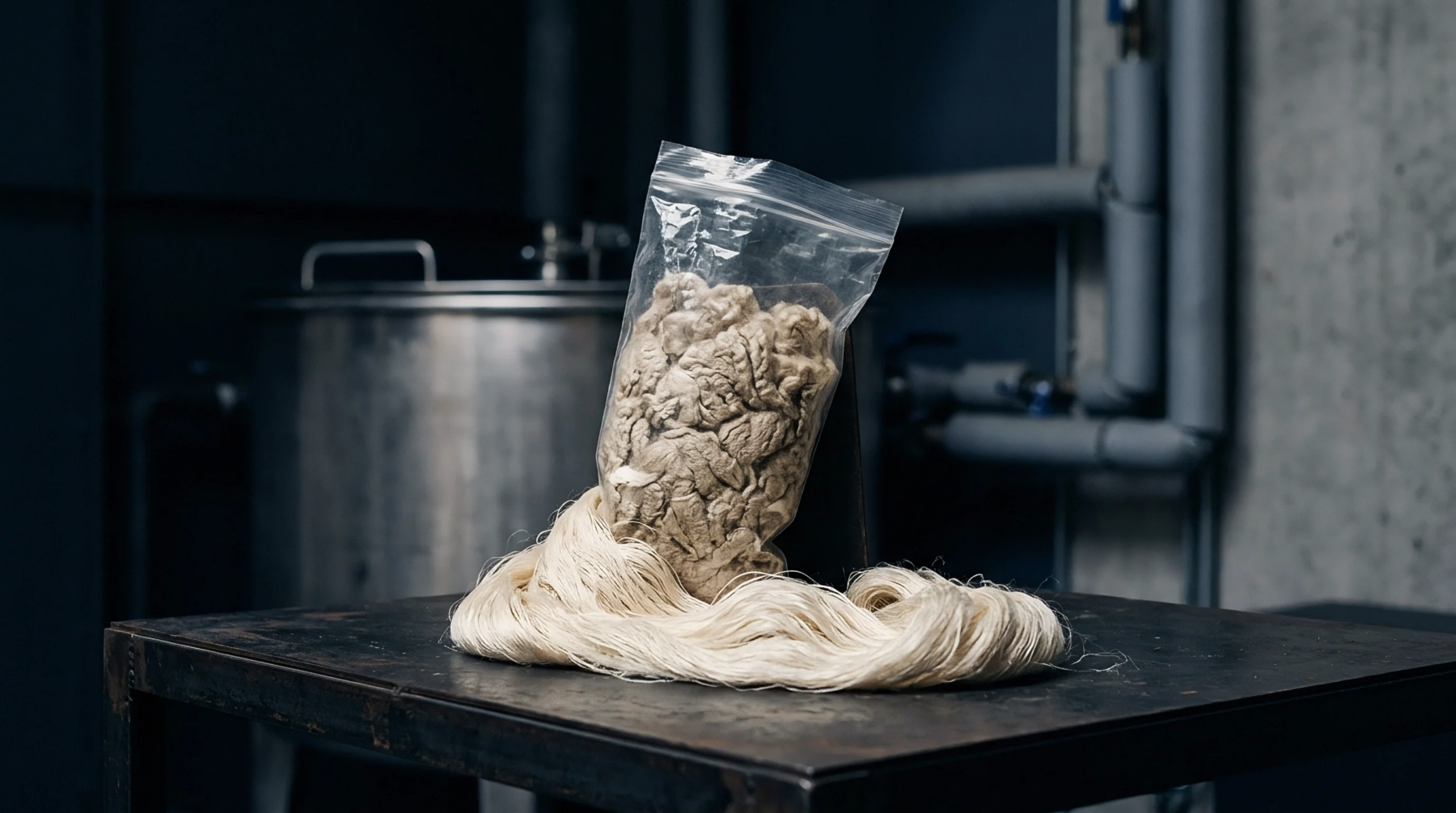
Determining Commercial Mass from Oven Dry Fibre Weights
Commercial mass equals oven-dry mass multiplied by standard regain allowances, establishing an immutable billable weight independent of transit moisture shifts.
Commercial moisture standards specifying the amount of water permitted in combed wool slivers ensure fair trade by establishing a uniform weight for shipment. The wool top regain is a fixed percentage added to the oven dry mass to determine the commercial mass for invoicing and contract fulfillment. For most international trade in combed wool, this figure is set at eighteen point two five percent by the international wool textile organisation.
This high value reflects the natural ability of wool fibers to absorb large amounts of atmospheric moisture without feeling damp. Using a standardized regain prevents financial losses and disputes that would otherwise occur due to the natural fluctuation of fiber weight in different climates. Every buyer of wool top relies on this technical constant to verify the quantity of material they are purchasing.
Producing wool top involves multiple stages of cleaning, gilling and combing to create a continuous, parallel bundle of long fibers. The wool top regain is applied to this intermediate product, which is the primary raw material for worsted spinning. During the combing process, moisture is often added to the fibers to reduce static electricity and improve the mechanical performance of the machinery.
Quality control teams monitor the actual moisture content of the sliver as it emerges from the final gill box. If the wool is too dry, it becomes brittle and difficult to spin, while excessive moisture can lead to biological degradation. The application of the standard regain during invoicing accounts for these necessary processing conditions.
Verification of the correct weight in the laboratory involves drying a sample of the wool top to a constant mass in a ventilated oven. The wool top regain is then mathematically added to this bone dry weight to calculate the commercial weight of the entire lot. This process ensures that the mill is paid for the actual amount of fiber delivered, adjusted to a standard moisture level.
Financial settlements are based on these calculated weights, which are reported on the commercial certificate and the shipping documents. Buyers may perform their own conditioning tests upon arrival to confirm that the material meets the agreed upon moisture specifications. Accurate weighing and calculation are essential for maintaining the integrity of the supply chain in the high value wool market.
Documentation of the moisture content and the applied regain is a mandatory part of the technical data provided with every shipment of wool top. Independent testing laboratories issue certificates that guarantee the accuracy of these measurements according to international standards. This certification is used by banks and insurance companies to facilitate trade finance and protect against losses.
The wool top regain serves as a neutral benchmark that allows for fair competition among growers and processors worldwide. Consistent application of these rules helps maintain the reputation of the wool industry for technical precision and reliability. Regular audits of the testing laboratories ensure that the equipment and methods remain in compliance with global protocols.
The stability of the international wool trade depends on the continued use of these standardized moisture values.
Commercial mass equals oven-dry mass multiplied by standard regain allowances, establishing an immutable billable weight independent of transit moisture shifts.
Expertise is a utility, not a secret. sentiention™ publishes its working knowledge as open reference: intelligence layer covering the materials it sources, the markets it enters, and the reference that serves both.