Moisture Regain Calculations in Commercial Fibre Blend Customs Declarations
Commercial moisture regain additions legally alter dry fibre mass ratios, shifting predominant weight and triggering customs tariff reclassifications.


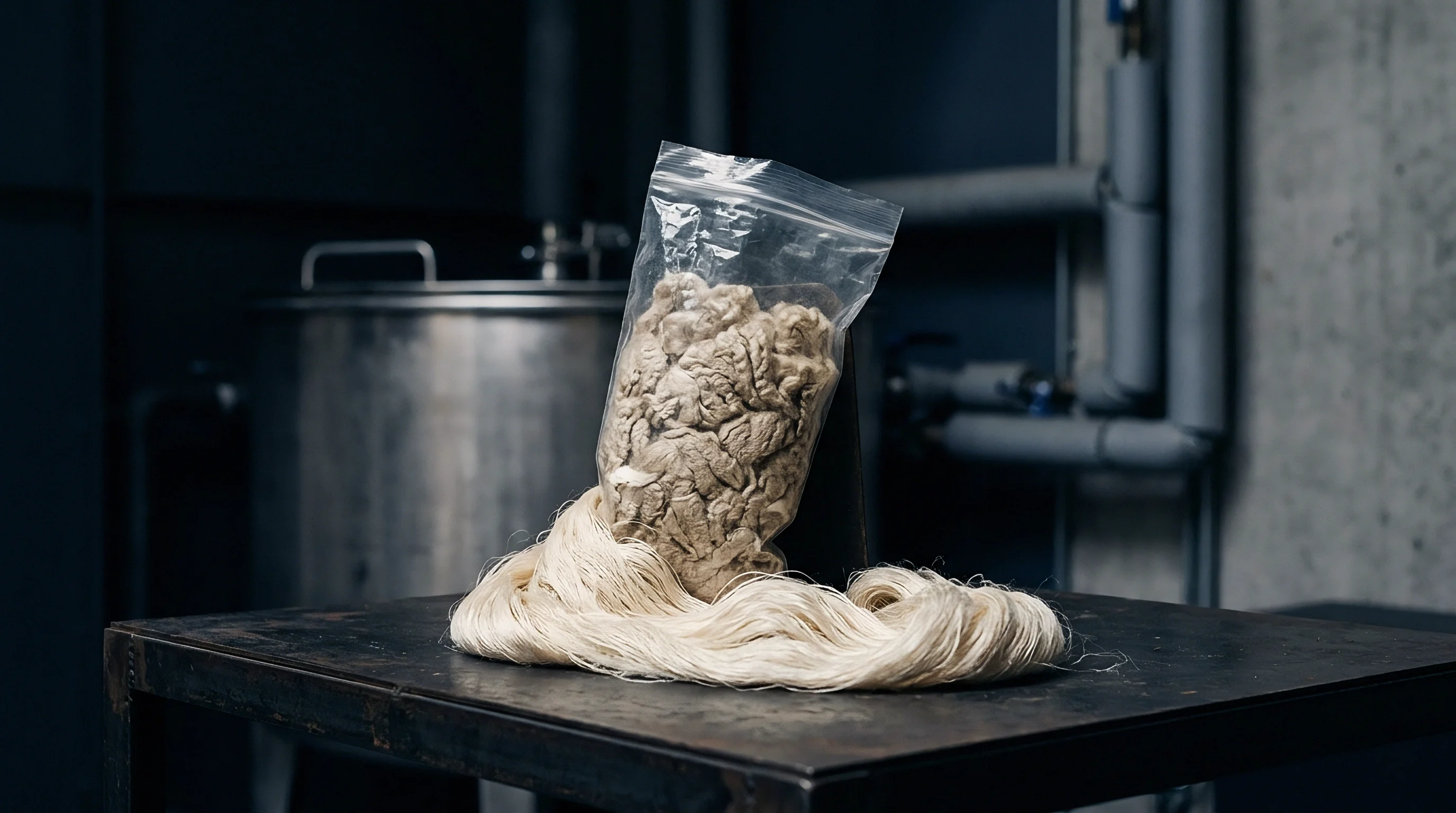
Oven
Desiccating a test swatch to constant mass at 105 degrees Celsius produces an absolute dry weight. Customs declarations across major borders never accept ambient receiving weight as the basis for fibre mixture percentages. Natural and regenerated cellulosic fibres absorb significant quantities of moisture directly from ambient air, while purely synthetic polymers reject moisture uptake almost entirely.
A shipping container packed in an equatorial port arrives at a temperate customs post with a gross mass that reflects ambient atmospheric humidity rather than polymer content. Customs tariffs classify mixed goods under Chapter 50 through Chapter 60 of the Harmonized System based on the single constituent predominating by weight. Failing to adjust raw oven-dry laboratory measurements by statutory moisture regain rates distorts the declared composition percentage, inverting legal predominance and invalidating shipping entries.
Atmospheric humidity alters commercial invoicing.
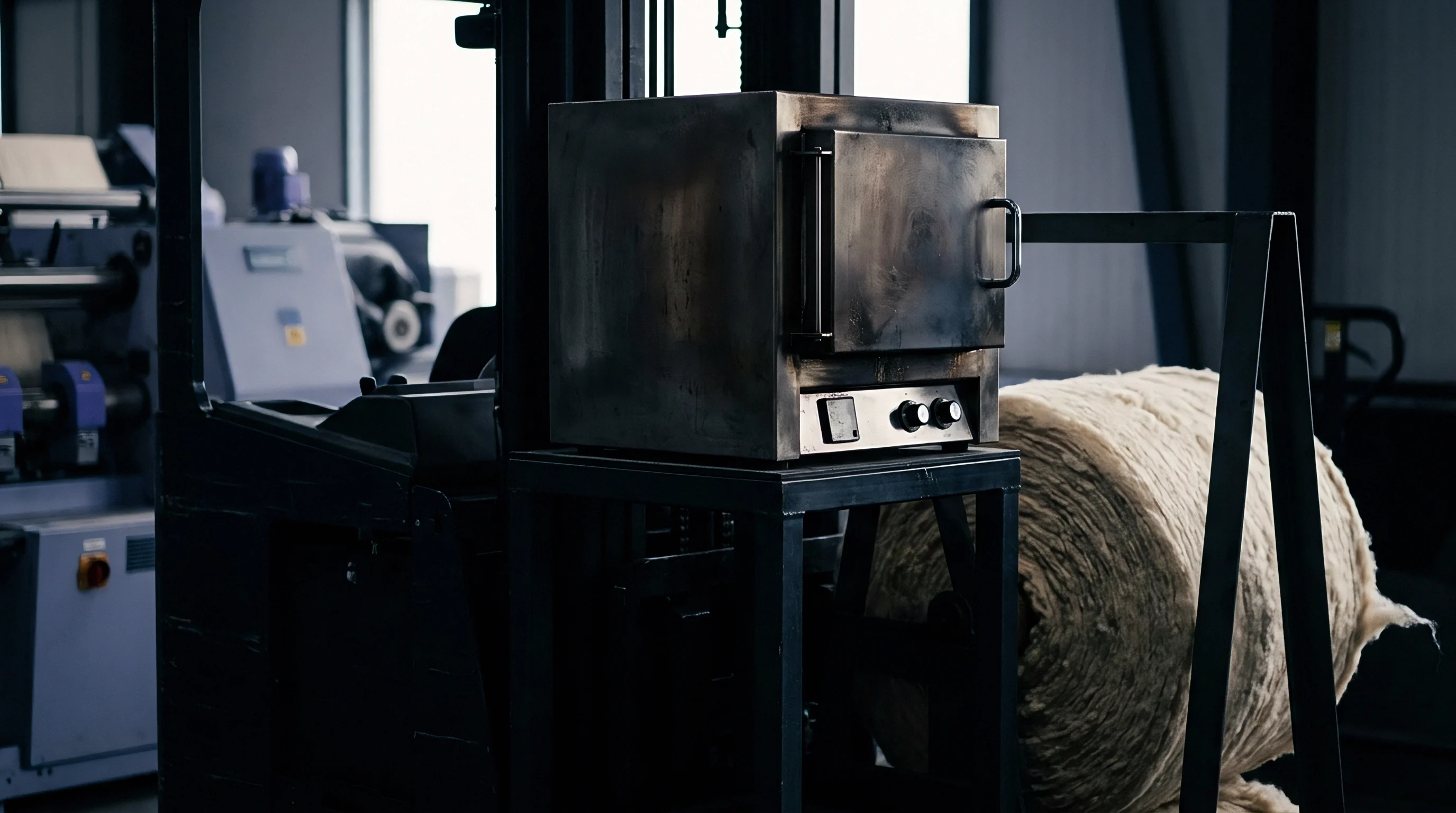
Analytical laboratories operating under ISO 1833 or ASTM D629 dry clean textile specimens inside ventilated ovens until successive weighings separated by fifteen minutes show an absolute weight variation below 0.05 percent. This endpoint delivers the oven-dry mass. Ambient moisture held within the amorphous zones of natural polymers evaporates completely under continuous hot air circulation.
Synthetic filaments like polyester or polypropylene hold less than one percent moisture under ordinary room conditions, while scoured cotton retains seven to ten percent and scoured wool holds fifteen to eighteen percent. Weighing a specimen immediately after desiccation requires sealed weighing bottles to prevent dry cellulose from absorbing ambient humidity during balance stabilization. The dried tare holds zero water.
Atmospheric humidity changes scale readings without adding a single gram of polymer.
Border authorities inspect commercial invoices against physical laboratory separations to verify tariff classifications. When a spinning mill supplies a yarn specified as an intimate mix of cotton and polyester, the mill classes its production using nominal batch proportions loaded into the blowroom hoppers. That blowroom batch mass contains atmospheric water in the cotton and minimal water in the polyester.
If an importer transposes those nominal inventory masses directly onto a customs entry declaration, the entry line risks immediate legal rejection upon audit. Customs inspectors draw verification cuts, bake the cloth to oven-dry mass, dissolve the soluble component, and apply official moisture allowances to recalculate the legal weight of each constituent. Cellulose absorbs water rapidly.
Polyester repels atmospheric vapor. Fibres originating from plant stems hold moisture while synthesized filaments shed surface water.

Allowance
International customs jurisdictions establish rigid statutory percentages added mathematically to oven-dry masses to calculate commercial weight. These values, termed commercial moisture regain allowances, represent legal conventions rather than fluctuating ambient measurements. Disparities exist between statutory figures enforced by customs codes and practical allowances used in commercial yarn trading contracts.
European Union customs enforcement relies upon the statutory allowances defined in Annex II of Regulation 1007/2011, whereas United States customs personnel enforce schedule notes aligned with ASTM D1909 conventions and Harmonized Tariff Schedule general notes. These regional variances alter the calculated percentages of identical cloth swatches tested in different destination ports.
Statutory allowances fix taxable weight. Cotton carries an official commercial moisture regain value of 8.50 percent across European Union customs schedules, British customs rules, and international standards including ISO 6741-1. This 8.50 percent baseline rests on standardized evaluations of unbleached carded cotton sliver evaluated across thirty test lots established during twentieth-century commodity treaties.
Chemical wet processing alters this baseline substantially: bleaching and scouring remove natural waxes and increase amorphous accessibility, whereas liquid ammonia mercerization alters cellulose crystal structures to elevate actual regain above 10.0 percent. Polyester maintains an official allowance of 1.50 percent under European Union rules and 3.00 percent under United States commercial schedules for spun staple yarns. Wool carries massive moisture capacity.
Customs schedules credit carded wool yarn with a 17.00 percent regain allowance, rising to 18.25 percent for worsted spun qualities.
Under standard commercial agreements, cotton calculated at eight and a half percent regain yields higher billing mass than scoured yarn weighed in dry conditions.
| Fibre Classification | ISO 6741 Commercial Regain Percentage | EU Regulation 1007/2011 Regain Allowance | US Customs and ASTM D1909 Commercial Allowance |
|---|---|---|---|
| Cotton (Raw or Bleached) | 8.50 | 8.50 | 8.50 |
| Polyester (Staple Fibre) | 1.50 | 1.50 | 3.00 |
| Viscose (Regenerated Cellulose) | 13.00 | 13.00 | 11.00 |
| Wool (Worsted Spun) | 18.25 | 18.25 | 13.60 |
| Nylon 6,6 (Polyamide) | 5.75 | 5.75 | 4.50 |
| Acrylic (Polyacrylonitrile) | 2.00 | 2.00 | 1.50 |
| Values express statutory percentage moisture added to oven-dry mass to establish invoiced commercial weight under customs classification rules. | |||
Proper entry documentation demands specific verification certificates supporting the commercial regain adjustments applied to each declared shipping lot.
- Certified desizing test documentation confirms whether sizing starches were removed before calculating dry gravimetric proportions.
- Commercial moisture addition certificates show the exact official percentage added to each separated component mass. Laboratory calculations without these values fail port audits.
- Oven dry weighing logs establish the stabilized dry mass of each specimen after reaching constant weight at 105 degrees Celsius.
- Solvent extraction analytical sheets record petroleum ether soluble spin finishes removed during quantitative separation.
Spinning facilities frequently maintain that factory floor humidity during packaging accounts for any variation detected across border checkpoints.

Equation
Mathematical conversion of dry laboratory mass into legal customs composition requires strict sequential computation. Quantitative chemical analysis according to ISO 1833 dissolves one fibre selectively, leaving the second constituent intact. Let the oven-dry mass of the insoluble component equal m1, and let the oven-dry mass of the dissolved component equal m2.
Before computing final percentages, technicians adjust m1 by a solubility correction factor, denoted as d, which accounts for slight polymer loss during chemical extraction. The corrected dry mass of the insoluble component equals m1 multiplied by d. Cotton exposed to 75 percent sulfuric acid during polyester extraction carries an experimental correction factor d of 1.03 under ISO 1833-11.
This value reflects testing across forty raw cotton specimens, though harsh mercerization shifts the required factor toward 1.05.
Commercial mass calculation applies statutory moisture allowances directly to these corrected dry values. Let a1 represent the statutory regain allowance for the first fibre, and let a2 represent the statutory regain allowance for the second fibre. The commercial mass of each component calculates through linear expansion:
M1 = (m1 d) (1 + (a1 / 100))
M2 = m2 (1 + (a2 / 100))
The total commercial mass of the textile mixture equals M1 plus M2. The legal percentage of the first fibre on the customs entry equals (M1 / (M1 + M2)) multiplied by 100. Customs declarations based strictly on dry mass ratios omit the moisture addition factors, generating erroneous percentages that misstate commercial content.
Customs schedules reject invoice masses.
Section notes under Harmonized System Chapter 54 dictate that tariff classification follows the single constituent that predominates by legal weight after statutory moisture addition.
Will Commercial Regain Invert Customs Classification?
Consider an intimate yarn mixture sold commercially as a 50/50 cotton and polyester blend. In chemical separation, a technician dries a 10.000 gram specimen to an oven-dry mass of 9.200 grams. Dissolving the cotton component leaves an insoluble polyester dry residue of 4.600 grams.
The dissolved cotton constituent accounts for 4.600 grams of dry mass. On an absolute dry gravimetric basis, each component constitutes exactly 50.00 percent of the polymer mass. Numbers shift tariff lines.
Applying European Union statutory regain rates alters this balance entirely. Cotton receives an 8.50 percent moisture addition, while polyester receives a 1.50 percent addition:
Commercial mass of cotton = 4.600 (1 + 0.085) = 4.991 grams
Commercial mass of polyester = 4.600 (1 + 0.015) = 4.669 grams
Total commercial mass = 4.991 + 4.669 = 9.660 grams
Final cotton percentage = (4.991 / 9.660) 100 = 51.67 percent
Final polyester percentage = (4.669 / 9.660) 100 = 48.33 percent
The yarn ceases to be an equal mixture under customs law. Cotton predominates by weight at 51.67 percent. Under the General Rules for the Interpretation of the Harmonized System, specifically Rule 3(b) and Chapter 52 notes, this material must enter customs under heading 5205 or 5206 as cotton yarn.
If the importer declared the consignment under heading 5509 as synthetic staple yarn, the declaration constitutes a legal misclassification. Tariff rates double on crossing.
Executing accurate customs declarations requires adhering to a rigorous four-stage physical testing sequence.
- Dry the sample to constant mass at 105 degrees Celsius to remove every trace of volatile moisture. Skimp on drying duration and the remaining moisture skews baseline gravimetric readings.
- Separate the fibre components quantitatively using the prescribed chemical solvent or mechanical sorting method under ISO 1833. Incomplete dissolution leads directly to tariff misclassification.
- Re-dry and weigh the insoluble residue in a tared weighing bottle to determine net oven-dry mass.
- Apply statutory moisture regain percentages to the dry masses to compute final commercial weights for customs entry lines.
Incorporating standard arbitration wording under international sales terms binds both parties to quantitative chemical separation results adjusted by statutory moisture regain figures.


Drift
Discrepancies between factory batch sheets and border test reports stem from multiple physical and mechanical factors. Spin finishes, knitting lubricants, and coning oils constitute up to three percent of gross yarn mass. Chemical extraction dissolves soluble polymers.
Unless test houses pre-extract non-fibrous materials using light petroleum ether in a Soxhlet apparatus before oven drying, finish residues deposit onto the insoluble component, inflating its apparent mass. Residual oils distort scale readings. Furthermore, moisture uptake rates differ sharply during maritime transit: high-density yarn packages absorb water along outer package layers while package cores remain dry, creating steep moisture gradients across a single shipping carton.
Are Extraction Tolerances Recognized in Border Disputes?
International test procedures ISO 1833-1 define an analytical tolerance of plus or minus one percent absolute for binary separations performed across duplicate specimens. Customs authorities, however, do not grant an automatic commercial margin when a mixture straddles a legal threshold. A tested cotton content of 50.4 percent places a shipment squarely into cotton headings, regardless of whether spinning floor records show a 49.5 percent target.
Certain regional clearing houses apply an arbitrary 1.50 percent deduction for non-fibrous size materials during border audits. This desk cannot defend that 1.50 percent arbitrary allowance because actual size application levels fluctuate between 0.80 percent and 4.20 percent depending on sizing box configurations and yarn linear density. In the face of this uncertainty, prudent buyers stipulate comprehensive pre-shipment desizing audits with attached analytical logs.
Grain trade elevators and green coffee bean warehouses face this exact physical balance challenge when bulk ocean holds absorb marine moisture during equatorial crossings. Bulk commodity shipping contracts penalize excess water because paying ocean freight rates on atmospheric water dilutes operating margins. In textile trade, water content alters the customs tariff code itself rather than merely shifting container freight weights.
| Nominal Yarn Mix | Oven-Dry Mass Ratio | Regain-Adjusted Ratio | Predominant Fibre by Weight | Customs Classification Consequence |
|---|---|---|---|---|
| 50/50 Cotton and Polyester | 50.00 / 50.00 | 51.67 / 48.33 | Cotton | Reclassifies from Chapter 55 to Chapter 52 |
| 50/50 Polyester and Viscose | 50.00 / 50.00 | 47.45 / 52.55 | Viscose | Reclassifies from Synthetic to Artificial Rayon Heading |
| 50/50 Wool and Polyester | 50.00 / 50.00 | 53.79 / 46.21 | Wool | Reclassifies from Chapter 55 to Chapter 51 |
| 50/50 Acrylic and Polyester | 50.00 / 50.00 | 50.12 / 49.88 | Acrylic | Shifts specific subheadings within Heading 5509 |
Operating a compliance review requires identifying sources of analytical error that alter laboratory percentages.
- Spin finish residue inflates synthetic component weight when solvent extraction steps are omitted prior to gravimetric analysis. The error distorts blend proportions by up to two percent.
- Differential moisture absorption rates cause packaged cones to shift weight during maritime shipping. Cotton yarns absorb container condensation while polyester yarns shed moisture.
- Chemical dissolution cross-solubility removes small fractions of insoluble fibres during reagent baths. Technicians apply correction factors to counteract this loss.
Whether customs laboratories across separate trading blocs will harmonize non-fibrous extraction standards remains an open question for cross-border logistics.

Exposure
Miscalculating regain adjustments exposes importers to substantial financial penalties and border seizures. When customs audits discover that a 50/50 nominal mixture crosses the 50 percent threshold into a higher tariff category, revenue agencies recalculate duties across every entry filed under that specification over preceding years. Importers bear classification liability.
In the European Union, standard most-favored-nation duties on pure synthetic staple yarns often differ from duties on cotton yarns or wool mixtures. In the United States, trade remedy duties under Section 301 or trade enforcement actions tied to raw material origins apply exclusively to specific Harmonized Tariff Schedule headings. Crossing a blend threshold into an affected heading activates prohibitive punitive tariffs.
Preferential trade agreements impose rigid yarn-forward rules of origin. Under such agreements, goods qualify for duty-free entry only if the predominant yarn constituent originates within qualifying signatory territories. If an importer declares a cloth mixture as predominantly polyester originating within a free-trade signatory, but customs recalculations establish that cotton constitutes 51.2 percent of the commercial mass due to moisture regain additions, origin qualification collapses entirely if the cotton was farmed in a non-signatory state.
The entire shipment loses duty-free preferential status. Liquidated entries remain vulnerable. Audit discovery demands immediate settlement.
Natural fibres expand in declared mass while synthetic components retain essentially their oven-dry weight.
Commercial protection requires writing explicit moisture correction parameters directly into spinning contracts, purchase orders, and customs clearing dossiers. Procurement teams must require mills to state both dry gravimetric mass and statutory regain-adjusted mass on testing certificates accompanying commercial invoices. Relying on raw bale mix formulations or ambient scale readings guarantees exposure to border customs seizures.
Reclassification into a higher tariff category generates immediate demands for retroactive duty payments accompanied by commercial interest penalties.