Determining Commercial Mass from Oven Dry Fibre Weights
Commercial mass equals oven-dry mass multiplied by standard regain allowances, establishing an immutable billable weight independent of transit moisture shifts.

Mass
Cross-border trade in textile raw materials requires a single, agreed basis for billable weight. Fibres harvested from plants or spun from synthetic polymers absorb moisture from the air, meaning a shipment weighed in a humid port city reads heavier than the exact same lot weighed in a desert warehouse. If invoices matched raw scale readings directly, transactions would reward sellers for shipping water and penalize buyers for receiving dry stock.
To eliminate this ambient volatility, international trade contracts define commercial mass through standardized moisture regain allowances applied directly to clean, oven-dry fibre weights.
Moisture content directly affects the final landed price of any shipment.
Oven-dry weight represents the absolute mass of fibre after total moisture removal under controlled thermal conditions, establishing the baseline for all subsequent commercial calculations. Because completely dry fibre cannot be processed efficiently in commercial spinning and converting, trade organizations define standard moisture regain values for every commercial fibre type. Commercial mass is then calculated by scaling the oven-dry mass to restore this contractual moisture content.
International standard ISO 6741-1 establishes the primary framework for determining the commercial mass of yarn and fibre lots, providing explicit formulas for single-fibre lots and complex multi-component blend batches.

Standard Regain Allowances in Commercial Contracts
Standard moisture regain percentages reflect the equilibrium moisture content that a dry fibre naturally absorbs when exposed to standard testing atmospheres of 20 degrees Celsius and 65 percent relative humidity. Commercial conventions often add a small surcharge for processing lubricants, spinning finishes, or residual wax, creating a distinction between official moisture regain and commercial allowance. Precise figures used in commercial contracts worldwide are published by organizations such as the International Bureau for the Standardisation of Man-Made Fibres (BISFA) and the International Wool Textile Organisation (IWTO).
Absorbed water adds billable weight that does not correspond to actual fibre mass.
Natural fibres demonstrate high moisture absorption due to hydrophilic chemical structures. Clean scoured wool carries a standard commercial regain of 18.25 percent for combed tops, while cotton yarn contracts typically specify an official moisture regain of 8.50 percent. Regenerated cellulosic materials, including viscose staple fibre, absorb substantial moisture, carrying an official commercial regain of 13.00 percent.
Synthetic fibres possess hydrophobic structures and require lower corrections: polyester staple fibre carries an official regain allowance of 1.50 percent, acrylic staple holds 2.00 percent, and polyamide 6.6 staple holds 5.75 percent.
| Fibre Type | Standard Regain Percentage | Commercial Allowance Percentage | Governing Standard Body |
|---|---|---|---|
| Cotton Yarn (Carded or Combed) | 8.50 | 8.50 | ISO 6741-1 / USDA |
| Viscose Staple Fibre | 13.00 | 14.00 | BISFA Rules |
| Wool Combed Top | 18.25 | 19.00 | IWTO Core Test Specifications |
| Polyester Staple Fibre (PET) | 1.50 | 1.50 | BISFA Rules |
| Polyamide 6.6 Staple | 5.75 | 6.25 | BISFA Rules |
| Acrylic Staple Fibre | 2.00 | 2.00 | BISFA Rules |
| Commercial allowance values include allowances for added processing finishes and extractable matter alongside moisture regain. | |||

The Mathematical Relationship between Bone-Dry Weight and Invoiced Weight
Calculating commercial mass starts by converting raw laboratory dry weight into the standard commercial equivalent. Laboratory technicians extract moisture from a representative sample drawn from bulk bales or yarn packages, recording the dry sample weight. The ratio of initial sample mass to dry mass determines the moisture factor of the tested bale group.
Commercial calculations rest on the fact that clean dry fibre mass remains constant.
When calculating a single-component shipment, the formula adds the official regain percentage directly to the clean dry mass. For a lot with an oven-dry weight designated as dry mass and an official regain designated as R, the commercial mass calculation scales the dry mass by one plus the quantity R divided by one hundred. When trading raw fibre containing non-fibrous additives, solvents extract grease, oil, and sizing agents prior to drying.
The commercial mass calculation incorporates an additional commercial allowance for these extractable components to reflect true processing yield.
Contractual settlement across international supply chains relies on these standard formulas to resolve discrepancies between bill-of-lading gross weights and verified laboratory dry weights. Discrepancies between physical scale weights at unloading and invoiced commercial mass frequently emerge when shipments spend several weeks in ocean container transit across varying temperature zones. When the laboratory confirms an oven-dry mass that differs from the seller’s initial moisture assumptions, the buyer claims an invoice adjustment calculated precisely on the deficit of dry fibre units delivered.
Standard clauses in international yarn contracts stipulate that when verified laboratory tests yield a commercial mass lower than the invoiced mass by more than 0.5 percent, the seller credits the full monetary value of the weight deficit along with the cost of laboratory testing.

Evaporation
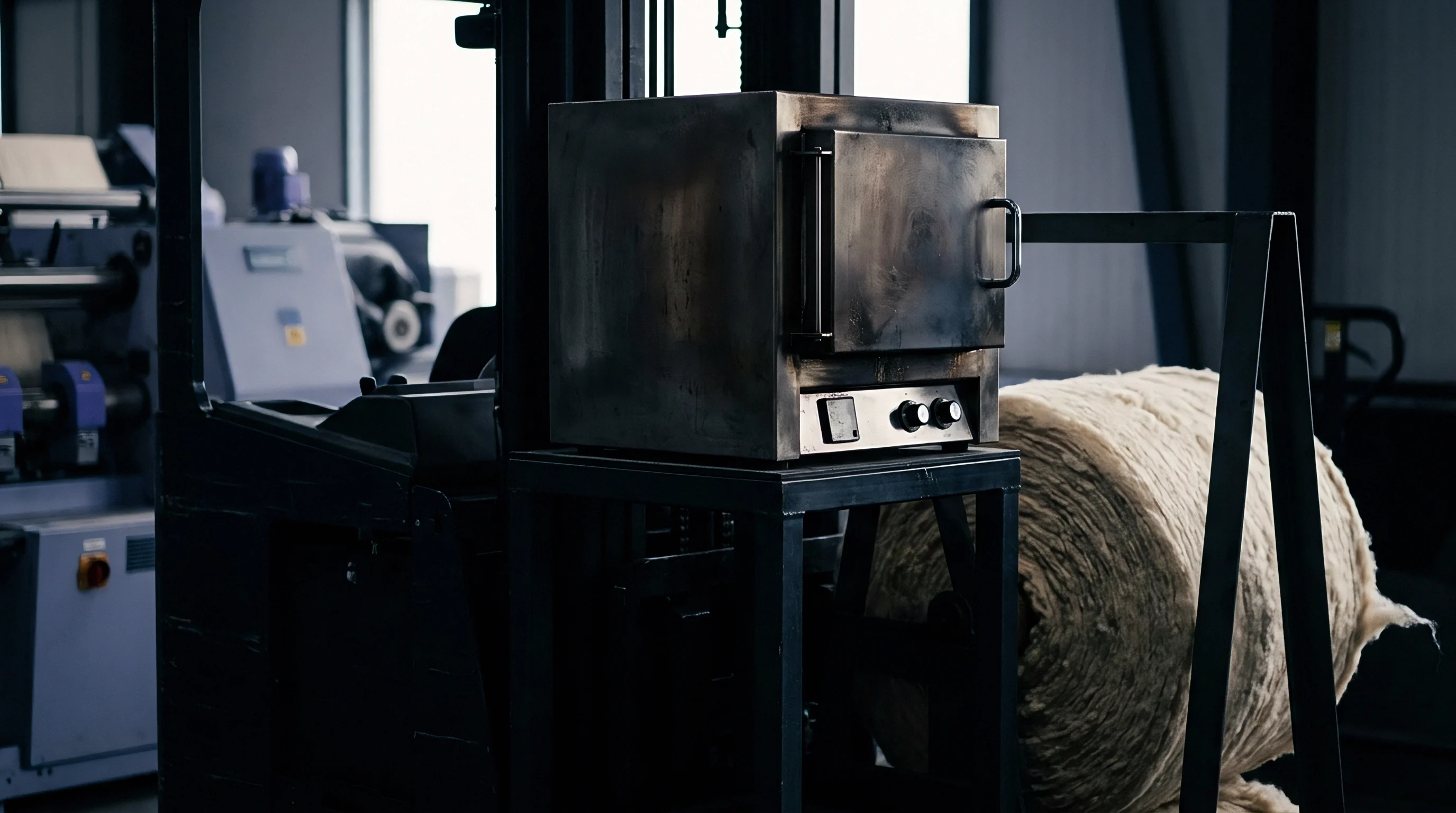
Determining the precise dry mass of a fibre sample demands complete extraction of all uncombined water without thermal degradation of the polymer substrate. Thermal desiccation inside specialized ventilated ovens represents the primary empirical method for driving off moisture. Laboratory technicians place sample specimens inside drying chambers maintained at fixed temperatures, exposing the material to dry air currents until continuous mass loss ceases entirely.
Standardized regain allowances prevent prolonged commercial disputes.
Standard protocols specify a drying temperature of 105 degrees Celsius plus or minus 3 degrees for the majority of organic and synthetic fibres. Thermal control remains tight throughout the drying cycle. Exceeding 108 degrees Celsius induces thermal oxidation in wool and sensitive cellulosic structures, causing yellowing and artificial mass loss through chemical decomposition.
Operating below 102 degrees Celsius fails to drive out bound water molecules held within crystalline and amorphous polymer zones, yielding an artificially elevated dry mass reading.
Thermal Extraction Dynamics inside Forced Draft Ovens
Modern drying systems employ forced-draft air circulation to maintain uniform thermal distribution across all sample baskets. Air passes through heating elements before circulating through the open-mesh stainless steel container holding the fibre specimen. Exhaust vents continuously discharge moisture-laden air to prevent relative humidity from building up inside the drying chamber.
Thermal drying removes volatile moisture without breaking down the fibre structure.
Technicians measure mass reduction progressively throughout the drying cycle. The specimen reaches constant mass when successive weighings at fifteen-minute intervals show a variation of less than 0.05 percent of the total sample weight. Standard testing instruments feature internal balance systems that weigh the specimen directly inside the heated chamber.
Weighing hot specimens inside the drying chamber prevents ambient moisture reabsorption, which begins within seconds when hot dry fibre meets room air.
The measured oven-dry weight of a wool sample drops by 0.18 percent if weighed inside an unheated balance enclosure three minutes after removal from the desiccating oven.
Determining oven-dry mass under ISO 6741 conditions follows a standard laboratory sequence.
- Draw representative sample tufts from at least ten distinct locations throughout the sampled bale lot to aggregate a total working specimen mass of 100 grams.
- Record the initial mass of the specimen immediately upon extraction using an analytical balance accurate to 0.001 grams.
- Place the uncompressed specimen inside a clean, pre-weighed stainless steel wire basket inside the ventilated oven set to 105 degrees Celsius.
- Activate the continuous forced-draft air circulation system to maintain high convective heat transfer across all internal fibre surfaces.
- Perform the initial specimen weight reading after 60 minutes of uninterrupted heating within the closed oven environment.
- Re-weigh the specimen at 15-minute intervals until two consecutive balance readings yield a mass difference below 0.05 percent.
- Record the final stabilized reading as the raw oven-dry mass of the specimen.
Handling Residual Oil Extraction and Scouring Corrections
Raw fibres contain non-polymeric impurities that alter thermal drying behavior and balance accuracy. Raw cotton carries natural waxes, pectins, and field trash. Wool clips carry lanolin grease and suint salts.
Synthetic staple fibres receive surface spin finishes containing anti-static agents and lubricants designed to facilitate high-speed carding and drawing.
Solvent extraction removes non-fibrous oil and wax residues.
Quantifying true clean dry fibre weight requires removing these non-fibrous impurities prior to or in conjunction with moisture desiccation. Standard laboratory protocols apply Soxhlet solvent extraction procedures using petroleum ether or dichloromethane to dissolve fat, wax, and oil residues. The specimen undergoes at least twenty extraction cycles inside the Soxhlet apparatus before moving to the drying oven.
Failure to extract spin finishes prior to high-temperature drying causes volatile finish components to evaporate alongside water, falsely inflating the recorded moisture loss and corrupting the dry mass baseline.
| Fibre Material | Maximum Safe Drying Temp (°C) | Standard Solvent for Extraction | Typical Non-Fibrous Residue Weight (%) |
|---|---|---|---|
| Raw Scoured Wool | 105 ± 3 | Dichloromethane | 0.50 to 1.50 |
| Raw Greige Cotton | 105 ± 3 | Petroleum Ether | 0.60 to 1.20 |
| Viscose Filament / Staple | 105 ± 3 | Deionized Water Wash | 0.30 to 0.80 |
| Polyester Staple (Finished) | 110 ± 3 | Petroleum Ether | 0.15 to 0.40 |
| Polyamide 6.6 Yarn | 105 ± 3 | Petroleum Ether | 0.40 to 0.90 |
Spinning lubricants can evaporate inside the test chamber during high-temperature drying on synthetic fibre deliveries, resulting in an inaccurate clean dry mass measurement.

Correction
Chemical quantitative analysis of fibre blends introduces further layers of calculation to establish true dry components. When a yarn consists of two or more intimate fibre components, such as a polyester and cotton blend, laboratory technicians dissolve one component using selective chemical reagents while leaving the partner fibre intact. The dry mass of the insoluble residue must undergo mathematical adjustment to account for minor structural mass loss during chemical immersion.
Dry mass serves as the only stable baseline for financial trade settlement.
Standard test method ISO 1833 defines chemical separation protocols for binary and ternary blends. Selective solvents include 75 percent sulfuric acid to dissolve cellulosic fibres out of polyester blends, cold acetone to remove acetate from triacetate or wool blends, and 80 percent formic acid to dissolve polyamide out of wool or cellulosic matrices. Each chemical treatment dissolves a tiny fraction of the insoluble target fibre.
Reagent correction factors, expressed as dry weight correction values designated as d, modify the raw dry residue weight back to its original pre-analysis clean dry value.
Do Solvent Extracts Alter Invoiced Fibre Weights?
Processing oils and surface waxes dissolved during chemical extraction subtract directly from the initial dry mass of the sample specimen. If an analyst fails to account for solvent-extractable non-fibrous matter, the calculated dry percentages of both the soluble and insoluble fibre components will drift off target. The loss of non-fibrous matter must be proportionally distributed or isolated before applying standard regain figures.
Bales absorb or release ambient moisture depending on local storage conditions.
The solvent extract percentage is determined by evaporating the solvent solution in a tared glass dish and weighing the non-volatile residue. In commercial transactions, contracts specify whether solvent extractable matter falls within the official commercial allowance or counts as a deficit against pure fibre mass. For example, if a cotton yarn batch yields 1.2 percent solvent extractable wax and oil, and the contract specifies an official allowance of 8.5 percent covering moisture alone, the billable commercial mass accounts for the clean dry fibre mass separately from the extractable residue.
According to ISO 1833-1, chemical quantitative separation results are invalid unless the insoluble dry residue mass is multiplied by the designated correction factor d to compensate for solubility loss during reagent immersion.
Evaluating multi-component raw materials requires systematic verification during quantitative testing.
- Pre-scour Validation confirms complete removal of water-soluble sizes, lubricants, and knitting oils before applying selective chemical solvents to the blend sample.
- Temperature Maintenance verifies that chemical dissolution reagents remain within specified temperature windows to prevent aggressive degradation of insoluble fibre residues.
- Glass Crucible Calibration establishes the tare weight of fritted glass filtering crucibles after drying at 105 degrees Celsius for two full hours.
- Correction Factor Selection applies precise solubility adjustment factors corresponding to the exact reagent concentration and immersion duration documented in standard lab procedures.
- Regain Allocation Check assigns standard commercial moisture regain figures strictly to the isolated dry mass of each individual blend component.

Quantitative Binary Separation Adjustment Factors
Testing a binary blend of polyester and viscose staple fibre with a 75 percent sulfuric acid solution dissolves the viscose component. Sulfuric acid under controlled contact time dissolves 100 percent of the viscose while attacking the polyester surface very slightly. Standard ISO 1833 specifications establish a correction factor d of 1.01 for polyester exposed to 75 percent sulfuric acid under standard test duration.
Commercial contracts specify standard regain rates for each individual fibre type.
If the insoluble dry polyester residue weighs exactly 6.500 grams after washing, neutralizing, and drying to constant mass, multiplying by the correction factor d of 1.01 yields an adjusted clean dry polyester mass of 6.565 grams. Omission of this correction factor understates the dry polyester content by 0.065 grams per sample, which translates to a 0.65 percent error on a 10-gram working sample. In a 50-ton bulk yarn order, an uncorrected 0.65 percent error misallocates hundreds of kilograms of premium synthetic fibre across the final commercial invoice.
When calculating commercial mass for binary blends, the dry mass of each separated component receives its own specific regain factor. Polyester dry mass is multiplied by 1.015, while the dissolved viscose dry mass is multiplied by 1.130. Summing the resulting individual commercial masses produces the total billable commercial weight of the blended lot.
Ignoring reagent correction factors in chemical composition testing quietly transfers hundreds of billable kilograms from seller to buyer across every high-volume blend order.

Computation
Execution of commercial weight reconciliation relies on structured arithmetic that progresses from gross balance readings to final financial invoices. Every step in the calculation sequence must preserve sample proportions and apply appropriate standard corrections. Mathematical roundings performed prematurely during multi-stage calculations introduce cumulative errors that distort final invoice balances.
Scale weight records raw gross mass before moisture correction.
Calculating commercial mass begins by determining the clean dry mass of the entire consignment based on sample core testing. Laboratory core sampling draws representative specimens across randomly selected bales according to statistical rules defined in ASTM D1445 or ISO 2859-1. The ratio of total dry mass plus commercial additions to the raw sampled mass establishes the lot commercial factor.
Applying this factor to the total net weight of the consignment produces the final billable mass.
Single Lot Commercial Weight Calculations
In a commercial shipment of 100 bales of carded cotton yarn, the gross weight recorded at the receiving dock scale equals 22,450 kilograms. Tare weight for bale wrapping, steel strapping, and wooden pallets equals 450 kilograms, yielding a net received mass of 22,000 kilograms. Core samples drawn from twenty bales yield an initial aggregate sample mass of 1,000.0 grams.
After complete oven drying at 105 degrees Celsius without solvent extraction, the dried sample weighs 915.0 grams.
Customs duties and import tariffs are calculated on standard commercial weight.
The moisture content of the sample equals 85.0 grams, representing an actual moisture content of 8.50 percent based on initial weight, or a moisture regain of 9.29 percent based on dry weight. The official commercial moisture regain for carded cotton yarn equals 8.50 percent. The clean oven-dry mass of the entire 22,000 kilogram net shipment equals 22,000 multiplied by 915.0 divided by 1000.0, which yields 20,130 kilograms of bone-dry cotton fibre.
Applying the standard commercial regain of 8.50 percent to the dry mass establishes the official commercial mass. The calculation multiplies 20,130 kilograms by 1.085, resulting in a commercial mass of 21,841.05 kilograms. Although the physical scale recorded a net weight of 22,000 kilograms because the yarn contained excess ambient moisture absorbed during transport, the seller can only invoice the buyer for 21,841.05 kilograms.
The buyer receives a billing adjustment deducting 158.95 kilograms of excess water weight.
Commercial mass calculations for blended yarns require applying individual standard regains to the isolated dry mass of each component fibre rather than applying a single weighted average regain to the raw initial weight.
Multi Blend Invoice Reconciliation for Blended Yarns
Calculating commercial mass for multi-fibre blends involves combined quantitative analysis and regain allocation. Consider a yarn shipment declared as 65 percent polyester and 35 percent combed cotton, with a delivered net physical mass of 15,000 kilograms. Sampling and testing yield the multi-stage dataset detailed in the following breakdown.
| Parameter / Calculation Step | Polyester Component | Cotton Component | Combined Total Lot |
|---|---|---|---|
| Initial Lab Sample Mass (g) | — | — | 1,000.00 |
| Oven-Dry Sample Mass (g) | — | — | 930.00 |
| Clean Dry Component Mass after Separation (g) | 602.50 | 327.50 | 930.00 |
| Dry Mass Share (%) | 64.785 | 35.215 | 100.000 |
| Total Shipment Bone-Dry Mass (kg) | 9,641.77 | 5,308.23 | 14,950.00 |
| Official Commercial Regain (%) | 1.50 | 8.50 | — |
| Calculated Commercial Mass (kg) | 9,786.40 | 5,759.43 | 15,545.83 |
| Commercial mass calculated via component dry mass aggregation: (9,641.77 × 1.015) + (5,308.23 × 1.085) = 15,545.83 kg. | |||
The calculation reveals significant commercial consequences. The raw initial sample contained 7.00 percent moisture. Dry separation analysis showed that the true dry mass ratio was 64.785 percent polyester and 35.215 percent cotton.
Applying the respective standard regain factors of 1.50 percent for polyester and 8.50 percent for cotton to their respective total dry masses yields a combined commercial mass of 15,545.83 kilograms. In this case, because the delivered lot was drier than standard allowance baseline, the final commercial billable mass exceeds the physical net scale weight by 545.83 kilograms.
Calculation errors occur regularly in commercial invoicing, often stemming from specific technical oversights.
- Unweighted Blend Regain Assumptions occur when accounts apply a simple weighted regain average directly to total wet net weight without separating bone-dry mass values first.
- Tare Mass Under-Reporting happens when standardized pallet weights are subtracted without verifying physical moisture retention within wooden packing materials.
- Non-Fibrous Solvent Extraction Omission leads to treating spinning oil weights as dry fibre mass, inflating synthetic component percentages artificially.
- Premature Rounding Truncation introduces weight drift when intermediate component percentages are rounded to single decimal places prior to mass multiplication.
- Ambient Equilibrium Neglect causes false claims when scale checks take place days after opening moisture-barrier bale wrapping in high-humidity facilities.
Applying ISO 6741 drying procedures and isolating solvent extractable content from pure dry fibre mass resolves weight discrepancies on high-viscose shipments.

Arbitration
Commercial disagreements over shipment weights arise when destination dock scale readings conflict with origin shipping documentation. Ocean transport inside sealed freight containers subjects textile goods to solar heating and moisture migration. Water evaporates from top-tier packages and condenses on container ceilings, dropping back onto outer packaging materials.
These localized moisture shifts alter scale weights dramatically without changing the clean dry fibre content inside the bales.
Weight shifts during ocean transit occur routinely across international shipping routes.
Resolving weight disputes requires immediate joint sampling and re-testing under standardized arbitration protocols. Contracts incorporating IWTO or BISFA trading rules specify that an accredited independent testing laboratory must draw fresh core samples within fourteen days of container discharge. The arbitration laboratory performs independent oven-dry desiccation, solvent extraction, and quantitative fibre separation to establish an authoritative commercial mass baseline.
Cross Border Settlement Discrepancy Tolerances
International commercial standards establish tolerance thresholds below which price adjustments are not triggered. Under standard yarn contracts, if the independent arbitration laboratory confirms a commercial mass within 0.50 percent of the seller’s invoice mass, the original invoice stands and the buyer absorbs testing costs. If the discrepancy exceeds 0.50 percent, the invoice is adjusted to match the arbitration certificate exactly, and the seller pays for all re-testing fees.
Laboratories perform chemical extraction tests to verify declared blend purity before approving final payment releases.
Establishing correct commercial mass is equally critical for customs clearance and international trade compliance. Customs authorities classify imported yarn and fabric under Harmonized System tariff codes based on chief weight. Under General Rules for the Interpretation of the Harmonized System, classification of multi-component textiles turns on which fibre predominates by weight.
Customs regulations specify that chief weight determination rests on clean oven-dry mass plus standard commercial regain, exactly matching the commercial mass protocol.

Customs Valuation and Tariff Impact of Moisture Adjustments
Misdeclaring weight on import documentation exposes buyers to legal liabilities including customs penalties, seizure of goods, and retroactively applied duty assessments. If an importer declares cargo weight based on wet scale readings, and a subsequent customs laboratory audit applies oven-dry regain calculations that push a secondary synthetic component over 50 percent total dry mass, the entire shipment reclassifies into a higher duty chapter.
The Harmonized System Section XI Legal Notes require fibre blend predominance to be calculated strictly using clean oven-dry mass plus official commercial moisture regain allowances.
In an imported woven cloth declared as 51 percent cotton and 49 percent polyester by raw weight, if destination laboratory desiccation reveals an actual moisture content of 10.0 percent in the cotton component and 0.5 percent in the polyester component, the dry mass composition changes. The dry mass ratio shifts to 48.6 percent cotton and 51.4 percent polyester. Applying standard commercial regain rates of 8.5 percent for cotton and 1.5 percent for polyester yields a commercial mass proportion of 50.3 percent cotton and 49.7 percent polyester.
The commercial regain calculation preserves the cotton heading classification under Chapter 52, whereas relying solely on raw bone-dry mass would have reclassified the shipment into Chapter 55 as a synthetic fabric, raising the duty rate from 4.2 percent to 12.0 percent.
Auditing commercial weight documentation at each stage of the supply chain protects landed margins against moisture volatility and tariff misclassification risk.
What unstandardized test protocols remain embedded in regional purchasing agreements that continue to expose textile buyers to unrecoverable moisture weight surcharges?