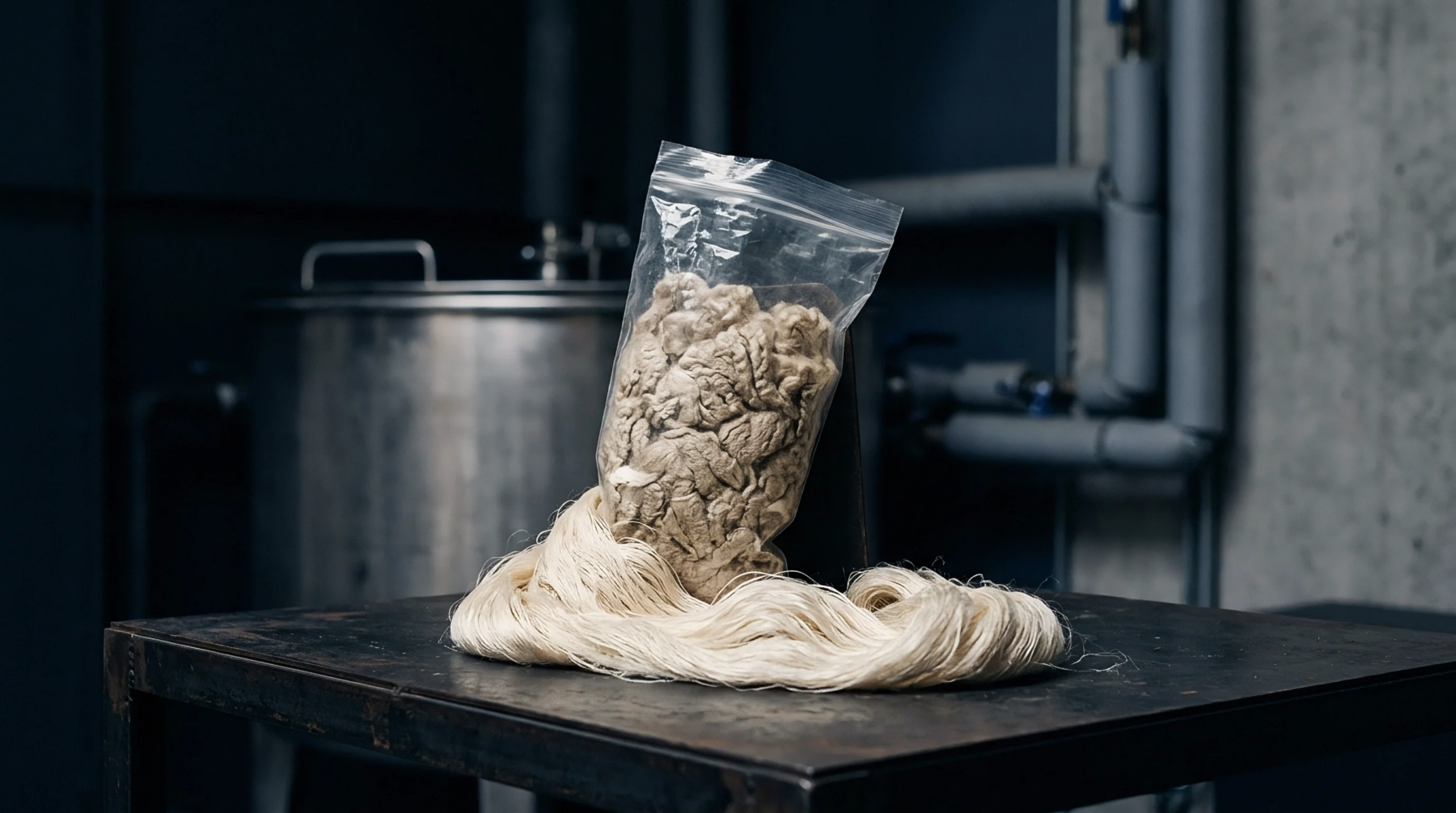
Determining Commercial Mass from Oven Dry Fibre Weights
Commercial mass equals oven-dry mass multiplied by standard regain allowances, establishing an immutable billable weight independent of transit moisture shifts.
Mechanical alignment of short cotton staples creates a linear assembly that retains surface irregularities and protruding ends along the primary strand. Carded cotton yarn remains distinct from combed varieties because the manufacturing sequence excludes the removal of short fibres through sequential metallic teeth. Industrial machinery draws raw fibre through a revolving drum covered in rigid wires to straighten the mass into a sliver.
This preparation phase leaves residual trash particles and nep clusters locked within the structure. Textile mills rely on this specific assembly for heavy fabrics where high uniformity ranks below material cost. Yarn produced via this method shows increased hairiness and a bulkier hand feel that helps trap thermal energy within a finished cloth.
Standard mill throughput increases when operators bypass the final cleaning stage to maintain higher output speeds. Machinery settings determine the final count of the strand by adjusting the draft ratio during the roving process. Raw cotton grades dictate the physical limits of the finished product strength and tenacity.
Spinning frames pull the rovings into a refined diameter that exhibits characteristic variability in mass per unit length. Mechanical friction between the fibres dictates the twist multiplier applied at the ring frame. Factories monitor the break frequency to ensure consistent operation across hundreds of spindles simultaneously.
Low twist applications produce a soft handle whereas high twist increases structural integrity under tension.
Variations in the fibre population lead to local density shifts throughout the length of the strand. Short staples protrude from the central axis to form a fuzzy surface layer that influences friction against loom components. Fabric designers select this output for items requiring opacity and surface coverage because the scattered ends bridge small gaps between yarns.
Heavy denim and corduroy rely on the uneven surface geometry to anchor indigo dyes deep into the fibre structure. Abrasion resistance decreases as the protruding hairs wear away under repeated mechanical stress. Moisture absorption proceeds at a higher rate compared to refined yarns because the porous structure allows liquid to penetrate the interstitial spaces.
Technical labs measure the mass variation coefficient through capacitive sensing during the spinning run. Technicians evaluate the hairiness index by passing the strand through laser beams that count protruding edges per unit length. Tensile testing determines the breaking point of the yarn under controlled humidity conditions.
Analysts look for neps and vegetable matter embedded in the strand to classify the batch according to existing mill standards. Results from these measurements confirm whether the raw material quality meets the intended fabric specification. Uniformity testing confirms that the output stays within the allowed tolerance for the target weave density.
Physical testing of the bulk production provides the empirical basis for settling contract disputes over delivery weight and yarn quality. Consistent performance depends upon the stability of the input fibre source and the precision of the mechanical settings on the carding engine.
Commercial mass equals oven-dry mass multiplied by standard regain allowances, establishing an immutable billable weight independent of transit moisture shifts.
Expertise is a utility, not a secret. sentiention™ publishes its working knowledge as open reference: intelligence layer covering the materials it sources, the markets it enters, and the reference that serves both.