Dynamic Yarn Interlocking Models across High Speed Continuous Wet Finishing and Compressive Shrinkage Ranges
Dynamic yarn interlocking controls dimensional stability by balancing line tension with rubber belt compaction to permanently lock relaxed crimp geometry.


Anchor
Internal shear forces determine yarn relocation when continuous open-width cotton web hits high-speed tension fields. At processing speeds exceeding 80 metres per minute, hydrodynamic shear inside open-width wash boxes forces warp yarns to slide against orthogonal weft contact areas. Greige woven constructions carrying 180 grams per square metre with 44 warp threads per centimetre and 28 weft threads per centimetre register progressive warp extension under liquid turbulence.
The weaving shed fixes interlacing geometry under dry static balance, yet aqueous immersion alters structural equilibrium through cellulose hydration and lateral fibre swelling. As cotton fibres swell up to 14 percent in diameter, yarn transverse cross-sections deform from circular geometries into elliptical profiles, altering the interlacing wave and modifying frictional resistance at every yarn contact zone.
Dynamic yarn interlocking describes the mechanical boundary where structural displacement transitions into irreversible fabric deformation. Warp threads subjected to continuous line tension compress weft floats, causing weft crimp migration and fabric width narrowing before chemical desizing concludes. When bath turbulence and roll deflection apply longitudinal forces without lateral restraint, the weave geometry alters its cover factor before entering the drying units.
Process engineers control this behavior through precise differential drive settings across isolated wash compartments. The balance between processing tension and fibre plasticity governs finished fabric dimensional stability across subsequent finishing steps.
Under ISO 5077 testing after five wash cycles, fabrics processed with warp line tension exceeding 350 Newtons per metre width exhibit residual warp shrinkage exceeding 6.5 percent.
Linear speed differentials across continuous washing ranges generate cumulative longitudinal tension. A typical continuous pre-treatment range spans forty to sixty metres of submerged web travel, incorporating multiple vertical accumulator towers and squeeze nips. The cumulative friction against immersion guide rolls raises web tension progressively across every compartment.
If the tension at the final exit nip reaches 450 Newtons across a 1.8-metre face width, warp yarns lock into elongated paths, displacing weft crimp into extreme amplitudes. This structural displacement freezes into the substrate during continuous cylinder drying, creating an unstable physical state that releases violently during laundering.
Mill technical sheets routinely disguise this structural distortion by quoting thread density and areal weight measured immediately downstream from the continuous drying cylinders. That measurement reflects an artificially stretched state held open by mechanical tension and rapid moisture evaporation. Commercial buyers accepting delivery weights taken at this stage accept goods destined for severe dimensional collapse during garment wet processing.
Specifying fabric weight under conditioned states per ISO 139 guarantees that warp and weft counts reflect structural equilibrium rather than temporary processing elongation.
Swell
Aqueous immersion alters yarn interaction through immediate dimensional expansion of natural cellulose structures. When dry cotton web enters an alkaline scouring bath at 95 degrees Celsius containing 40 grams per litre of sodium hydroxide, fibres absorb liquor rapidly, initiating swelling within 1.2 seconds of fluid contact. Cotton fibre cross-sectional area expands between 20 and 30 percent, while axial length contracts by 1 to 2 percent.
This volumetric change forces neighboring fibres inside ring-spun and open-end yarns into closer physical proximity, increasing internal yarn packing density and restricting lateral yarn compression.
As the yarn diameter increases, the free space at warp and weft intersections drops toward zero. In a standard plain weave with balanced 30 tex yarns in both directions, the theoretical pore space between orthogonal yarns contracts by more than 40 percent during full alkaline saturation. The yarn paths can no longer retain their dry planar positions.
They deform into three-dimensional undulations dictated by Pierce’s rigid yarn geometry model. Increased yarn rigidity amplifies the normal force exerted at intersection contact points, raising the static friction coefficient between crossed yarns from 0.22 in dry conditions to over 0.55 in wet alkaline states.

Fluid Dynamics and Boundary Layer Shear
High-speed movement of swollen textiles through aqueous compartments generates hydraulic drag forces along the boundary layer. Fluid boundary layers develop across both fabric faces as running speed accelerates toward 120 metres per minute. Fluid shears against surface yarn crowns, generating local hydrodynamic pressure gradients that force yarn displacement.
The relative velocity between moving substrate and turbulent liquor displaces loosely bound weft picks, particularly in twill or satin weaves where float lengths span three or more yarn diameters without intersection locking.
Counter-flow liquor circulation, while thermally efficient, magnifies boundary layer shear against fabric surfaces. Wash box nozzles directing liquor counter to web transit apply continuous drag forces across unsupported fabric spans. When the longitudinal hydraulic drag combines with machine drive tension, the resulting axial load exceeds the yarn-on-yarn frictional holding force.
The structural consequence is progressive warp elongation accompanied by severe fabric narrowing, known across dyehouse floors as necking. This dimensional distortion cannot be reversed by subsequent stenter widening without inducing broken filaments or yarn slip faults.

Modelling Interlocking Force Transitions
The mathematical representation of dynamic yarn interlocking in wet environments relies on modified Capstan equations incorporating wet viscoelastic modulus parameters. The frictional force opposing warp yarn translation through a weft crimp wave follows an exponential relationship governed by contact angle and effective friction coefficient:
T_exit = T_entry exp(mu_wet theta)
The term mu_wet represents the dynamic friction coefficient of wet, swollen cellulose in the presence of surfactant chemistry, ranging from 0.35 to 0.62. The wrap angle theta reflects the geometric crimp path around intersecting yarns, varying continuously as fabric moves through tension zones. In wet open-width processing, both mu_wet and theta increase simultaneously, causing interlocking forces to escalate rapidly under modest increases in entry tension.
| Processing State | Fibre Diameter Swelling (Percent) | Effective Friction (mu) | Contact Wrap Angle (Radians) | Interlocking Force Multiplier |
|---|---|---|---|---|
| Dry Loomstate (Greige) | 0.0 | 0.24 | 0.78 | 1.21 |
| Aqueous Desize (60 C, Neutral) | 12.5 | 0.38 | 0.89 | 1.40 |
| Alkaline Scour (95 C, 40 g/L NaOH) | 28.0 | 0.58 | 1.12 | 1.91 |
| Caustic Mercerization (20 C, 220 g/L NaOH) | 46.0 | 0.72 | 1.35 | 2.64 |
| Hot Water Rinse (80 C, Counter-Flow) | 18.0 | 0.42 | 0.98 | 1.51 |
The transition from a low-friction greige state to an immobilised mercerized state occurs across fractions of a second during continuous immersion. When the interlocking force multiplier exceeds 2.0, mechanical tension applied along the warp direction causes immediate pick jamming. Once yarn jamming takes place, the fabric loses structural compliance, transferring processing stress directly to internal fibre chains.
This induces permanent latent strain within cellulose amorphous zones, establishing high residual shrinkage potential.
A wet-processing tension increase of 50 Newtons across a wash range produces greater finished shrinkage than an uncalibrated drying cylinder bank.
Operating a continuous line without tension-controlled drive motors between individual wash boxes guarantees uneven dimensional results from roll to roll. Multi-motor inverter drives equipped with floating dancer rolls or load cells maintain web tension within narrow limits, preventing dynamic interlocking forces from locking yarns into distorted geometries. Processing lines lacking active load-cell feedback routinely experience longitudinal stretch rates of 4 to 8 percent during scouring alone, consuming the natural elasticity of the yarn and destroying garment wash stability.
Fabric structures with low thread densities exhibit the highest vulnerability to hydrodynamic yarn displacement. An open plain weave with 20 warp ends and 16 weft picks per centimetre allows liquor to pass through open pores, yet lacks sufficient yarn contact points to prevent yarn displacement under high-speed fluid turbulence. In contrast, high-density poplin weaves with 52 ends and 30 picks per centimetre suppress liquor flow through the cross-section, generating higher surface boundary shear that demands tighter tension regulation across every wet processing compartment.

Draft
Machine speed variations across continuous wet ranges govern the accumulation of draft between processing units. In continuous operations, small percentage speed differences between consecutive driven nips compound along the processing route. A 0.5 percent positive draft between six consecutive wash boxes results in a cumulative machine draft exceeding 3.0 percent.
This mechanical extension pulls warp yarns flat, forcing weft picks to buckle into severe sinusoidal crimp configurations that resist lateral recovery.
Draft-induced crimp interchange represents a fundamental mechanism of fabric distortion. Under dry conditions, yarns resist crimp modification due to natural bending rigidity. In wet finishing baths, hot water and surfactants plasticize cellulose fibres, lowering their flexural rigidity by up to 60 percent.
The reduced bending resistance permits applied longitudinal tension to draw crimp out of warp threads, shifting structural undulation into weft yarns. The finished result is a fabric with extended warp paths and highly crimped weft paths, setting up extreme dimensional instability along both axes.
Mechanical Sources of Uncontrolled Strain
Web handling through vertical serpentine roll configurations introduces cyclic tension spikes at every roller pass. As fabric wraps around driven and idler rolls, speed differences generate frictional drag along the inner fabric surface. The force required to rotate idler rolls mounted on worn mechanical bearings adds substantial tensile strain directly into the wet web.
Over a vertical wash box containing twenty top and bottom rolls, bearing resistance alone can add 120 Newtons of uncontrolled tension across the running fabric width.
Drying sections compound the problem through moisture removal under continuous web constraint. Cylinder drying ranges run dry cans in driven stacks where surface speed synchronization is critical. When dry can surface speeds exceed wet fabric shrinkage rates, yarns are ironed into an elongated state.
Moisture removal under high warp tension locks the cellulose amorphous domains into frozen strain configurations, preventing natural relaxation until the finished fabric encounters domestic laundering.

Evaluation of Line Speed on Dynamic Interlocking
Running line speed directly determines the time available for structural yarn relaxation during wet processing. At lower running speeds, viscoelastic relaxation within wet cotton yarns partially dissipates applied tensile strains. As line speed increases to commercial production rates between 90 and 140 metres per minute, dwell time within each compartment drops below the relaxation threshold of hydrated cellulose.
- Hydrodynamic drag escalation occurs when process speed rises from 60 to 120 metres per minute, tripling surface shear forces and accelerating pick displacement across unsupported wet fabric spans.
- Shortened dwell time restricts the penetration of wetting and softening agents into dense yarn cores, leaving internal fibres unlubricated and susceptible to stick-slip interlocking failures under tension.
- Nip shock loading subjects wet yarns to rapid compression cycles of less than 15 milliseconds, causing sudden yarn flattening and immediate structural jamming at intersecting contact zones.
- Centrifugal liquor throw-off at guide rollers generates localized tension spikes that pull outer warp margins out of parallel alignment, creating skewed pick profiles.
Processing lines operating without closed-loop speed synchronization inevitably generate wide shrinkage variances between the start and finish of a dye lot. A continuous range starting cold at 40 metres per minute exhibits vastly different dynamic yarn interlocking properties than the same range running steady at 110 metres per minute. Sourcing agreements that fail to define maximum allowable processing tensions across continuous wet ranges leave buyers exposed to dimensional failure across high-volume production orders.
Nip
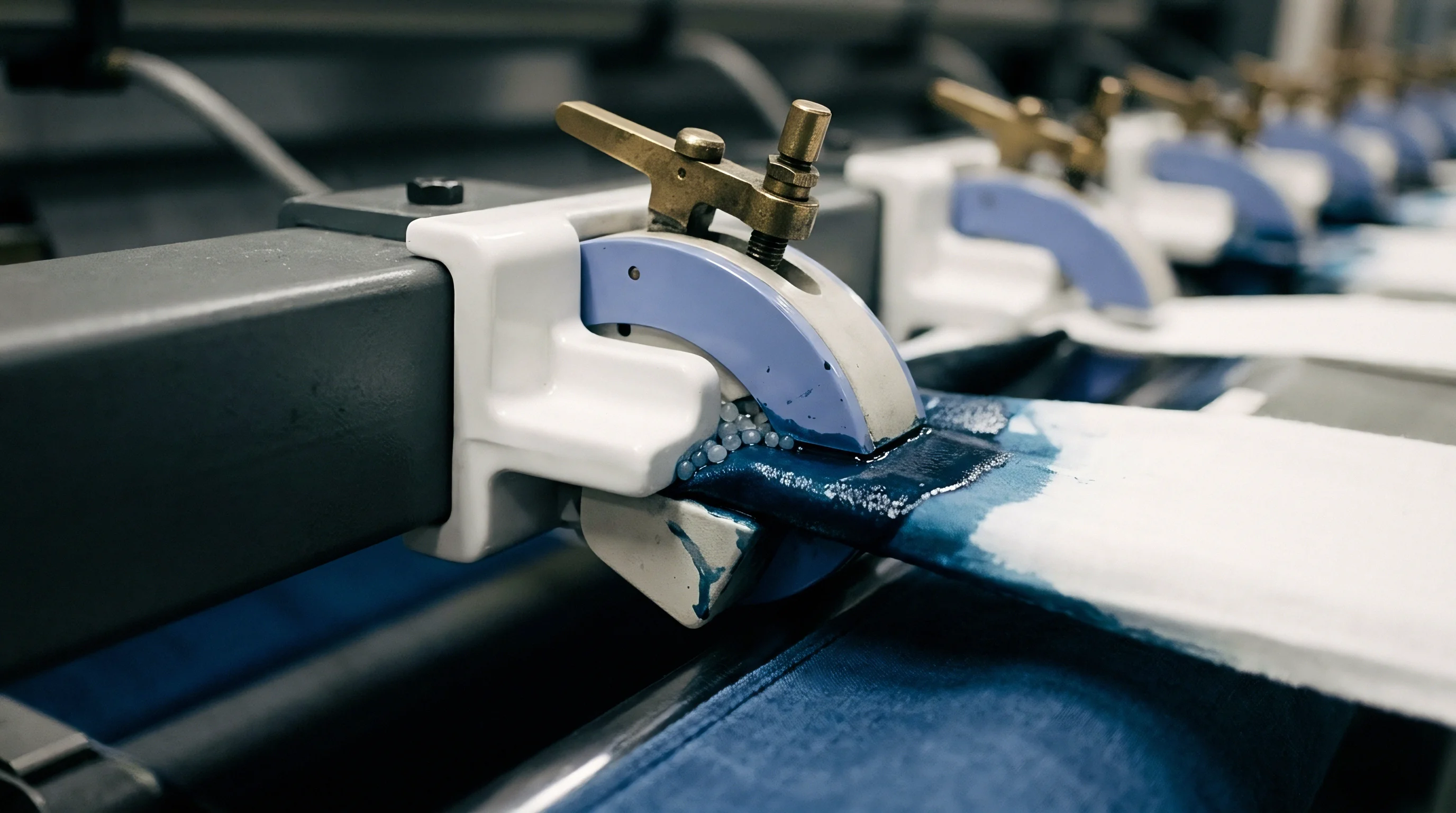
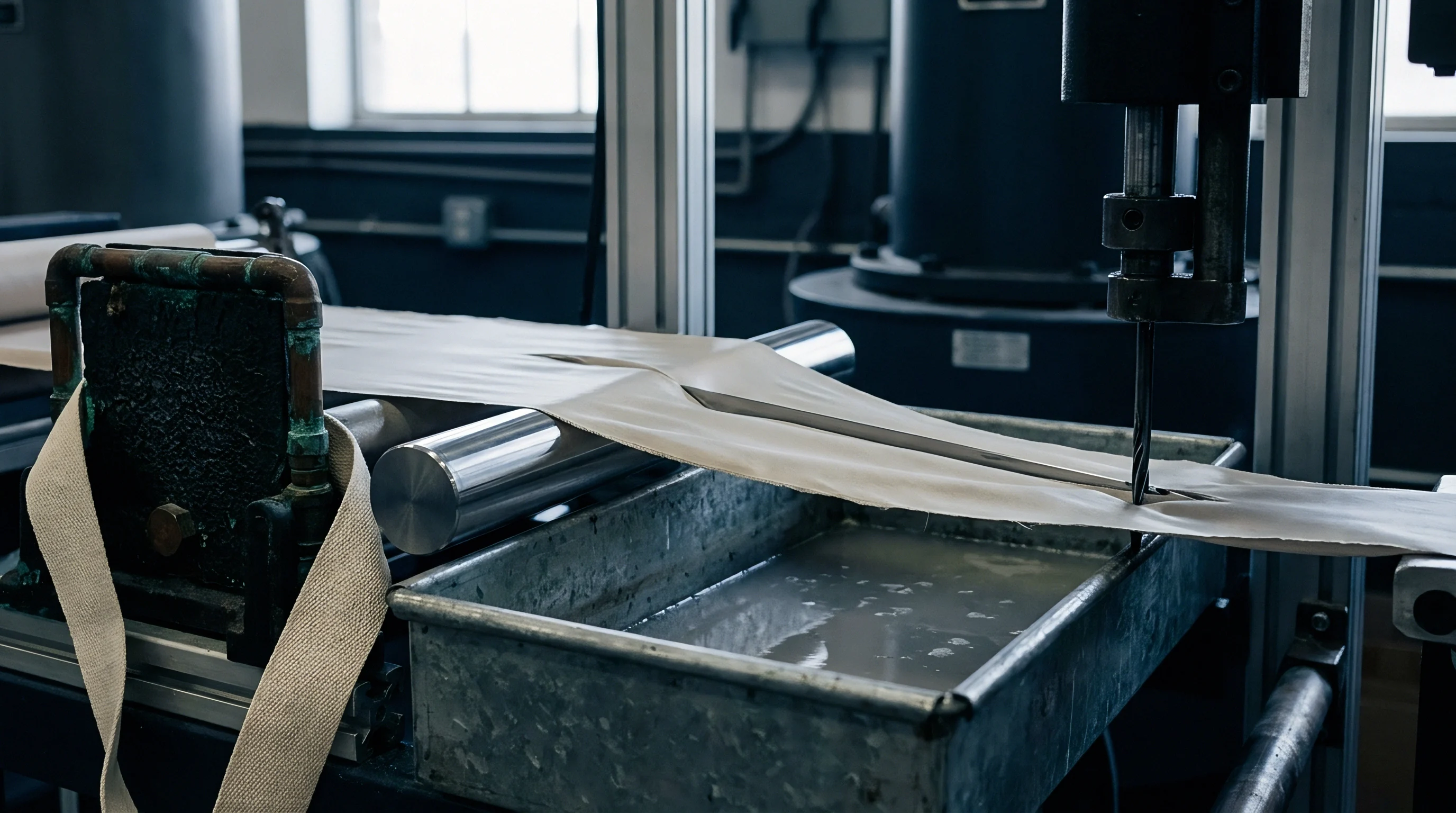
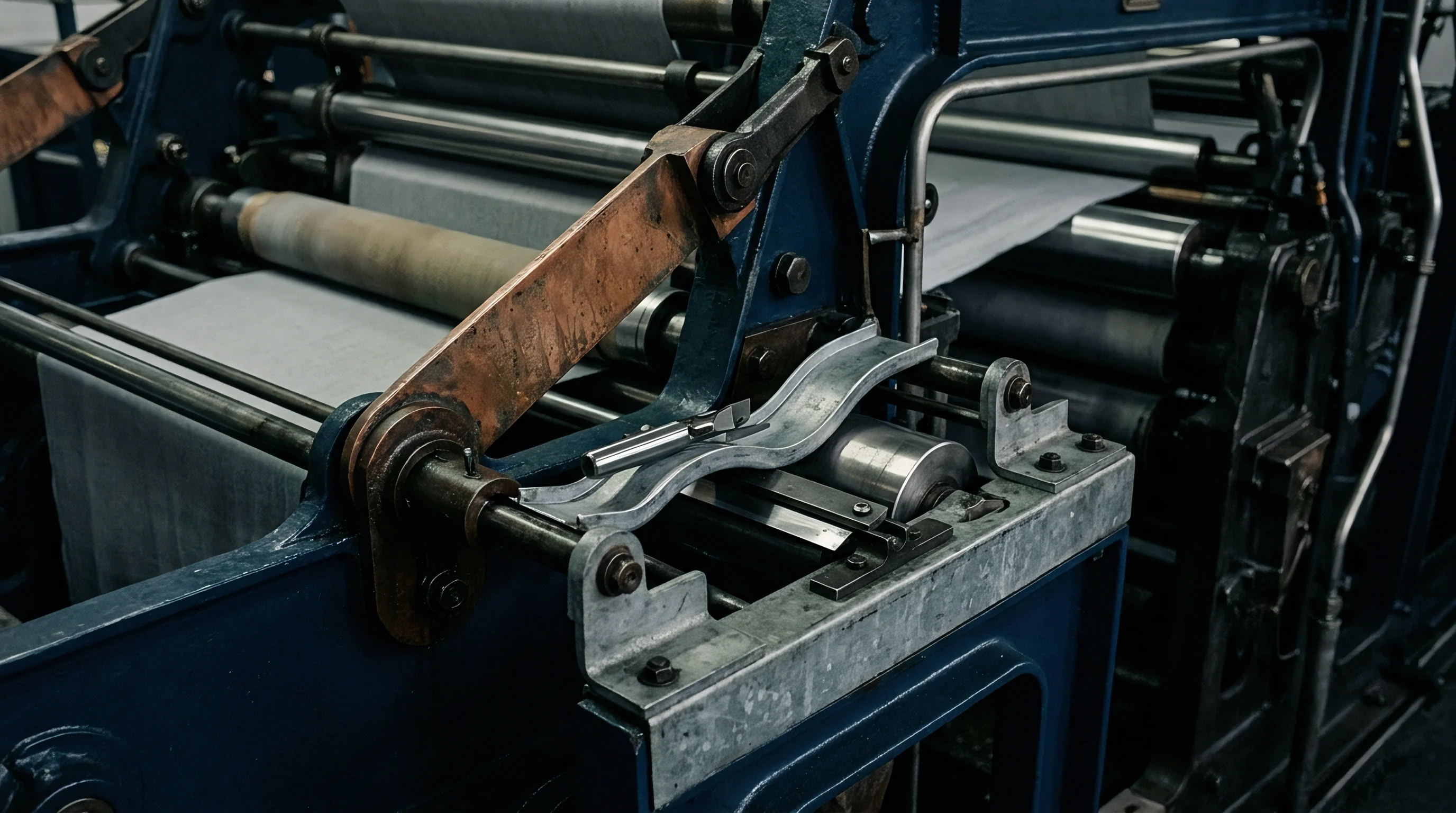
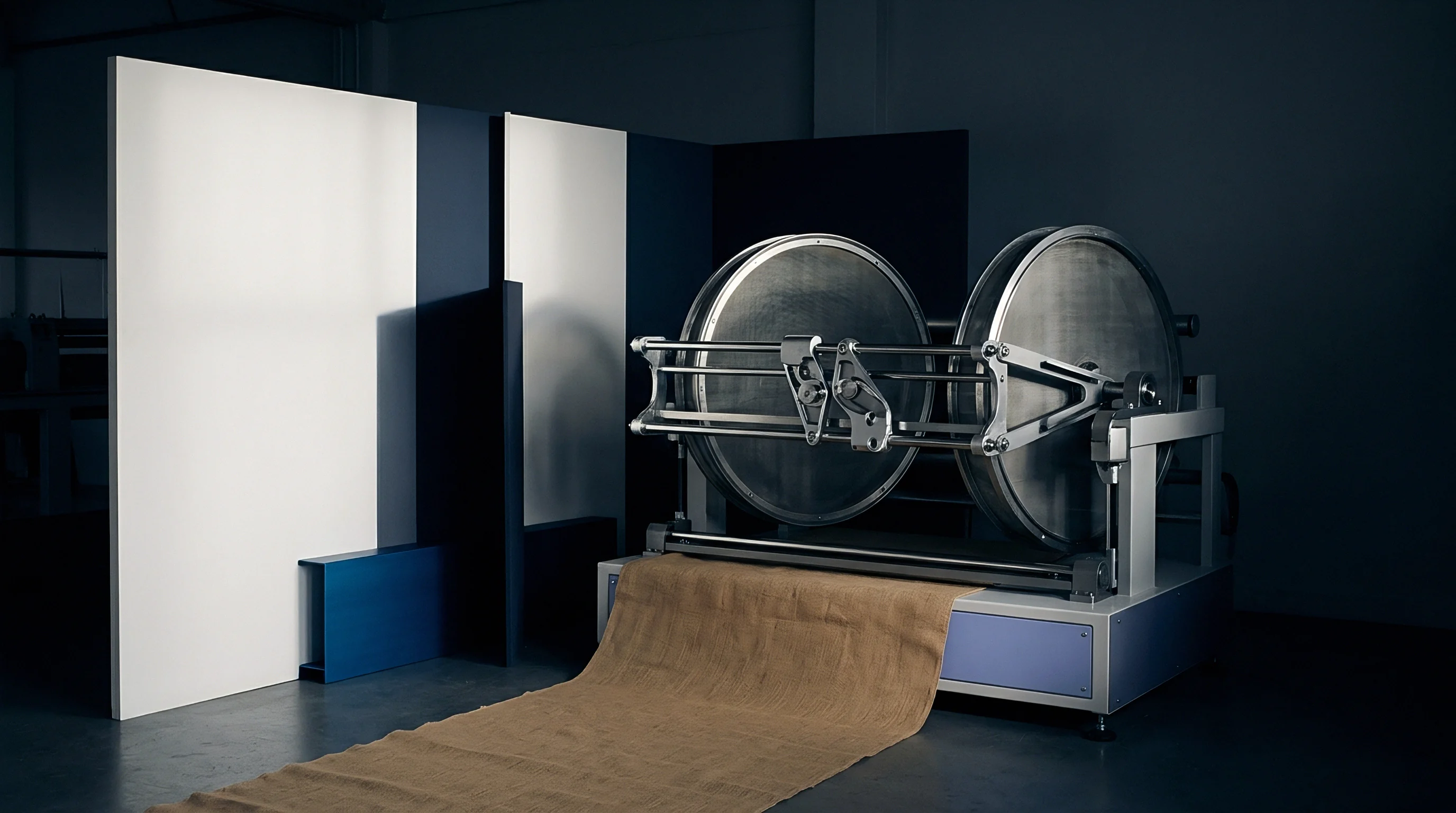
The compressive shrinkage unit relies on mechanical force to reverse longitudinal yarn extension by dynamic pick crowding. Inside the compressive shrinkage machine, fabric enters the compaction zone between a heated chrome cylinder and a thick, continuous rubber belt. The heavy rubber belt, typically 50 to 70 millimetres thick, passes around a small-diameter steel roll, producing severe convex curvature that stretches its outer elastomeric surface.
Fabric contacts this expanded rubber surface immediately prior to reaching the central nip point against the steam-heated drum.
As the rubber belt wraps around the large-diameter heated cylinder, its outer surface reverses from an extended convex state into a compressed concave state. The elastomeric surface contracts instantaneously, carrying the adhering fabric along with it. The compressive force grips the lower yarn crowns, driving warp yarns into a compressed path while crowding adjacent weft picks tightly together.
This mechanical action forces flat, elongated warp yarns to buckle into deep, relaxed crimp waves, restoring structural equilibrium lost during continuous wet processing.
What Governs Mechanical Belt Compaction?
Compaction efficiency depends on the precise regulation of three operational variables: rubber belt durometer hardness, radial pressure at the main pressure roll, and moisture content of incoming goods. Rubber belts vulcanized to a Shore A hardness of 38 to 42 offer the optimum balance between surface friction and elastic recovery under standard processing loads. Softer belts deform excessively, leading to irregular compaction across the width, while harder belts fail to achieve sufficient surface contraction to drive heavy twill or denim weaves into balanced crimp states.
Radial squeeze pressure exerted by the main pressure roll forces the wet fabric into direct mechanical engagement with the contracting rubber surface. Squeeze pressures typically range from 0.35 to 0.65 MegaPascals, depending on fabric weight and density. Insufficient roll pressure permits the fabric to slip relative to the contracting rubber surface, resulting in partial compaction and surface creasing.
Excessive roll pressure crushes yarn crowns, reducing tear strength and generating localized yarn glazed marks that alter surface appearance and cause shade drift.
Compressive shrinkage units fail to stabilize goods if incoming fabric moisture falls outside the narrow processing window of 12 to 16 percent.
Moisture delivery prior to the rubber belt governs the plastic deformation capability of the cellulose fibres. Steam damping units must distribute fine water vapor uniformly across the web cross-section without creating surface wet spots. When fabric enters the compressive zone containing less than 10 percent moisture, cellulose fibres remain in a rigid, brittle state, resisting crimp deformation and suffering mechanical micro-fractures under belt shear.
Conversely, moisture levels exceeding 18 percent turn the fabric into a slippery barrier, reducing surface friction against the rubber belt and causing erratic shrinkage performance.
| Fabric Construction | Areal Weight (g/m2) | Input Moisture (Percent) | Belt Pressure (MPa) | Drum Temp (C) | Target Length Compaction (Percent) |
|---|---|---|---|---|---|
| Plain Weave Poplin (60s x 60s) | 115 | 10.0 to 12.0 | 0.30 to 0.40 | 135 to 145 | 3.5 to 5.0 |
| Twill Chino (20s x 16s, 3/1) | 245 | 12.0 to 14.0 | 0.45 to 0.55 | 150 to 160 | 6.0 to 8.5 |
| Heavy Denim (7s x 6s, 3/1 Right-Hand Twill) | 460 | 15.0 to 18.0 | 0.55 to 0.70 | 165 to 175 | 10.0 to 14.5 |
| Canvas Duck (10s/2 x 10s/2, Plain Weave) | 340 | 13.0 to 15.0 | 0.50 to 0.60 | 155 to 165 | 7.0 to 9.5 |
The relationship between drum temperature and machine running speed fixes the moisture flash-off rate during compaction. The steam-heated drum, operating between 140 and 175 degrees Celsius, vaporizes the applied moisture while the fabric remains compressed against its mirror-polished surface. This flash drying fixes the newly formed warp crimp waves into place before the fabric detaches from the rubber belt.
Line speed must balance against drying capacity: running a heavy twill at 75 metres per minute across a 1.5-metre drum yields insufficient heat transfer, leaving residual dampness that permits the compacted yarns to pull straight under exit winder tension.

Skew
Asymmetrical twill structures introduce torque-driven angular distortion during compressive shrinkage. In 3/1 right-hand twills, yarn floating asymmetry produces unbalanced internal shear forces that twist the fabric off orthogonal axes under longitudinal compression. When the contracting rubber belt crowds warp yarns together, the directional diagonal floats slide across weft picks preferentially along the twill line.
This mechanical migration manifests as skew, rotating the weft picks away from a 90-degree alignment with the warp margins.
Differential rubber belt contraction across the face width exacerbates weft distortion. Belt wear occurs primarily across the central processing zone where fabric runs continuously, leaving outer belt edges thicker with higher elastic contraction potential. Fabric running through a worn belt range experiences greater longitudinal compaction at its outer selvedges than along its centreline, causing curved pick lines, commonly designated as bow.
Processing specifications must restrict allowable bow and skew to tight limits, particularly for garments designed with long, straight seam profiles.
Mechanics of Pre-Skew Application
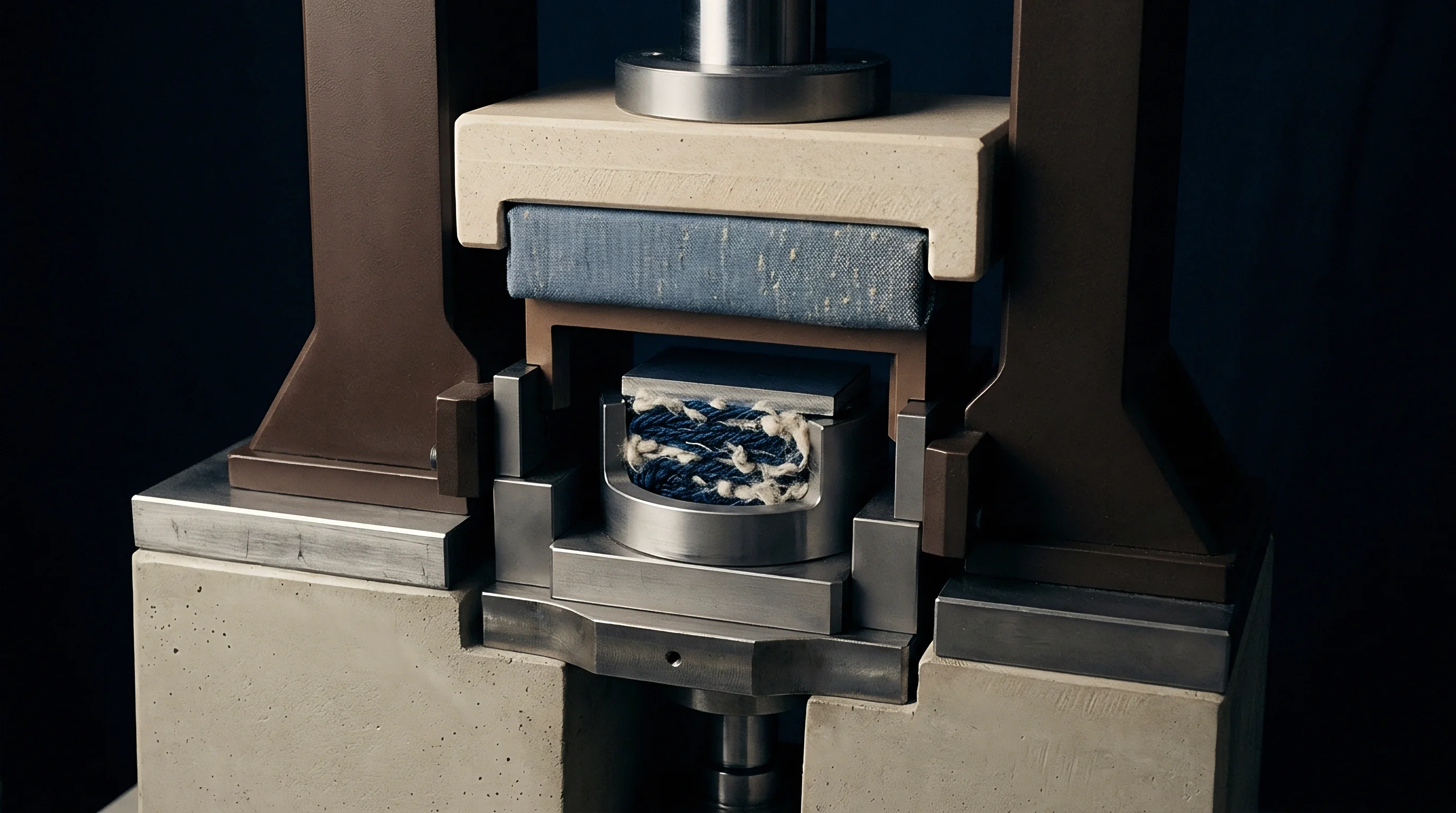
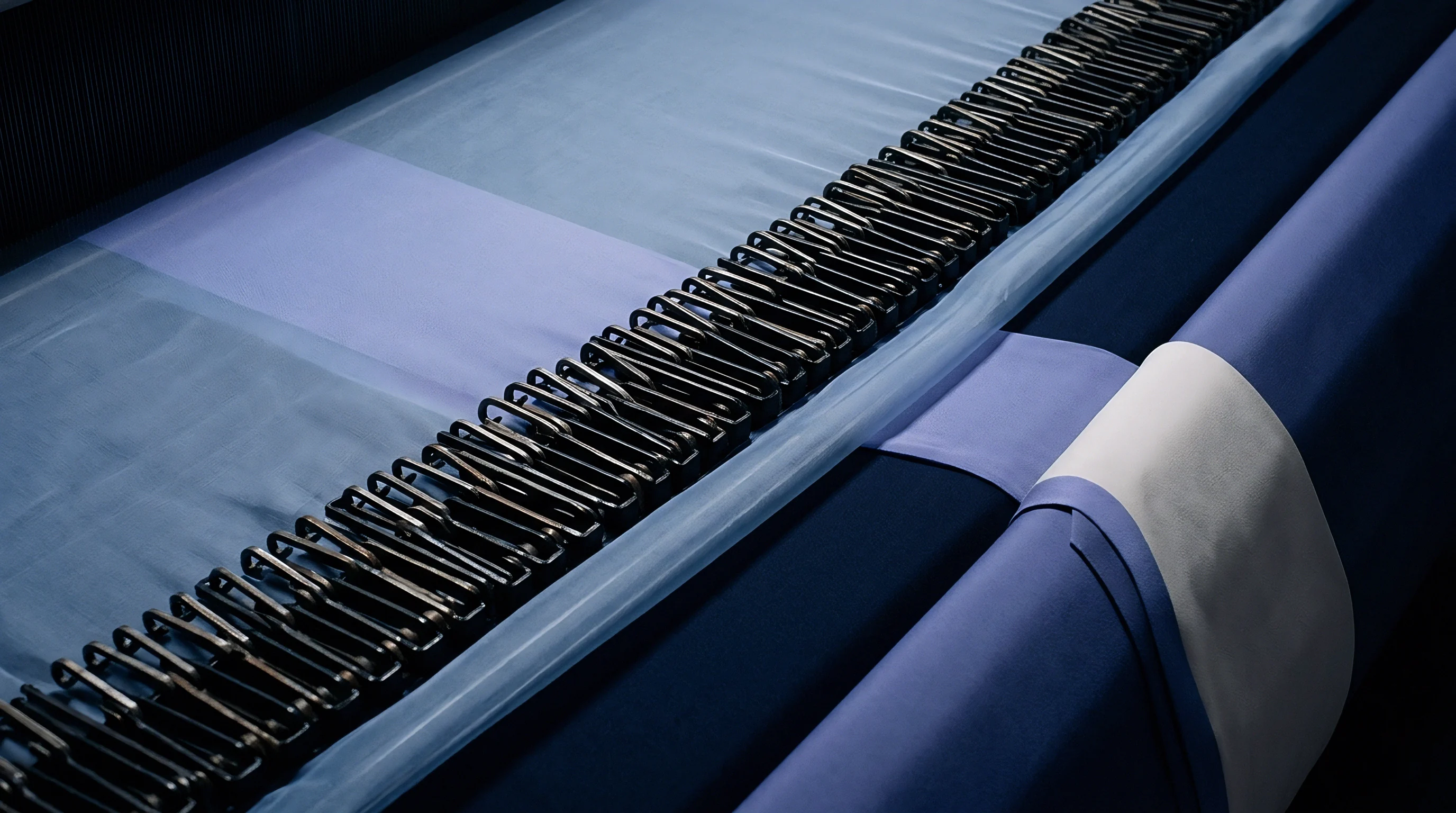
Correcting torque-induced pick angularity demands deliberate mechanical pre-skewing prior to compressive finishing. Pre-skewing units tilt running guide rolls to introduce an opposing angular bias into the fabric, deliberately throwing picks out of square in the direction counter to natural twill rotation. Differential tentering ranges with independent left and right chain motor drives provide precise control over pre-skew introduction.
When properly calibrated, the natural twisting action inside the rubber belt unit pulls the pre-skewed picks back into square alignment as longitudinal compaction occurs.
Achieving stable pick alignment across 3/1 denim requires continuous mathematical compensation based on yarn twist direction and weave float distribution. Heavy bottom-weight twills woven with Z-twist ring yarns naturally skew toward the right during laundering. Operators must introduce between 4 and 8 percent left-hand pre-skew on the finishing line to yield finished goods that hang plumb on the cutting table.
Sourcing teams reviewing pre-production spec sheets verify that target skew angles account for both the mechanical line distortion and the latent rotational energy preserved within the spinning twist of the yarn.
Failure Modes in High-Speed Shrinkage Ranges
Compressive shrinkage operations involve critical mechanical and thermal adjustments where minor operating deviations produce distinct structural defects:
- Yarn slippage and glazing develops when drum surface temperatures exceed 175 degrees Celsius without sufficient incoming moisture, burning chemical sizing residues and flattening warp crowns.
- Corrugation and ripple defects emerge when rubber belt radial pressure drops below critical limits, allowing the web to buckle uncontrollably away from the belt during surface contraction.
- Selvedge puckering results from unmatched tension between the fabric body and dense, tightly woven selvedge constructions, leaving loose fabric pockets alongside tight edges.
- Structural tearing along picks occurs when excessive machine overfeed crowds weft yarns past the maximum geometrical packing limit, fracturing brittle fibres at intersection crowns.
Structural failure during compressive shrinkage cannot be repaired by re-running goods through the range. Once fibres fracture or suffer severe surface glazing under combined pressure and heat, tensile strength drops permanently below performance thresholds. Quality assurance protocols require continuous sampling at the delivery end of the shrinkage range, pulling cut swatches every 1,500 metres to verify that warp tensile loss per ISO 13934 does not exceed 10 percent of greige baseline values.
Drift
Longitudinal stability achieved through compressive shrinkage degrades over extended warehouse storage if internal yarn strains remain unrelaxed. Cellulose behaves as a viscoelastic material possessing both instantaneous elastic memory and long-term mechanical creep properties. High-speed compaction forces yarns into tight crimp configurations through external friction and drying heat, but cannot entirely extinguish the latent molecular stresses introduced across prior continuous wet ranges.
Under ambient humidity fluctuations, moisture re-enters the fibre amorphous matrix, plasticizing cellulose chains and permitting gradual recovery of elongated yarn paths.
This dimensional movement over time, designated as shrinkage drift, undermines garment pattern accuracy and creates fit failures across cutting operations. Fabric rolls certified at 1.5 percent residual shrinkage immediately after compressive finishing can drift to 3.8 percent shrinkage following six weeks of ocean transit in humid shipping containers. The moisture sorption cycles experienced inside container holds act as a slow-motion conditioning chamber, easing the mechanical compaction forced into the web by the rubber belt.
Sourcing teams specifying goods for trans-oceanic shipping establish stability acceptance limits based on conditioned wash testing performed after artificial relaxation treatments.

Worked Calculation of Crimp Interchange and Areal Mass Drift
To evaluate the structural shifts occurring across continuous pre-treatment and final compressive finishing, consider a commercial bottom-weight chino fabric. The production route processes a 20,000-metre dye lot running across an open-width continuous scouring and bleaching line at 95 metres per minute, dried over steam cans, pad-dyed with vat chemistries, and stabilized through a rubber belt compressive shrinkage range. The targeted finished state must achieve dimensional stability within 2.0 percent warp and weft shrinkage per ISO 6330 wash cycle 4N (tumble dry).
The greige specification establishes the baseline parameters:
Greige ends per centimetre: 42.0 Greige picks per centimetre: 24.0 Warp yarn count: 20 tex (ring spun, 100 percent cotton) Weft yarn count: 25 tex (ring spun, 100 percent cotton) Greige fabric weight: 210.0 g/m2 (ISO 3801 conditioned) Greige warp crimp ratio: 8.5 percent Greige weft crimp ratio: 5.2 percent
During continuous wet processing, excessive longitudinal machine draft extends the running fabric web, producing structural changes measured at the exit of the cylinder drying range prior to finishing:
Warp draft extension: +4.0 percent (warp elongation) Weft width contraction: -5.5 percent (width loss due to Poisson contraction and crimp transfer) Intermediate warp crimp ratio: drops from 8.5 percent to 3.8 percent Intermediate weft crimp ratio: rises from 5.2 percent to 11.4 percent Intermediate thread counts: 40.4 ends/cm, 25.4 picks/cm Intermediate fabric weight: 198.5 g/m2
The compressive shrinkage unit must reverse this longitudinal extension. To deliver a finished fabric capable of passing retail testing, the operator adjusts the rubber belt range to compress the warp axis by 7.5 percent, overfeeding goods into the compaction zone. The resulting structural recovery yields:
Finished warp compaction: -7.5 percent (calculated against intermediate dried state) Net warp dimension change: -3.8 percent net relative to greige baseline Finished ends per centimetre: 43.6 ends/cm (ISO 7211-2, tolerance +/- 1.0) Finished picks per centimetre: 27.5 picks/cm (ISO 7211-2, tolerance +/- 1.0) Finished warp crimp ratio: 12.8 percent (ISO 7211-3) Finished weft crimp ratio: 6.1 percent (ISO 7211-3) Finished fabric weight: 224.2 g/m2 (ISO 3801, tolerance +/- 3.0 percent)
Calculated finished weight shifts because crowding 27.5 picks into each longitudinal centimetre concentrates yarn mass per unit area. Sourcing invoices billed on linear metres benefit from lower compaction settings, as overfeeding fabric consumes greige yardage. Compacting a 20,000-metre greige run by 7.5 percent instead of 4.0 percent consumes 700 additional linear metres of production, translating directly into a higher landed cost per finished metre.
Mill managers facing fixed-price linear meter contracts frequently dial down belt compaction, sacrificing garment dimensional stability to maximize invoiced yardage.
| Performance Metric | Correct Compaction (7.5 Percent) | Deficient Compaction (4.0 Percent) | Test Method and Tolerance |
|---|---|---|---|
| Warp Shrinkage (3 Cycles 60 C) | -1.2 percent | -4.8 percent | ISO 5077 / ISO 6330 (+/- 0.5) |
| Weft Shrinkage (3 Cycles 60 C) | -0.8 percent | +1.2 percent (Growth) | ISO 5077 / ISO 6330 (+/- 0.5) |
| Warp Tensile Strength | 680 Newtons | 710 Newtons | ISO 13934-1 (-50 N min) |
| Warp Tear Resistance | 22 Newtons | 26 Newtons | ISO 13937-1 (-2 N min) |
| Areal Density (Conditioned) | 224 g/m2 | 214 g/m2 | ISO 3801 (+/- 5 g/m2) |
| Finished Yield Across Order | 18,500 metres | 19,200 metres | Invoiced Linear Metres |
The table reveals the clear trade-off between delivered yardage and physical fabric performance. Deficient compaction yields 700 additional metres on the shipping invoice, yet leaves residual warp shrinkage at 4.8 percent. For a standard trouser pattern with an 80-centimetre inseam, that residual shrinkage translates to an unwearable loss of 3.8 centimetres in finished length after home laundering.
Buyers auditing incoming inspection records trace this stability failure directly to line speed and belt pressure records held on the dyehouse finishing floor.
Shrinkage variance also introduces skew instability during laundering. When weft crimp remains locked in an unbalanced configuration due to inadequate rubber belt relaxation, subsequent washing cycles release the differential stress unevenly across the garment panels. Side seams on garments cut from under-compacted twill rotate around the leg, resulting in uncorrectable torquing faults.
Sourcing contracts must mandate residual torque limits of less than 2.5 percent per ISO 16322 alongside standard dimensional stability metrics to prevent distorted garments at the retail destination.
The commercial gap between mill claims and physical reality stems from testing methods applied immediately downstream of finishing. A single domestic wash cycle under ISO 6330 frequently fails to release the complete latent strain preserved within tightly compacted cotton structures. True dimensional equilibrium requires three consecutive laundering cycles with intermediate line or tumble drying.
Specifying three-cycle testing within the core purchasing agreement prevents mills from delivering borderline goods stabilized only through superficial calender pressing.
Technical sourcing specifications that tie final commercial payment release to independent verification under ISO 5077 after three consecutive washes shift financial risk back to the converter. When mills know that laboratory technicians evaluate conditioned thread count, crimp ratio, and dimensional movement across multi-cycle protocols, line operators run wet ranges with lower continuous drafts and higher compressive belt pressures. Managing dynamic yarn interlocking requires rigorous verification protocols backed by strict financial remedies written directly into the purchase specification.
This leaves open the operational problem of verifying real-time yarn crimp transfer on continuous ranges running at full speed without relying on post-finishing laboratory wash cycles.