Air Jet Spun Yarn Mechanics in Elastic Woven Fabrics
Air jet core-spun yarns deliver torque-free, pill-resistant elastic wovens by locking polyurethane filaments inside parallel staple cores bound by vortex wrappers.
Torque
Air jet spun yarns utilize a distinct structural architecture comprising an untwisted parallel core bound by helical wrapper fibers. When integrating an elastomeric core such as elastane into air jet spinning, known commercially as air-jet core-spun yarn production, the mechanics of torque generation and tension decay depart substantially from traditional ring-spun core yarns. In a standard ring core yarn, continuous real twist runs through the entire cross-section, imparting radial compressive forces that lock the elastane filament along its length.
Air jet spinning, operated via high-speed vortex nozzles at speeds exceeding 400 metres per minute, introduces false twist inside the nozzle chamber followed by wrapper fiber entrapment at the nozzle exit.
The wrapper fibers constitute approximately 5 percent to 12 percent of the total fiber volume in a typical Murata Vortex Spinning (MVS) cotton-sheath construction. These exterior fibers settle at varying helix angles ranging from 30 degrees to 65 degrees relative to the yarn longitudinal axis. Because the parallel inner staple fibers lack true twist, the radial clamping force on the central polyurethane filament depends entirely on the tensile preload of the wrapper fibers and the drafting ratio applied to the elastomer during yarn consolidation.
A drafting ratio below 2.8 on a 44 dtex elastane core permits filament retraction inside the vortex chamber, generating irregular sheath slubs.
Torque balance in single air jet core yarns remains exceptionally neutral compared to ring-spun counterparts. Ring yarns exhibit residual torque caused by the torsional energy stored in continuous helical twists, causing skewness in woven twills if untreated. Air jet spun yarns demonstrate near-zero residual torque because the internal parallel fibers hold no rotational energy.
The wrapper fibers alternate between left-hand and right-hand wrapping configurations depending on turbulence fluctuations within the swirl chamber, canceling directional torsional moments.
Frictional Gripping along Untwisted Core Bundles
Friction along the boundary between the staple fiber core and the elastomeric filament governs structural integrity under load. When an elastic woven fabric stretches during wear or wet processing, tensile strain transfers from the outer sheath fibers to the inner elastomeric filament through inter-fiber friction. In ring core-spun yarns, the continuous twist maintains normal force across the yarn radius.
In air jet core yarns, the localized normal force exists primarily beneath the tight wraps of outer sheath fibers.
Between these wrapper zones, the staple fibers remain unconstrained and parallel. When tensile elongation surpasses 20 percent in the woven structure, the elastomer stretches within these unconstrained segments without engaging the surrounding staple matrix. This localized elongation discrepancy creates micro-voids along the yarn axis.
If the wrapper density falls below 40 wraps per centimetre on a 20 tex cotton-elastane yarn, the staple fibers shift longitudinally along the slick polyurethane core.
| Yarn Spinning System | Core Fiber Retention Force (cN) | Wrapper Helix Angle (Degrees) | Residual Torque (Turns/Metre) | Tenacity at Break (cN/tex) |
|---|---|---|---|---|
| Vortex Air Jet Core | 142 | 45 to 60 | 12 | 14.8 |
| Ring Core Spun | 210 | 35 to 40 | 78 | 18.2 |
| Rotor Open End Core | 98 | 20 to 35 | 34 | 11.6 |
| Air Jet False Twist Core | 118 | 40 to 55 | 18 | 13.1 |
Fibers with higher surface friction coefficients, such as carded upland cotton or micro-denier viscose, compensate for the absent core twist by increasing frictional contact area per unit length. Processors setting yarn specifications establish sheath-to-core mass ratios between 88:12 and 94:6. Dropping below 88 percent sheath mass exposes the elastomeric filament through gaps in the wrapper envelope during reed beat-up.
Raising sheath mass above 94 percent dilutes fabric elastic recovery, causing permanent set after repeated extension cycles.
A supplier who blames elastane slippage on loom humidity defaults on basic spinning geometry. The fault lies in nozzle orifice wear or inadequate air pressure settings during pneumatic wrapping.

Crimp
Elastic woven fabrics manufactured with air jet core-spun filling yarns exhibit complex crimp interchange dynamics during and immediately following the weaving cycle. Crimp reflects the percentage difference between the straightened length of a yarn and its path length inside the woven interlacing matrix. In standard rigid fabrics, crimp remains governed strictly by thread density, yarn diameter, and weave float length.
In elastic wovens, the internal strain energy of the air jet filling yarn actively alters crimp distribution the instant the fabric clears the loom take-up roll.
On the loom under active warp and weft tension, the elastane core remains elongated. The warp yarns maintain high mechanical tension between 25 cN and 45 cN per end to preserve a clear shed geometry for high-speed projectile or air jet insertion. This high warp tension flattens the warp ends against the filling picks, forcing the filling picks to accept the initial structural crimp while on the loom.
The moment the cloth exits the sand roller and falls slack into the fabric roll, the stored mechanical elastic energy in the filling yarn elastane core initiates rapid contraction.
Warp Sett Resistance and Crimp Interchange
Contraction along the weft direction forces the flexible warp yarns to buckle outward, increasing warp crimp while simultaneously reducing weft path amplitude. The untwisted parallel sheath fibers of the air jet filling yarn compress axially during this contraction phase. Unlike ring yarns that resist axial compression through twist rigidity, the parallel core fibers inside an air jet yarn readily buckle outward within the helical wrapper cages.
This phenomenon increases the effective cross-sectional diameter of the filling yarn by 15 percent to 30 percent in the off-loom relaxed state.
Warp sett acts as a mechanical brake against filling contraction. Dense warp configurations with cover factors exceeding 18 in plain weaves restrict the lateral movement of filling picks. When warp density is excessively high, the contracted air jet filling yarn cannot push adjacent warp ends aside to complete its crimp interchange.
This leaves stored latent strain trapped inside the off-loom cloth, which will release during subsequent wet finishing.
- Off-Loom Crimp Differential measures the contraction variance between warp tension release and weft core retraction before wet relaxation.
- Wrapper Buckling Coefficient quantifies the lateral expansion of parallel core staple fibers when the elastane core snaps back inside the woven intersection points.
- Interlacing Jamming Limit designates the critical pick density where filling yarns fail to contract due to geometric interference from adjacent warp ends.
- Dynamic Cover Factor tracks the progressive increase in optical fabric opacity as axial yarn compression bulks the untwisted sheath fiber core.
The rate of elastic contraction depends directly on the weave pattern float length. Long float architectures such as 3/1 twills and 4/1 satins offer minimal yarn interlacing contact points, permitting unhindered contraction of the air jet core yarn. Plain weaves introduce an interlacing crossover point at every single yarn intersection, maximizing frictional lock and constraining filling contraction to under 12 percent off-loom.
ASTM D3883 confirms that woven elastic fabrics using air jet filling exhibit twenty percent higher filling crimp variance than equivalent ring constructions before scouring.
Yarn cross-sections distort into lenticular shapes under interfacial pressure at warp-weft crossover points. The soft, untwisted core of the air jet yarn flattens more easily than a ring yarn of identical count. This high compressibility yields a smooth, flat fabric face but lowers the shear rigidity of the greige cloth.
The greige fabric shows elevated susceptibility to diagonal distortion during off-loom rolling if winding tension varies across the roll width.
Contract clauses that specify loom-state pick counts instead of finished, conditioned thread densities fail to control final fabric stretch. Fabric buyers write finished specifications based on ISO 7211-2 to eliminate dimensional disputes caused by off-loom crimp interchange variance.

Relaxation
Wet processing transforms the metastable greige elastic woven construction into a dimensionally stable commercial fabric. Greige elastic fabric straight off the loom holds irregular residual tensions across its width. The primary objective of wet relaxation is to relieve these internal mechanical stresses in an open-width, tensionless aqueous environment, allowing the elastomeric core to fully contract and bulk the surrounding air jet sheath fibers before thermal fixation.
Continuous scouring ranges designed for elastic wovens utilize pre-relaxation tanks operating between 60 degrees Celsius and 80 degrees Celsius with mild non-ionic surfactants. Cold water immersion fails to trigger complete elastane recovery. Immersion above 90 degrees Celsius without controlled overfeed causes sudden, uncontrolled fabric contraction, leading to longitudinal creases and edge curling that become impossible to flatten out in subsequent stenter passes.
Could Heat Setting Lock Structural Crimp Prematurely?
Applying heat setting to under-relaxed fabric permanently freezes structural defects into the polymer matrix of the elastane filament. Elastane cores consist of alternating hard polyurethane segments and soft polyether or polyester segments. Thermal stabilization on a stenter frame at temperatures between 185 degrees Celsius and 195 degrees Celsius breaks and reforms the hydrogen bonds in these hard segments, establishing a new permanent equilibrium length for the core yarn.
| Processing Stage | Operating Temperature (°C) | Overfeed Rate (%) | Dwell Time (Seconds) | Tension Control Parameter |
|---|---|---|---|---|
| Continuous Open-Width Scour | 70 to 80 | +8 to +12 | 45 to 60 | Load Cell Driven: 50 N/m Width |
| Intermediate Tensionless Dry | 110 to 120 | +10 to +15 | 30 to 40 | Air Cushion Conveyor Belt |
| Stenter Thermal Stabilization | 188 to 192 | +12 to +18 | 35 to 45 | Pin Chain Width Reduction: -8% |
| Jet Dyeing Cycle | 95 to 130 | Relaxed Loop | 60 to 90 min | Nozzle Pressure: 0.12 to 0.18 bar |
| Final Equalizing Stenter | 150 to 160 | +5 to +8 | 20 to 25 | Target Width Fixation ±1.0 cm |
Heat-setting temperature dictates the available residual elasticity and recovery force in the finished woven fabric. If the stenter temperature drops below 182 degrees Celsius, the elastane core fails to reset its morphological network, yielding high washing shrinkage during subsequent garment laundering. If the temperature exceeds 198 degrees Celsius, the thermal degradation of polyurethane accelerates, reducing yarn tensile strength and causing core yellowing.
The speed of fabric transport through the stenter chamber must synchronize with fabric thickness and moisture content. A heavy bottom-weight twill of 320 grams per square metre requires a 45-second dwell time at 190 degrees Celsius to ensure the heat penetrates through the bulky air jet sheath to the core. Insufficient dwell time leaves the center of the yarn under-set while the outer sheath fibers dry out, producing differential stretch properties between the fabric face and back.
Overfeed on the stenter pin chains must exceed the calculated filling shrinkage to prevent cross-directional edge tear during heat setting.
Dyeing tension represents another critical variable. Jet dyeing machines running elastic fabrics require low-friction PTFE-lined chambers, gentle hydraulic liquor nozzles, and short fabric rope loops to prevent permanent rope-mark creases. Air jet core yarns, with their lofty and untwisted sheath structure, absorb dye liquor faster than tightly twisted ring yarns.
This open capillary structure improves dye yield by 8 percent to 12 percent but demands precise dosing control to prevent unlevelness at the start of the dyeing cycle.
Uneven tension across the width of a washing machine or stenter generates edge-to-center stretch variance. An operator running excess pull on an extraction mangle creates narrow, non-elastic center zones and wavy selvedges across the bulk roll.
Tension
Weft insertion on high-speed air jet looms presents distinct operational challenges when launching air jet core-spun yarns. Industrial air jet looms insert filling picks at velocities exceeding 35 metres per second, propelled by a main nozzle and sustained across the fabric width by periodic relay nozzles firing compressed air inside a profiled reed tunnel. The unique surface morphology and internal elasticity of air jet core yarns fundamentally alter the aerodynamics of this insertion process.
Because the untwisted sheath fibers are held only by periodic wrapper strands, high-velocity compressed air streams can lift loose surface fiber ends away from the yarn core. This pneumatic surface abrasion increases aerodynamic drag during flight. While high aerodynamic drag helps the yarn tip fly cleanly through the shed, excessive drag strips trailing fibers back along the yarn axis, forming small fiber clusters known as peeling defects or ringers behind the loom main nozzle.

Nozzle Pressure Optimization and Flight Stability
Main nozzle pressure settings for air jet core-spun yarns require lower values than equivalent counts of 100 percent cotton ring yarns. Standard ring yarns of 20 tex typically operate at main nozzle pressures between 0.35 MPa and 0.45 MPa. Air jet core yarns containing an elastane filament operate efficiently within a tighter window between 0.25 MPa and 0.32 MPa.
Excessive nozzle pressure forces compressed air between the wrapper fibers, disrupting the parallel core alignment and partially stripping the sheath off the elastomeric filament.
Relay nozzle firing timing must account for the rapid deceleration profile of elastic yarns. When the filling pick arrives at the right-hand fabric selvedge, the loom mechanical yarn brake clamps the trailing end on the feeder side. The elastomeric core inside an air jet yarn causes an instantaneous elastic recoil.
If the stretch-nozzle at the receiving side fails to catch the yarn tip under steady pneumatic suction at the precise millisecond of insertion completion, the pick recoils inward, creating a loose, snarled weft defect in the right selvedge zone.
- Pre-winder drum tensioners maintain back-tension below 8 cN to avoid elongating the elastane core before nozzle launch.
- Main nozzle acceleration profiles ramp pressure progressively over 12 milliseconds to eliminate shock-induced sheath slip.
- Profiled reed channels direct compressed air strictly parallel to the pick axis without vertical air escape.
- Receiving stretch nozzles apply steady extraction suction at 0.15 MPa to hold the pick fully extended until reed beat-up occurs.
Yarn storage on loom pre-winders also influences insertion performance. Magnetic yarn brakes on the pre-winder drum must apply uniform, low-friction damping. High mechanical braking friction stretches the elastomeric core on the drum surface.
When the pick releases during insertion, this unevenly stretched segment causes unpredictable flight times, triggering optical weft-stop sensor alarms and reducing loom operational efficiency below 85 percent.
Loom shed opening timing must coordinate with weft arrival curves. Early shed closure pinches the elastic filling pick while it remains under high kinetic energy, resulting in stretched picks that contract aggressively off the loom, narrowing the greige reed width. Late shed closure allows the pick to snarl under elastic recoil before the warp ends lock it into the fabric fell.
Standardized specifications establish insertion arrival tolerances within ±15 degrees of main shaft rotation. Wider arrival windows indicate fluctuating yarn friction or variable wrapper fiber density across the yarn supply cones.

Defect
Failure modes in elastic wovens constructed from air jet spun yarns differ fundamentally from standard rigid fabrics or ring-spun elastic textiles. The localized absence of true twist creates structural vulnerabilities that manifest during garment manufacturing, home laundering, and mechanical wear. Sourcing teams and textile engineers evaluate these failure modes to establish clear, enforceable quality control criteria before bulk yardage ships.
The most catastrophic failure mode is core-sheath slippage, often termed yarn strip-back. This occurs when external frictional forces strip the protective staple fiber wrapper away from the central elastane filament. During high-speed commercial sewing, a ball-point or sharp needle penetrates the filling yarn.
If the needle displaces a wrapper fiber, the stretched elastane core snaps back inside the needle hole, leaving a bare, puckered loop on the fabric surface.
Whose Specification Protects against Core Grin Through?
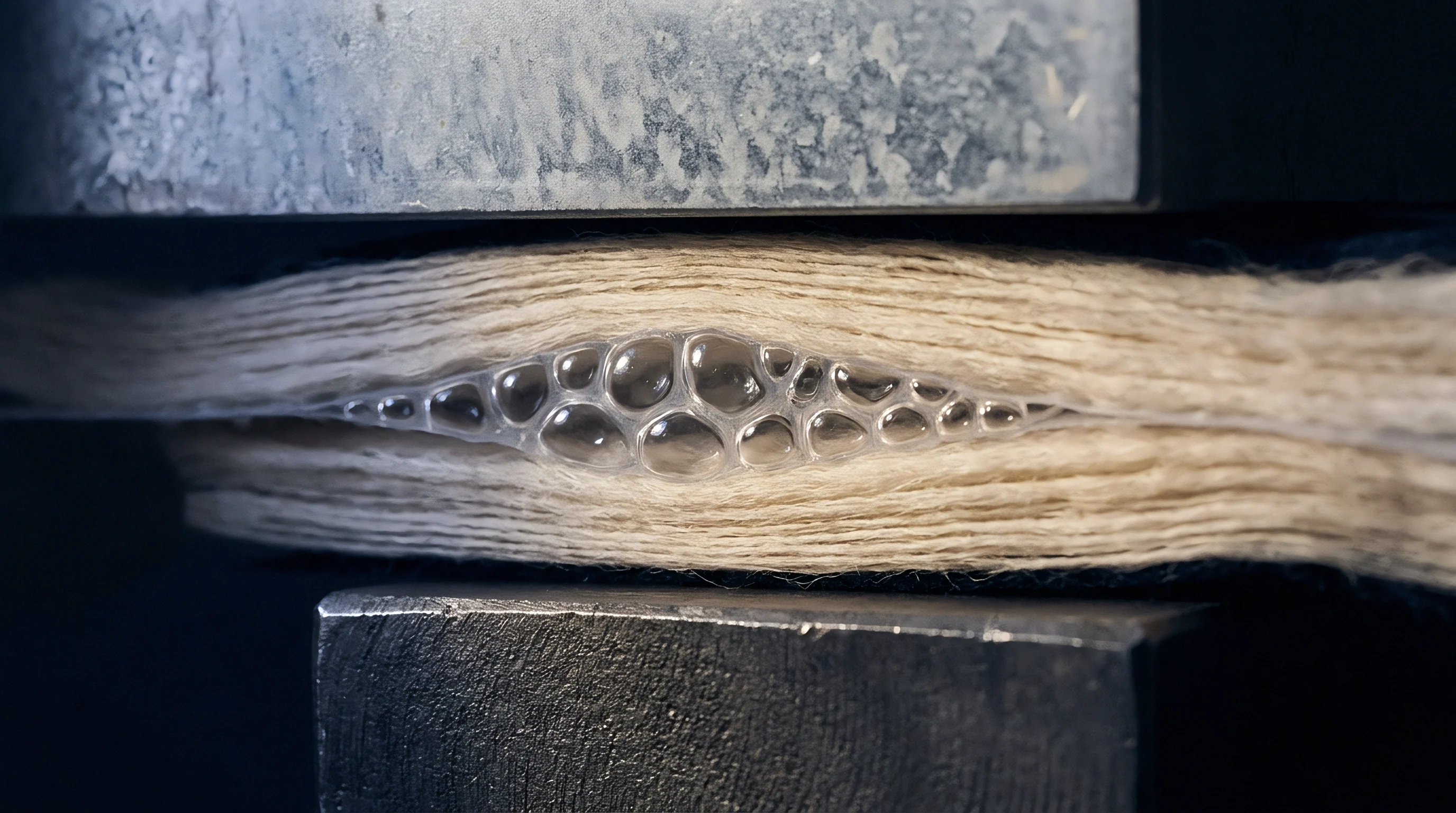
Core grin-through occurs when the white, translucent, or reflective elastomeric filament becomes visible on the face of a dyed woven fabric. This visual defect stems from three root causes: uneven sheath fiber coverage during vortex spinning, over-stretching of the fabric during stenter processing, or fiber degradation during wet finishing. In air jet spinning, momentary air pressure fluctuations inside the vortex nozzle drop wrapper fiber density, exposing sections of the bare core along lengths of 1 millimetre to 5 millimetres.
| Performance Metric | Applicable Test Standard | Commercial Acceptability Limit | Rejection Threshold |
|---|---|---|---|
| Seam Slippage at 6 mm Opening | ISO 13936-1 | > 100 N Force | < 70 N Force |
| Pilling Resistance (2000 Martindale Rubs) | ISO 12945-2 | Grade 4-5 | < Grade 3-4 |
| Dimensional Stability (3x 40°C Wash Cycles) | ISO 5077 / ISO 6330 | ± 3.0% Warp / Weft | > ± 5.0% Length or Width |
| Elastic Stretch Percentage | ASTM D3107 | 22% to 28% | < 18% or > 32% |
| Elastic Recovery (After 30 min) | ASTM D3107 | > 92% Recovery | < 88% Recovery |
| Core-Sheath Stripping Force | Internal Mill Standard (0.5m) | > 120 cN | < 85 cN |
Abrasion resistance and surface pilling present distinct characteristics in air jet core fabrics. Vortex air jet yarns demonstrate superior pilling resistance compared to ring yarns because the loose fiber ends on the yarn surface remain wrapped tightly around the core rather than protruding as fuzzy surface hair. Under ISO 12945-2 testing, air jet elastic twills routinely achieve Grade 4 to 4-5 after 2,000 rubs.
However, once the outer wrapper fibers are abraded through by continuous heavy mechanical wear, the untwisted core fibers disintegrate rapidly, resulting in sudden, localized fabric thinning rather than gradual fuzzy pill development.
Seam slippage under ISO 13936-1 constitutes another critical vulnerability. The smooth, compressible nature of air jet yarns permits warp threads to slide easily over the filling yarns when subjected to transverse seam loading. In garments with tight fit profiles, such as stretch denim or performance trousers, seam openings exceed acceptable limits if the woven fabric construction lacks sufficient pick density or if the seam allowance is narrower than 12 millimetres.
A supplier who claims that core grin-through is an unavoidable feature of stretch weaving ignores fundamental vortex spinning dynamics. Proper yarn quality control requires continuous optical sensors on every spinning spindle to detect and clear sheath gaps before yarn ever reaches a loom beam.
Purchasing agreements governing bulk production require specific performance limits tied directly to ASTM D3107 for growth and recovery and ISO 13936-1 for seam performance. When bulk fabric fails these metrics, the cost of garment factory downtime, recutting, and returns lands entirely on the fabric mill.