Corrected Invoiced Commercial Mass Calculations from Desiccated Fibre Regain Data
Invoiced commercial mass equals total oven-dry fibre weight multiplied by one hundred plus standard regain and finish allowance percentages, divided by one hundred.
Oven
Thermal desiccation at one hundred and five degrees Celsius removes free water from raw fibre stock and finished yarns. Water alters gross shipment weight. International trade agreements under the International Bureau for the Standardisation of Man-Made Fibres and the International Wool Textile Organisation establish that invoices settle on dry substance plus an agreed moisture allowance rather than scale weight at the destination warehouse.
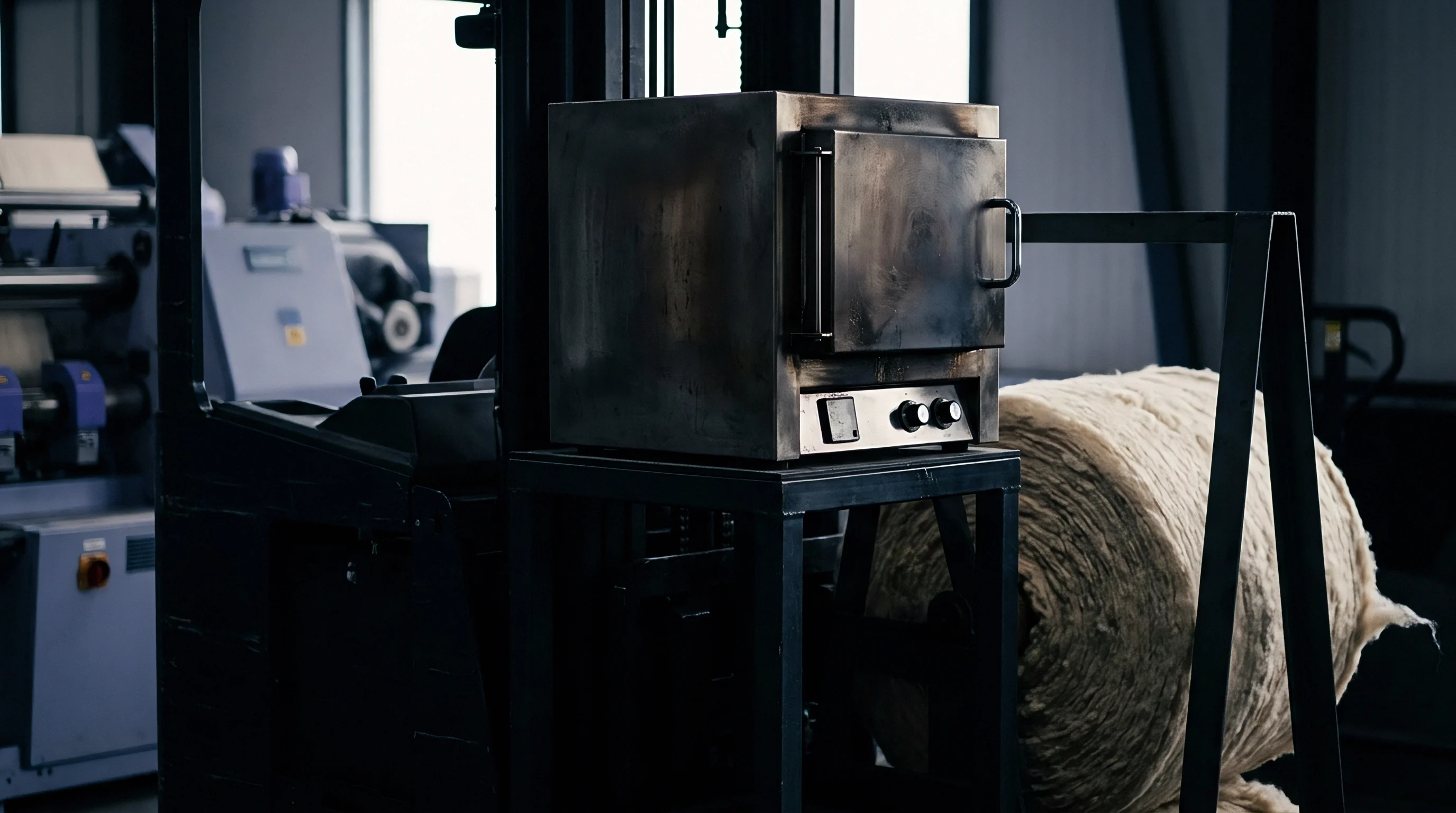
Testing facilities determine this dry base by placing representative samples inside ventilated drying chambers equipped with internal analytical balances. Airflow circulates through the specimen basket at velocities between zero point two and zero point five metres per second, carrying volatilised moisture through exhaust flues until successive mass readings show no progressive loss.
Specimen containers require strict thermal management during the drying cycle. The laboratory heating cycle continues until consecutive weighings taken at fifteen-minute intervals show an alteration of less than zero point zero five percent of the total sample mass. Standard laboratory drying chambers run between one hundred and five and one hundred and ten degrees Celsius for synthetics and cellulosics.
Pure wool specimens degrade when exposed to prolonged temperatures above one hundred and five degrees Celsius, necessitating precise thermostatic regulation to avoid polymer scorching or volatile mass loss.
A sealed laboratory weighing vessel prevents hygroscopic regain exceeding zero point zero two percent per minute during balance transfer.
Hot test specimens create convective drafts. When technicians weigh dried samples inside the heated oven chamber, thermal lift reduces the apparent downward force on the balance pan, registering a false mass reduction. Modern testing equipment circumvents this physical error by integrating bottom-loading balance links that shield the weighing transducer from the hot air column.
Alternative testing houses transfer dried plugs into ground-glass stoppered weighing bottles inside a desiccator charged with activated silica gel or phosphorus pentoxide. The desiccator cools every sample. Ambient laboratory air entering an open bottle delivers rapid moisture reabsorption, destroying the accuracy of the desiccated reading within forty seconds.
Drying continues until mass stabilises. The technician records the final tare of the weighing container immediately before calculating the net desiccated mass of the test coupon.
- Delayed balance transfer exposes desiccated fibre plugs to ambient laboratory humidity, inflating the apparent dry weight before balance equilibrium registers.
- Chamber ventilation failure traps evaporating steam inside the heating zone, halting desorption and leaving residual bound water within the sample core.
- Thermal finish volatilisation strips processing oils along with moisture, yielding an artificially low dry mass reading that inflates supplier regain calculations.
- Uneven specimen packing creates dense moisture pockets inside the drying basket, requiring extended dwell cycles that risk thermal polymer degradation.
The spinning mill maintains that lingering container humidity during container unloading accounts for the two percent discrepancy between factory scale manifests and destination laboratory certificates.


Formulation
Commercial mass reconciles the discrepancy between physical weighbridge measurements and the contractual standard dry mass of textile materials. Invoiced mass overrides gross scale readings. Textile fibres exchange water vapour continuously with surrounding air, causing bulk container shipments to gain or lose hundreds of kilograms between the dispatch dock and the receiving warehouse.
Commercial contracts eliminate this ambient volatility by defining an official moisture regain value for each polymer category. The contractual invoiced quantity represents the calculated mass the shipment would exhibit if every kilogram of dry fibre held exactly its legal commercial regain percentage.
Can Oven Drying Isolate True Fibre Mass?
Thermal drying drives off both unbound surface moisture and bound capillary water, exposing the net dry polymer skeleton. Moisture regain exceeds moisture content. Technicians distinguish between moisture content, which expresses water weight as a percentage of original moist mass, and moisture regain, which calculates water weight as a percentage of bone-dry mass.
A sample weighing one hundred grams damp that yields ninety grams dry carries a moisture content of ten percent, whereas its moisture regain stands at eleven point eleven percent.
Moisture regain calculates water as a fraction of dry fibre mass, whereas moisture content measures water against total damp mass.
The calculation of corrected commercial mass proceeds through a sequence of proportional steps. Let original net mass received at the destination weighbridge equal M. The laboratory draws representative sealed specimens having an aggregate initial mass of m. After desiccation at one hundred and five degrees Celsius until constant weight, this test lot yields an oven-dry mass of d.
The oven-dry mass ratio equals d divided by m. Total bone-dry mass of the bulk delivery equals M multiplied by the quantity d divided by m. Corrected invoiced commercial mass equals this total dry mass multiplied by one hundred plus the official commercial regain R, divided by one hundred.
When the commercial contract permits an additional commercial allowance A for spin finish or natural wax, the multiplier expands to one hundred plus R plus A, divided by one hundred.
| Fibre Classification | Standard Regain Percentage | Commercial Allowance Percentage | Governing Standard Code | Equilibrium Regain at 65% RH |
|---|---|---|---|---|
| Combed Cotton Yarn | 8.50 | 0.00 | ISO 6741-1 | 7.50 to 8.50 |
| Carded Cotton Yarn | 8.50 | 0.00 | ASTM D1909 | 8.00 to 9.00 |
| Wool Top Combed Oil | 18.25 | 1.00 | IWTO-33 | 16.00 to 17.50 |
| Wool Top Dry Combed | 18.25 | 0.00 | IWTO-33 | 16.00 to 17.50 |
| Viscose Rayon Staple | 13.00 | 0.00 | BISFA Rules | 12.00 to 14.00 |
| Polyester Filament | 1.50 | 0.00 | BISFA Rules | 0.40 to 0.60 |
| Polyester Staple Tow | 3.00 | 0.00 | ISO 6741-2 | 0.40 to 0.60 |
| Nylon 6.6 Continuous Filament | 5.75 | 0.00 | ASTM D1909 | 4.00 to 4.50 |
| Acrylic Staple Tow | 2.00 | 0.00 | BISFA Rules | 1.50 to 2.00 |
| Mulberry Raw Silk | 11.00 | 0.00 | ISO 6741-3 | 10.00 to 11.00 |
Clean dry mass governs commercial calculation. Assume a receiving facility accepts an international container shipment of combed cotton yarn with an unconditioned net scale mass of ten thousand kilograms. The laboratory extracts representative test plugs totalling five hundred grams.
Following desiccation at one hundred and five degrees Celsius, the dry specimen weighs four hundred and fifty-five grams. The oven-dry ratio evaluates to zero point nine one zero. Total dry mass inside the container equals nine thousand one hundred kilograms.
Cotton carries an official commercial moisture regain of eight point five zero percent under ISO 6741-1. The corrected commercial mass equals nine thousand one hundred multiplied by one hundred and eight point five, divided by one hundred. The resulting settlement mass equals nine thousand eight hundred and seventy-three point five kilograms.
Sellers absorb excess water weight.
- Gross lot weighing records total weight at container discharge before warehouse atmosphere induces secondary moisture migration.
- Tare sample extraction determines the average mass of pallets, cardboard cartons, plastic wrap, and yarn cones.
- Core specimen sampling draws hermetically sealed plugs across multiple packing units in accordance with ISO 1130 sampling tables.
- Oven desiccation drives out all volatile moisture until successive analytical balance readings confirm constant mass.
- Commercial regain adjustment yields final invoiced mass by applying contractual regain percentages to the calculated total dry weight.
Miscalculating the moisture base shifts invoice values by several percentage points, penalising buyers during humid shipping seasons and triggering financial write-downs during audit cycles.

Ratio
Binary fibre compositions demand mass-weighted calculations because constituent polymers possess divergent hydrophilic affinities. Cotton draws water molecules into internal amorphous lumens. Polyester absorbs minimal ambient vapour.
When spinning mills produce hybrid yarns combining multiple polymer types, the commercial regain calculation must reflect the exact dry mass proportion of each constituent rather than the raw nominal blend percentages quoted on purchasing specifications.

Fractional Regain Equations
Determining the composite commercial regain of a multi-fibre substrate requires quantitative chemical separation or selective dissolution of the components following ISO 1833 procedures. Cellulose absorbs water readily. The technician isolates the clean oven-dry mass of component A and component B from a desized specimen.
Let the dry mass proportion of component A equal P_A and component B equal P_B, where the sum of P_A and P_B equals one hundred. The composite commercial regain R_c equals the sum of P_A multiplied by R_A and P_B multiplied by R_B, the entire sum divided by one hundred.
Natural cellulosic fibres draw ambient moisture faster than synthetic filaments can collect surface vapour.
Wool holds substantial bound moisture. Consider a hybrid yarn nominally described as sixty percent combed cotton and forty percent polyester staple. Chemical separation reveals an actual bone-dry composition of sixty-one point two percent cotton and thirty-eight point eight percent polyester.
Official regain standards allocate eight point five percent to cotton and three point zero percent to polyester staple. Cotton contributes five point two零two percent to the mixture regain. Polyester contributes one point one six four percent.
Summing these values establishes a composite commercial regain of six point three六六 percent. Applying a flat nominal six point three zero percent calculation generates an erroneous dry-mass valuation across a multi-container contract.
| Fibre Combination | Dry Mass Split | Component Regain Percentages | Composite Commercial Regain | Invoiced Weight per 10,000 kg Dry Base |
|---|---|---|---|---|
| Cotton / Polyester | 60.0 / 40.0 | 8.50 / 3.00 | 6.30% | 10,630 kg |
| Cotton / Polyester | 50.0 / 50.0 | 8.50 / 3.00 | 5.75% | 10,575 kg |
| Wool / Polyester Top | 55.0 / 45.0 | 18.25 / 1.50 | 10.71% | 11,071 kg |
| Viscose / Cotton | 70.0 / 30.0 | 13.00 / 8.50 | 11.65% | 11,165 kg |
| Nylon 6.6 / Wool | 20.0 / 80.0 | 5.75 / 18.25 | 15.75% | 11,575 kg |
| Acrylic / Wool | 70.0 / 30.0 | 2.00 / 18.25 | 6.88% | 10,688 kg |
| Calculations follow ISO 6741-4 weighted dry mass distribution without non-fibrous extraction deductions. | ||||
Hydrophobic components consistently stabilise composite mass figures against seasonal humidity swings.

Extract
Non-fibrous processing aids cling to yarn surfaces and distort clean dry mass determinations. Coning oils, antistatic lubricants, knitting waxes, and warp sizing materials add artificial weight to the delivery package. If a laboratory dries an unwashed specimen directly in the conditioning oven, these chemical coatings remain counted as raw fibre substance.
Thermal degradation during oven drying can also partially volatilise light mineral oils, producing fluctuating dry readings that mimic moisture evaporation. Accurate commercial mass determinations require solvent extraction prior to final desiccation whenever processing aids exceed trade allowances.
Soxhlet Washing Procedures
Standard extraction procedures under ISO 1833 and IWTO-33 specify continuous solvent percolation inside a Soxhlet apparatus. Dichloromethane dissolves mineral coning oils, natural wool grease, and synthetic lubricants without dissolving or hydrolysing polyester, polyamide, or cellulosic polymers. The extraction cycle runs for four hours, achieving a minimum of twenty solvent siphonings through the cellulose thimble.
The technician extracts the solvent from the collection flask, dries the residual oil to constant weight, and determines the percentage of extractable non-fibrous material.
Solvent extraction strips non-fibrous oils. Invoiced commercial mass calculations incorporate non-fibrous corrections through distinct contractual mechanisms. Under BISFA rules for synthetic filament yarns, processing finish counts as part of the commercial mass provided the extractable finish level falls below the contractual limit, typically one point zero percent.
If laboratory testing reveals an extraction level of two point four percent, the excess one point four percent deducts directly from the clean dry mass before commercial regain multipliers apply. In wool tops, IWTO regulations permit a one point zero percent fatty matter allowance on oil-combed product. Any residual grease discovered beyond this allowance reduces the billable commercial mass accordingly.
- Solvent purity certification confirms laboratory dichloromethane leaves zero non-volatile oily residue upon blank distillation.
- Extraction duration logs verify minimum Soxhlet siphon cycles took place before specimen removal.
- Oven conditioning records track specimen stabilization post-extraction at one hundred and five degrees Celsius.
- Commercial allowance clauses specify agreed oil percentages permissible within the standard trade regain factor.
Technicians continue to debate whether modern water-soluble synthetic lubricants justify replacing traditional halogenated solvent washes with milder aqueous extraction sequences.


Tare
Packaging components distort gross weighbridge tallies when paper cones, plastic films, and wooden pallets absorb moisture alongside the yarn. Container floors absorb rainwater during sea transit. Ocean freight containers moving across tropical maritime routes experience extreme internal temperature cycles, causing condensation droplets to fall from steel ceilings onto carton lids.
A weighbridge ticket stamped at the import terminal records gross mass that includes wet packaging. Commercial mass calculations isolate pure net fibre mass by establishing verified tare values under bone-dry or conditioned criteria.
What Recourse Resolves Wet Container Weights?
Receiving inspection requires prompt physical tare separation before atmospheric drying alters packaging weights. The receiving team separates twenty representative cartons from the delivery lot, weighing individual plastic cone inserts, cardboard separators, corrugated outer cartons, and timber skids. Moisture meters lack legal standing.
Paper cones manufactured from compressed recycled pulp possess high moisture affinity, gaining up to four percent additional weight under ninety percent relative humidity. Contracts specify whether tare settles on actual weighed packaging mass at container unsealing or on standard dry tare allowances established by packaging manufacturers.
Tare weights shift across ocean voyages. Laboratory test reports anchor commercial settlement. Assume a shipment of texturised polyester yarn arrives with an invoice gross mass of twenty-two thousand kilograms and an invoiced net mass of twenty thousand kilograms based on a stated tare of two thousand kilograms.
Port weighbridges confirm the twenty-two thousand kilogram gross weight. Destination stripping reveals wet wooden pallets and damp carton liners. Actual weighed tare reaches two thousand three hundred kilograms, dropping received net yarn mass to nineteen thousand seven hundred kilograms.
Laboratory desiccation tests indicate the yarn arrived at a moisture level of zero point eight零percent, while the commercial regain allowance under BISFA standards stands at one point five零percent. The calculation establishes true invoiced commercial mass from received dry substance, preventing the buyer from paying textile rates for moisture-logged shipping pallets.
| Shipment Metric | Invoiced Contract Value | Port Terminal Received Value | Corrected Settlement Value | Variance Impact |
|---|---|---|---|---|
| Gross Consignment Mass | 22,000 kg | 22,000 kg | 22,000 kg | 0 kg |
| Packaging Tare Mass | 2,000 kg | 2,300 kg (wet) | 2,050 kg (conditioned) | -250 kg net textile loss |
| Net Received Yarn Mass | 20,000 kg | 19,700 kg | 19,950 kg | -50 kg actual material |
| Oven-Dry Fibre Mass | 19,704 kg | 19,543 kg | 19,655 kg | -49 kg dry polymer |
| Contract Regain Factor | 1.50% | 1.50% | 1.50% | Contract standard |
| Billable Commercial Mass | 20,000 kg | 19,836 kg | 19,950 kg | -50 kg billing credit |
Incorporating the International Wool Textile Organisation standard arbitration clause binds both signatories to neutral conditioning house certificates, extinguishing local weighbridge disputes before cargo discharge.