Commercial Indemnity Allocation for Post-Transit Formaldehyde Regeneration in Ocean Freight Shipments
Reversible DMDHEU hydrolysis during ocean transit constitutes an inherent manufacturing defect, requiring pre-shipment vapor testing and explicit indemnity terms.
Equilibrium
Cellulose cross-linking reagents applied during textile finishing do not form permanent chemical bonds under all post-production storage conditions. Most non-iron and anti-wrinkle finishing formulations rely on modified dimethyloldihydroxyethyleneurea (DMDHEU) or etherified melamine resins. These reactants deposit within the amorphous regions of cotton or viscose fibers, establishing covalent ether bridges with cellulose hydroxyl groups.
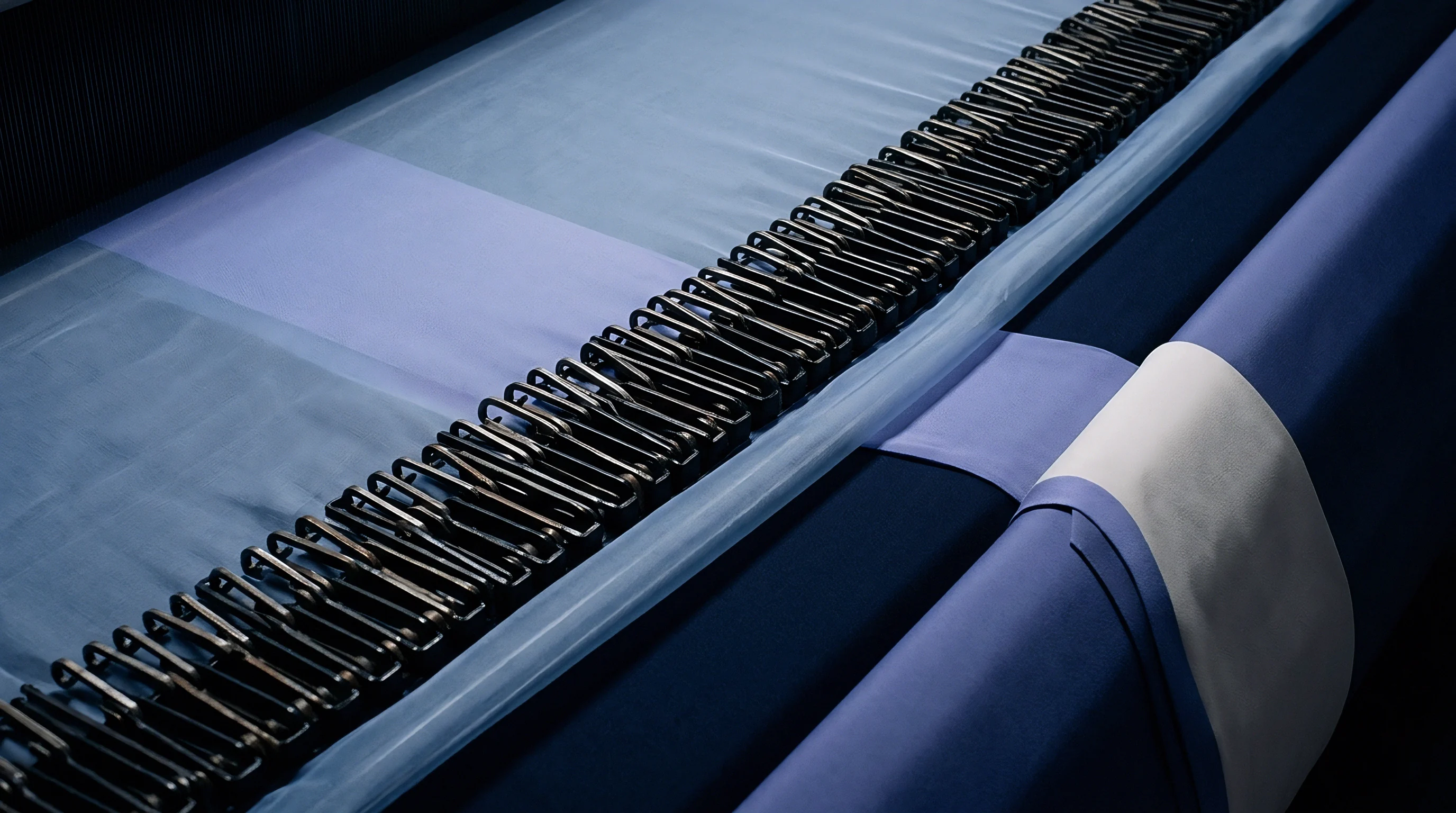
Acid catalysts such as magnesium chloride or zinc fluoroborate drive this forward condensation reaction on the stenter frame. Incomplete catalyst neutralization, inadequate curing temperatures, or unwashed reagent residues leave the finished yardage vulnerable to chemical reversal. Water molecules cleave the ether linkages and reform N-hydroxymethyl groupings whenever relative humidity and ambient heat cross activation thresholds.
The resulting scission releases monomeric formaldehyde directly into the fiber matrix. Finishing mills often conduct factory-gate clearance testing using water-extraction methods immediately after final mechanical tumbling. ISO 14184-1 measures only the free and easily extractable formaldehyde present on the unaged specimen at that single moment.
A lot showing an initial extraction reading of 32 milligrams per kilogram meets consumer apparel thresholds under standard compliance programs. That baseline number masks the presence of uncured methylol functional groups waiting for moisture. Once hydrolytic cleavage commences, free formaldehyde concentrations steadily climb until the chemical reaction reaches equilibrium with the enclosed environment.
A lot showing 32 milligrams per kilogram at origin can yield 185 milligrams per kilogram at destination discharge following four weeks under high moisture.
Washing steps after resin curing determine the chemical stability of the final yardage. Finishing plants seeking to preserve mechanical strength or conserve thermal energy often bypass the alkaline process wash. Leaving unneutralized Lewis acid catalysts on the textile creates an ongoing internal degradation drive.
Acidity accelerates ether cleavage whenever moisture penetrates the packed rolls. Steaming and pressing operations at garment manufacturing stages compound the issue by generating localized condensation inside primary packaging. The mill dispatch certificate records a clean result, yet the chemical potential for toxic outgassing remains locked inside the finished fibers.
Plant managers frequently maintain that any off-gassing observed overseas stems from unapproved warehouse additives applied after cargo left their loading dock.
Hold
Standard ocean freight containers function as hermetic pressure chambers across long equatorial trade lanes. Steel boxes stowed on deck or in upper cellular tiers encounter surface temperatures exceeding 65 degrees Celsius under direct equatorial sunlight. Ocean journeys from East Asian export hubs to European or North American intake ports take twenty to forty-five days.
Daily thermal cycling drives severe vapor pressure differentials between the textile core and the interior airspace of the container. Moisture retained within cotton fibers evaporates during daytime peak heat, collecting along the corrugated ceiling and walls. Night cooling induces immediate condensation, producing internal liquid dripping commonly termed container rain.

What Releases Bound Formaldehyde inside Enclosed Containers?
Hydrolytic degradation of DMDHEU cross-links accelerates under the specific atmospheric conditions found inside maritime shipping units. Elevated moisture creates an ideal reactant supply for ether bond cleavage. Dense carton packing methods prevent the escape of volatile gases, generating closed chemical reaction environments.
- Thermal cycling stress drives repeated moisture evaporation and re-condensation cycles through packed textile bales, sustaining continuous wet-heat hydrolysis across the entire transit voyage.
- Trapped acidic microclimates form when volatile finishing aids and residual acetic acid evaporate into enclosed polybags, lowering fiber surface pH below five.
- Desiccant pack exhaustion occurs when silica gel or clay sachets reach maximum moisture absorption capacity within the first ten days at sea, leaving subsequent condensation unbuffered.
- Vapor phase accumulation concentrates airborne formaldehyde molecules around the sealed goods, causing re-absorption into untreated linings, trims, and packaging cardboard.
Textile cartons wrapped in low-density polyethylene wrap concentrate regenerated gases rather than preventing their generation. While film wrappers block direct water drips from rusty container ceilings, they trap fiber moisture within individual garment bags. Free formaldehyde cannot escape into the container headspace.
The gas dissolves into the localized moisture layer coating fiber surfaces. When regional import regulators sample arriving shipments, secondary linings and untreated pocket bags often display higher chemical values than the resin-treated outer shell through cross-contamination.
| Finishing Chemistry | Mean Container Temp | Relative Humidity | Origin ISO 14184-1 | Discharge ISO 14184-1 | Regeneration Delta |
|---|---|---|---|---|---|
| Standard Low-Formaldehyde DMDHEU | 28 °C | 55% | 24 mg/kg | 38 mg/kg | +14 mg/kg |
| Standard Low-Formaldehyde DMDHEU | 55 °C | 85% | 26 mg/kg | 142 mg/kg | +116 mg/kg |
| Etherified Modified DMDHEU Unwashed | 60 °C | 90% | 34 mg/kg | 210 mg/kg | +176 mg/kg |
| Etherified Modified DMDHEU Alkaline Washed | 60 °C | 90% | 18 mg/kg | 52 mg/kg | +34 mg/kg |
| Zero-Formaldehyde Polycarboxylic Acid | 60 °C | 90% | 0 mg/kg | 0 mg/kg | 0 mg/kg |
Fiber moisture content dictates chemical outcome. Dry textiles rarely hydrolyze at sea.

Stipulation
Purchase contracts routinely fail because they specify analytical standards that cannot detect latent chemical instability. Standard purchase orders demand proof of conformity with destination market regulations, such as EU REACH Annex XVII Entry 72 or Japanese Law 112. These frameworks mandate strict concentration ceilings, typically set at 75 milligrams per kilogram for direct-skin adult garments and non-detectable levels below 16 milligrams per kilogram for infant apparel.
Suppliers supply compliance certificates derived from ISO 14184-1 water extraction executed on freshly manufactured cloth. That method isolates only the unbound free aldehyde present in the swatch at ambient laboratory conditions.
Vapor-phase extraction methods reveal the actual chemical risk profile of cross-linked resin goods. Testing under AATCC 112 or ISO 14184-2 suspends the textile swatch above water in a sealed container maintained at 49 degrees Celsius or 65 degrees Celsius for twenty hours. The thermal stress releases both unbound formaldehyde and loosely etherified N-methylol groups.
This simulates maritime hold conditions prior to bill of lading issuance. Importers specifying only ISO 14184-1 accept legal title to goods whose chemical stability has never undergone rigorous laboratory appraisal.
Contracts incorporating AATCC 112 vapor release limits alongside standard extraction tests eliminate eighty percent of border quarantine actions.
Master supply agreements must establish technical requirements that govern lot acceptance throughout transit duration. Quality assurance provisions must dictate precise testing sequences to bridge origin batch records with arrival intake checks.
- Origin batch clearance mandates testing across both ISO 14184-1 for free aldehyde and ISO 14184-2 for latent releasable content, enforcing a maximum allowable vapor-phase release cap of 150 milligrams per kilogram.
- Independent third-party sampling technicians extract specimen cuts directly from the center of production rolls rather than accepting pre-selected mill swatches.
- Specimens undergo immediate split packaging into airtight aluminized foil barriers, preserving origin moisture content for reference arbitration.
- Garment manufacturing lines enforce an alkaline washdown process step whenever residual core pH tests below 5.5 prior to cutting.
- Container loading plans mandate verified calcium chloride desiccants with thirty percent absorption guarantees across all long-haul ocean routes.
Precise contract wording reassigns financial exposure back to the converter. Standard purchase order language stating that goods comply with destination regulations upon arrival overrides traditional Incoterms transfer milestones for latent manufacturing faults.


Apportionment
Financial liabilities emerging from destination chemical rejections generate complex disputes across procurement counterparties. When customs border agents or corporate retail intake teams impound a container showing 160 milligrams per kilogram of free formaldehyde, losses mount rapidly. Costs include container demurrage, terminal storage, specialized hazardous material warehouse storage, third-party laboratory verification, and corrective industrial washing.
Standard commercial freight terms transfer physical cargo risk to the buyer once the container clears the vessel rail at origin. Marine cargo insurance underwriters reject chemical rebound claims under Institute Cargo Clauses A, citing the inherent vice exclusion under Clause 4.4.
Whose Ledger Bears Latent Chemical Rebound Costs?
Commercial contracts determine whether the buyer absorbs destination expenses or recovers them through vendor debit notes. When the purchase order contains explicit latent defect indemnification provisions, the mill remains financially accountable for post-transit chemical degradation. The chemical instability represents an inherent manufacturing defect established during improper resin curing rather than transit damage.
Proving this position requires showing that container stowage conditions remained within reasonable commercial norms while the textile finish failed due to latent chemistry.
| Cost Component | Basis of Computation | Direct Mitigation (Wash) | Total Destruction Path | Contract Recovery Channel |
|---|---|---|---|---|
| Port Demurrage & Detention | 21 days at marine terminal | $4,200 | $8,400 | Supplier indemnity debit note |
| Accredited Retesting Fees | 3 composite sample rounds | $1,850 | $1,850 | Supplier quality chargeback |
| Customs Bond & Warehouse | Quarantine storage handling | $3,600 | $5,200 | Carrier or supplier claim |
| Industrial Remediation | Alkaline wash and drying | $14,000 | $0 | Factory defect warranty claim |
| Inventory Write-Down | Complete batch scrap value | $0 | $160,000 | Supplier invoice holdback |
| Freight and Duty Surcharges | Non-recoverable landed duty | $2,400 | $24,000 | Customs drawback or vendor loss |
Remediation strategies depend on fabric construction and destination logistics. Industrial laundering using urea or sodium bisulfite scavengers hydrolyzes residual unreacted methylol groups and removes volatile aldehyde residues. This process drops ISO 14184-1 levels below 20 milligrams per kilogram, permitting market entry.
Remediation costs between seventy cents and one dollar per garment. However, laundering removes pressed creases, degrades hand feel, and invalidates original hangtags and packaging. When garment styles cannot endure re-washing, full cargo destruction remains the only lawful outcome under border enforcement actions.
A typical financial exposure model demonstrates the leverage points. Assume an import lot of 20,000 cotton shirts valued at eight dollars per unit Free On Board. Landed duty value reaches ten dollars per unit.
Origin extraction reports show 35 milligrams per kilogram. Arrival inspection at Rotterdam reveals 115 milligrams per kilogram against an EU regulatory ceiling of 75 milligrams per kilogram. Remediation salvages the goods for a total corrective expenditure of 26,050 dollars, representing sixteen percent of invoice value.
Complete commercial rejection with destruction yields a total loss of 199,450 dollars. Without specific latent defect indemnity language in the supply agreement, the buyer absorbs the entire balance.
Marine cargo insurance policies exclude chemical regeneration claims under standard inherent vice clauses.
Buyers operating without explicit chemical warranty clauses absorb terminal demurrage and full product write-downs while legal liability bounces unresolved between forwarders, insurers, and manufacturing mills.
Arbitration
Legal recovery actions depend upon objective evidentiary proof gathered at origin and destination. When chemical disputes escalate to formal tribunal proceedings, parties must prove whether post-transit formaldehyde spikes originated from finish formulation defects or anomalous maritime carriage. International arbitration bodies weigh batch conformity evidence strictly against chain-of-custody documentation.
A single missing inspection report or unsealed reference package compromises the entire commercial claim.
Retained production yardage swatches represent decisive evidence in cross-border contract arbitrations. Mills routinely keep fabric swatches in air-conditioned office drawers. Those unsealed storage conditions permit volatile gases to evaporate naturally into ambient air.
When retested three months later, the mill reference swatch displays legal compliance while the containerized goods fail border testing. Procurement teams protect their commercial recovery positions by enforcing strict retention guidelines:
- Hermetic specimen preservation requires sealing origin swatches in multi-layer aluminum barrier film immediately after inspection, preventing vapor exchange.
- Environmental data loggers placed inside shipping containers document actual interior temperature and relative humidity profiles, confirming whether transit conditions exceeded normal maritime limits.
- Standardized secondary testing mandates parallel analysis of retained control specimens under accelerated sealed-jar aging protocols to reproduce transit hydrolysis in an accredited laboratory.
- Chain of custody tracking records the exact container seal numbers, inspection timestamps, and accredited laboratory sample access logs.
Apportioning indemnity between suppliers, converters, and freight forwarders rests upon defining where inherent chemical vice ends and carrier transport fault begins. If shipping logs confirm ocean temperatures remained within normal limits of forty to fifty-five degrees Celsius, tribunals view chemical regeneration as an inherent product failure attributable to mill curing practices. When carriers subject containers to prolonged abnormal heat above seventy degrees Celsius through negligent placement near vessel engine rooms, liability shifts toward shipping lines under maritime cargo conventions.
The core dispute centers on whether maritime carriage environments constitute normal foreseeable transport conditions or extraordinary external forces sufficient to break the manufacturer causal liability chain.