Quantifying Microstructural Matrix Collapse Kinetics during Multistage Polymer Desorption in Transit Microclimates
Transit desorption permanently collapses polymer matrix pores in regenerated cellulosics, reducing moisture regain and altering yarn count to distort landed cost.


Void
Laboratory gas sorption analysis on wet-spun lyocell tow reveals an initial pore volume of 0.28 cubic centimeters per gram before thermal packaging. Atmospheric moisture bound within amorphous regions acts as an internal plasticizer, maintaining free volume between adjacent cellulose chains. When relative humidity inside a shipping enclosure falls, water molecules desorb from capillary spaces.
Capillary pressure across pore walls increases exponentially as the liquid meniscus recedes, generating compressive stresses that exceed the yield strength of the un-crosslinked polymer network.
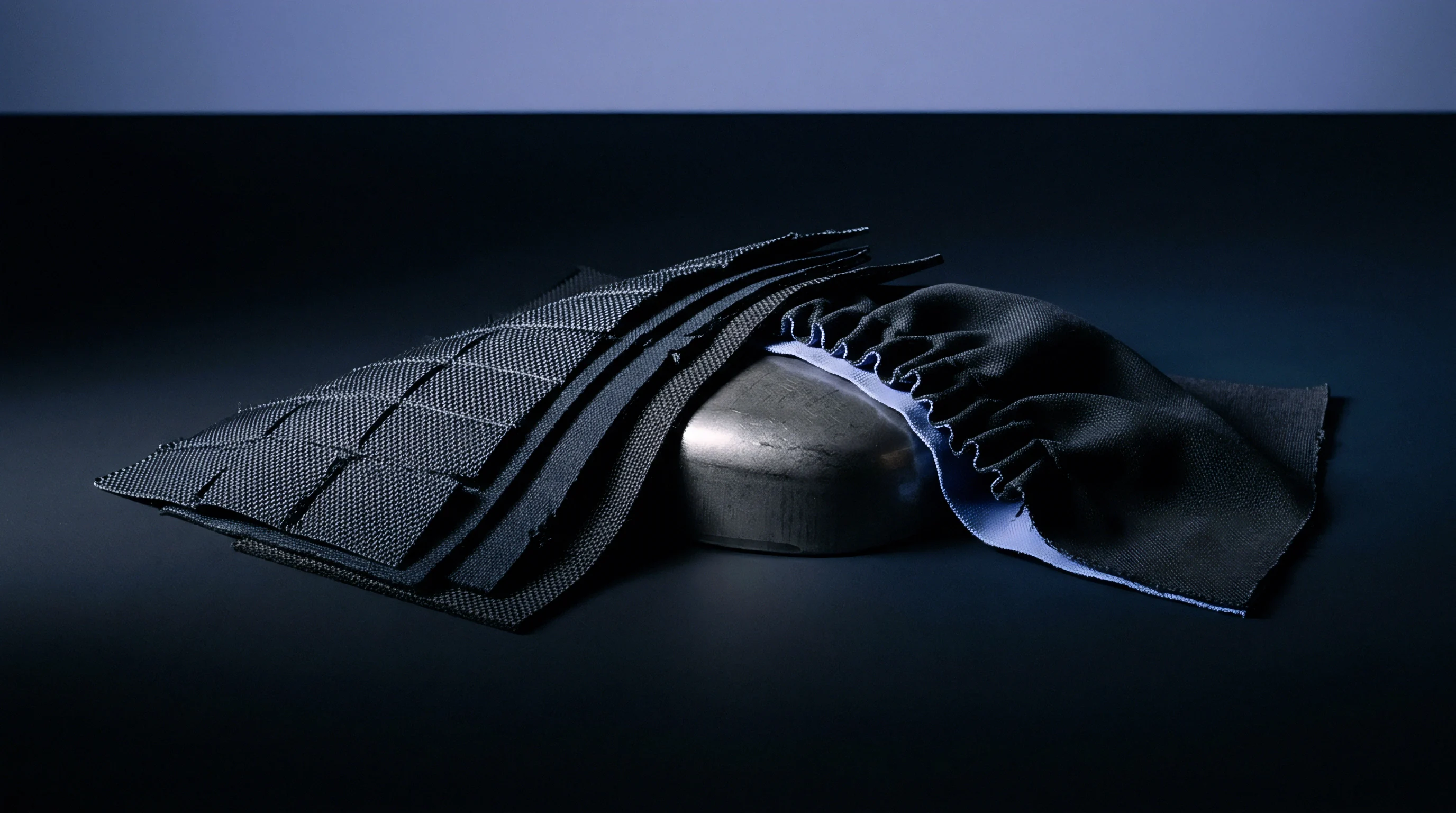
Free Volume Dynamics in Wet Spun Matrices
Positron annihilation lifetime spectroscopy tracks the progressive loss of nanometer-scale free volume fractions during controlled drying. Amorphous polymer segments draw together under strong hydrogen bonding as plasticizing moisture evaporates. Initial desorptive loss removes weakly bound bulk water without altering structural dimensions.
Continued moisture loss forces structural collapse of macro-pores measuring 10 to 50 nanometers in diameter.
Cellulosic filaments produced via direct solvent spinning exhibit higher initial porosity than viscose fibers formed through xanthate regeneration. The isotropic pore geometry of lyocell makes the microstructural framework vulnerable to collapse under rapid desorption rates. When transit microclimates drop below 45 percent relative humidity at elevated temperatures, collapse kinetics transition from surface-limited evaporation to internal diffusion control.
A 40 percent reduction in internal pore radius occurs when wet-spun regenerated cellulose drops below 8 percent moisture content at 50 degrees Celsius.
Free volume shrinkage shifts the glass transition zone of the amorphous polymer matrix. Dry cellulose chains lose segmental mobility, locking the collapsed pore architecture into a dense molecular configuration. Structural density increases from an initial 1.41 grams per cubic centimeter to 1.52 grams per cubic centimeter in fully collapsed regions.
Laboratory rehydration under ambient conditions fails to restore the original pore network once hydrogen bonds form across previously separated amorphous chains.

Thermodynamic Forces Driving Pore Contraction
Desorption thermodynamics govern the speed and extent of matrix contraction inside sealed cargo units. The chemical potential gradient between the wet yarn package and dry surrounding air provides the primary driving force for solvent loss. At elevated transport temperatures, desorption rates increase, raising internal capillary tension to levels above 50 megapascals within nanometer pores.
| Filament Fiber Type | Initial Moisture (%) | Pore Radius at 85% RH (nm) | Pore Radius at 30% RH (nm) | Matrix Density (g/cm³) |
|---|---|---|---|---|
| Standard Viscose | 13.0 | 18.4 | 4.2 | 1.49 |
| Modal High Tenacity | 11.5 | 14.1 | 3.8 | 1.51 |
| Solvent Spun Lyocell | 11.0 | 22.6 | 2.1 | 1.53 |
| Cuprammonium Rayon | 12.5 | 16.8 | 5.0 | 1.48 |
| Data measured via nitrogen gas adsorption and helium pycnometry at 23 degrees Celsius following simulated transit desorption cycles. | ||||
Pore contraction follows non-linear kinetic pathways determined by local vapor pressure. Secondary desorption stages pull tightly bound hydration shells from hydroxyl groups along the polymer backbone, increasing matrix density as tensile stresses build along the perimeter of cross-linked crystallites and flatten micro-voids across the fiber cross section.
Drying wet-spun continuous filaments below equilibrium moisture content during transit permanently closes intermolecular pores that wet processing cannot re-open.

Isotherm
Desorption hysteresis curves measured via dynamic vapour sorption demonstrate distinct kinetic steps as moisture leaves amorphous polymer regions. Saturated yarn packages entering marine transit carry moisture regains between 11 percent and 14 percent. As heat builds inside closed container modules, air moisture capacity expands, triggering rapid desorption from outer yarn package layers.
Bound water molecules desorb in multi-stage sequences that reflect differing thermodynamic bond energies.

Multistage Desorption Curves in Closed Containers
Initial desorption stage kinetics follow Fickian diffusion driven by concentration gradients across the package boundary. Moisture content drops from saturation to the critical moisture threshold without altering crystalline spacing. Secondary desorption stages require energy inputs exceeding 45 kilojoules per mole to break hydrogen bonds between cellulose chains and primary hydration shells, permanently compacting amorphous regions.
Container thermal shifts create cyclic desorption profiles. Day temperatures reaching 60 degrees Celsius drive moisture from the core of tightly wound packages to the surrounding air space. Night cooling drops container wall temperatures below the dew point, causing condensation that wets exterior packaging while the yarn core continues losing interior moisture.
This directional vapor pressure gradient accelerates matrix contraction in localized package zones.
- Capillary pore collapse occurs when liquid water menisci recede into sub-micron pores, generating compressive capillary pressures that pull internal microfibrils together.
- Glass transition elevation develops as plasticizing water molecules desorb, raising the polymer glass transition temperature above ambient transit temperatures.
- Crystalline region compacting emerges when parallel amorphous chains draw close enough to form secondary hydrogen bonds, increasing insoluble crystalline fractions.
- Cross-sectional shape flattening surfaces when radial desorptive forces contract fiber perimeters unevenly, altering ribbon-factor metrics and optical luster.
Does Desorption Permanently Alter Fiber Linear Density?
Linear density calculations depend directly on mass per unit length under standardized environmental regain. When transit desorption collapses internal matrix pores, moisture re-absorption kinetics slow substantially. Standard conditioning under ISO 139 for 24 hours fails to re-establish initial equilibrium moisture content in collapsed fibers.
Standard ISO 139 conditioning before physical measurement invalidates commercial weight claims when microstructural collapse locks out atmospheric moisture regain.
Physical yarn count measurements performed at destination ports frequently show artificial dtex increases due to irreversible longitudinal relaxation and cross-sectional contraction. A 150 dtex filament yarn subjected to harsh transit desorption contracts up to 2.8 percent in axial length while losing volumetric free volume. Desorption enthalpy alters the glass transition, leaving the resulting filament denser, shorter, and stiffer than the freshly spun origin material.
Permanent tensile loss and dye streaks stem from uncalibrated drying protocols applied before container loading rather than maritime humidity spikes.

Contraction
Differential scanning calorimetry shows a shift in polymer glass transition temperature from 25 degrees Celsius to 82 degrees Celsius as internal moisture decreases from 13 percent to 3 percent. The removal of bound water forces amorphous polymer chains into tight physical proximity. Non-covalent bonding networks reform across adjacent chains, stabilizing the compacted state and preventing spontaneous re-expansion upon re-wetting.

Glass Transition Shifts during Solvent Evaporation
Polymer matrix dynamics shift dramatically when transit microclimates drive temperature above the instantaneous glass transition threshold of moist fiber. In humid environments, water lowers the glass transition temperature, allowing polymer chains to slide under low mechanical loads. As container temperatures peak and relative humidity falls, rapid desorption drives glass transition temperatures upward, freezing chains in strained configurations.
Yarn package density increases measureably. Tightly wound filament cheeses under high wind tension experience internal radial pressures exceeding 3 megapascals during matrix collapse. Outer layers contract against rigid core tubes, inducing permanent latent crimp and irregular longitudinal stress distribution throughout the package.

Morphological Shrinkage Mechanics in Continuous Filaments
Quantitative analysis of a 14,000 kilogram shipment of 100 percent lyocell filament tow illustrates the physical progression of matrix collapse under containerized transport. Assume an initial yarn linear density of 1.33 dtex per filament, an initial moisture regain of 11.5 percent, and a nominal package density of 0.85 grams per cubic centimeter. The container experiences three equatorial heating cycles with peak temperatures reaching 58 degrees Celsius at 22 percent relative humidity.
During transit, internal fiber moisture drops from 11.5 percent to 3.1 percent. Total desorbed water mass across the shipment equals 1,142 kilograms. Calculated microstructural volume loss within the polymer matrix equals 0.042 cubic centimeters per gram of dry fiber.
Fiber cross-sectional area contracts by 5.8 percent, while total axial yarn length shrinks by 1.6 percent under package restraint forces.
| Yarn Blend Composition | Desorption Rate (% RH/hr) | Density Change (g/cm³) | Axial Contraction (%) | Tenacity Retention (%) |
|---|---|---|---|---|
| 100% Solvent Spun Lyocell | 1.85 | +0.12 | 1.60 | 92.4 |
| 70% Lyocell / 30% Filament Polyester | 1.20 | +0.07 | 0.95 | 96.8 |
| 50% Modal / 50% Combed Cotton | 0.92 | +0.05 | 0.70 | 98.1 |
| 100% Xanthate Viscose Rayon | 2.10 | +0.14 | 2.15 | 88.6 |
Re-conditioning the yarn at standard atmosphere (20 degrees Celsius, 65 percent relative humidity) recovers only 62 percent of lost moisture volume after 48 hours. Structural density remains elevated at 1.51 grams per cubic centimeter compared to the initial 1.43 grams per cubic centimeter. Filament cross sections flatten unevenly.
Polymer chains held under high tensile tension during drying retain structural void spaces better than relaxed yarn packages exposed to rapid thermal drops.
Ignoring transit matrix kinetics results in bulk fabric roll width variations exceeding five percent, leading to automated cutting table shutdowns and full shipment rejections at the garment factory.


Chamber
Data loggers placed inside ocean freight containers during equatorial passage record daily temperature fluctuations between 18 degrees Celsius and 62 degrees Celsius. Relative humidity drops to 18 percent during afternoon solar peaks and rises above 90 percent during ocean nights. Deck storage accelerates thermal swings.
These cyclical microclimate shifts create a multistage desorption regime that alters polymer matrix structures far more aggressively than constant-temperature laboratory drying.
Container Microclimate Fluctuations across Equatorial Transit
Solar radiation heating cargo container roofs generates sharp vertical thermal gradients. Top cargo tiers experience extreme desorptive conditions, while bottom tiers near the metal floor remain cool and damp. Relative humidity drives sorption shifts.
Moisture driven from upper pallet layers migrates downward or condenses on cold steel walls, establishing severe batch non-uniformity within a single freight container.
Desorption rates inside sealed liner bags accelerate when desiccants reach vapor saturation limits. Calcium chloride desiccant bags absorb moisture until saturated, after which elevated container temperatures force partial re-evaporation of stored water, spiking local vapor pressures and exposing adjacent yarn rolls to aggressive thermal-moisture shocks.
Vapour Pressure Spikes inside Sealed Freight Units
In-transit matrix verification requires systematic sampling across container depth zones immediately upon unsealing transport units. Laboratory protocols must isolate microstructural damage caused by transit from defects originating on spinning frames.
- Cut representative 5-meter fabric swatches from top, middle, and floor pallets immediately after opening container doors.
- Seal drawn swatches in moisture-impermeable aluminum foil bags within three minutes of collection to prevent ambient air equilibration.
- Measure total net weight of swatches instantly using a field balance calibrated to 0.001 grams precision.
- Execute nitrogen gas sorption testing on fiber specimens extracted from swatch cores to calculate remaining micro-pore volume.
- Condition remaining swatch sections under standard ISO 139 atmospheric conditions for 48 hours to determine total irreversible mass loss and hysteresis recovery ratios.
Container floor temperatures often exceed ambient air readings by fifteen degrees during equatorial deck storage, driving localized moisture migration to upper package layers.
Incorporating ASTM D1776 conditioning limits with explicit transit relative humidity maximums in purchase agreements reassigns financial liability for matrix deformation back to the freight forwarder.

Settlement
Commercial invoices based on original mill weight frequently generate customs discrepancies when moisture loss alters net delivery mass at the destination port. Customs officials assess duty based on declared commercial mass, calculated from clean dry mass plus official standard moisture regain percentages. Laboratory conditioning resets superficial regain.
When transit desorption causes irreversible microstructural pore collapse, fibers absorb less atmospheric moisture during intake testing than official customs standard tables mandate.
Commercial Reconciliation of Mass and Linear Density
Destination intake laboratories testing collapsed yarn shipments record lower moisture regains than the declared commercial allowances (13.0 percent for viscose, 11.5 percent for lyocell). Tariff authorities re-weigh incoming container loads, finding net physical weights below manifest declarations. Customs officers retest linear density.
Weight discrepancies trigger duty audits.
Financial calculations must adjust for matrix collapse effects on landed cloth costs. The mill invoices 10,000 kilograms of lyocell yarn at nominal regain. Transit desorption drops physical weight to 9,200 kilograms while permanently increasing yarn linear density from 1.33 dtex to 1.38 dtex equivalent.
The buyer receives less total length of thicker, denser yarn, reducing final finished fabric yield per kilogram by over 3.5 percent.
Customs Valuation and Tariff Line Distortions
Raw fiber composition declarations turn on predominant weight fractions under Harmonized System tariff classification rules. Microstructural matrix collapse and differential desorptive mass loss in fiber blends can alter blend ratios enough to shift customs classification lines.
- Linear density verification confirms whether yarn dtex shifts resulted from structural physical shrinkage or improper spinning draft settings.
- Desorption enthalpy limits establish maximum permissible microclimatic heating thresholds in logistics service level contracts.
- Microclimate packaging specs specify vapor barrier foil wrapping standards to prevent moisture migration during equatorial transit.
- Conditioning tolerance bands define accepted lab weight variance limits between origin bill of lading and destination intake checks.
A 50/50 lyocell and polyester blended yarn subjected to rapid container desorption loses water weight exclusively from the cellulosic component. Polyester moisture regain remains below 0.4 percent, while lyocell loses up to 10 percent of its mass. Destination testing reveals a dry mass blend ratio of 47 percent lyocell and 53 percent polyester by weight.
Customs inspectors reclassify the consignment under synthetic filament tariff lines carrying higher import duty rates.
| Cost Component Parameter | Origin Mill Invoice | Destination Intake | Financial Variance |
|---|---|---|---|
| Billed Gross Mass (kg) | 10,000 | 9,220 | -780 kg |
| Equilibrium Regain (%) | 11.5% | 7.2% | -4.3% regain |
| Yarn Linear Density (dtex) | 133.0 | 137.8 | +4.8 dtex |
| Applicable Tariff Line | HS 5403.31.00 (4.3%) | HS 5403.32.00 (6.5%) | +2.2% duty rate |
| Effective Cost per Finished Meter ($) | $2.45 | $2.68 | +$0.23 / meter |
Landed cost calculations require correction. Moisture loss reduces invoice mass. Precision contracts include specific transit microclimate clauses specifying maximum temperature ceilings and continuous relative humidity monitoring inside containers.
Supply agreements link final settlement invoices directly to oven-dry mass testing verified by independent destination laboratories operating under ISO 6741 standards. The buyer adjusts the final payout to reflect lost filament length and tariff surcharges incurred from transit-induced structural matrix collapse.