Quantifying Hydrothermal Degradation Kinetics of Polyether Polyurethane Microfilaments under Cyclic Mechanical Stress Field Conditions
Cyclic strain accelerates hydrothermal cleavage in polyether elastane microfilaments by lowering activation energy and expanding water diffusivity.
Microstructure
Polyether polyurethane microfilaments contain alternating soft and hard polymer domains that dictate physical elasticity under mechanical load. The elastic soft phase consists of long polyether chains, typically poly(tetramethylene ether) glycol, providing molecular flexibility and low glass transition temperatures. Rigid hard phases comprise aromatic diisocyanates, such as 4,4′-diphenylmethane diisocyanate, extended with low-molecular-weight aliphatic diamines or diols.
These hard blocks form semicrystalline domains stabilized by intermolecular hydrogen bonding. Phase separation between soft and hard domains establishes the physical crosslinks required for retractive elastic behavior. Microfilament surface area accelerates hydrolytic ingress.
In fine filament geometries ranging from 11 dtex to 44 dtex, higher surface-to-volume ratios expose a greater proportion of reactive urethane and urea bonds directly to environmental moisture.
Polymer Architecture and Phase Separation Dynamics
Poly(tetramethylene ether) glycol forms flexible polyether matrices within elastomeric synthetic yarns. Amorphous polyether chains display high segmental mobility at ambient and wet processing temperatures. Physical crosslinks occur where aromatic hard blocks aggregate into organized domains through hydrogen bonding between carbonyl groups and amine hydrogen atoms.
Phase separation governs elastomeric recovery. Thermal history alters baseline crystallinity. When exposed to hot aqueous environments during scouring or dyeing, thermal energy breaks weaker inter-chain hydrogen bonds in the hard domains.
This thermal disruption allows water molecules to diffuse directly into the soft-hard domain interfaces, altering phase morphology and reducing physical crosslink density.
Dyehouse heat setting fixes soft domain orientation. Under mechanical tension, polyether chains extend along the filament axis, promoting strain-induced crystallization within the soft domains. High surface area in fine microfilaments accelerates the exchange of absorbed water molecules with the bulk fluid.
Consequently, microfilaments experience faster plasticization than heavy monofilaments of identical chemical stoichiometry. Moisture ingress alters the dielectric environment of the polymer matrix, lowering the glass transition temperature of hard domain interphase regions and predisposing urethane-urea linkages to hydrolytic cleavage.
Polyether polyurethane microfilaments tested at 80 degrees Celsius under twenty percent dynamic strain exhibit a forty-two percent increase in ester link hydrolytic cleavage rate compared to unstrained controls.

Microfilament Surface Geometry and Ingress Kinetics
Fine denier single filaments presenting cross-sectional diameters below forty micrometres yield elevated surface contact per unit mass. Water molecule transport into the filament core follows Fickian diffusion mechanics in static conditions. Cyclic mechanical loading shifts transport dynamics toward non-Fickian anomalous diffusion.
Mechanical compression and relaxation cycles generate localized hydrostatic pressure gradients within internal microvoids. These pressure gradients pump aqueous dye bath chemistry into core domain structures, bypassing the kinetic limits established by classical static diffusion coefficients.
Filament cross-sectional symmetry directly impacts stress distribution across individual microfilament profiles. Dynamic testing isolates mechanical stress field effects. Multi-filament bundles of 22 dtex f2 or 44 dtex f4 experience localized inter-filament friction during cyclic extension.
Inter-filament abrasion strips surface finishes, exposing raw polymer chains directly to hot bath liquor. Microfilament surface area accelerates hydrolytic ingress. The combined effect of elevated fluid access, continuous mechanical shear, and localized thermal agitation accelerates structural degradation relative to coarse continuous elastomeric yarns.
Clamp
Dynamic mechanical testing of fine elastomeric yarns in aqueous media demands sealed liquid bath chambers mounted directly onto tensiometer frames. The mechanical testing apparatus maintains controlled strain fields across microfilaments submersed in water at temperature steps between 40 degrees Celsius and 100 degrees Celsius. Sinusoidal strain excitation simulates the mechanical field conditions experienced by stretch yarns during industrial wet finishing and end-use laundering cycles.
Measuring force degradation in real time requires piezoelectric load transducers isolated from thermal conduction and liquid bath fluid motion.
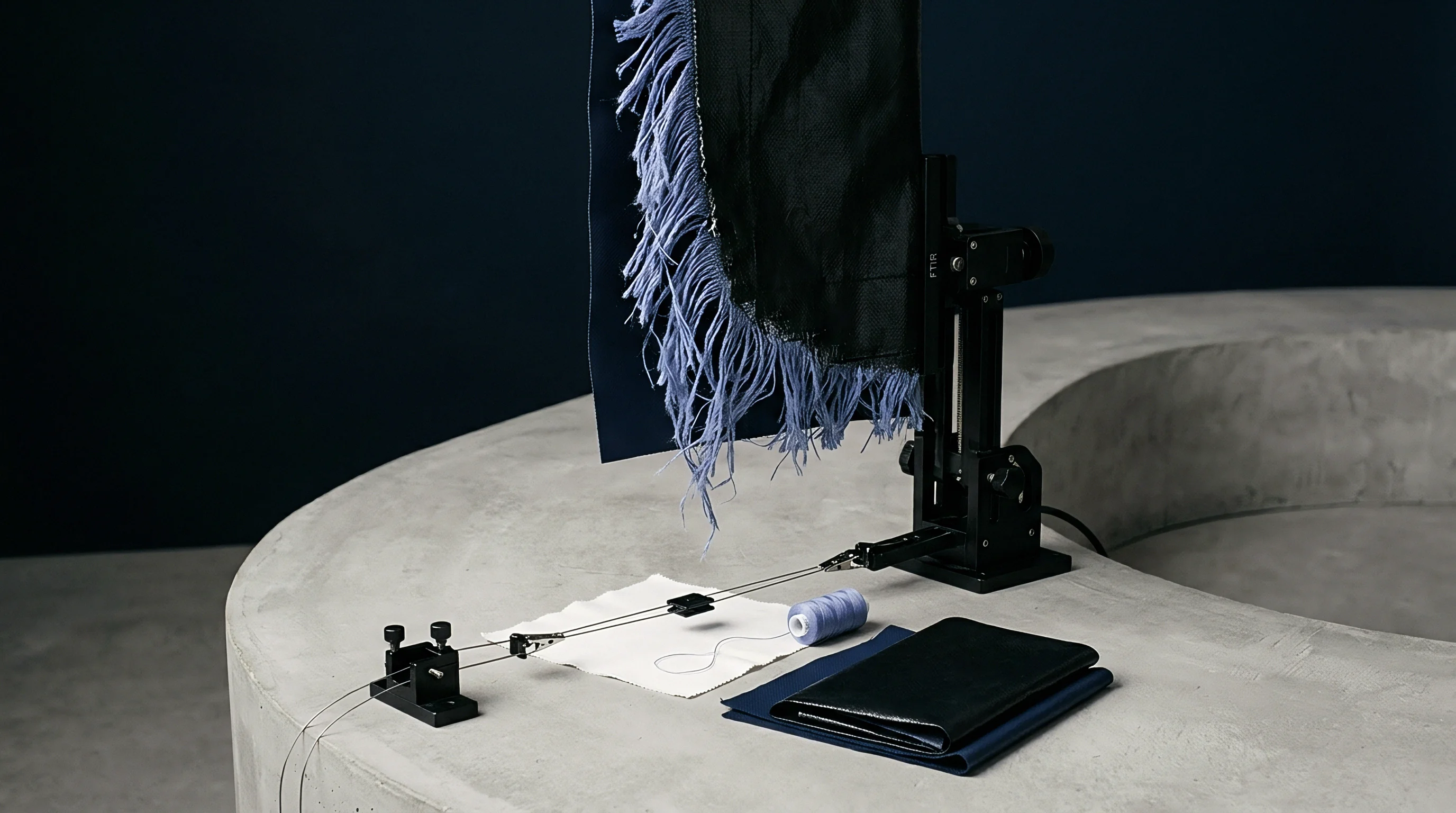
Hydrothermal Dynamic Test Rig Configuration
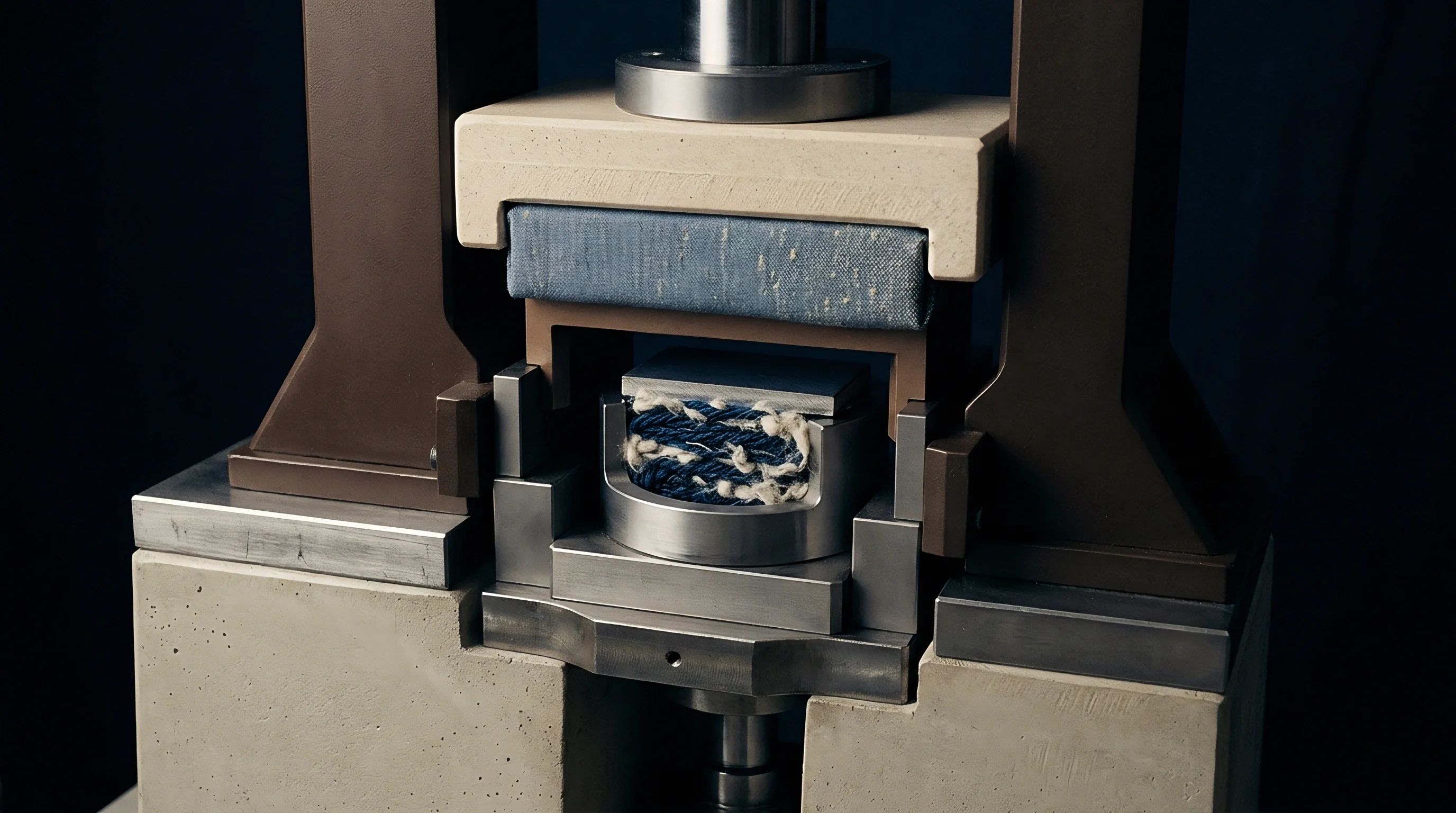
Fluid-submersed tensioning apparatus relies on piezoelectric load sensors calibrated to measure millinewton force changes during continuous sinusoidal motion. Pneumatic yarn grips lined with textured fluoroelastomer inserts prevent filament slippage without crushing delicate microfilament bundles. Slip at the grip face introduces artificial strain relaxation, corrupting dynamic modulus measurements.
Temperature control loops maintain fluid media within 0.2 degrees Celsius of target setpoints across extended testing periods up to 120 hours.
Static immersion understates dynamic degradation kinetics. To isolate mechanical acceleration factors, testing protocols compare static submerged controls against specimens subjected to cyclic strain amplitudes from 5 percent to 50 percent elongation. Frequency sweeps between 0.5 Hertz and 5.0 Hertz match the mechanical frequencies encountered on high-speed circular knitting machines and jet dyeing machinery nozzles.
Continuous logging of peak tension, trough tension, and hysteresis energy dissipation captures structural loss across hundreds of thousands of extension cycles.
Mechanical Stress Fields and Diffusive Volume Expansion
Applied sinusoidal strain stretches amorphous polyether chains, expanding internal spaces between polymer backbones. Mechanical tension dilates polymer free volume. Dilation lowers the energy barrier for water molecule migration, allowing hydrolytic agents to penetrate deeply into hard domain boundaries.
Cyclic strain lowers activation energy thresholds. Under dynamic extension, mechanical stress concentrates at hard block junctions, straining urea and urethane covalent bonds toward their dissociation limits.
| Strain Amplitude (%) | Temperature (°C) | Diffusivity D_w (x10^-8 cm²/s) | Rate Constant k (x10^-3 h^-1) | Activation Energy E_a (kJ/mol) |
|---|---|---|---|---|
| 0 (Static) | 70 | 1.12 | 0.45 | 88.4 |
| 0 (Static) | 85 | 2.45 | 1.18 | 88.4 |
| 0 (Static) | 100 | 5.10 | 2.85 | 88.4 |
| 20 (Cyclic, 1 Hz) | 70 | 2.88 | 0.98 | 67.2 |
| 20 (Cyclic, 1 Hz) | 85 | 6.15 | 2.74 | 67.2 |
| 20 (Cyclic, 1 Hz) | 100 | 12.40 | 6.92 | 67.2 |
| 40 (Cyclic, 1 Hz) | 70 | 4.95 | 1.82 | 54.1 |
| 40 (Cyclic, 1 Hz) | 85 | 10.80 | 4.91 | 54.1 |
| 40 (Cyclic, 1 Hz) | 100 | 21.30 | 12.15 | 54.1 |
| Test media: Deionized water, pH 6.8. Testing conducted on 22 dtex f2 polyether polyurethane microfilament yarn per ASTM D2731 modified for fluid submersion. | ||||
- Grip Calibration Protocol verifies pneumatic clamping pressure against microfilament crushing limits to prevent jaw breaks during multi-day fluid submersion runs.
- Fluid Displacement Balancing minimizes hydrodynamic drag artifacts on delicate millinewton load cell signals during high-frequency sinusoidal motion.
- Thermal Buffer Isolation prevents temperature drift in external force sensors caused by thermal radiation from boiling water baths.
- Pre-conditioning Alignment normalizes initial filament orientation under 0.005 cN/dtex pretension before initiating dynamic thermal cycles.
Yarn spinners frequently assert that elevated modulus loss during scouring stems entirely from ambient dyehouse tension rather than polymer backbone instability.
Scission
Hydrolytic cleavage of central urethane and urea bonds reduces effective molecular mass in synthetic elastomeric fibers. Water attack targets electron-deficient carbonyl carbons within urea and urethane links. Urea linkages hydrolyze into primary amine end-groups and carbon dioxide gas, while urethane groups yield aromatic hydroxyl compounds and amines.
In polyether polyurethane formulations, polyether soft segments resist simple hydrolytic scission far better than polyester alternatives. Polyether chains remain vulnerable to auto-oxidative cleavage when exposed to elevated temperatures and dissolved oxygen in aqueous finishing baths.
What Mechanisms Govern Hydrolytic Rate Acceleration under Strain?
Water molecules launch nucleophilic attacks against polar carbonyl groups along urethane backbones. Applied tensile stress alters chemical bond angles, lengthening carbon-nitrogen bonds within urea and urethane groups. Mechanical strain lowers the thermodynamic energy barrier required to reach the transition state during hydrolytic cleavage.
Urea bonds degrade before polyether chains. Consequently, reaction rate constants increase non-linearly as cyclic strain amplitude rises.
Modified Arrhenius equations model stress-dependent scission kinetics by incorporating an activation volume parameter. Mechanical tension applies potential energy directly into bond coordinates, effectively subtracting mechanical work from the nominal thermal activation energy. The expression k equals A times exponential of minus activation energy minus mechanical stress times activation volume divided by gas constant and absolute temperature captures this relationship.
High strain fields accelerate bond scission rates by several orders of magnitude compared to thermal degradation alone.
- Hard Segment Cleavage dissolves physical crosslinks, leading to permanent structural set and rapid loss of elastomeric retractive force.
- Soft Segment Oxidation generates hydroperoxides along polyether segments, inducing chain scission and radical-propagated degradation cascades.
- Microvoid Nucleation creates microscopic internal fractures at damaged hard domain boundaries, escalating liquid transport rates into the filament core.
- Oligomer Extraction leaches low molecular weight fragments into wet processing baths, altering yarn finish composition and contaminating machinery walls.
Quantifying scission kinetics requires measuring intrinsic viscosity and gel permeation chromatography profiles before and after hydrothermal stress exposure. Scission reduces numerical average molecular weight while broadening polydispersity index figures. As molecular weight drops below critical thresholds, microfilaments lose mechanical integrity, exhibiting premature catastrophic snap during high-speed textile processing.
Compliance with ISO 2062 strain retention criteria mandates that elastane microfilaments maintain seventy-five percent of initial retractive force after 500 hours of hot water exposure.
Specifying unstabilized polyether elastane in high-temperature jet dyeing runs yields premature filament snaps on the loom, driving fabric defect rates above seven percent and invalidating buyer delivery schedules.
Fatigue
Continuous cyclic extension in hot water alters internal chain orientation, driving permanent set growth across extended exposure times. Microfilaments subjected to millions of stretch cycles suffer progressive structural rearrangement. Hard domain crystallites realign along the strain axis, breaking original hydrogen-bonded networks and reforming in unconstrained positions.
This structural slip prevents full elastic recovery upon tension release, manifesting as dynamic permanent set and unrecoverable length expansion.

Dynamic Hysteresis and Retractive Force Decoupling
Repeated mechanical stretching within boiling dye baths reduces the force exerted during elastic recovery. Hysteresis loss loops widen during early fatigue stages, reflecting energy dissipated through viscous friction between sliding polyether soft chains. Retractive force drops rapidly under high tension.
As scission weakens physical crosslinks, hysteresis behavior shifts from viscoelastic damping to irreversible plastic deformation.
The parameter F-100, defining retractive force at 100 percent elongation during unloading curves, serves as a sensitive indicator of elastomeric degradation. Unstabilized microfilaments show severe F-100 degradation after dynamic hydrothermal processing. Loss of retractive force causes garment bagginess, poor dimensional stability, and reduced holding power in technical sportswear applications.
| Filament Specimen | Exposure Conditions | Cycles (N) | F_300 Loading (cN/dtex) | F_100 Unloading (cN/dtex) | Dynamic Set (%) |
|---|---|---|---|---|---|
| 11 dtex f1 | Dry, 20°C (Control) | 50,000 | 0.145 | 0.028 | 4.2 |
| 11 dtex f1 | Water, 98°C, 20% Strain | 50,000 | 0.082 | 0.011 | 18.6 |
| 22 dtex f2 | Dry, 20°C (Control) | 50,000 | 0.152 | 0.031 | 3.8 |
| 22 dtex f2 | Water, 98°C, 20% Strain | 50,000 | 0.098 | 0.016 | 14.2 |
| 44 dtex f4 | Dry, 20°C (Control) | 50,000 | 0.158 | 0.033 | 3.5 |
| 44 dtex f4 | Water, 98°C, 20% Strain | 50,000 | 0.112 | 0.021 | 11.1 |
Thermal Environment Interactions during Wet Processing
Dyehouse scouring at elevated temperatures opens amorphous polyether matrix networks to chemical bath additives. Finishing temperatures shift phase transition thresholds. Acid dyes, leveling agents, and residual spinning oils act as plasticizers when absorbed into the polymer mass.
Plasticization increases soft chain mobility, compounding the structural damage inflicted by cyclic mechanical stress field conditions.
- Retractive Force Loss Tolerance specifies minimum permissible unloading force values at specified elongation thresholds to ensure stretch garment retention.
- Maximum Dynamic Set Boundary defines the upper limit for irreversible length increase after ten thousand hydrothermal fatigue cycles.
- Thermal Stability Index measures baseline resistance to hard domain melting during heat setting operations at temperatures exceeding 180 degrees Celsius.
- Anti-Oxidant Concentration Floor mandates minimum phenolic or amine stabilizer retention levels post-dyeing to prevent atmospheric oxidation during end-use laundering.
Unstabilized polymers fail within forty laundering cycles. Heat setting conditions must be optimized to maximize hard domain crystallization without thermally degrading polyether soft segments prior to mechanical stress exposure.
Higher urea hard segment crosslinking reduces hydrolytic swelling rates during elevated temperature jet dyeing.
Section 4.2 of standard performance purchase agreements converts unverified elastane set accumulation into grounds for immediate lot rejection upon third-party laboratory verification.
Dossier
Technical qualification documents for elastic continuous synthetic filaments consolidate chemical purity data, tensile recovery curves, and dynamic thermal stability limits. Establishing a rigorous qualification dossier prevents catastrophic elastane degradation during high-temperature wet processing. Sourcing technical teams evaluate throwster yarns against strict chemical and mechanical tolerances before approving full bulk production orders.
Qualification Protocols for Bulk Filament Procurement
Factory qualification procedures mandate lot-level verification of intrinsic viscosity before shipping throwster packages. Standard test protocols such as ISO 2062 measure baseline breaking force and elongation at break under dry ambient conditions. These static measurements fail to predict yarn behavior inside pressurized jet dyeing vessels.
Qualification dossiers must include dynamic hydrothermal fatigue metrics to accurately gauge performance under realistic operational stress field conditions.
Bulk yarn specifications dictate long-term durability. Quality assurance protocols require suppliers to declare chemical stabilization formulations, including phenolic antioxidants and hindered amine light stabilizers. Unstabilized polyether polyurethane microfilaments experience accelerated oxidative degradation when exposed to trace metal ions or chlorine in wash water, compounding mechanical fatigue damage.

Analytical Method Verification and Sampling Schedules
Systematic sampling across yarn packages identifies cross-spool tension variation prior to circular knitting. Unrecoverable stretch loss during yarn texturing or beaming creates barre defects in finished knitted fabrics. Verification testing utilizes statistical process control schemes to sample five percent of incoming yarn bobbins across multiple production lots.
- Sample three bobbin packages from the top, middle, and core of each production package pallet.
- Condition yarn specimens at 20 degrees Celsius and 65 percent relative humidity for twenty-four hours in accordance with ISO 139 standards.
- Perform baseline static tensile testing per ISO 2062 to record initial linear density, breaking force, and tenacity.
- Mount microfilament samples into submersed dynamic testing rigs filled with deionized water maintained at 95 degrees Celsius.
- Subject specimens to twenty percent cyclic strain at 1.0 Hertz for 20,000 continuous cycles.
- Extract tested samples, condition for twelve hours, and perform post-fatigue tensile recovery analysis per ASTM D2731.
- Calculate percentage retractive force retention and dynamic set; reject lots exhibiting retractive force loss exceeding twenty-five percent.
Dynamic mechanical stress fields accelerate water molecule diffusion into domain interfaces prior to chemical bond breakage.
Whether anti-oxidant additives can fully suppress mechanically induced free radical generation in polyether soft segments without compromising heat-setting efficiency remains open for empirical trial across extended production runs.
Ledger
Financial accounting across stretch fabric conversion tracks monetary losses resulting from filament breakage, dyehouse re-runs, and degraded elastic recovery. Elastane microfilaments represent a minor percentage of overall fabric weight but drive a disproportionate share of fabric quality claims. Selecting under-stabilized elastane yarns to save initial raw material cost increases scrap rates during thermal finishing and wet processing.
Cost Mapping across Finishing Routes and Yield Scrap
Fabric conversion costs expand rapidly when heat setting temperatures hydrolyze elastomeric yarn components in wet stenter houses. Microfilament snapping during high-speed jet dyeing forces machinery shutdowns, requiring manual re-threading and generating fabric defect points. Scrap rates escalate during uncontrolled thermal runs.
Dyehouse re-runs required to correct shade levelness subject microfilaments to repeated hydrothermal cycles, quadrupling the cumulative scission rate and destroying fabric stretch properties.
| Filament Grade / Route | Yarn Cost ($/kg) | Jet Dyeing Scrap Rate (%) | Re-Dye Risk Factor | Finished Fabric Yield (%) | Landed Cost ($/m) |
|---|---|---|---|---|---|
| Standard PE-PU (Unstabilized) | 12.50 | 6.8 | High (12% re-run) | 86.2 | 4.85 |
| Heat-Stabilized PE-PU Grade A | 15.80 | 1.2 | Low (2% re-run) | 96.5 | 4.32 |
| High-Urea Crosslinked PE-PU Grade S | 18.20 | 0.5 | Minimal (<1% re-run) | 98.1 | 4.28 |
Commercial Risk Allocation in Purchase Agreements
Supply contracts assign financial liability for elastic degradation based on third-party laboratory verification of initial tension retention. Procurement contracts incorporate explicit quality clauses defining allowable retractive force loss post-dyeing. Establishing clear legal boundaries protects buyers from paying for converter processing errors while guaranteeing yarn throwsters adhere to agreed polymer stabilization formulations.
Purchasing higher-grade, thermally stabilized polyether elastane adds minor upfront yarn expense while reducing overall landed fabric cost per metre. Reduced defect rates, improved stenter throughput, and eliminated garment return claims yield significant net savings across commercial production volumes.
Thicker individual microfilaments consistently withstand aggressive dyehouse processing cycles far better than fine denier bundles of equivalent total weight.