Gas Chromatography Mass Spectrometry Protocol Optimization for Polyurethane Residual Solvent Determination
Optimize GC-MS solvent testing using methanol swelling and deuterated internal standards to verify sub-ppm polar amide compliance before shipment clearance.

Substrate

Polyurethanes in Technical Textiles
Synthetic leather coatings, microporous waterproof membranes, and elastomeric binders rely heavily on organic solvents during resin synthesis and casting. Producing solvent-borne polyurethanes at scale requires high-boiling polar aprotic media that can dissolve both hard and soft polymer segments, maintaining workable viscosity across knife-over-roll, transfer coating, and wet-coagulation dipping lines. Solvent selection governs initial dope homogeneity as well as final pore architecture.
Dimethylformamide, N,N-dimethylacetamide, N-methyl-2-pyrrolidone, formamide, tetrahydrofuran, and toluene serve as primary processing solvents and reaction carriers. When downstream drying, gelation, or washing stages fail to drive off these low-volatility organics, residual solvent remains trapped inside the crosslinked elastomeric matrix.
Polyurethane resins retain polar solvents through physical entrapment and chemical affinity. Secondary amines, urethane groups, and urea segments along the polymer backbone form strong hydrogen bonds with carbonyl oxygens in amide solvents like dimethylformamide and dimethylacetamide. This bonding significantly depresses the effective vapour pressure of the trapped solvent relative to its pure liquid state.
In wet-process polyurethanes, the cellular skin formed during aqueous phase inversion creates a tortuous pore network that physically impedes solvent gas diffusion. Thermoplastic polyurethane films and dense solvent-cast coatings hold residual volatiles primarily within amorphous soft-segment domains, leading to batch-to-batch analytical variance driven by cure temperature, line speed, film thickness, and ambient humidity.
The choice of solvent during production dictates which international regulatory limits apply downstream. Dimethylformamide is the principal target in synthetic leather and coated outerwear, while dimethylacetamide predominates in wet-spun elastomeric yarns such as spandex. N-methyl-2-pyrrolidone acts as a coalescing aid in waterborne polyurethane dispersions, and formamide routinely appears as a thermal breakdown product of blowing agents in expanded foam backings.
Toluene and tetrahydrofuran remain common carriers for specialty topcoats and adhesive tie-layers. Quantifying these compounds from mill swatches requires analytical methods that separate volatile aromatics from high-boiling polar amides within heavy, non-volatile resin matrices.
At a bath ratio of twenty to one and a thermal equilibrium temperature of eighty degrees Celsius, dimethylformamide recovery drops below sixty percent when sample particle size exceeds three millimeters.

Regulatory Limits and Target Thresholds
Compliance frameworks restrict residual solvent levels based on systemic toxicity, skin sensitization, and reproductive risks. Under REACH Regulation Annex XVII Entry 72, the European Union enforces a 3000 milligrams per kilogram ceiling for dimethylformamide, dimethylacetamide, and N-methyl-2-pyrrolidone in clothing, footwear, and consumer textiles. Entry 76 of Annex XVII sets a tighter 500 milligrams per kilogram limit for dimethylformamide in industrial polyurethane manufacturing.
Additionally, the REACH Candidate List classifies dimethylformamide, dimethylacetamide, N-methyl-2-pyrrolidone, and formamide as Substances of Very High Concern due to reproductive toxicity under Regulation EC 1272/2008.
Voluntary eco-standards enforce thresholds well below mandatory statutory baselines. OEKO-TEX Standard 100 Class I for infant items caps total residual polar solvents at a cumulative 10 milligrams per kilogram, whereas Classes II through IV set individual limits between 50 and 500 milligrams per kilogram. In China, mandatory standard GB 31701 restricts residual solvents in infant wear, referencing test methods in GB/T 29862 and GB 18401.
Under California Proposition 65, Maximum Allowable Dose Levels for oral and inhalation exposure stand at 12 micrograms per day for dimethylformamide and 9.8 micrograms per day for dimethylacetamide, forcing importers to confirm trace levels to manage liability.
Polyurethane coatings retain process solvents with varying tenacity depending on polymer chemistry, directly influencing analyte release during extraction. Routine compliance testing often applies standard sample masses and temperatures without accounting for specific morphology; dense, crosslinked aromatic polyurethanes release trapped dimethylformamide far more slowly than open-cell microporous aliphatic coatings. Assuming all synthetic leather matrices respond identically risks false negatives and commercial exposure for brand compliance teams.
| Resin System Type | Primary Target Solvents | REACH Annex XVII Limit | OEKO-TEX Class I Limit | Prop 65 MADL Level |
|---|---|---|---|---|
| Coagulated Wet-Process PU | Dimethylformamide, Toluene | 3000 mg/kg | 10 mg/kg (Cumulative) | 12 µg/day (DMF) |
| Solvent-Borne Topcoat | Dimethylacetamide, THF | 3000 mg/kg | 10 mg/kg (Cumulative) | 9.8 µg/day (DMAC) |
| Waterborne PUD Dispersion | N-Methyl-2-pyrrolidone | 3000 mg/kg | 10 mg/kg (Cumulative) | N/A (SVHC Listed) |
| Expanded Foam PU Backing | Formamide, Toluene | 3000 mg/kg | 10 mg/kg (Cumulative) | N/A (SVHC Listed) |
| Spandex Elastomeric Filament | Dimethylacetamide, DMF | 3000 mg/kg | 10 mg/kg (Cumulative) | 9.8 µg/day (DMAC) |
Misclassifying polymer structure prior to setting test parameters results in incomplete solvent recovery, corrupted quantification, and invalid testing certificates.
Extraction
Solvation Mechanics and Polymer Swelling
Accurate quantification of target analytes trapped in crosslinked polymers demands complete resin dissolution or controlled solvent swelling. Liquid extraction requires the solvent to infiltrate the polymer matrix, disrupt secondary hydrogen bonds, and increase free volume so bound amides can diffuse into the extractant. Static headspace methods heat dry swatches in sealed vials to desorb analytes into the gas phase; without a swelling agent, however, target amides often stay locked in crystalline hard segments, leading to underreporting.
Methanol serves as the standard extraction solvent in EN ISO 16189 and DIN 54231 for polar solvent testing. It penetrates polyurethane networks readily, swelling soft polyol segments without dissolving the high-molecular-weight backbone, which would otherwise precipitate in the inlet or foul the column. Although tetrahydrofuran or dichloromethane mixtures fully dissolve the resin, direct injection of dissolved polyurethane introduces non-volatile oligomers, plasticizers, and flame retardants into the GC system.
This matrix accumulation fouls inlet liners, degrades stationary phases, and causes peak tailing on high boilers such as N-methyl-2-pyrrolidone.
Ultrasonic extraction speeds solvent penetration into dense synthetic leather. Maintaining the bath at 60 degrees Celsius for 60 minutes optimizes mass transfer kinetics without thermally degrading sensitive targets. Acoustic cavitation generates localized micro-jets that rupture closed cells in coagulated polyurethanes, exposing internal surfaces to methanol.
Cryogenic milling reduces swatch particle size below one millimeter, removing diffusion distance as a rate-limiting factor.
Under standard EN ISO 16189, methanol liquid phase swelling without complete polymer swelling leaves up to forty percent of bound N-methyl-2-pyrrolidone unreleased in dense coagulated polyurethane layers.
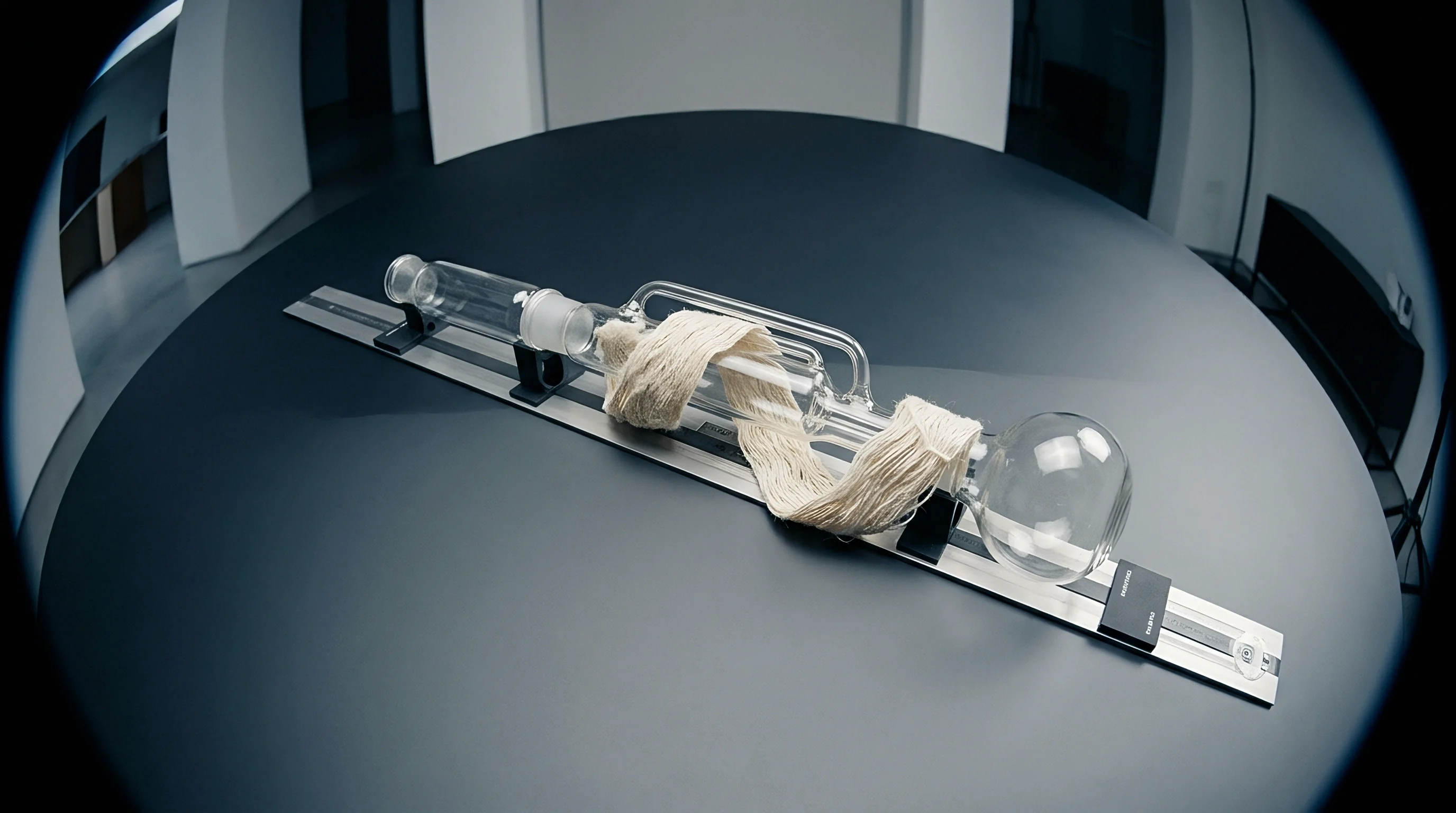
Standardized Extraction Procedure Workflow
Laboratories conducting compliance testing for residual polar amides follow a sample preparation sequence designed to ensure target recovery from technical textiles.
- Cut representative swatches from five distinct locations across the full width of the fabric roll, excluding selvage edges by at least ten centimeters.
- Dice combined swatches using stainless steel shears into uniform particles measuring approximately one millimeter by one millimeter.
- Weigh exactly 1.00 gram of diced sample into a 20-milliliter glass extraction vial using an analytical balance sensitive to 0.1 milligrams.
- Spike the solid sample with 100 microliters of deuterated internal standard solution containing dimethylformamide-d7 and N-methyl-2-pyrrolidone-d6 at 100 milligrams per liter concentration.
- Add exactly 10.0 milliliters of HPLC-grade methanol to the vial using a calibrated volumetric glass pipette.
- Seal the glass vial tightly with a PTFE-lined butyl rubber crimp cap to prevent volatile target loss during thermal agitation.
- Place sealed vials into an ultrasonic bath filled with ultra-pure water and operate at 37 kilohertz frequency and 60 degrees Celsius for 60 minutes.
- Allow the extraction vial to cool to ambient laboratory temperature of 22 degrees Celsius over 20 minutes to re-establish liquid-vapour equilibrium.
- Filter 1.5 milliliters of liquid extract through a 0.22-micrometer PTFE syringe filter directly into a 2-milliliter auto-sampler vial for gas chromatography injection.
Smaller particles provide greater surface area for methanol penetration, and elevated extraction temperatures drive diffusion out of the polymer. When processing dense polyurethane swatches, cryo-milling with liquid nitrogen prevents frictional heat during grinding, retaining volatile compounds like toluene and tetrahydrofuran that would otherwise evaporate.
Drying lines can appear to eliminate residual dimethylformamide down to non-detectable levels, but surface drying forms a sealed outer skin over thick polyurethane coatings, trapping high concentrations of polar amides within core substrate layers.

Column

Gas Chromatography Separation Mechanics
Resolving polar amides, volatile aromatics, and low-boiling ethers from co-extracted matrix compounds requires deliberate stationary phase selection. Polyethylene glycol (wax) capillary columns offer strong retention for polar analytes like dimethylformamide, dimethylacetamide, and N-methyl-2-pyrrolidone. Dipole-dipole interactions retain the amide carbonyl groups, separating target peaks from non-polar polyurethane oligomers and plasticizer fragments.
Conversely, non-polar 100 percent dimethylpolysiloxane or 5 percent phenyl-methylpolysiloxane phases retain low-molecular-weight amides poorly, causing early elution near the solvent front where volatile matrix interferences overlap.
Mid-polarity phases based on 6 percent cyanopropylphenyl and 94 percent dimethylpolysiloxane offer a balanced option for general solvent screening. The cyanopropyl groups provide adequate selectivity for polar amides while retaining non-polar aromatics like toluene and xylenes. Standard column dimensions of 30 meters length, 0.25 millimeters internal diameter, and 0.25 micrometers film thickness balance resolution against analysis time.
Moving to a 60-meter column with a 1.8-micrometer film increases loading capacity for volatiles, but extends retention times and broadens peaks for high boilers like N-methyl-2-pyrrolidone and formamide.
Carrier gas selection and flow stability dictate overall efficiency and peak symmetry. Helium in constant flow mode at 1.2 milliliters per minute maintains steady linear velocity across thermal gradient ramps. Switching to hydrogen allows linear velocities up to 45 centimeters per second, reducing run times by 30 percent while preserving plate counts.
Oven temperature profiles typically start with a 2-minute hold at 40 degrees Celsius to focus volatile compounds like tetrahydrofuran and dichloromethane, ramp at 10 degrees Celsius per minute to 180 degrees Celsius, and finish with a 240 degrees Celsius bakeout to purge residual high-boiling matrix components.
Mid-polar capillary columns resolve target amides efficiently under optimized thermal gradients.
| Stationary Phase Type | Column Dimensions | Target Analytes | Peak Symmetry Factor | Bakeout Limit |
|---|---|---|---|---|
| Polyethylene Glycol (Wax) | 30 m × 0.25 mm × 0.25 µm | DMF, DMAC, NMP, Formamide | 0.92 to 1.05 | 250 °C |
| 6% Cyanopropylphenyl / 94% Dimethyl | 30 m × 0.25 mm × 0.25 µm | DMF, Toluene, THF, MEK | 0.85 to 0.98 | 280 °C |
| 5% Phenyl / 95% Dimethylpolysiloxane | 30 m × 0.25 mm × 0.25 µm | Toluene, Xylene, Cyclohexanone | 0.70 to 0.82 | 325 °C |
| Thick-Film 624-Type Phase | 60 m × 0.32 mm × 1.80 µm | Volatile Organics, THF, MEK | 0.88 to 1.02 | 260 °C |
Chromatographic Performance and System Degradation
High-throughput testing laboratories monitor chromatographic metrics continuously to spot peak distortion, retention drift, and column fouling before analytical standard failure occurs.
- Active silanol tailing occurs when basic amide nitrogen centers interact with un-silanized hydroxyl sites on fused silica column walls, distorting DMF and NMP peaks into asymmetric shapes.
- Stationary phase bleed accelerates when oxygen contamination or continuous thermal exposure above 250 degrees Celsius degrades polyethylene glycol polymers, elevating baseline ion current noise in mass detectors.
- Inlet liner residue buildup stems from non-volatile polyurethane oligomers and fatty acid slip additives depositing inside glass liners, causing rapid thermal breakdown of sensitive targets.
- Retention time drift manifests when carrier gas supply pressure fluctuates or when column front-end contamination alters phase partitioning kinetics across consecutive sequence runs.
- Split injection discrimination arises when high-boiling analytes like N-methyl-2-pyrrolidone vaporize slower than volatile solvents inside the inlet, yielding artificially suppressed peak areas.
Deactivated single-gooseneck liners packed with high-purity glass wool help minimize inlet discrimination and trap non-volatile residues before they reach the column. With dense polyurethane extracts, these liners generally require replacement every fifty injections to maintain peak shape and quantitative consistency.
Excessive injection volumes overload low-capacity capillary columns, producing severe peak fronting and co-elution with matrix interferences.

Ionization

Mass Spectrometry Parameter Optimization
Standard 70 electronvolt Electron Impact (EI) ionization fragments target solvents into reproducible mass patterns, allowing straightforward spectral matching against the NIST library. Keeping the ion source at 230 degrees Celsius prevents high-boiling amides from condensing onto the repeller and source lenses, while maintaining the quadrupole at 150 degrees Celsius ensures transmission stability through extended runs of complex textile extracts.
Selected Ion Monitoring (SIM) provides substantially higher sensitivity than full scan acquisition. While full scan across m/z 35 to 350 aids general screening of unknown additives, background pyrolytic noise from the polyurethane matrix elevates baseline limits. SIM focuses dwell times exclusively on target mass channels, suppressing matrix background and permitting quantification down to sub-milligram per kilogram concentrations.
Methods designate one primary quantifier ion and at least two qualifier ions per compound, confirming identity against reference spectra within a 20 percent relative ion ratio window.
Co-extracted plasticizers and monomer fragments frequently introduce matrix interferences when analyzing thick wet-process coatings. Dimethylformamide is quantified using the dimethylcarbamoyl fragment at m/z 73, with m/z 44 and m/z 58 as qualifiers. Dimethylacetamide quantifies on m/z 87 with qualifiers m/z 43 and m/z 72.
N-methyl-2-pyrrolidone uses m/z 99 for quantification and m/z 44 and m/z 70 for confirmation. Toluene quantifies on base ion m/z 91 alongside qualifier m/z 92, while tetrahydrofuran uses m/z 42 and m/z 71. Monitoring specific fragment ions avoids false-positive quantitation caused by common background interferences, such as the m/z 149 fragment from phthalate plasticizers.
Co-eluting plasticizer breakdown products shift target ion ratios past acceptable qualifier thresholds during high-temperature mass spectrometry scanning.

Does Deuterated Solvent Addition Correct Extraction Loss?
Spiking swatches with stable isotope internal standards prior to extraction compensates for solvent evaporation, incomplete extraction yields, and source suppression in the mass spectrometer. Deuterated analogues ~ such as dimethylformamide-d7, dimethylacetamide-d9, and N-methyl-2-pyrrolidone-d6 ~ mirror the physical and chemical behavior of unlabelled targets throughout extraction, inlet vaporization, and ionization, eluting just ahead of native peaks due to isotopic retention shifts.
Interference from co-extracted polyurethane additives presents distinct analytical signatures during mass spectrum interpretation across high-sensitivity compliance runs.
- Phthalate plasticizer fragments yield prominent m/z 149 ions and low-mass hydrocarbon clusters that elevate baseline noise during target amide retention windows.
- Diisocyanate monomer residues like 4,4′-diphenylmethane diisocyanate undergo thermal degradation in injection ports, producing aromatic amine peaks that corrupt mass spectrum baselines.
- Organophosphorus flame retardants degrade under high electron impact source energies, generating low-mass phosphorus oxide fragments that overlap with target qualifier ions.
- Fatty acid slip agents including erucamide and oleamide produce dense homologous hydrocarbon ion series that suppress target ion signal intensities.
Because deuterated standards experience matrix suppression identical to native analytes, they provide continuous correction across analytical batches ~ even when matrix effects alter detector response by as much as thirty percent.
Spectral overlap between target qualifier ions and co-extracted resin degradation products raises questions regarding whether single-quadrupole instruments can definitively confirm trace polar solvent contamination without secondary triple-quadrupole tandem mass spectrometry verification.
Calibration
Quantitative Calibration Mechanics
Establishing linear calibration requires serial dilutions of target solvents in neat solvent or matrix-matched solutions. Stock solutions containing dimethylformamide, dimethylacetamide, N-methyl-2-pyrrolidone, formamide, toluene, and tetrahydrofuran are prepared in HPLC-grade methanol at 1000 milligrams per liter. Working standards are then prepared at 0.1, 0.5, 1.0, 5.0, 10.0, 50.0, and 100.0 milligrams per liter, each spiked with internal standards dimethylformamide-d7 and N-methyl-2-pyrrolidone-d6 at 1.0 milligram per liter to generate internal standard response curves.
Residual solvent concentration in the fabric is calculated from the extract concentration, total extraction volume, dry sample mass, and applicable dilution and recovery factors. The concentration C (in milligrams per kilogram) is determined using sample mass M in grams, extract volume V in milliliters, target peak area A_t, internal standard peak area A_is, target response factor RF_t, internal standard response factor RF_is, and extraction recovery factor R.
Equation for solid sample target solvent concentration calculation:
Target concentration C is derived from peak area ratios and response factors, adjusted for extract volume, sample mass, and recovery factor R.
Methanol ultrasonic extraction at sixty degrees Celsius yields average recoveries of ninety-four percent. Secondary dilutions performed prior to injection are accounted for with dilution factor D. Calibration curves must maintain a coefficient of determination (R-squared) above 0.995 across the working range. Limits of Detection (LOD) and Limits of Quantitation (LOQ) are established per ISO 17025 validation guidelines using 3:1 and 10:1 signal-to-noise ratios.
Working LOQs must reach 0.5 milligrams per kilogram or lower to verify compliance against brand restricted substance lists and OEKO-TEX Class I criteria.
Matrix-matched standards prepared from solvent-free polyurethane resin prevent systemic underreporting of polar target analytes during automated peak integration.
| Target Solvent Analytes | Quantifier Ion (m/z) | Qualifier Ions (m/z) | Linear Range (mg/L) | Target LOD (mg/kg) | Target LOQ (mg/kg) |
|---|---|---|---|---|---|
| Dimethylformamide (DMF) | 73 | 44, 58 | 0.1 to 100.0 | 0.10 | 0.30 |
| Dimethylacetamide (DMAC) | 87 | 43, 72 | 0.1 to 100.0 | 0.10 | 0.30 |
| N-Methyl-2-pyrrolidone (NMP) | 99 | 44, 70 | 0.1 to 100.0 | 0.15 | 0.50 |
| Formamide | 45 | 29, 44 | 0.5 to 100.0 | 0.25 | 0.80 |
| Toluene | 91 | 92, 65 | 0.05 to 50.0 | 0.05 | 0.15 |
| Tetrahydrofuran (THF) | 42 | 71, 72 | 0.05 to 50.0 | 0.05 | 0.15 |
Method Validation File Requirements
Auditing accredited testing laboratories demands reviewing complete analytical validation packages to verify that reported non-detectable results reflect genuine analyte absence rather than poor instrument sensitivity.
- Initial precision and recovery records demonstrating mean recovery between 80 percent and 120 percent across six spiked virgin matrix samples.
- Linearity verification charts proving R-squared correlation coefficients exceed 0.995 for all targeted polar amides across seven calibration levels.
- Blank sample chromatograms proving extraction solvents and glassware contain zero target solvent contamination above method detection limits.
- Instrument signal-to-noise calculations establishing true limit of quantitation values at or below brand restricted substance thresholds.
- Retention time stability logs tracking internal standard retention windows within plus or minus 0.05 minutes across twenty-four-hour sequences.
- Qualifier ion ratio tolerance tables establishing acceptable match bands within twenty percent relative of reference calibration standards.
Internal standard correction accounts for slight volume variations, while matrix-matched calibration curves correct for ionization suppression caused by co-extracted polyurethane components.
Compliance discrepancies often trace back to unverified split injection ratios where laboratories skip validating recovery against their ISO 17025 scope. Quality agreements generally require test packages to provide raw chromatograms, ion ratio tables, and batch spike recoveries before releasing production lots.

Enforcement

Market Surveillance and Border Clearance
Customs authorities across the European Union, the United States, and China actively screen imported technical textiles and synthetic leathers for residual polar amides. In Europe, RAPEX Safety Gate alerts trigger when surveillance identifies dimethylformamide above the REACH Annex XVII Entry 72 threshold of 3000 milligrams per kilogram. Shipments failing compliance checks at port of entry face detention, mandatory re-export, or destruction at the importer’s expense.
Clearance of flagged shipments depends heavily on test documentation. Customs reviewers check that laboratory scopes cover specific test methods, such as EN ISO 16189, under an active ISO/IEC 17025 accreditation schedule. Generic gas chromatography accreditations lacking detailed solvent extraction parameters are routinely rejected during audits.
Laboratory reporting limits often exceed target buyer specifications when testing facilities utilize low-sensitivity screening protocols. Matrix matching for all polyurethane synthetic leather testing eliminates false-negative outcomes on commercial shipments. Transaction certificates must link individual fabric rolls directly to tested batch lot numbers, establishing an unbroken traceability chain from chemical supplier and wet-processing mill to finished garment container.
Solvent levels frequently vary between edge swatches and the roll core, complicating lot acceptance. Standard drying lines can produce a clean surface while leaving high solvent concentrations inside interior layers. To mitigate this risk, importers often apply ISO 2859-1 acceptance sampling plans, taking core samples from ten percent of imported rolls to verify mill compliance before settling invoices.