Recycled Polyester Content Held as Mass Balance against Segregated Stock
Customs compliance requires physical composition testing while brand claims rely on audited mass balance ledgers, forcing buyers to manage separate verification streams.

Flake
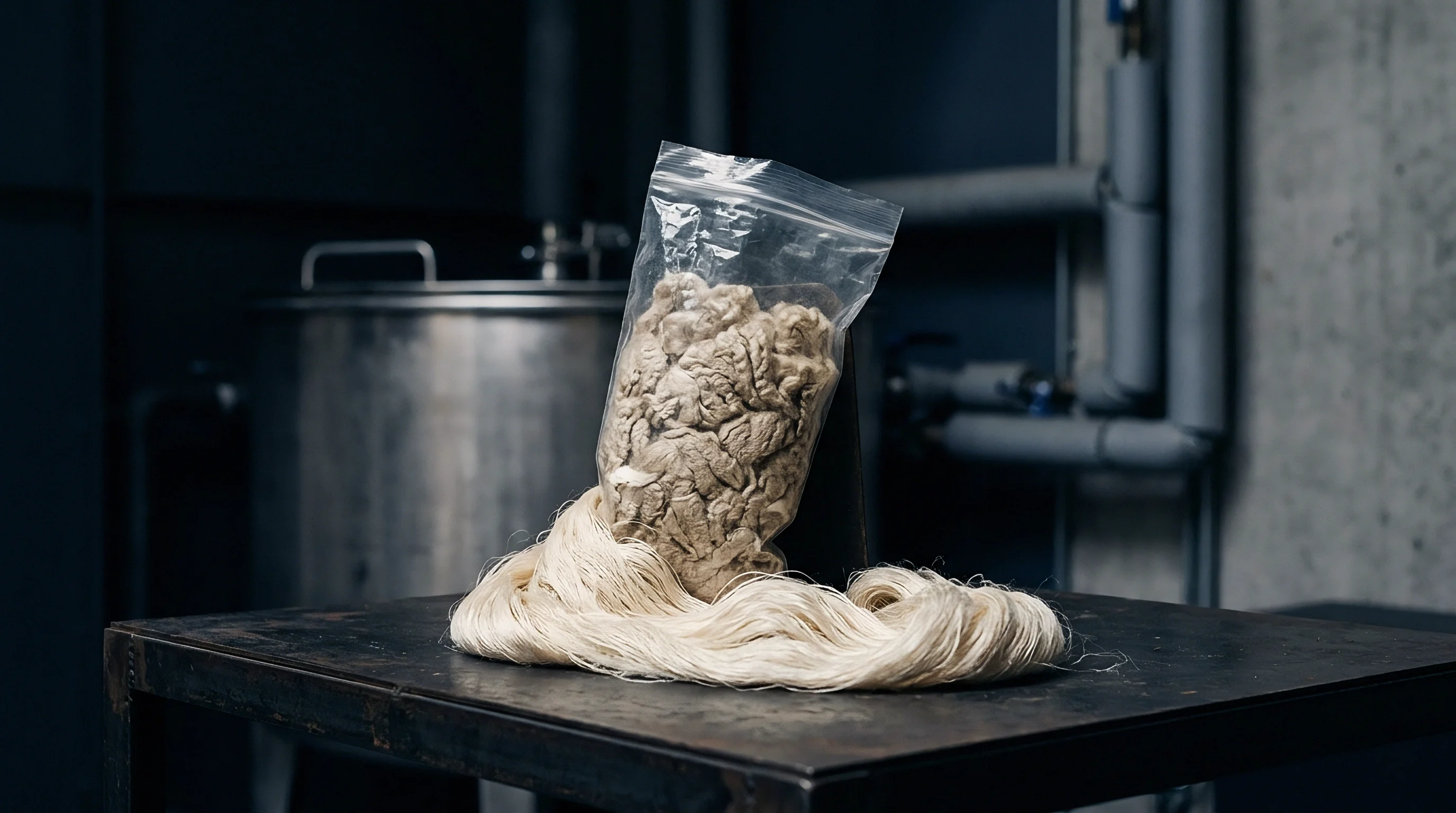
Bale rooms receiving post-consumer polymer stock mark an immediate physical divide between chain-of-custody models. Raw bales of compacted polybutylene terephthalate and polyethylene terephthalate bottles arrive at wash plants carrying dirt, polyolefin closure rings, adhesive residues, and clear or tinted bottles. Preparing this material for mechanical fiber production takes sorting, cold and hot wash steps, caustic bath separation, and optical sorting to isolate clear bottle fragments.
When dedicated mechanical lines process this input, the ground material moves directly into dedicated silos for drying and solid-state polymerization. Physical segregation demands an unbroken barrier from the receiving dock to the final yarn package. Every vessel, transfer line, hopper, and extruder barrel maintains exclusive custody of the recycled lot.
The system operates on inventory isolation, where virgin resin never enters the material handling circuit.
Chemical conversion infrastructure runs on a completely different model. Mass balance accounting exists because continuous chemical plants feed post-consumer feedstock straight into multi-stage depolymerization reactors alongside virgin petrochemicals. High-throughput chemical synthesis units cannot economically isolate small batches of post-consumer scrap into separate physical production runs.
Glycolysis and methanolysis systems dissolve mixed polymer feedstocks, breaking ester bonds to generate purified monomers such as dimethyl terephthalate and mono-ethylene glycol. Once refined through vacuum distillation and crystallization, these monomers flow directly into the continuous polymer synthesis stream. Inside the polycondensation reactor, a monomer unit derived from a post-consumer bottle behaves identically to one derived from crude oil.
The polymer melt exiting the die face is a single molecular blend in which virgin and recycled polymer chains are physically indistinguishable.
A bottle-flake lot carrying over 50 parts per million of polyolefin caps reduces melt-filter pack life by half during mechanical re-extrusion.
Mechanical flakes carry residual bottle adhesive. The mechanical route retains the thermal history of the original bottle resin ~ including degradation products, branched polymer structures, and residual catalysts left behind from initial synthesis. Chemical recycling erases that physical history entirely by breaking the polymer down to its basic chemical building blocks.
When evaluating incoming feedstocks, the split between physical segregation and mass balance allocation starts right at the receiving bay door.
Physical segregation systems suffer specific operational vulnerabilities during feedstock preparation and line changeovers:
- Cross-contamination during hopper loading happens when shared pneumatic conveyance lines hold residual virgin resin pellets that enter dedicated recycled storage bins.
- Color shifting from heat exposure develops when post-consumer scrap carrying trace polyvinyl chloride fragments releases hydrochloric acid during drying, degrading intrinsic viscosity.
- Melt filtration pressure spikes build up when micro-fine aluminum particle passing through sixty-micron filter meshes during continuous filament extrusion.
- Volatile organic compound off-gassing occurs when residual bottle contents volatilize inside an unvented extruder barrel, causing filament breaks at the spinneret face.
Mass balance systems bypass these processing disruptions by shifting post-consumer material into the monomer refining stage. Continuous chemical plants accept wider feedstock specifications because chemical purification steps remove inorganic pigments, heavy metals, and foreign polymers before repolymerization occurs. The resulting polymer chips or direct melt stream flow into standard melt-spinning equipment at uniform temperatures and pressures.
A buyer receiving yarn spun from this melt holds a document assigning recycled content rather than a package containing isolated recycled molecules. On the factory floor, the material entering the spinning mill processes identically to pure virgin petrochemical resin. Extruder performance confirms this equivalence, as pressure differentials across the spin pack remain flat over extended production cycles.
This divergence between physical custody and accounting allocation leaves buyers facing a fundamental compliance question: does the physical presence of recycled molecules determine product identity, or does audited allocation across a mass balance system satisfy trade claims?

Chemistry
Molecular mass distribution in synthetic polymers depends entirely on the polymerization pathway and subsequent thermal processing. Polyethylene terephthalate formed by direct esterification of purified terephthalic acid with mono-ethylene glycol exhibits a narrow molecular weight distribution, with intrinsic viscosity typically targeted between 0.64 and 0.68 deciliters per gram for textile-grade filament yarns. When mechanical recycling processes post-consumer bottle flake, repeated thermal cycles introduce hydrolytic and thermal cleavage of the ester backbone.
Water content above 0.005 percent by weight during melt extrusion degrades polymer chain length, dropping intrinsic viscosity below 0.60 deciliters per gram. That degradation cuts melt strength, shifts the melt flow index, and alters crystallization kinetics during filament drawing.
Chemical depolymerization avoids thermal chain degradation by reversing the polycondensation reaction. Glycolysis breaks the polymer chain using excess mono-ethylene glycol at temperatures between 190 and 240 degrees Celsius in the presence of transesterification catalysts such as zinc acetate or manganese acetate. The primary reaction product, bis(2-hydroxyethyl) terephthalate, undergoes filtration, decolorization with activated carbon, and fractional crystallization to isolate pure monomer.
Methanolysis subjects the polymer to high-pressure reaction with methanol, producing refined dimethyl terephthalate and mono-ethylene glycol. Both chemical pathways yield monomer inputs that match virgin petrochemical specifications, eliminating the thermal degradation history of the post-consumer scrap.
| Process Route | Intrinsic Viscosity (dL/g) | Diethylene Glycol Content (%) | Residual Antimony (ppm) | Melt Temperature Peak (°C) |
|---|---|---|---|---|
| Virgin Petrochemical Synthesis | 0.645 ± 0.010 | 1.15 ± 0.05 | 180 to 220 | 255.5 |
| Mechanical Flake Re-extrusion | 0.580 ± 0.035 | 1.65 ± 0.20 | 240 to 310 | 251.0 |
| Glycolysis Mass Balance Output | 0.648 ± 0.008 | 1.18 ± 0.04 | 185 to 215 | 255.2 |
| Methanolysis Mass Balance Output | 0.646 ± 0.007 | 1.14 ± 0.03 | 180 to 210 | 255.4 |
Diethylene glycol formation during repolymerization serves as an analytical marker for thermal stress in polyester manufacturing. Higher diethylene glycol content lowers the polymer melting point, alters dye uptake rates, and decreases ultraviolet stability. Mechanical recycling routes consistently show elevated diethylene glycol levels from repeated heating during bottle manufacturing, flake drying, and yarn extrusion.
Chemical depolymerization processes remove diethylene glycol during monomer crystallization, yielding repolymerized mass balance resin with diethylene glycol percentages identical to virgin synthesis lines. The thermal stability of yarn produced from mass balance melt-spinning matches virgin petrochemical yarn, avoiding the dye-batch variance commonly observed in mechanically recycled fibers.
Catalyst residues further differentiate physical processing from chemical depolymerization. Antimony trioxide serves as the primary polycondensation catalyst in global polyester production. Mechanical recycling of bottle flake concentrates antimony levels because bottle resins typically utilize higher catalyst loads to achieve rapid polycondensation.
Chemical mass balance systems, when introducing purified bis(2-hydroxyethyl) terephthalate back into the primary synthesis reactor, maintain controlled antimony concentrations within standard virgin tolerances. Polymer exiting a mass balance chemical reactor demonstrates uniform crystal nucleation rates during cooling, preventing localized stress concentration points that cause filament breaks during high-speed drawing at three thousand meters per minute.
Physical segregation maintains distinct physical boundaries at the cost of molecular uniformity. Chemical mass balance restores virgin molecular architecture while blending post-consumer monomer inputs into continuous production runs. Thermal history dictates fiber tenacity.
Fiber drawn from chemically depolymerized mass balance polymer displays tensile strength and elongation metrics indistinguishable from virgin stock, whereas mechanically recycled fiber exhibits wider statistical variance across single-filament tensile tests.
Melt filtration pressure remains flat when processing chemically repolymerized mass balance resin.
Ledger
Accounting for recycled volume inside continuous chemical plants requires strict bookkeeping rules to preserve market integrity. Mass balance standards, including ISCC PLUS and ISO 22095, define procedures for tracking sustainable attributes through complex manufacturing systems. The central mechanism relies on credit allocation: physical post-consumer feedstock enters the processing facility, is quantified by net mass and dry purity, and is converted into equivalent credit units based on chemical yield factors.
These credits enter a virtual inventory register. As finished polymer products exit the facility, the manufacturer assigns recycled credits to specific outbound lots, allowing those lots to be sold with certified recycled claims even though the physical molecules represent the plant’s average operational mixture.
Credit allocation methods directly influence commercial accounting. ISO 22095 defines several chain-of-custody models, including proportional allocation and free allocation. Proportional allocation requires that every unit of output leaving the facility carries the exact percentage of recycled attributes corresponding to the total input ratio during the determination period.
Free allocation permits the manufacturer to concentrate recycled credits onto specific product lines, marking a portion of production as one hundred percent recycled while labeling the remaining output as zero percent recycled. This concentration of credits enables high-value sustainable branding but severs any remaining correlation between the physical yarn package and its documented recycled content.
Contractual allocation under ISCC PLUS rules strictly limits credit transfers to site-specific mass balance ledgers within a rolling twelve-month window.
Mass balance accounting follows a structured operational sequence to ensure credit integrity across complex manufacturing operations:
- Feedstock weight and composition are verified at the facility gate via chemical assay and weighbridge certification.
- Stoichiometric conversion factors are applied to calculate the theoretical monomer yield from the verified raw material mass.
- Processing losses and energy co-products are deducted from the credit pool using audited chemical yield equations.
- Net recycled monomer credits are registered in the site-specific mass balance accounting software.
- Finished polymer production runs are credited against the register using either proportional or free allocation rules.
- Outbound transaction certificates are issued to buyers, deducting equivalent credits from the site inventory.
- Annual third-party audits reconcile physical material receipts against issued mass balance transaction certificates.
Physical losses during depolymerization reduce the net credits available for allocation. When a plant processes post-consumer flake containing ten percent non-PET contamination, the accounting system must deduct the mass of non-reactive contaminants alongside the chemical yield loss occurring during glycolysis. If one hundred metric tons of crude flake yields eighty-two metric tons of purified bis(2-hydroxyethyl) terephthalate monomer, only eighty-two metric tons of recycled credit enter the ledger.
Applying conversion factors accurately prevents credit inflation across the supply chain.
Site-specific limits govern mass balance transfers under established certification standards. Credits generated at a chemical synthesis plant in one location cannot be transferred to a separate manufacturing site operating under a different legal entity or outside the physical boundary of the certified site balance, unless multi-site certification rules explicitly cover the interconnected facilities. Credits carry a defined shelf life, typically expiring twelve months after entry into the register.
Expired credits are canceled from the accounting system to prevent the accumulation of historical recycled claims that do not correspond to recent physical production.
Failure to reconcile accounting ledgers with physical plant throughput exposes buyers to significant regulatory compliance risks. When an audit reveals that a facility issued transaction certificates exceeding its physical recycled feedstock intake, the certifying body suspends the plant’s chain-of-custody certificate. Products purchased under suspended certificates lose their sustainable designation retroactively, forcing brands to retract public content claims and potentially exposing importers to mislabeling penalties under consumer protection laws.
Audit logs track credit movements annually. The financial impact of credit cancellation falls directly on the brand holding unverified allocation claims.
Mass balance allocation balances the plant ledger. Landed cost calculations factor in the credit premium charged per kilogram of certified output. Mismanaging credit balances corrupts the document trail, turning a certified supply chain into a commercial liability.


Bench
Analytical verification of recycled polyester content presents stark technical differences between physically segregated stock and mass balance allocations. Physical segregation relies on detecting physical markers, thermal history variations, or trace contaminants inherent to post-consumer processing. Differing thermal properties surface clearly during Differential Scanning Calorimetry analysis.
Mechanically recycled polyethylene terephthalate often exhibits a secondary melting shoulder or broadened crystallization peak caused by degraded polymer chains, foreign polyolefins, or variable diethylene glycol content. Inductively Coupled Plasma Mass Spectrometry detects residual catalyst elements, such as elevated antimony or trace titanium dioxide delustrant particles, providing a chemical fingerprint characteristic of post-consumer bottle streams.
Chemically depolymerized mass balance polyester invalidates traditional physical detection methods. Because chemical recycling reduces post-consumer waste to purified monomers before repolymerization, the resulting polymer chains possess identical molecular weight distributions, crystal structures, and chemical purity to virgin petrochemical polyester. Spectroscopic techniques, including Fourier-Transform Infrared Spectroscopy and Nuclear Magnetic Resonance Spectroscopy, return identical spectra for virgin polymer and chemically recycled mass balance polymer.
Isotope Ratio Mass Spectrometry fails to differentiate between fossil-derived virgin PET and fossil-derived bottle scrap because both originate from crude oil inputs with identical carbon-14 signatures.

Why Do Mass Balance Polymer Batches Pass Isotopic Tests?
Mass balance polyester batches pass carbon-14 isotopic testing because post-consumer PET bottles and virgin petrochemical polyester share identical fossil carbon origins. Isotopic testing reliably identifies bio-based content by measuring the decay of radio-carbon isotopes present in plant-derived feedstocks. Fossil-derived PET contains zero carbon-14, regardless of whether it was synthesized yesterday from ethylene or recovered from a five-year-old water bottle.
Consequently, carbon isotope analysis confirms the synthetic origin of the polymer but cannot determine whether the carbon passed through a recycling process.
| Test Method | Target Parameter | Detection Limit | Physical Segregation Utility | Mass Balance Utility |
|---|---|---|---|---|
| Differential Scanning Calorimetry (DSC) | Thermal transitions and melting peak width | 0.5% contaminant content | High (detects thermal history) | None (identical to virgin) |
| ICP-MS Catalyst Fingerprinting | Antimony, Titanium, Germanium ratios | 0.1 parts per million | Moderate (identifies bottle resin) | None (monomer refining cleans metals) |
| Gel Permeation Chromatography (GPC) | Molecular weight distribution (Mw/Mn) | ± 2,000 Daltons | Moderate (shows chain degradation) | None (controlled polymerization) |
| Isotope Ratio Mass Spectrometry (IRMS) | Carbon-13 / Carbon-12 isotope ratios | 0.1 per mil relative variance | Low (regional oil source variations) | None (shared fossil feedstock) |
| Chemical Tracer Taggant Analysis | Exogenous marker molecules | 1 part per billion | High (if tracer added to batch) | High (if tracer added to monomer) |
Physical testing laboratories cannot verify mass balance claims through fabric testing alone. Chemical mass balance leaves no physical tracer. When a customs authority or brand auditor submits a cloth swatch to an accredited testing facility, quantitative chemical analysis following ISO 1833-11 returns a declaration of one hundred percent polyester, but cannot determine the allocation method used on the upstream polymer ledger.
Verification of mass balance supply chains relies entirely on documentary audits rather than physical bench testing. Certifying bodies inspect site ledgers, mass balance accounting software logs, raw material invoices, and shipping transaction certificates to verify that credit entries match plant throughput. Physical sampling confirms material identification and performance parameters, but documentation proves the sustainable attribute claim.
When questioned about the lack of physical test evidence for a mass balance shipment, the absolute molecular identity of recycled and virgin polymer leaves document auditing as the sole scientifically sound verification method.
Tariff
Customs classification of synthetic yarn and fabric relies strictly on physical material composition as presented to customs authorities at the port of entry. The Harmonized Commodity Description and Coding System assigns headings based on fiber type, staple length, linear density, and weight distribution. Continuous filament polyester yarn falls under HS heading 5402, while polyester staple fiber falls under heading 5503.
Tariff schedules do not differentiate between virgin polyester, mechanically recycled polyester, and chemically depolymerized mass balance polyester. Duty rates apply strictly based on the physical presence of polyester fiber, regardless of sustainability marketing claims or mass balance certification certificates attached to the commercial invoice.
Customs officers sample physical yarn. Border authorities perform physical composition testing to verify tariff classification and check for misdeclaration of fiber blend ratios. If an importer declares a shipment as seventy percent cotton and thirty percent recycled polyester under HS code 5211.42, the customs laboratory executes quantitative chemical separation according to standard test protocols.
The laboratory measures physical mass loss after solvent dissolution to confirm exact weight percentages. The presence of an ISCC PLUS mass balance transaction certificate asserting fifty percent recycled credit allocation does not alter the physical weight calculation used by customs to assess import duties and compliance with trade agreements.
Customs authorities examine the physical cloth on the cutting table rather than the paper credits in the trader ledger.
Import documentation for mass balance synthetic goods must maintain a clear distinction between physical trade declarations and environmental marketing claims:
- Physical composition declarations state the true fiber percentages verified by physical mass separation for customs duty valuation.
- Transaction certificates provide third-party verification of mass balance credit allocation for supply chain transparency claims.
- Bills of lading must match the physical gross weight of the shipment rather than the allocated credit mass listed on sustainable attribute claims.
- Country of origin documentation identifies the location of physical spinning or weaving operations under international origin rules.
Green claims regulations introduce legal risks when selling mass balance products to end consumers. The European Union Green Claims Directive and the United States Federal Trade Commission Green Guides establish strict guidelines for environmental assertions. Marketing a textile product as made from recycled materials when the underlying supply chain utilizes mass balance allocation with free credit concentration requires explicit qualifying language.
Regulatory bodies penalize claims that imply physical recycled content when the product contains molecules derived from virgin petrochemical sources allocated via a mass balance ledger.
Trade agreements and preferential tariff frameworks turn on country-of-origin rules defined by specific transformation steps rather than chemical attribute allocations. Preferential origin for polyester yarn requires substantial transformation, typically defined as extrusion from resin or spinning from staple fiber within a participating trade partner territory. Paper allocation certificates credit transfers across international corporate entities do not satisfy origin criteria.
Importers must align physical logistics with documentary compliance to prevent tariff penalties, unexpected duty assessments, and potential seizure of shipments at customs checkpoints.
Customs duty tariffs apply to physical mass. Commercial contracts must include specific risk allocation clauses to protect buyers against regulatory friction caused by mismatches between customs declarations and mass balance documentation. Standard trade contract provisions explicitly define liability when imported goods meet physical technical specifications but fail local green claims verification laws due to unapproved mass balance allocation practices.

Spindle
Extrusion lines running continuous polyester filament operate at winding speeds between three thousand and five thousand meters per minute. Processing mechanically recycled PET flake through high-speed draw-texturing machinery reveals distinct mechanical performance boundaries compared to chemically repolymerized mass balance resin. Mechanically recycled polymer carries micro-variations in intrinsic viscosity and trace inorganic contaminants, causing localized tension fluctuations during high-speed drawing.
These tension spikes result in higher filament break rates, increased yarn hairiness, and frequent spin-pack pressure buildups that mandate shorter pack life cycles. Spinning mills compensate for mechanical flake limitations by dropping extrusion speeds, increasing denier targets, or introducing dedicated melt-filtration systems.
Chemically depolymerized mass balance resin processes on high-speed extrusion lines with identical efficiency to virgin petrochemical polymer. Because chemical depolymerization yields refined monomers, the resulting polymer melt exhibits uniform melt strength, constant crystallization kinetics, and zero residual bottle-grade contaminants. Spinning speed drops when oligomers build up.
In mass balance production, spin-pack life matches virgin operational norms, maintaining flat pressure curves across multi-week continuous extrusion runs. Yarn drawn from mass balance polymer displays low coefficient of variation metrics for linear density and tenacity, enabling high-speed weaving and knitting operations without the machine downtime associated with mechanically recycled yarns.
| Yarn Type | Tenacity (cN/tex) | Elongation at Break (%) | Boiling Water Shrinkage (%) | Linear Density CV (%) |
|---|---|---|---|---|
| Virgin Petrochemical Polyester | 4.45 ± 0.12 | 22.5 ± 1.2 | 6.2 ± 0.3 | 0.85 |
| Mechanically Recycled Segregated Stock | 3.85 ± 0.28 | 18.2 ± 2.1 | 7.8 ± 0.6 | 1.65 |
| Mass Balance Chemically Recycled PET | 4.42 ± 0.11 | 22.3 ± 1.1 | 6.3 ± 0.3 | 0.88 |
Commercial pricing structures reflect technological and operational differences between physical segregation and mass balance allocation. Mechanically recycled polyester filament carries a price premium driven by feedstock sorting, wash plant operations, and dedicated line cleaning overheads. However, its processing limitations cap its utility in ultra-fine denier applications, such as twenty-denier monofilaments or micro-denier athletic fabrics.
Chemically depolymerized mass balance polyester commands a premium based on chemical plant capital expenditures and third-party certification auditing costs, but delivers full performance parity with virgin fiber in complex, fine-denier constructions.
Chemical depolymerization erases the thermal history of post-consumer waste, producing filament yarn indistinguishable from petrochemical polyester on the spinning frame.
Landed cost calculations must weigh physical processing yields against attribute credit costs across the manufacturing value chain. When specifying yarns for high-density woven constructions, a buyer evaluating mechanically recycled options must factor in higher loom stop rates, variable dye uptake between dye lots, and increased scrap rates during garment cutting. Mass balance yarns eliminate these weaving mill inefficiencies, maintaining standard production yields while providing certified attribute claims for brand reporting.
Physical segregation demands dedicated storage silos. The commercial decision turns on whether the buyer requires physical proof of recycled molecules in the finished garment or validated corporate allocation ledgers that support broader sustainability metrics. Yarn tension logs across warp preparation confirm that mass balance lots deliver the structural uniformity demanded by high-speed air-jet looms.