Pore Structure Mechanics Dictating Mass Transport Limits in Dense Cellulosic Wet Processing
Dense cellulosic wet transport is limited by swelling-induced micro-pore collapse; forced hydraulic convection and controlled diffusion times prevent core pale-outs.
Bore
Dense cellulosic fabrics resist liquid penetration during continuous and batch wet processing. Substrates woven at high cover factors ~ like 80s/2 combed cotton poplins, high-density twills, and dense lyocell constructions ~ possess a dual-scale porous network. Fluid moves through two distinct domains here: inter-yarn channels between warp and weft threads, and intra-yarn capillary spaces between microfibrils.
Once cover factors pass 85% under ISO 2116 structural formulas, inter-yarn channels constrict to hydraulic diameters below 5 micrometres, shifting mass transport from bulk convective flow to restricted capillary migration.
The geometric layout of these internal voids dictates how wet processing liquors pass through the fabric. In open weaves, liquor moves quickly along broad paths under a minimal hydraulic gradient. Dense cellulosic constructions force fluid into long, convoluted routes instead.
Structural tortuosity ~ the ratio of actual fluid path length to straight-line fabric thickness ~ means liquor changes direction constantly inside the yarn bundle, sharply cutting effective velocity.

Pore Void Distributions in High Cover Cellulosic Wovens
Void volume inside dense cellulosic matrices spans three tiers. Micro-voids in the crystalline and amorphous regions of cellulose fibers measure less than 2 nanometres across. Meso-voids between internal microfibrils range from 2 to 50 nanometres.
Macro-voids ~ the spaces between adjacent fibers in spun yarn and the gaps between intersecting warp and weft yarns ~ span 0.5 to 12 micrometres. Processing efficiency depends on liquid reaching these meso-voids, where reactive and direct dyes bond.
Fabric construction parameters fix the boundary conditions for fluid transport from the start. Warp end count, weft pick count, twist factor, and cross-sectional flattening during weaving establish total initial porosity. High twist multipliers in ring-spun yarns yield dense packing in the yarn core, restricting initial fluid entry into intra-yarn voids.
Rotor-spun yarns have a looser core wrapped by tight surface fibers, causing irregular radial suction during padding. Vortex-spun cellulosics maintain aligned parallel cores with anisotropic flow rates under pressure.
A high structural tortuosity factor multiplies internal hydrodynamic friction and retards liquor displacement.
Yarn crimp introduces further geometric barriers to mass transport. High warp crimp lengthens inter-yarn macro-channels along the Z-axis. During continuous padding, liquor takes the path of least resistance and bypasses dense crossover points, leaving dry zones inside the weave.
Liquid enters these crossover regions through slow capillary absorption rather than convective flow. Standardized micro-structural measurements outline these dimensions below.
| Substrate Construction | Cover Factor (%) | Macro-Pore Mean Diameter (µm) | Meso-Pore Volume (cm³/g) | Structural Tortuosity Factor |
|---|---|---|---|---|
| Combed Cotton Poplin (80/2 x 80/2, 175 x 92) | 91.2 | 1.85 | 0.042 | 2.85 |
| Carded Cotton Twill (30/1 x 15/1, 108 x 56) | 86.4 | 4.20 | 0.038 | 2.10 |
| Lyocell Plain Weave (60/1 x 60/1, 120 x 80) | 88.7 | 2.15 | 0.065 | 2.45 |
| Viscose Rayon Lawn (50/1 x 50/1, 96 x 72) | 78.5 | 6.80 | 0.051 | 1.65 |

Structural Tortuosity and Capillary Radius Breakdown
Fluid migration through fine inter-fiber spaces follows capillary pressure dynamics under the Young-Laplace equation. Capillary pressure rises as effective capillary radius shrinks. Higher yarn packing density narrows inter-fiber capillaries, pulling liquid into surface pores with greater suction.
That pressure does not ensure rapid volumetric throughput, however. Poiseuille’s law dictates that fluid flux varies with the fourth power of capillary radius: halving the radius doubles capillary pressure while cutting fluid throughput sixteen-fold at the same driving pressure.
Relying on passive wicking alone creates severe bottlenecks in dense cellulosics. Capillary suction draws liquid into outer fiber bundles, leaving yarn cores completely dry. Liquid entering narrow capillaries faces heavy drag against fiber walls, losing its applied pressure head within a few hundred micrometres of entering the fabric.
Wetting agents lower surface tension to aid initial contact, but reducing surface tension also drops capillary driving pressure. Maintaining fluid momentum through dense voids requires balancing wetting agent levels against forced hydraulic pressure.
Primary structural factors governing void distribution include:
- Yarn twist multiplier alters internal fiber packing, with high twist coefficients compressing inter-fiber spaces to restrict longitudinal capillary flow.
- Warp and weft thread density sets inter-yarn macro-pore dimensions and determines cross-sectional open area before wet finishing.
- Fiber cross-sectional geometry defines micro-channel shapes, where kidney-shaped natural cotton fibers yield different flow paths than circular regenerated cellulosics.
- Sizing chemical deposit levels plug surface macro-voids until desizing occurs, temporarily elevating structural tortuosity.
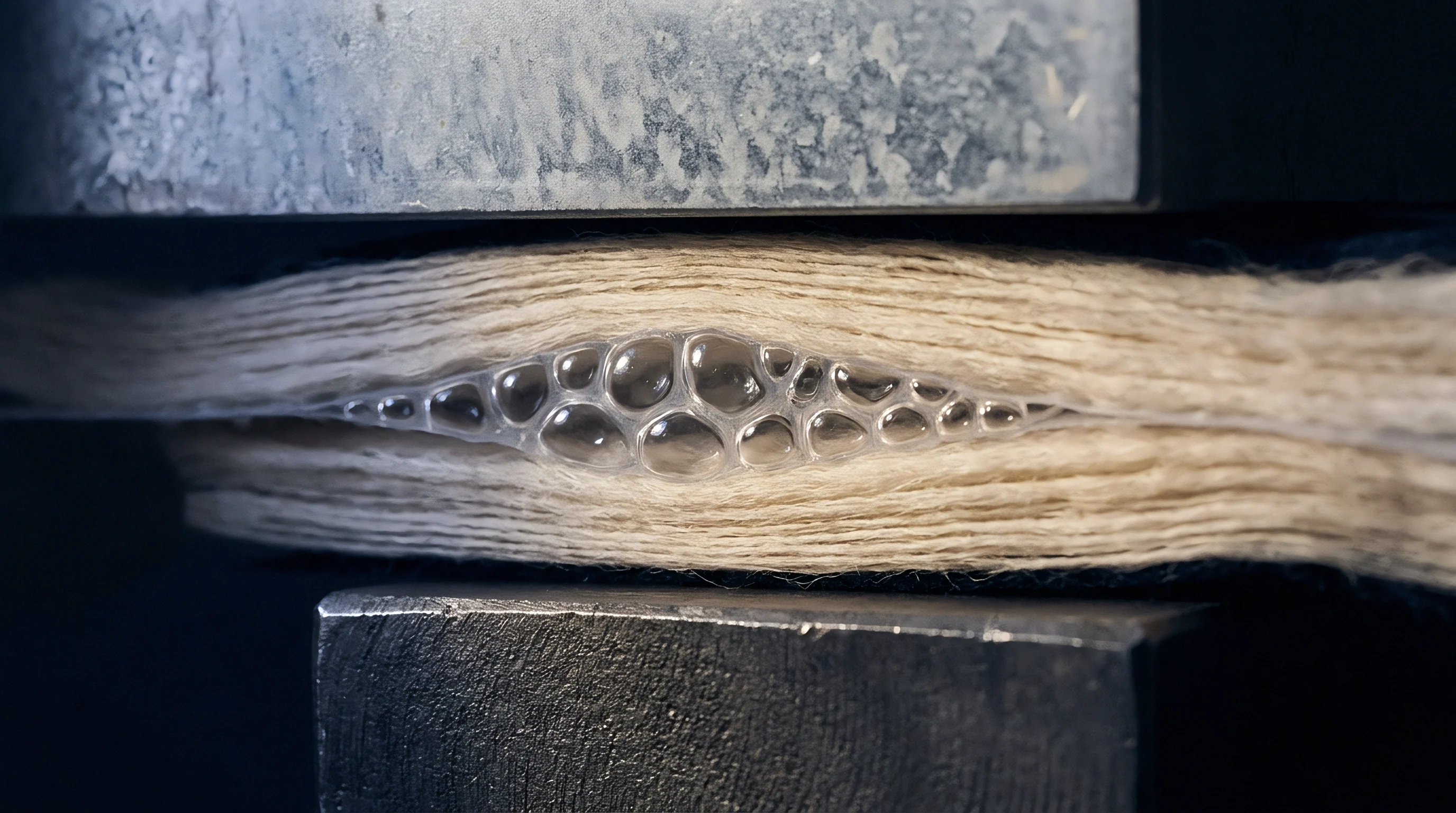
Structural metrics set clear boundaries on continuous dye ranges. High-density wovens padded at standard nip pressures reject liquid almost immediately at high line speeds. Once liquid coats outer yarn surfaces, air trapped in intra-yarn macro-voids cannot escape.
These trapped bubbles build localized back-pressure that blocks liquor from entering yarn centers. Running high-cover cellulosics without vacuum de-aeration or forced low-tension liquor displacement produces severe center-to-edge shade variation and uneven dye distribution.
Ignoring initial void architecture during greige fabric qualification leads to severe internal pale-outs and uneven dye distribution across the lot.

Swell
Contact with water immediately transforms cellulosic fibers. Anhydroglucose polymer chains carry abundant hydroxyl groups that bond with polar water molecules. Upon immersion, water disrupts inter-chain hydrogen bonds in amorphous regions of the cellulose matrix, forcing chains apart to accommodate bound water layers.
Individual fibers expand radially as a result: diameter increases 14% to 22% during hydration, while longitudinal growth stays below 1.5%. This radial expansion alters internal pore geometry within seconds.
As individual fibers expand outward into adjacent void space, the diameter of inter-fiber macro-pores shrinks, cutting total inter-fiber void volume rapidly. Swelling fibers crowd against each other, collapsing intra-yarn voids under pressure. High packing densities speed up this effect: in dense poplins, radial fiber swelling reduces total internal macro-porosity by up to 45% within the first 30 seconds of wet processing.

Microfibrillar Hydration Mechanics and Void Closure
Swelling behavior depends heavily on microfibril alignment. Cotton fibers contain spiraling microfibrils that unwind slightly during hydration, generating internal rotational shear. Regenerated cellulosics like viscose and lyocell lack this spiraled structure, expanding isotropically instead.
Highly oriented crystalline domains in lyocell restrict overall volume swell compared to viscose, but wet mechanical action causes lyocell microfibrils to fibrillate. This releases fine micro-fibers into inter-yarn channels, forming a physical mesh that chokes fluid flow and raises tortuosity.
Immersion in caustic soda reshapes the fiber structure entirely. Mercerization in 20% to 28% aqueous sodium hydroxide solutions alters the crystal lattice, converting native Cellulose I into an alkalicellulose complex. Hydroxide ions enter crystalline domains, breaking inter-chain bonds and driving intense swelling.
Fiber volume expands by up to 60%, rounding out naturally kidney-shaped cotton cross-sections. As the cell wall swells inward and outward at once, lumen voids collapse completely, eliminating inter-fiber gaps inside dense yarn cores.
Standard ISO 105-J03 color difference evaluations mandate sub-surface levelness checks to catch interior yarn ring dyeing before lot approval.
Swelling dictates fluid limits during chemical application, driving down permeability non-linearly as it progresses. Initial contact meets high permeability, enabling quick surface wetting. As water enters fiber interiors, swelling takes over and permeability falls steeply.
Equipment running at constant pressure sees flow rates drop steadily over time, meaning chemical mass transfer requires ongoing adjustments to applied pressure or mechanical energy.
| Processing Bath Chemistry | Fiber Radial Expansion (%) | Inter-Fiber Void Reduction (%) | Hydraulic Permeability Constant (m²) | Equilibrium Water Cut-off Time (s) |
|---|---|---|---|---|
| Deionized Water (20°C) | 14.2 | 28.5 | 4.12 x 10⁻¹² | 12.4 |
| Wetting Agent Bath (2 g/L, 60°C) | 16.8 | 34.1 | 2.85 x 10⁻¹² | 6.2 |
| Caustic Mercerization (220 g/L NaOH, 20°C) | 58.5 | 84.2 | 1.15 x 10⁻¹4 | 1.8 |
| Alkaline Bleach Bath (4 g/L NaOH, 95°C) | 22.4 | 46.8 | 1.62 x 10⁻¹² | 4.5 |
Hydrodynamic Permeability Reduction in Caustic Media
Fluid movement through swollen cellulosic matrices follows modified Kozeny-Carman dynamics, linking permeability to porosity and specific surface area. Volumetric swelling reduces total porosity while expanding the fiber surface area in contact with liquid. That extra surface area amplifies viscous drag at the liquid-solid interface.
In dense cotton poplin, exposure to caustic mercerizing liquors drops the hydraulic permeability constant by over two orders of magnitude, shifting fluid transport almost entirely from viscous convective flow to slow molecular diffusion.
This sharp drop in permeability complicates continuous mercerizing operations. Cold caustic liquor applied to greige or desized fabric swells outer fibers instantly, forming a tight shell around yarn bundles. This swollen skin blocks liquor from penetrating the yarn core.
Un-mercerized cores remain through the fabric thickness, causing uneven dye affinity, shade variations, and patchy luster. Bulk audits show shade depth varying by over 2.5 Delta E CMC units between fabric surface and interior.
Temperature governs both swelling kinetics and permeability decline. Hotter baths weaken hydrogen bonding and reduce liquid viscosity, speeding up displacement before maximum swelling takes hold. Scouring and bleaching at 95°C to 100°C allows chemicals to reach yarn cores before swollen fibers seal off internal flow paths.
Cold processing, by contrast, demands high-concentration non-ionic wetting agents that stay effective under high ionic strength.
Increasing pad nip pressure does not resolve poor chemical pick-up on dense cellulosics; physical displacement limits of swollen micro-voids render mechanical pressure ineffective once fiber expansion closes internal channels.

Transit
Chemical movement through dense cellulosics relies on two coupled mechanisms: convective bulk flow and diffusive mass transfer. Convection carries dissolved dyes, auxiliaries, and alkalis through larger macro-pores under external pressure. Diffusion moves species through stagnant liquid boundary layers and into micro-voids along concentration gradients.
High tortuosity and swollen fibers shut down convective flow inside yarn cores, leaving diffusion as the rate-limiting step in chemical application.
The Peclet number (Pe) reflects whether convection or diffusion dominates within the pore structure. Defined as fluid velocity multiplied by characteristic pore length over the molecular diffusion coefficient, high Peclet numbers (Pe gg 1) mark convection-dominated flow, while low numbers (Pe ll 1) signal diffusion-dominated movement. Convection dominates in inter-yarn macro-channels during padding or jet circulation.
Inside swollen microfibril bundles, however, fluid velocity drops to zero and brings the local Peclet number far below unity, forcing chemical transport inside yarn cores to rely entirely on molecular Fickian diffusion.
Is Forced Liquor Convection Necessary for Sub-Surface Penetration?
Getting chemicals deep into high-cover cellulosics requires active liquid displacement across the web. Passive immersion depends on capillary action, which stalls quickly as air bubbles gather and swelling narrows internal channels. Mechanical equipment must apply positive pressure across the fabric face to force liquor through micro-voids before swollen fibers seal off outer yarn perimeters.
Beam dyeing machines rely on forced convective displacement to process dense substrates. Pumps drive liquor through perforated internal beams, pushing fluid through hundreds of fabric layers under pressure. Fluid velocity must stay high enough to sustain convective flow into intra-yarn spaces without distorting the web or tearing selvedges.
Balancing pump pressure against fabric resistance requires tight control over circulation parameters.
Setting optimal liquor velocity parameters on dense beam packages follows a structured technical process:
- Calculate total fabric package resistance by measuring clean water pressure drop across the bare beam core at maximum rated flow capacity.
- Mount the dense fabric roll under controlled tension, maintaining beam winding density between 340 and 380 grams per litre to prevent channeling.
- Initiate low-temperature liquor circulation at 30°C using an initial fluid velocity of 15 litres per kilogram per minute to purge trapped air from macro-voids.
- Increase bath temperature to processing level while modulating pump reversal cycles to alternate flow direction from inside-out to outside-in every 4 minutes.
Dye molecular size directly dictates diffusion rates through swollen micro-voids. Reactive dyes vary in molecular weight, geometry, and aggregation behavior. Monochlorotriazine (MCT) and vinyl sulfone dyes have low molecular weights (500 to 900 g/mol) and compact hydrated radii (1.0 to 1.5 nm), enabling them to diffuse into internal micro-voids.
High-molecular-weight direct dyes and aggregated phthalocyanines present diameters above 3.5 nm ~ exceeding the pore size of swollen intra-fibrillar gaps and restricting dye deposition to fiber perimeters.
Viscous drag inside micro-channels converts applied pump energy into heat, dropping effective differential pressure across dense beam packages.
Molecular aggregation compounds these transport limits. In aqueous solution, dye molecules form clusters at low temperatures or high electrolyte concentrations. Aggregation increases the effective hydrodynamic radius, lowering the diffusion coefficient per the Stokes-Einstein equation.
Dyeing dense cellulosics with reactive dyes requires elevated bath temperatures (60°C to 80°C) and controlled salt profiles to suppress aggregation, keeping molecules small enough to pass through swollen pores.

Diffusive Mass Transfer and Molecular Aggregation Thresholds
Diffusion through water-filled pores follows modified Fickian kinetics that account for tortuosity and pore contraction. The effective diffusion coefficient (Deff) inside fabric pores sits far below the free-solution coefficient (D0), delaying equilibrium between the bath and yarn cores. In high-density cotton poplins, Deff drops below 10% of D0, extending required dwell times in cold pad-batch dyeing from 6 hours to over 24 hours.
Stagnant concentration boundary layers at fiber surfaces add further resistance. Fluid surrounding individual fibers remains stationary due to viscous drag, forcing dye molecules to cross this boundary by diffusion before reaching the fiber surface. High fluid agitation sweeps away these stagnant layers, thinning them and accelerating transport.
In low-liquor-ratio jets, rapid fabric circulation (300 to 400 metres per minute) maximizes shear forces to minimize boundary layer resistance.
Sub-surface ring dyeing is the principal failure mode arising from transport bottlenecks. It occurs when dye fixes to outer fiber layers before penetrating the yarn core. Microtome cross-sections of ring-dyed yarns show intense outer coloration around stark white centers.
These fabrics perform poorly under ISO 105-X12 abrasion testing, as wear friction exposes un-dyed core fibers and creates visible frosting along seams and rub points.
Under ISO 105-J01 optical evaluation standards, specifications for dense cellulosic wovens require complete cross-sectional penetration ~ verified by microtome sectioning ~ with under 5% relative shade depth variance between surface and core fibers.

Liquor
Equipment design and mechanical execution generate the force needed to drive liquor through dense cellulosic matrices. Processing machinery must apply external work to overcome internal hydrodynamic drag within fine pore networks. Jets, beams, continuous pad-steamers, and package dyeing units rely on distinct mechanisms to force fluid exchange through dense web structures.
Jet machinery combines fabric transport with high-velocity nozzle impact. As dense fabric passes through the nozzle, liquor hits the rope under pressures from 1.5 to 3.5 bar, driving fluid into inter-yarn macro-pores. At the same time, mechanical folding opens temporary gaps between warp and weft threads.
This flexing alters tortuosity briefly, admitting liquid into internal yarn structures before tension restores tight pore geometry.
Forced Fluid Dynamics in Beam and Package Machinery
Beam dyeing offers a clear model of forced radial flow. Fabric is wound under controlled tension onto a perforated cylinder, and liquor is pumped under positive displacement ~ either outward through the roll or inward from the bath. Success on dense cellulosics depends on managing differential pressure (Δ P) across the package web; if Δ P exceeds critical limits, fluid carves low-resistance channels that bypass dense fabric zones completely.
Winding density sets initial package resistance. Loose winding causes liquor to short-circuit along roll edges, while overly tight winding compresses internal micro-pores and drives up hydrodynamic resistance exponentially. Winding density for high-cover cotton poplin should be kept between 350 and 380 kg/m³ to maintain uniform resistance across the beam width and avoid flow starvation.
Managing differential pressure during high-density package processing involves critical control steps:
- Package density calibration requires measuring dry roll mass against total wound volume to keep winding density within +/- 2% of target parameters.
- Flow rate stabilization prevents rapid pressure spikes by ramping pump frequencies over a 180-second period during directional flow reversals.
- Differential pressure capping maintains maximum Δ P below 1.8 bar to prevent mechanical yarn compaction and internal pore collapse.
- Viscosity monitoring adjusts pump pressure when bath temperatures change, maintaining constant volumetric flow rates across temperature ramps.
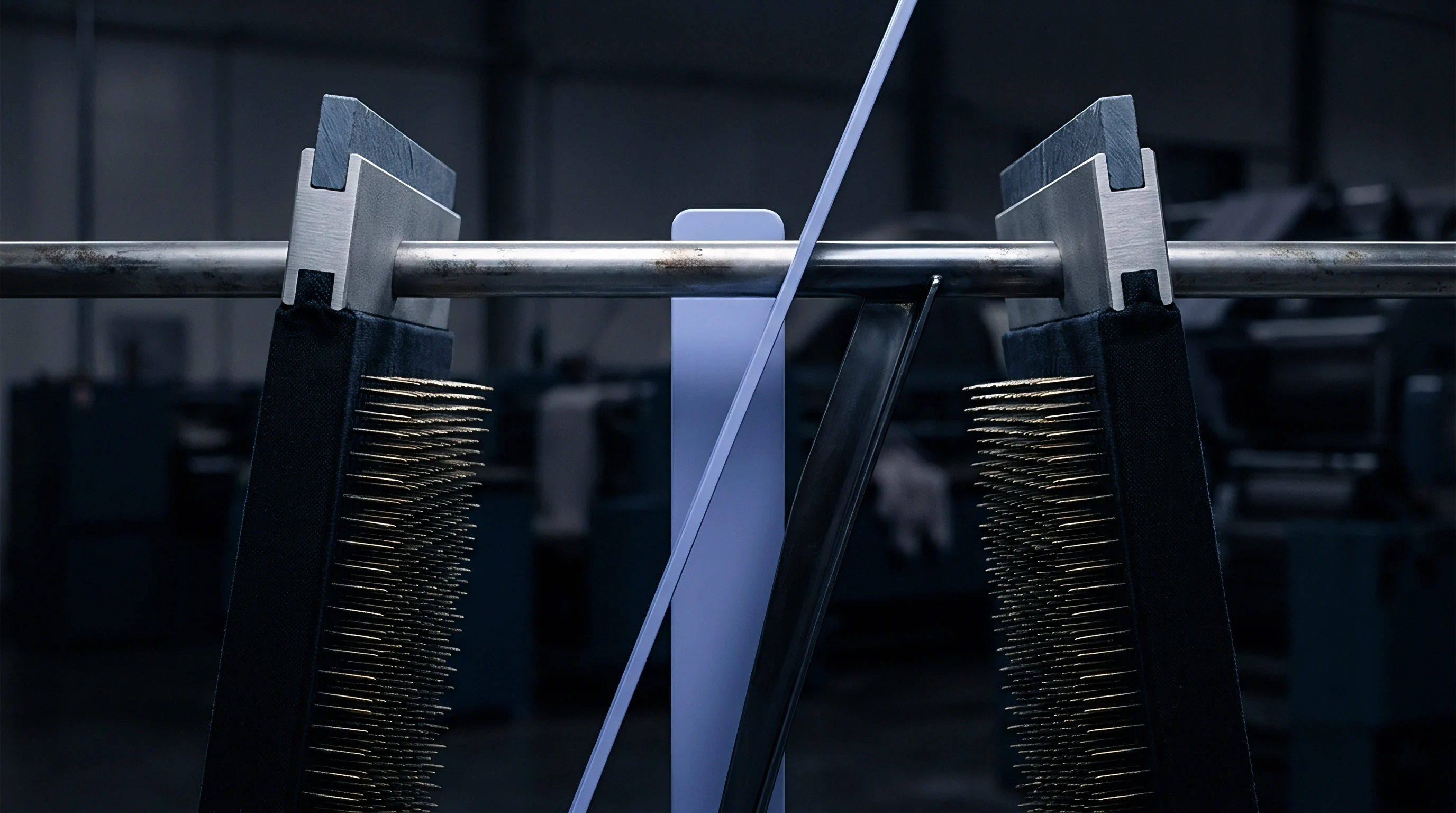
Excessive differential pressure across dense rolls causes severe mechanical compression. Hydraulic forces push inner fabric layers against outer ones, generating web tension that flattens yarns against adjacent wraps and closes inter-yarn macro-channels. This compression reduces fabric thickness by up to 20% during pumping operations, choking transport paths during dye fixation.
Compaction Stress and Mechanical Pore Collapse
Stenters and continuous pad lines apply longitudinal tension to keep fabric flat and aligned. That tension pulls warp yarns taut and forces weft picks closer together, cutting inter-yarn void area by up to 35%. Applying liquor under high web tension restricts liquor pick-up; continuous ranges need to operate at low tension (below 150 N/m web width) to preserve internal void spaces during padding.
Vacuum extraction units after padders remove excess surface liquor while shifting internal pore balances. High-vacuum slots (20 to 40 kPa pressure drop) draw air through the wet web, stripping unbound liquid from macro-pores while leaving bound liquid in microfibrillar meso-pores. This elevates chemical concentration in intra-yarn spaces and reduces wet pick-up, cutting the energy needed for drying.
Applying 2.2 bar differential pressure across a dense cotton beam roll compresses internal fabric layers and reduces overall hydraulic permeability by 40%.
High-pressure steam in continuous steamers speeds mass transport through thermal expansion and condensation. Saturated steam hits cold wet fabric and condenses immediately into water, releasing latent heat (2260 kJ/kg) and rapidly heating internal liquid. Thermal expansion forces trapped air bubbles out of micro-voids, letting chemical liquor move into previously sealed spaces.
Condensing steam accelerates diffusion into swollen microfibrils three to five times faster than hot air dwell.
Edge-to-center shade un-levelness on dense wovens often stems from mechanical beam compression and excessive web tension that physically collapse pore structures, rather than chemical formulation errors.
Receipt
Mass transport constraints in dense cellulosic processing carry direct financial consequences. High-cover fabrics demand higher chemical additions, longer cycle times, increased thermal energy, and higher rejection rates than standard textiles. Quantifying these trade-offs enables sourcing teams and dyehouse managers to calculate true landed costs per metre before committing to bulk orders.
Extended cycle times drive up batch processing costs. Dyeing dense cotton poplin in jet or beam equipment demands slow heating, gradual dosing, and prolonged holds at peak temperature to achieve core penetration. A standard plain-weave cotton (120 g/m²) completes a reactive dyeing cycle in about 360 minutes, whereas dense combed cotton poplin (140 g/m², cover factor > 90%) requires up to 540 minutes to ensure full core penetration and avoid ring dyeing.

Commercial Yield and Drying Energy Overhead
Drying dense cellulosics consumes substantial energy because water is trapped within micro-voids. Bound water in swollen microfibril meso-pores requires more evaporative energy than free water in macro-pores. High capillary pressures depress water vapor pressure, requiring higher stenter temperatures.
Dense wovens also carry high wet-pickup values after padding, which raises the evaporative load and cuts stenter line speeds by 25% to 40%.
Drying energy metrics illustrate the added operational overhead of processing dense cellulosic structures compared to standard constructions under industrial conditions.
| Fabric Construction | Dyeing Cycle Time (min) | Stenter Speed (m/min) | Thermal Energy Input (kWh/1,000m) | Landed Processing Cost (USD/m) |
|---|---|---|---|---|
| Standard Cotton Sheeting (20/1 x 20/1, 60 x 60) | 340 | 38.0 | 850 | 0.62 |
| Dense Cotton Poplin (80/2 x 80/2, 175 x 92) | 540 | 22.5 | 1,420 | 1.28 |
| High-Density Lyocell (60/1 x 60/1, 120 x 80) | 480 | 26.0 | 1,210 | 1.15 |
| Heavy Cotton Canvas (10/2 x 10/2, 48 x 36) | 510 | 18.0 | 1,680 | 1.45 |
Diagnostic Verification of Cross-Sectional Penetration Depth
Confirming deep mass transport relies on destructive cross-sectional analysis and optical measurement. Surface colorimetry under ISO 105-J03 measures surface reflectance but misses un-dyed cores inside dense yarns. Microtome sectioning isolates yarn cross-sections so optical microscopy can determine the Relative Penetration Index (RPI) ~ the ratio of dyed fiber cross-sectional area to total yarn cross-sectional area.
Commercial specs for dense cellulosics typically require an RPI of at least 0.92 for shade approval.
Incomplete dye penetration leads to downstream failures during garment assembly. Ring-dyed fabrics suffer needle cutting in high-speed sewing, where frictional heat and shear burst surface-dyed yarns to reveal un-dyed core fibers. Sewing tension then pulls these raw fibers to the surface, forming white seam lines that trigger lot rejections during final inspection.
Diagnosing shade penetration failure in dense high-cover poplins follows a systematic checklist:
- Microtome sectioning isolates three cross-sectional yarn samples across warp and weft directions to measure internal dye core distribution under 400x magnification.
- Rubbing fastness testing executes wet and dry Martindale abrasion trials per ISO 105-X12, checking for rapid shade depth loss indicative of surface-only dye fixation.
- Differential extraction strips unfixed surface dye using aqueous dimethylformamide solutions to determine the ratio of chemically bound dye inside micro-voids versus un-fixed surface dye deposits.
- Image analysis measurement calculates the precise percentage of un-dyed inner fiber area relative to total yarn cross-section to confirm compliance with minimum penetration thresholds.
Stripping and re-dyeing carry severe financial penalties. Stripping un-level reactive dyes from dense cellulosics requires aggressive sodium hydrosulfite reduction at 95°C under strongly alkaline conditions. This degrades cellulose chain length, cutting tensile strength under ISO 13934-1 by 15% to 25%.
The process also causes severe fibrillation, surface pilling, and permanent tear strength loss. Landed costs roughly double when a lot requires stripping and re-dyeing, wiping out margins.
Modifying yarn spinning architecture prior to weaving offers a more cost-effective way to lower structural tortuosity than applying forced mechanical liquor pressure during wet processing.