Warp and Weft Crimp Exchange Mechanisms during Wet Processing and Stentering
Warp and weft crimp exchange during wet finishing balances longitudinal overfeed and lateral rail draft to set fabric weight and arrest post-wash shrinkage.

Geometry
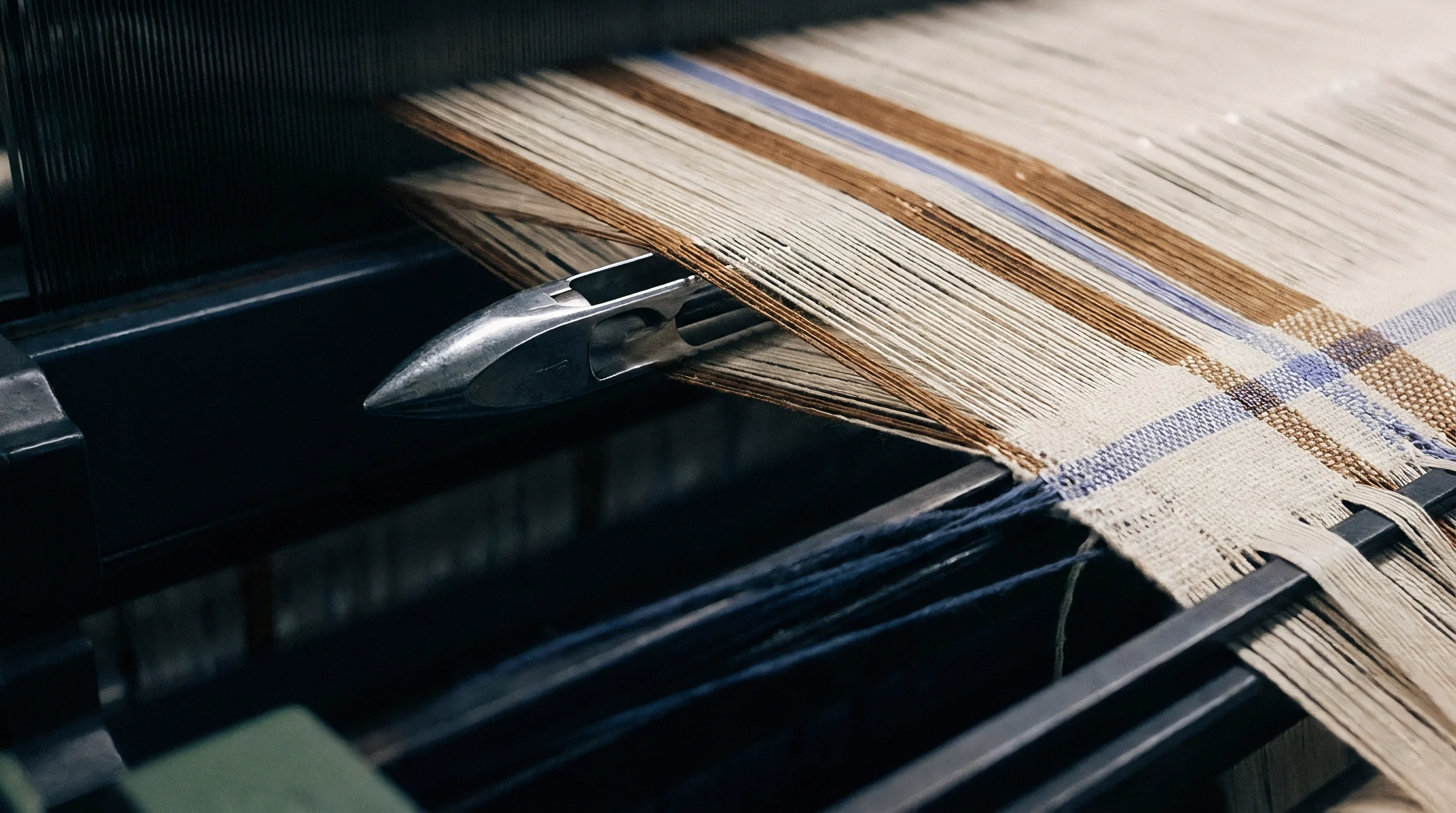
Loom-state fabric holds an unstable structural equilibrium imposed by continuous longitudinal tension during shedding, beat-up, and take-up. The warp yarn stays under mechanical draft throughout the weaving cycle, forcing it into an elongated, low-crimp geometry while the weft yarn bends around it with higher waviness. On the loom, warp crimp frequently measures between 3.0% and 6.0% under standard primary tension, whereas weft crimp on the same plain weave construction floats between 8.0% and 16.0% depending on insertion speed and yarn count.
This asymmetric balance defines the initial condition of the greige substrate.
Peirce geometry establishes that the total modular length of yarn in a woven unit cell divides into straight segments and circular arcs curving around orthogonal yarn axes. When external tension pulls one yarn system straight, the yarn cross-section acts as a mechanical wedge, pushing the intersecting system into deeper alternating arcs. This physical coupling is crimp interchange.
The sum of the yarn axis projections in the thickness plane cannot drop below the sum of the two yarn diameters without severe transverse compression of the fibrous bundle.
A greige construction with unequal warp and weft crimp stores internal energy that releases during the first aqueous processing stage.
Yarn flexural rigidity governs the resistance to this mechanical bending. Coarse yarns with high twist factors resist curvature changes, requiring greater perpendicular forces from the intersecting system to alter their wave amplitude. Fine filament yarns with minimal twist flatten rapidly at crossing points, shifting the cross-sectional aspect ratio from circular to lenticular.
The geometry settles where the internal bending moments of both systems equal the external normal forces generated at the interlacing contact points.
Modular Unit Cell Dynamics
Analytical calculations of unit cell dimensions rely on classic circular-thread geometry where yarn diameter remains constant along the repeating segment. Real processing conditions disrupt this baseline. The effective yarn spacing in the warp direction, denoted as p1, and the weft spacing, denoted as p2, determine the available path length for the opposing yarn system.
As p1 decreases through loom relaxation, the warp ends compress the weft picks closer together, forcing the weft yarn to traverse a steeper path angle theta-two.
Where the yarn packing factor within the unit cell reaches saturation, jamming occurs. Jamming limits the degree to which crimp can transfer from one yarn system to another without inducing out-of-plane fabric buckling or severe yarn flattening. A plain weave fabric reaches the jammed state at lower cover factors than a twill or satin weave because the higher interlacing frequency of the 1/1 structure introduces contact points at every intersection.
A 2/2 twill construction distributes its interlacing points across four ends and four picks, allowing yarn segments to slide longitudinally before normal forces lock the structure.
Tension release during wet processing alters thread spacing and yarn crimp across standard industrial constructions, shifting greige dimensions toward relaxed structural equilibriums.
| Fabric Construction | State | Warp Crimp (%) | Weft Crimp (%) | Warp Sett (ends/cm) | Weft Sett (picks/cm) | Fabric Mass (g/m²) |
|---|---|---|---|---|---|---|
| Ne 30/1 x Ne 30/1 Plain Weave | Greige Loom State | 4.2 | 13.8 | 28.0 | 24.0 | 118.0 |
| Ne 30/1 x Ne 30/1 Plain Weave | Aqueous Relaxed | 11.5 | 6.1 | 31.2 | 23.2 | 134.5 |
| Ne 20/1 x Ne 16/1 3/1 Twill | Greige Loom State | 5.8 | 12.4 | 42.0 | 22.0 | 235.0 |
| Ne 20/1 x Ne 16/1 3/1 Twill | Aqueous Relaxed | 14.2 | 5.2 | 47.5 | 21.0 | 268.0 |
| Ne 40/1 x Ne 40/1 Poplin | Greige Loom State | 3.5 | 15.2 | 52.0 | 28.0 | 112.0 |
| Ne 40/1 x Ne 40/1 Poplin | Aqueous Relaxed | 9.8 | 7.4 | 56.5 | 27.1 | 126.0 |
Moving from greige to relaxed states shows how warp crimp rises as weft crimp drops once longitudinal constraints fall away. Warp thread density increases proportionally with lost fabric length, while weft density responds to the lateral tension held across the open-width line.
Swell
Aqueous immersion alters the mechanical characteristics of hydrophilic natural fibres and regenerated cellulosics. Water molecules penetrate the amorphous regions of cotton or viscose fibres, breaking intermolecular hydrogen bonds between adjacent cellulose chains. The absorption of moisture causes substantial fibre diametral expansion, often increasing the diameter of cotton fibres by 14.0% to 20.0% while longitudinal swelling remains below 1.5%.
Viscose fibres exhibit diametral swelling exceeding 25.0% under neutral aqueous conditions.
The volumetric growth of individual fibres forces the entire yarn bundle to increase in cross-sectional area. Because yarn length remains relatively stable while its diameter expands, the internal helix angle of the twisted fibres steepens. The yarn bundle shortens through axial contraction, a phenomenon termed hydrodynamic yarn shrinkage.
In a woven assembly, this diametral swelling increases the effective yarn diameter d1 and d2 inside the Peirce unit cell, drastically reducing the free clearance between adjacent threads.
Aqueous Relaxation and Interlocking
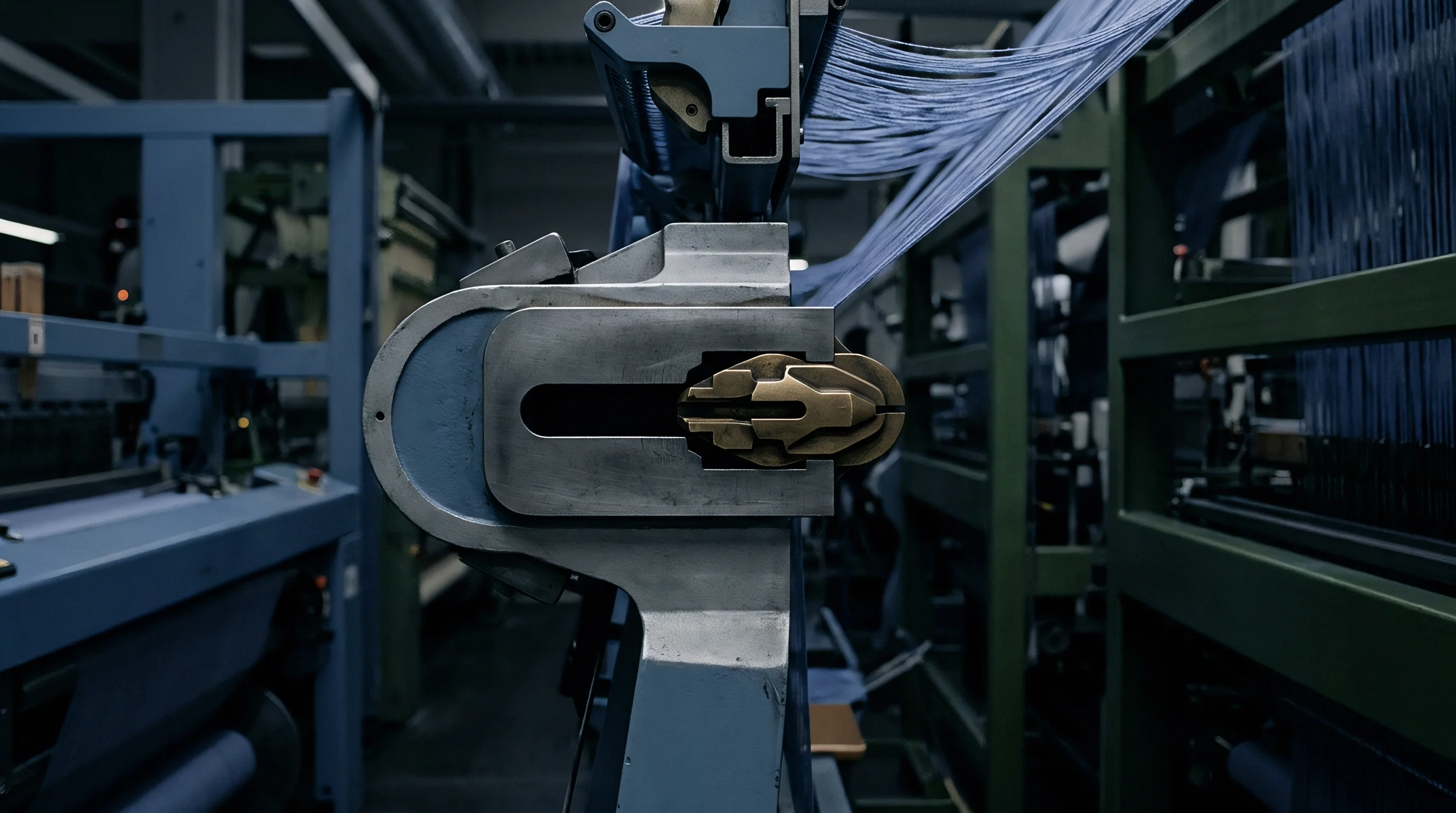
During desizing, scouring, and continuous bleaching, fabrics experience varying balances of thermal energy, chemical exposure, and line tension. In continuous open-width preparation ranges, fabric runs over driven rollers that maintain longitudinal tension between 200 N and 600 N across a standard 1.8-metre face width. This continuous draft prevents the warp yarn from contracting, locking the warp in its extended, low-crimp geometry while hot alkaline liquors swell the fibres.
The weft yarn, free from lateral mechanical restraint during open-width roller passage, undergoes severe crimp accumulation as it bends around the swollen, taut warp ends.
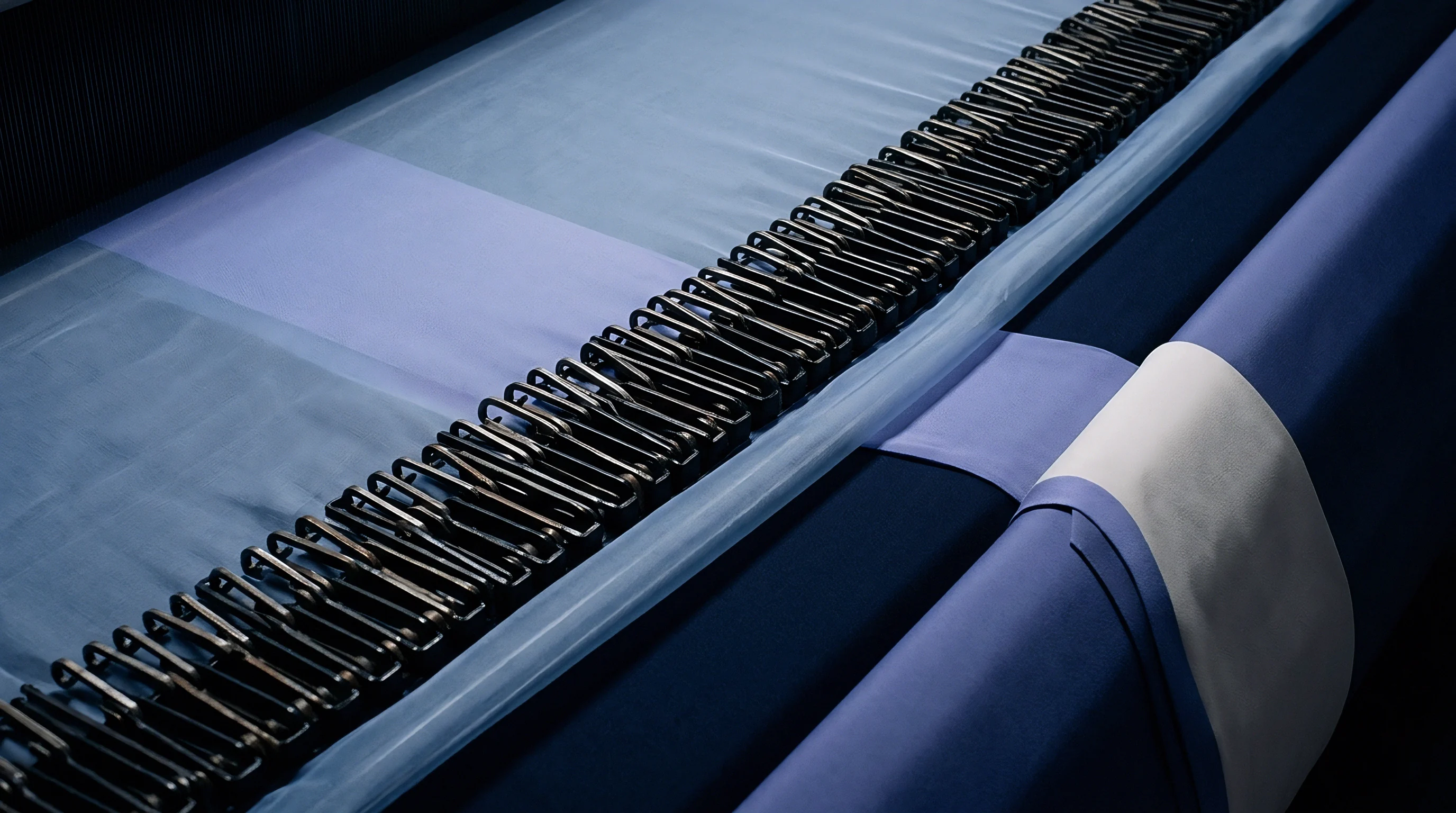
Discontinuous processing in jet dyeing machines or winches subjects the substrate to a different mechanical environment. In jet vessels, the rope experiences isotropic liquid turbulence combined with cyclic longitudinal acceleration through the transport nozzle, followed by complete relaxation in the J-box accumulator. In the accumulator, warp tension drops to zero in the presence of boiling dye liquor.
The warp yarn contracts rapidly, increasing its crimp percentage from 4.0% to over 12.0%.
Under immersion without longitudinal pull, the warp system absorbs energy and increases crimp amplitude by pushing weft threads into flatter trajectories.
This rapid increase in warp crimp exerts a strong wedging force against the weft yarns. The weft picks are pulled into a straighter horizontal plane, releasing weft crimp and extending fabric width if unrestrained, or causing pick jamming if the weft density is high. When the fabric exits the jet vessel, the relative crimp balance has completely inverted relative to its greige state.
Where Do Yarn Interchange Forces Reach Equilibrium?
Yarn intersection contact forces reach mechanical equilibrium when the radial restoring force of the compressed yarn core balances the tensile bending component of the orthogonal yarn system. In cold water, this balance rests on elastic deformation. In boiling dye baths containing wetting agents and alkali, cellulose plastification lowers the yarn bending modulus, shifting the equilibrium point toward tighter packing configurations.
Cellulosic and synthetic fibers experience distinct mechanical changes during wet processing stages.
- Cotton ring spun yarns undergo severe diametral swelling in alkaline scours, generating high transverse pressure that forces weft crimp extraction unless open-width line draft exceeds 400 N.
- Continuous filament polyester exhibits negligible aqueous swelling, with crimp redistribution driven primarily by thermal contraction and relaxation of residual extrusion stress above the polymer glass transition temperature.
- Lyocell micro-fibrillar bundles experience surface fibrillation and high lateral gel-swelling, which mechanically locks the warp and weft intersection nodes and halts further crimp transfer early in the wet cycle.
- Wool worsted assemblies demonstrate progressive felting shrinkage if agitation accompanies swelling, causing irreversible directional friction migration that overrides the classical Peirce geometric crimp exchange.
The balance of crimp remaining after wet preparation dictates the mechanical correction required during final heat setting and dimensional stabilization, leaving technicians with the task of calculating how much residual stress remains trapped in the fibre network.
Overfeed
The stenter frame serves as the definitive mechanical apparatus for setting the final warp and weft crimp relationship. Fabric enters the entry field through guiding systems, passing over a series of tension-controlled scroll rolls and skew-correcting bow rollers before mechanical clips or pins grip both selvedges. The fundamental controls on the machine comprise the longitudinal overfeed percentage, the transverse pin-chain width expansion, and the hot air chamber heat transfer rate.
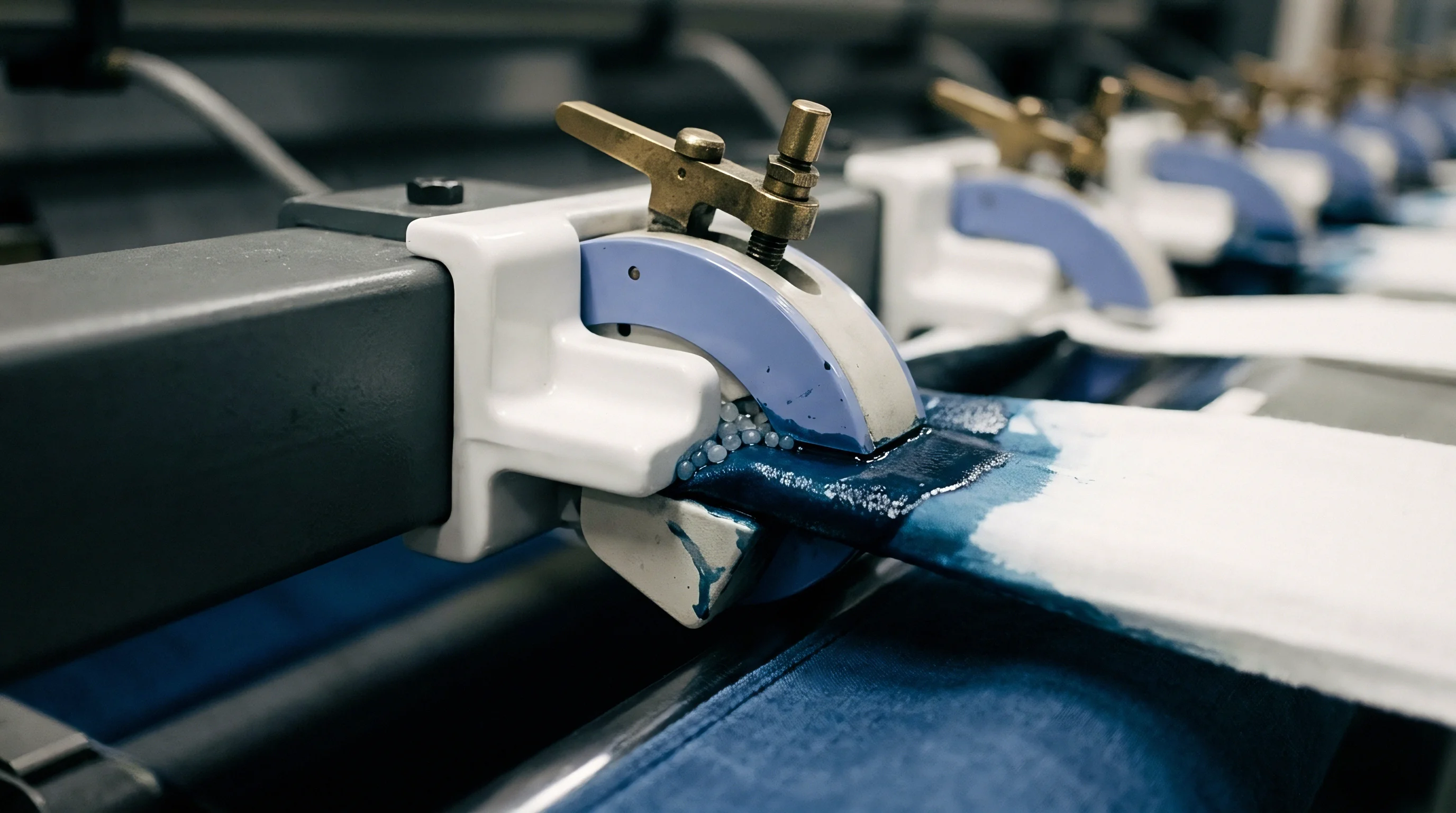
Pinning wheels press the fabric onto stainless steel pins mounted on circulating chains. By driving the entry nip rolls at a surface velocity higher than the chain speed, operators introduce positive overfeed, expressed as a percentage above nominal chain travel. Positive overfeed presents loose, excess fabric along the machine axis, allowing the warp yarns to contract and develop crimp within the heated drying zones.
Negative overfeed stretches the fabric along the warp, stripping crimp from the warp and forcing it into the weft.

Biaxial Tension Interactions on the Pin Chain
Width adjustment on a stenter relies on diverging pin tracks across the initial heating bays. When the chain rails diverge, lateral tension pulls the weft picks straight, reducing weft crimp toward minimal values. According to the mechanics of crimp exchange, this lateral extension forces the warp ends to bend more sharply around the straightening weft picks, assuming sufficient warp length exists on the pins.
Longitudinal overfeed feeds excess warp length to accommodate this induced bending wave. If the stenter operator applies 10.0% lateral expansion to meet a wide target width while maintaining 0.0% longitudinal overfeed, the warp ends experience extreme tension spikes. The warp yarns cannot supply the linear length needed to bend around the straightening weft picks.
Consequently, the fabric develops severe warp tension, warp crimp drops toward zero, weft threads straighten, and the finished cloth leaves the stenter with high residual warp shrinkage potential.
A pinned stenter rail divergence without corresponding longitudinal overfeed increases warp-way residual shrinkage during garment laundering.
Thermal fixation in the stenter chambers stabilizes the engineered crimp distribution. For 100% cotton, drying removes the lubricating water film, allowing hydrogen bonds to reform between cellulose chains in the newly established yarn paths. For synthetic polymers like polyester or polyamide, air temperatures above 180 degrees Celsius induce polymer chain relaxation and recrystallization, fixing the yarn bend radii into permanent geometry.

What Thread Count Adjustments Prevent Weft Bowing?
Weft bowing occurs when the center of the fabric web travels at a different linear speed than the pinned selvedges. In the drying chambers, air nozzles apply aerodynamic pressure against the unsupported fabric center. If overfeed is set too high without sufficient lateral tension, the center sags and falls behind the pinned edges, creating positive bow distortion.
Setting the differential drive on the exit overfeed rollers and adjusting the nozzle velocity profile across the web face corrects this distortion.
Stenter operational parameters directly determine the final physical geometry, residual shrinkage, and areal weight of woven fabrics across different processing profiles.
| Trial Parameter | Overfeed (%) | Rail Width (cm) | Chamber Temp (°C) | Dwell Time (s) | Warp Crimp (%) | Weft Crimp (%) | Warp Shrinkage (%) | Weft Shrinkage (%) |
|---|---|---|---|---|---|---|---|---|
| Condition Alpha | +2.0 | 152.0 | 150.0 | 35.0 | 6.2 | 11.4 | +6.8 | -1.2 |
| Condition Beta | +8.0 | 148.0 | 150.0 | 35.0 | 10.5 | 8.1 | +2.4 | +1.8 |
| Condition Gamma | +14.0 | 144.0 | 150.0 | 35.0 | 14.8 | 4.6 | -0.5 | +5.2 |
| Condition Delta | -4.0 | 155.0 | 150.0 | 35.0 | 3.1 | 14.2 | +11.5 | -3.5 |
Condition Beta represents a balanced setting where longitudinal overfeed of 8.0% and a width of 148.0 cm bring both warp and weft wash shrinkage within commercially viable boundaries of less than 3.0% under standard testing procedures.
Improper overfeed and width combinations produce skewed grain lines, uneven surface density from edge to center, and structural instability that causes cut panels to torque during garment assembly.
Balance
Predicting the final state of a woven fabric requires a combined mathematical model that links initial yarn linear density, loom sett, wet relaxation contraction, and stenter crimp exchange. The fundamental relationship connecting yarn crimp to thread density and finished fabric mass per unit area derives from the mass balance equation of the constituent yarn systems.
Let c1 represent fractional warp crimp, c2 represent fractional weft crimp, n1 represent warp thread density (ends per centimeter), n2 represent weft thread density (picks per centimeter), N1 represent warp yarn linear density in tex, and N2 represent weft yarn linear density in tex. The finished areal mass M in grams per square meter, excluding chemical add-on, equals the sum of the curved yarn masses within a unit square area:
M = n1 N1 (1 + c1) / 10 + n2 N2 (1 + c2) / 10
When the stenter adjusts width, n1 changes inversely with the finished width ratio. If greige reed width is Wr and finished pinned width is Wf, warp thread density scales as n1 = n1_greige (Wr / Wf) (1 – e_w), where e_w represents the lateral yarn shrinkage during processing. Weft thread density n2 scales directly with the machine overfeed and longitudinal relaxation ratio.

Worked Construction Case
Take a medium-weight bottom-weight plain weave fabric specified for workwear uniforms. The technical specification demands a finished fabric mass of 215 g/m² (+/- 3%) at a cuttable width of 148 cm (+/- 1 cm), with domestic wash shrinkage (ISO 5077 / ISO 6330, 4N wash at 60 degrees Celsius, flat dry) below 2.5% in both warp and weft directions.
Assume the greige loom construction parameters:
- Warp Yarn ~ Ne 20/1 ring spun cotton (29.53 tex), twist multiplier 4.2 alpha-e.
- Weft Yarn ~ Ne 20/1 ring spun cotton (29.53 tex), twist multiplier 3.8 alpha-e.
- Loom Reed Sett ~ 23.6 ends/cm over a total reed width of 162.0 cm.
- Loom Pick Sett ~ 20.5 picks/cm off the loom take-up roll.
- Greige Crimp Values ~ Warp crimp c1 = 4.5% (0.045), weft crimp c2 = 13.5% (0.135).
Off the loom, the greige areal mass calculates as: M_greige = 23.6 29.53 (1.045) / 10 + 20.5 29.53 (1.135) / 10 = 72.82 + 68.70 = 141.52 g/m².
The lot undergoes continuous pad-steam desizing, scouring, and pad-dry-pad-steam dyeing with reactive dyes. Across the continuous dye range, warp tension averages 450 N, while the open-width fabric narrows to 142 cm. At the stenter entry, warp crimp measures 3.8% and weft crimp measures 16.2%, reflecting severe warp draft and weft contraction.
A wet processing line that applies continuous warp tension strips longitudinal crimp and forces compensatory overfeed settings at the stenter.
To reach the target finished width of 148 cm from the 142 cm dyed state, the stenter entry rails must expand the fabric transversely by 4.2%. Simultaneously, to achieve the required finished warp shrinkage of less than 2.5%, the stenter overfeed must introduce enough warp slack to elevate warp crimp c1 from 3.8% to 11.2% in the dry state. This elevates the finished pick density.
Setting the stenter to +9.5% overfeed and 149.5 cm chain width (allowing 1.5 cm width relaxation after unpinning) results in the following finished parameters:
- Finished Warp Sett ~ 25.8 ends/cm across 148.0 cm finished width.
- Finished Weft Sett ~ 22.8 picks/cm after overfeed consolidation.
- Finished Crimp Values ~ c1 = 11.0% (0.110), c2 = 7.2% (0.072).
Recalculating final fabric mass: M_finished = 25.8 29.53 (1.110) / 10 + 22.8 29.53 (1.072) / 10 = 84.57 + 72.18 = 156.75 g/m².
Adding 3.5% for sizing desize loss, dye mass, and finish chemical pick-up (sanforizing softener), the mass stabilizes at 162.2 g/m².
When the fabric construction requires a heavier finished weight of 215 g/m², this Ne 20/1 structure proves incapable of meeting the target. Sourcing engineers must alter the greige yarn counts to Ne 14/1 (42.18 tex) or increase loom sett to 31.0 ends/cm and 26.0 picks/cm. Predicting these limits prevents costly bulk-dyeing trials on unsuitable greige builds.
Yarn count selection limits the achievable fabric density when crimp interchange reaches structural jamming.
Settlement
Warp and weft crimp balance governs the commercial performance and quality clearance of bulk woven goods. The dimensional stability of finished textiles depends on whether the residual mechanical strains trapped within the interlaced yarn paths can release during standard maintenance laundering. The international benchmark standard ISO 5077, evaluated via domestic washing procedures outlined in ISO 6330, serves as the primary gateway for buyer acceptance.
When finished fabric exhibits dimensional failure, the root cause traces directly to an unresolved crimp imbalance locked into the structure during stentering. Fabric finished with excessive warp tension and insufficient overfeed retains high residual warp crimp potential energy. Upon exposure to moisture and mechanical agitation in a washing machine, the cellulose or synthetic fibers swell, hydrogen bonds break, and the warp yarn immediately contracts into its preferred wavy configuration, shortening the fabric along the length.

Mechanical Compaction and Sanforizing
For high-performance cotton substrates, stenter processing alone cannot deliver zero-shrinkage tolerances. Residual warp shrinkage between 3.0% and 6.0% frequently remains after the stenter chain. To eliminate this remaining strain, converters run the cloth through a compressive shrinkage range, or rubber belt sanforizer.
The sanforizer operates by passing the pre-dampened fabric between a heated chrome cylinder and a thick, compressed rubber belt. As the elastomeric rubber belt curves around a feed roller, its outer surface extends. When it contacts the heated drum and flattens, the outer surface contracts, mechanically forcing the warp yarns into high-amplitude crimp waves while pushing the weft picks closer together.
Sanforizing increases warp crimp by an additional 3.0% to 7.0%, locking the finished dimensional change to within +/- 1.0%.

Inspection Parameters and Contractual Tolerances
A technical fabric specification must state the structural parameters with unambiguous tolerances alongside the relevant ISO or ASTM test methods. Relying solely on greige descriptions exposes the buyer to severe finished product variation when the wet processing route shifts from one finishing mill to another.
| Parameter | Target Metric | Test Standard | Commercial Tolerance | Operational Risk Factor |
|---|---|---|---|---|
| Finished Mass | g/m² | ISO 3801 | +/- 3.0% | Garment yield and drape failure |
| Cuttable Width | Centimeters | ISO 22198 | -0.5 cm / +1.5 cm | Marker layout panel shortage |
| Warp Dimensional Change | Percentage | ISO 5077 / ISO 6330 | -2.0% / +1.0% | Progressive garment length loss |
| Weft Dimensional Change | Percentage | ISO 5077 / ISO 6330 | -2.0% / +1.0% | Garment waist and chest tightening |
| Warp Crimp | Percentage | ISO 7211-3 | +/- 1.5% | Tensile and tear strength imbalance |
| Weft Crimp | Percentage | ISO 7211-3 | +/- 1.5% | Weft stretch and bagging defects |
| Weft Skew / Bow | Percentage | ISO 13015 | Max 2.0% | Garment leg twisting after washing |
When dimensional stability failures occur in garment production, dispute often centers on whether cut panels were distorted by excessive pressing temperatures or improper garment washing rather than structural crimp imbalances established during stentering.