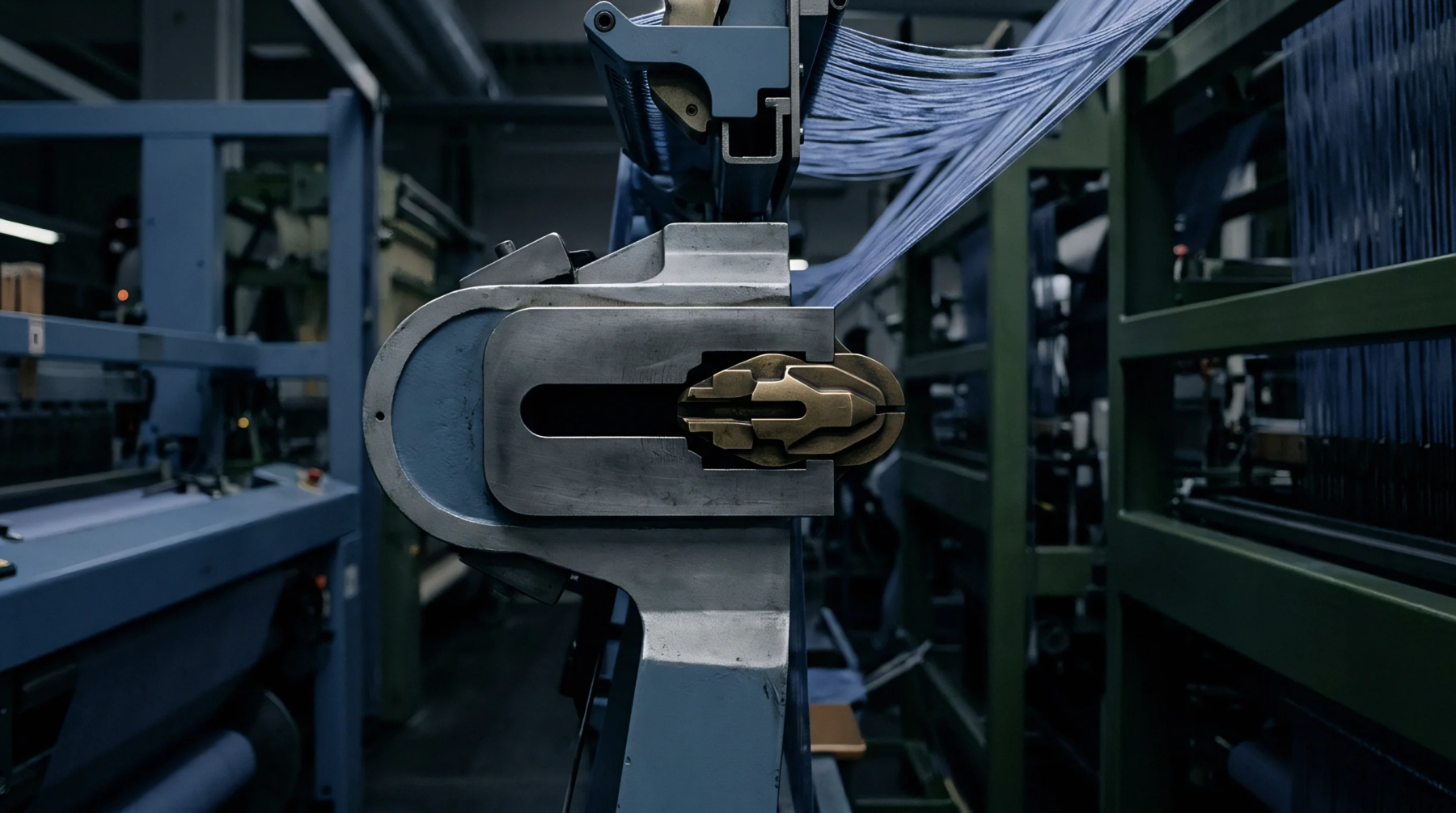
Warp and Weft Crimp Exchange Mechanisms during Wet Processing and Stentering
Warp and weft crimp exchange during wet finishing balances longitudinal overfeed and lateral rail draft to set fabric weight and arrest post-wash shrinkage.
Hydrophilic polymer extrusion involves cross-sectional dimensional increase when peripheral filaments absorb atmospheric moisture during wet spinning stages. Diametral swelling occurs primarily inside regenerated cellulose lines like viscose rayon after extrusion coagulates the liquid polymer into nascent filaments. Production management monitors this transverse volume change because excessive hydration strains the spinneret draw ratio and distorts the circular profile of individual filaments.
Fluid absorption alters the polymer chain orientation radially rather than axially, which means linear shrinkage remains low while cross-sectional area increases by ten to twenty percent during aquatic immersion. Technical laboratories measure this phenomenon by submerging conditioned tow samples in standardized water baths and recording dimensional shifts via optical micrometers before drying the material under controlled tension.
Cross-sectional thickness expansion alters yarn porosity and subsequent packing density inside woven fabrics during wet finishing sequences. Diametral swelling forces adjacent filaments outward within the multifilament bundle, reducing interstitial voids and increasing overall yarn diameter after scouring or dyeing. Mill engineers compensate for this geometric shift during twisting and sizing operations by maintaining specific air gap allowances between warp ends on the loom beam.
Yarn structural integrity depends on how uniformly constituent fibers absorb dye liquors, because differential radial expansion creates localized stress points that rupture weak filament bonds during high-speed mechanical processing.
Dimensional shifts at the yarn level dictate the final hand and cover factor of finished woven textiles exposed to laundering or high humidity environments. Diametral swelling restricts liquid water permeability in dense cotton and rayon fabrics by sealing interstitial spaces as wet yarns expand laterally to fill available cloth interstices. Garment manufacturers account for this behavior during pattern cutting by applying predetermined dimensional shrinkage factors derived from standard wetting tests performed on grey goods.
Fabric hand stiffens temporarily during initial wetting stages because radial expansion locks crossover points between warp and filling yarns into fixed geometric positions until complete drying restores normal flexibility.
Quality verification protocols require standardized immersion testing to quantify transverse dimensional change under repeatable laboratory conditions. Diametral swelling values serve as baseline acceptance criteria for technical textiles deployed in filtration and medical apparel sectors where dimensional stability under wet conditions governs operational efficacy. Testing facilities immerse conditioned fabric swatches in distilled water for specified intervals before measuring dimensional shifts through digital image analysis or mechanical dial gauges.
Commercial contracts specify maximum allowable transverse expansion thresholds, rejecting any textile lot exceeding these limits due to the risk of seam puckering and premature burst failure during industrial laundering cycles.
Warp and weft crimp exchange during wet finishing balances longitudinal overfeed and lateral rail draft to set fabric weight and arrest post-wash shrinkage.
Expertise is a utility, not a secret. sentiention™ publishes its working knowledge as open reference: intelligence layer covering the materials it sources, the markets it enters, and the reference that serves both.