Cross-Market Tensile Test Method Equivalence for Woven Garments
Grab and strip tensile test methods yield divergent breaking force values; cross-market compliance demands method-specific testing on identical batch swatches.
Clamp
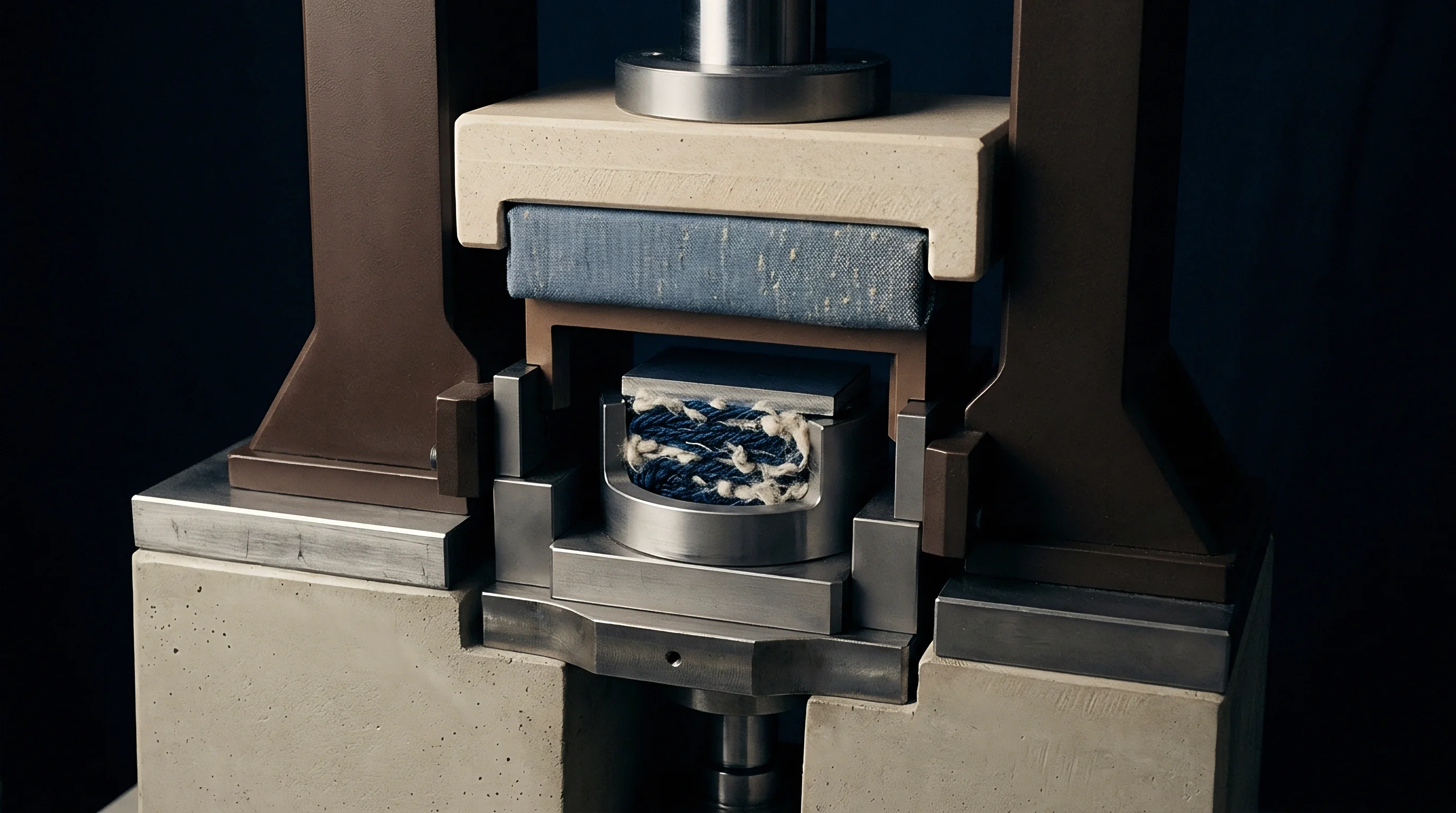
Tensile testing equipment secures woven swatches between parallel steel faces during uniaxial load application. Across all international standards, the primary objective is to transfer force into the warp or weft yarns until the fabric ruptures. Differences between testing frameworks start right at the grip.
American methods under ASTM D5034 use grab testing, where jaw faces grip only the central section of a wider specimen. European and international standards under ISO 13934-1 require strip testing, mounting the entire width of a prepared swatch directly between the clamps. This mechanical difference alters stress distribution across adjacent yarns and directly changes the measured breaking force.
Jaw face mechanics determine whether a test measures true material strength or localized failure. Smooth steel surfaces demand high pneumatic pressure to stop swatches from slipping as load escalates, but excessive pressure at the clamping edge creates stress concentrations that break yarns prematurely at the jaw line. Rubber-coated or serrated inserts prevent slippage, though each jaw geometry introduces its own frictional forces.
Anyone evaluating cross-market equivalence needs to look at jaw face dimensions and clamping pressure settings before comparing peak breaking force numbers.
Jaw Surface Mechanics and Specimen Slippage
Mechanical gripping interfaces transfer force directly into warp and weft yarn systems. When a woven swatch slips within the jaws during extension, the load-elongation curve shows artificial displacement plateaus. Standardized methods mandate specific jaw dimensions for each testing regime.
ASTM D5034 grab testing specifies a front jaw face measuring 25 millimeters by 25 millimeters and a rear face measuring 25 millimeters by 50 millimeters or larger. ISO 13934-1 strip testing requires jaw faces wider than the 50 millimeter swatch width to ensure uniform clamping across every longitudinal thread.
Pneumatic clamping systems maintain consistent lateral pressure throughout execution, whereas manual screw clamps rely on operator torque and introduce substantial variability in gripping force. Loose manual clamping permits yarn pull-out, artificially depressing peak breaking strength measurements. Conversely, over-tightening crushes delicate continuous filament or high-twist yarns at the anvil edge, causing jaw breaks that invalidate test reports under both ISO and ASTM standards.
Higher yarn crimp in textured woven structures shifts peak tensile resistance toward greater strain elongation before specimen rupture.
A jaw break occurs when a specimen fails within 5 millimeters of the clamping line. International standards set strict rejection criteria for jaw breaks that occur below the lot’s average load. ISO 13934-1 requires discarding any test with jaw failure and running a fresh swatch.
ASTM D5034 permits retaining jaw break data only if the recorded force falls within acceptable statistical limits for the batch.
Apparatus configurations produce predictable failure modes during physical testing across laboratories:
- Jaw Face Crush occurs when excessive pneumatic pressure crushes warp threads at the clamping edge, causing premature failure below true breaking limits.
- Lateral Swatch Slippage manifests when smooth steel jaw inserts fail to grip dense high-tenacity synthetic yarns, generating false elongation readings.
- Asymmetric Clamp Mounting develops when swatches sit misaligned relative to the pull axis, concentrating load on one edge and reducing recorded peak force.
- Transverse Yarn Depinning arises in grab testing when uncaught longitudinal yarns slide past caught central threads during high-load extension.
Jaw face pinch marks on tested swatches reflect localized fiber damage under high clamping forces rather than machine calibration errors.

Gauge
The distance between active gripping lines defines the nominal strain field during extension. Standard gauge lengths vary across international standards, directly affecting how much material is subjected to stress. ISO 13934-1 mandates a 200 millimeter gauge length for strip testing, whereas ISO 13934-2 and ASTM D5034 set gauge length at 100 millimeters for grab testing.
Chinese standard GB/T 3923.1 mirrors the 200 millimeter ISO length, while Japanese standard JIS L1096 specifies 200 millimeters in Method A and 75 millimeters in Method B. Because these different gauge lengths alter the strain rate, raw data cannot be directly compared across regional test reports.
Pulling speed creates another divide between standards. Modern constant rate of extension machines pull swatches at a controlled velocity regardless of load accumulation. ISO 13934-1 sets the extension speed at 100 millimeters per minute for a 200 millimeter gauge length, yielding a nominal strain rate of 50 percent per minute.
ASTM D5034 requires 300 millimeters per minute across a 100 millimeter gauge length, imposing a 300 percent per minute strain rate. Because viscoelastic polymers in synthetic yarns show a higher apparent modulus and elevated breaking force at faster strain rates, this difference skews comparative data.
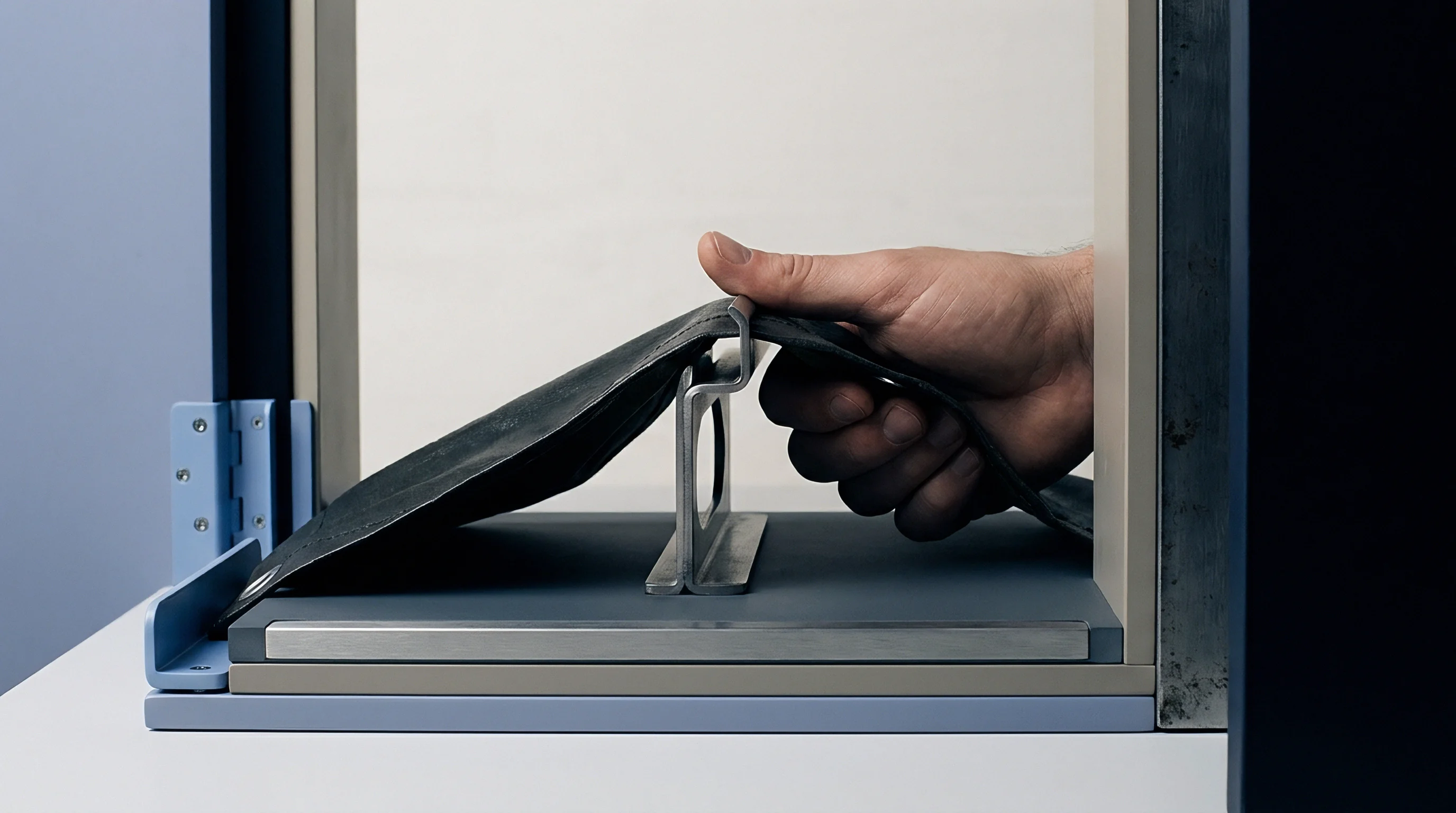
Dimensional Parameters in Strip and Grab Protocols
Specimen preparation protocols establish structural integrity before mounting. ISO 13934-1 requires cutting swatches to approximately 60 millimeters wide and unraveling longitudinal yarns from both edges until the active width measures exactly 50 millimeters. This frayed-strip method ensures that every remaining longitudinal thread runs continuously from jaw to jaw without truncated edge fibers.
ASTM D5035 unraveled strip testing follows a similar 50 millimeter finished width protocol. By contrast, ASTM D5034 grab testing calls for 100 millimeter wide swatches with only the central 25 millimeters clamped in the jaws, leaving uncaught fabric margins along both sides.
Conditioning atmospheres alter physical properties before destructive testing. ISO 139 mandates 20 degrees Celsius and 65 percent relative humidity for conditioning, while ASTM D1776 specifies 21 degrees Celsius and 65 percent relative humidity. Cellulosic fibers such as cotton and linen absorb moisture, which increases hydrogen bonding between molecular chains and boosts tensile strength by 10 to 20 percent.
Synthetic polymers like polyamide, on the other hand, lose strength as absorbed moisture plasticizes their crystalline structures. Strict 24-hour atmospheric stabilization remains mandatory before testing.
ISO 13934-1 clause 8.2 specifies a constant rate of extension at 100 millimeters per minute, rendering speed variations grounds for formal batch report invalidation.
A structured approach governs swatch preparation and environmental stabilization across testing facilities:
- Sample selection requires cutting swatches at least 150 millimeters away from cloth selvedges to avoid structural distortion near the edges.
- Specimen orientation demands aligning warp specimens parallel to end threads and weft specimens parallel to pick threads using precision dies.
- Frayed-strip preparation involves removing fringe yarns equally from both sides until the active specimen width reaches target specifications.
- Environmental equilibrium requires conditioning specimens in a climate chamber at controlled temperature and humidity for at least 24 continuous hours.
- Bench calibration requires zeroing load cells and setting jaw separation distances precisely before executing destructive pulls.

Constant Rate Mechanics across CRE CRT and CRL Machines
Machine drive mechanics alter how force is applied. While legacy laboratories occasionally deploy constant rate of traverse or constant rate of loading equipment, constant rate of extension units are the reference standard across ISO, ASTM, GB/T, and JIS frameworks. Constant rate of traverse machines pull the lower jaw at a uniform speed while the upper jaw moves against a pendulum weighting mechanism, producing variable strain rates during testing.
Constant rate of loading machines increase force at fixed time intervals, causing rapid specimen acceleration near collapse. Testing identical swatches on constant rate of traverse equipment yields lower breaking force readings than constant rate of extension testing because of load cell inertia.
| Standard Designation | Test Configuration | Specimen Width (mm) | Gauge Length (mm) | Extension Speed (mm/min) | Pre-tension Force (N) |
|---|---|---|---|---|---|
| ISO 13934-1 | Unraveled Strip | 50 (active) | 200 | 100 | 2 to 5 |
| ISO 13934-2 | Grab Method | 100 (25 gripped) | 100 | 50 | 5 |
| ASTM D5034 | Grab Method | 100 (25 gripped) | 100 | 300 | None (Manual zero) |
| ASTM D5035 | Unraveled Strip | 25 or 50 | 75 or 200 | 300 | None (Manual zero) |
| GB/T 3923.1 | Unraveled Strip | 50 (active) | 200 | 100 | 2 to 5 |
| JIS L1096 Method A | Cut Strip | 50 | 200 | 150 | None |
ISO 13934-1 clause 8.2 specifies a constant rate of extension at 100 millimeters per minute, rendering velocity adjustments grounds for batch test rejection.
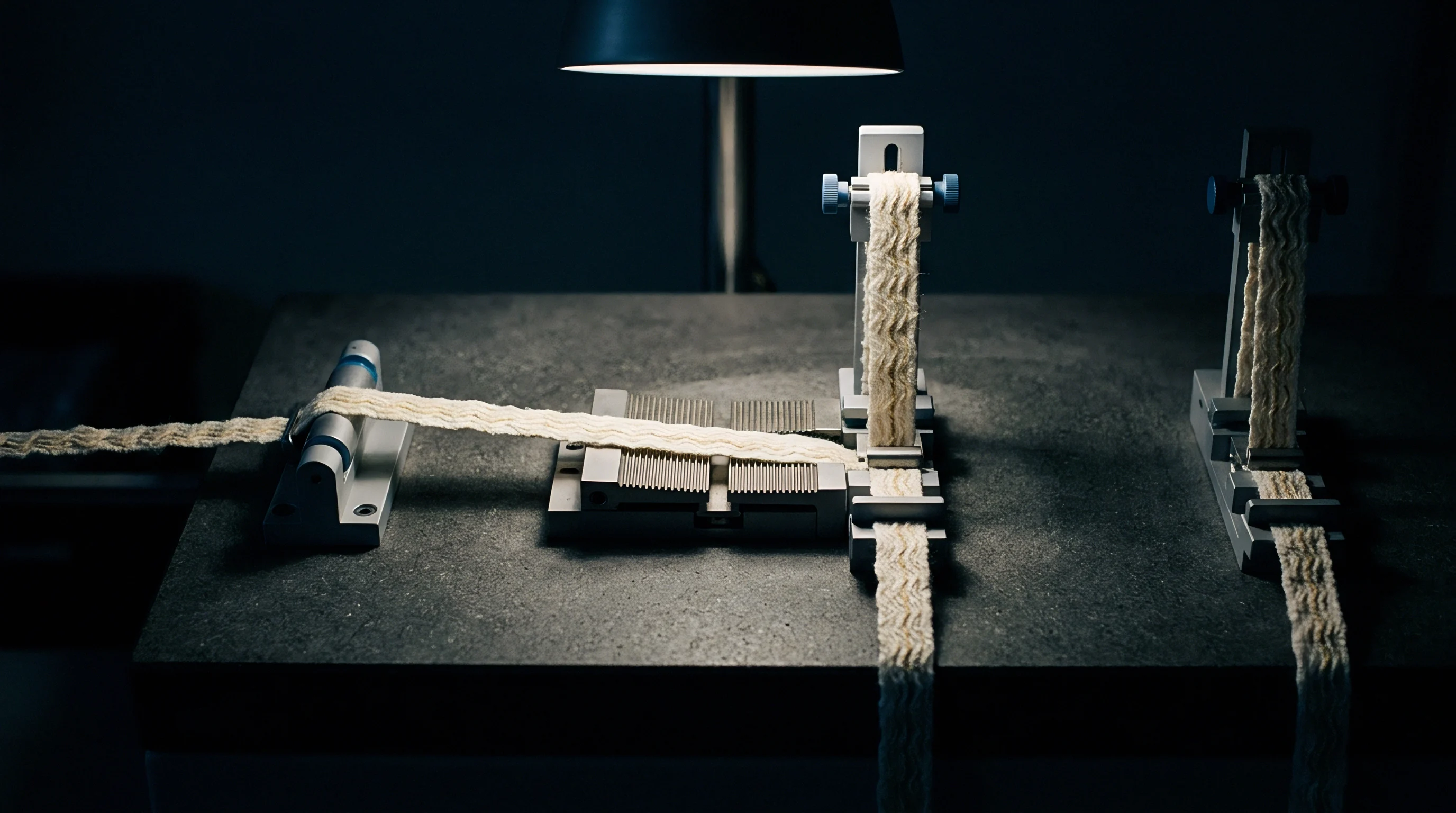
Variance
Tensile results from different international testing frameworks diverge significantly on identical fabric lots. This gap stems from the mechanical contribution of uncaught side yarns during grab testing. In an unraveled strip test under ISO 13934-1, exactly 50 millimeters of longitudinal yarns carry the entire axial force, with no transverse yarns extending beyond the clamping width.
In an ASTM D5034 grab test, a 25 millimeter central jaw grips a 100 millimeter wide swatch. The 37.5 millimeters of material extending past each edge of the jaw add structural resistance through yarn cross-over friction and shear force distribution.
Textile physicists refer to this added resistance as the fabric assistance factor. It elevates recorded grab test breaking forces above narrow strip test values, with the degree of strength inflation depending on weave density, yarn count, and crimp geometry. Tight twill and satin weaves exhibit pronounced fabric assistance due to frequent yarn intersections and high shear resistance.
Loose plain weaves show minimal assistance because side yarns slide easily past loaded central threads under tension.
Can Grab Test Values Derive Strip Method Tensile Limits?
Direct mathematical conversion between grab and strip values is unreliable across different weave constructions. Converting grab test certificates using fixed percentage multipliers introduces serious compliance risk. Laboratory trials across commercial fabrics show that grab test values exceed strip test results by anywhere from 15 percent to over 40 percent, depending on fabric weight and float lengths.
A buyer relying on an ASTM D5034 grab report to satisfy an ISO 13934-1 strip specification risks accepting substandard material that fails destination market verification.
To quantify method divergence across specific constructions, consider an empirical evaluation of identical heavy woven swatches subjected to parallel testing protocols. For a 100 percent cotton 3/1 warp-faced twill workwear fabric with a nominal mass of 240 grams per square meter, warp density of 42 ends per centimeter, and weft density of 22 picks per centimeter, ISO 13934-1 unraveled strip testing establishes a baseline warp breaking strength of 720 Newtons at 18.5 percent elongation. Subjecting the same material lot to ASTM D5034 grab testing yields an average warp breaking strength of 885 Newtons at 24.2 percent elongation.
The resulting 165 Newton increase represents a 22.9 percent inflation in breaking force, driven entirely by fabric assistance and strain rate amplification. The ASTM D5034 strain rate of 300 percent per minute accelerates polymeric alignment in cellulosic fibers compared to the slower 50 percent per minute rate under ISO 13934-1. Furthermore, uncaught side yarns in the grab specimen restrict lateral necking, holding transverse threads in place and spreading the axial load over a broader zone.
| Weave Structure | Nominal Weight (g/m²) | ISO 13934-1 Strip Strength (N) | ASTM D5034 Grab Strength (N) | Observed Force Variance (%) | Dominant Variance Driver |
|---|---|---|---|---|---|
| Plain Weave Cotton Poplin | 120 | 340 | 395 | +16.2 | Moderate cross-over yarn friction |
| 3/1 Warp Twill Cotton Canvas | 240 | 720 | 885 | +22.9 | High yarn density and strain velocity |
| 5-Harness Satin Polyester/Viscose | 180 | 510 | 680 | +33.3 | Long yarn floats and side shear assist |
| 2/2 Twill Wool Worstened Suiting | 210 | 290 | 355 | +22.4 | Yarn crimp recovery and fiber friction |
| High-Tenacity Nylon Ripstop | 85 | 950 | 1120 | +17.9 | Filament tenacity and load distribution |
When a buyer attempts to validate a shipment bound for Europe using American testing documentation, compliance depends entirely on whether the original standard designation appears in purchase order specifications. If a European brand specifies 600 Newtons under ISO 13934-1, a swatch achieving 650 Newtons under ASTM D5034 looks compliant on paper. However, destructive retesting under ISO 13934-1 will reveal an actual strip strength near 530 Newtons, failing the contract threshold and risking batch rejection at port.
Stress Distribution Dynamics in Extended Woven Fabric Structures
Internal stress distribution governs structural displacement. Tensile force applied to a woven structure causes crimp interchange before individual fibers begin carrying axial load. This occurs as tensioned warp yarns straighten, forcing perpendicular weft yarns into greater undulation.
In strip testing, lateral edges remain unconstrained, allowing free cross-wise contraction during longitudinal extension. In grab testing, uncaught side fabric resists lateral contraction, creating a complex biaxial stress zone near the jaw corners.
Structural parameters govern force variance magnitude across woven substrate categories:
- Float Length Extension increases shear assistance in satin and complex weaves as long yarn floats bind adjacent uncaught threads during extension.
- Yarn Interlocking Resistance raises recorded grab forces in tightly woven, high-pick constructions due to elevated friction between yarns.
- Elongation Rate Sensitivity elevates measured breaking load in strain-rate sensitive synthetic polymers subjected to high crosshead speeds.
- Moisture Plasticization Effects alter cellulosic yarn modulus during prolonged bench exposure if ambient humidity strays from controlled limits.
ASTM D5034 grab testing on 240 g/m² cotton twill yields peak breaking force values 22.9 percent higher than ISO 13934-1 strip testing on identical fabric.
Woven structures featuring higher yarn density distribute transverse clamping shear more effectively, narrowing the gap between strip and grab test force readings.
Dossier
Compliance files for cross-border textile shipments require precise alignment between laboratory accreditation scopes and buyer technical specifications. Building an acceptable dossier demands documenting exact test standards, environmental conditioning logs, crosshead velocities, and detailed swatch failure classifications. A test certificate that lists only breaking force figures without method numbers, gauge lengths, or conditioning parameters holds zero legal standing during commercial disputes or customs audits.
Sourcing agencies must enforce rigorous document collection at origin before cargo departs.
Laboratory competence requires formal verification under ISO/IEC 17025 accreditation standards. Testing facilities supplying compliance documents must hold an accredited scope specifically covering the target tensile method. An accredited scope for ASTM D5034 does not authorize a lab to issue accredited reports for ISO 13934-1 or GB/T 3923.1.
International laboratory recognition operates through the International Laboratory Accreditation Cooperation Mutual Recognition Arrangement, so buyers must verify that the accreditation body holds active signatory status under the ILAC agreement.
Laboratory Scope Verification under ILAC Mutual Recognition Agreements
Customs authorities detain unevidenced goods, making laboratory scope verification essential. When importing woven apparel into China, national standard GB 18401 mandates compliance with physical safety and performance parameters, incorporating GB/T 3923.1 tensile methods for specific product categories. Submitting test reports from origin laboratories lacking GB/T 3923.1 in their formal ISO/IEC 17025 scope triggers immediate rejection by Chinese market surveillance inspectors, regardless of whether testing was conducted accurately under equivalent ASTM methods.
Authenticating laboratory credentials requires reviewing specific documentation markers. Inspection personnel must examine four critical elements on incoming test reports:
- Accreditation Body Logo displaying valid institutional symbols alongside the testing laboratory’s unique registration number.
- Explicit Standard Citation confirming execution of the exact test method version cited in purchase contract specifications.
- Individual Swatch Failure Descriptions recording whether ruptures occurred within the central specimen area or at the clamping line.
- Environmental Conditioning Statement confirming specimen stabilization within required temperature and humidity tolerances for 24 hours.

Cross-Market Certificate Validation Checklist
Systematic document review prevents regulatory delays. Sourcing teams should audit incoming test files using a clear decision framework, cross-checking laboratory test parameters against destination market legal limits and buyer physical quality standards. Any discrepancy between tested parameters and required market conditions demands immediate re-testing before goods enter transit.
Document verification teams follow a precise administrative evaluation sequence:
- Verify that the testing laboratory maintains active ISO/IEC 17025 accreditation through an ILAC signatory body.
- Confirm that the specific standard designation on the report matches purchase order requirements exactly without substitution.
- Check that recorded gauge lengths and crosshead speeds align with standard method specifications.
- Validate that tested sample counts meet statistical sampling rules required by the destination retail market.
- Ensure test report issuance dates fall within contractually specified validity windows relative to production batch dates.
Submitting an unaccredited grab tensile report for a market requiring strip testing triggers mandatory re-testing and border holding costs for the importer.

Exposure
Commercial disputes over fabric tensile failure fall directly on the importer of record when border testing contradicts origin certificates. Retesting fees, port demurrage charges, freight cancellation penalties, and retail stockouts compound financial losses when shipments face detention. When a destination market audit uncovers tensile failure against declared national standards, regulatory bodies issue mandatory recall orders or market withdrawal demands, destroying brand equity and triggering severe contractual indemnification claims from retailers.
Protecting against contractual liability requires embedding explicit tensile test method designations into raw material purchase orders and garment manufacturing agreements. Generic references to tensile strength minimums create legal ambiguity that suppliers exploit during quality disputes. Purchase orders must state the target standard, exact method variant, minimum acceptable breaking force in Newtons, allowable strain elongation percentage, and designated ISO/IEC 17025 accredited laboratory facilities.
Shifting compliance risk upstream means linking invoice payment clearance directly to verified test report acceptance.
Financial Liability Allocation in Subcontracted Laboratory Retests
When destination verification testing yields failing tensile strength results, secondary retests are often requested. Subcontracting retests to third-party reference laboratories introduces additional testing costs and delays. Clear purchase contracts specify that if retest results confirm initial non-compliance, the fabric mill or vendor bears all testing fees, port storage expenses, and logistics costs associated with the delayed shipment.
Destructive retests requested after border detention double the administrative lead time while holding port storage fees on the importer.
Destination markets impose varying regulatory liabilities for physical performance failures. In the European Union, market surveillance authorities execute random retail sampling under consumer safety regulations, placing non-compliant apparel on public safety portals and ordering forced destruction. In China, market surveillance bureaus impose administrative fines calculated as a multiple of the lot’s commercial value, alongside mandatory confiscation of revenue from non-compliant sales.
Contractual Safeguards for Tensile Method Discrepancies
Drafting robust procurement clauses mitigates cross-border enforcement risks. Compliance clauses must specify exact method execution parameters and explicitly reject unapproved testing cross-conversions. Standardized contract language prevents the substitution of convenient local testing protocols for destination market standards.
A comprehensive physical compliance clause incorporates explicit procedural constraints:
- Method Specification Line identifying exact standard numbers, including section and method variants, required for material clearance.
- Accredited Facility Designation restricting valid test report issuance exclusively to pre-approved ISO/IEC 17025 certified testing laboratories.
- Batch Sampling Mandates defining exact roll selection counts and swatch cutting locations across production lots.
- Indemnification Allocation holding suppliers fully liable for landed costs, legal fees, and administrative fines arising from border test failures.
Whether international standards bodies will ever publish unified mathematical conversion tables linking grab and strip tensile strength results remains an open question across technical committees.