Quantifying Capillary Dye Transport and Core Penetration Limits in High Twist Plied Woven Cotton
High twist plied cottons restrict core dye transport through sub-micron pore collapse, requiring extended pad-batch dwell times to eliminate ring dyeing.

Geometry
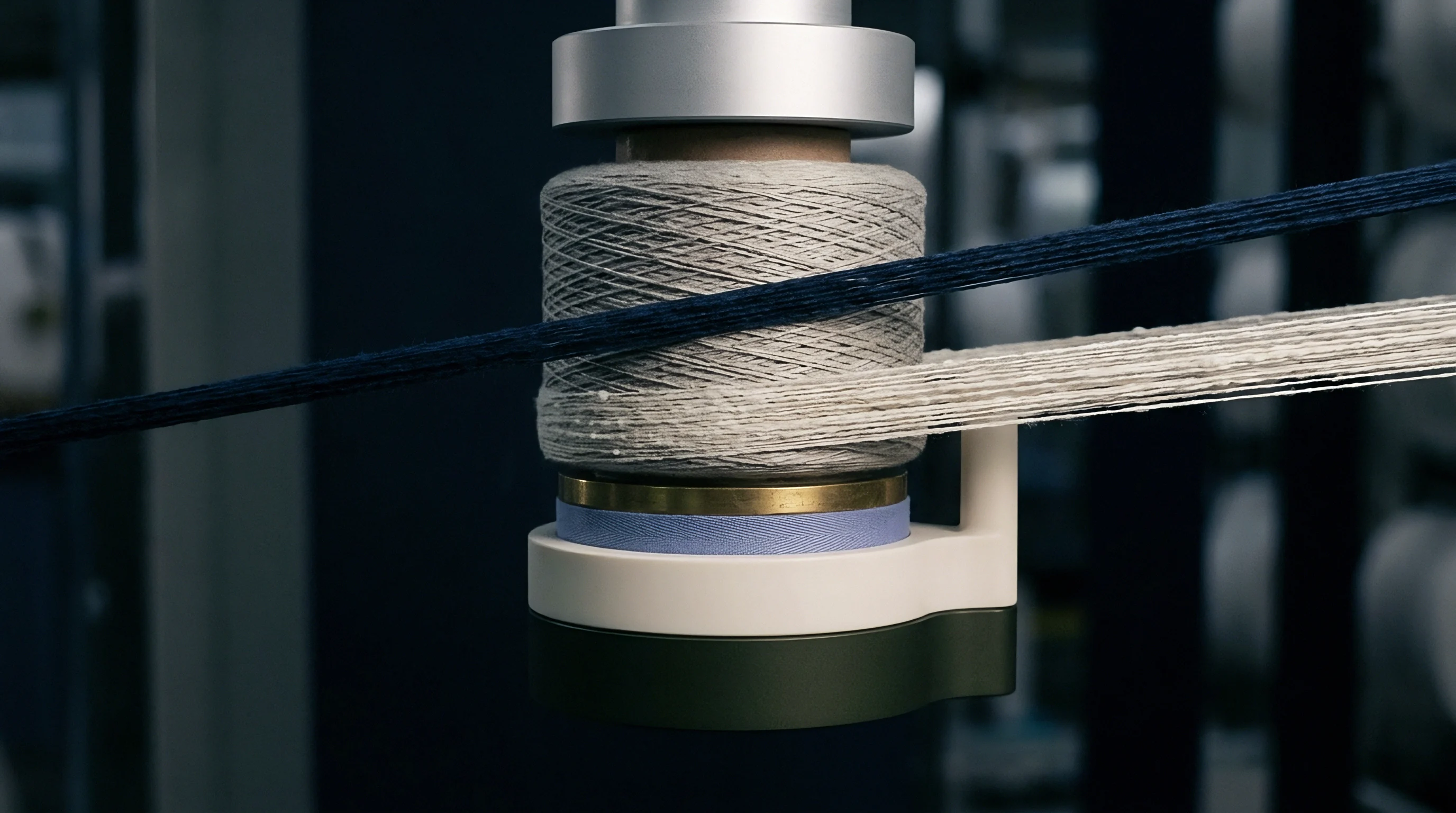
Yarn construction in high-twist plied cottons creates a dense arrangement of individual cellulose filaments that restricts fluid migration during wet processing. Spun yarns produced for high-performance apparel or industrial wovens rely on elevated twist levels to achieve tensile strength, abrasion resistance, and crisp tactile hand. When two single yarns undergo plying, the secondary twisting operation alters both the spatial orientation of individual fibers and the open space available between them.
The spatial arrangement governs how liquids move through the structure during pretreatment and dyeing.
Plied Structural Parameters and Fiber Packing Fractions
Singles yarns spun at high twist factors exhibit tight consolidation, which intensifies when two or more strands undergo folding in the opposite direction. The total yarn density is measured by the fiber packing fraction, defined as the ratio of fiber volume to total yarn volume. Un-plied ring-spun yarns typically display packing fractions ranging from 0.52 to 0.60.
High-twist plied structures, such as 2/80s or 2/100s Ne combed cottons twisted at twist multipliers exceeding four point two, reach packing fractions between 0.72 and 0.82 in the central zone.
Pore radii contract rapidly under these packing levels.
Higher twist factors directly alter internal fiber packing.
As packing fraction increases, the void spaces between filaments contract. Inter-fiber capillaries that measure five to ten micrometres in conventional weaving yarns contract to sub-micron dimensions in high-twist plied constructions. The distribution of these capillary void radii determines whether incoming dye liquor permeates the entire cross-section or remains confined to outer perimeter zones.
Yarn twist escalation compresses inter-fiber voids before altering individual cellulose fiber dimensions.
| Yarn Count (Ne) | Twist Factor (αe) | Packing Fraction (φ) | Mean Pore Radius (μm) | Tortuosity Factor (τ) |
|---|---|---|---|---|
| 2/80s Combed Cotton | 3.6 | 0.58 | 3.40 | 1.22 |
| 2/80s Combed Cotton | 4.4 | 0.69 | 1.50 | 1.48 |
| 2/100s Combed Cotton | 4.8 | 0.76 | 0.80 | 1.82 |
| 2/120s Combed Cotton | 5.2 | 0.81 | 0.40 | 2.15 |
Helical Trajectories and Micro-Capillary Alignment
Twisting individual yarns alters the orientation of inter-filament channels relative to the longitudinal yarn axis. Filament paths follow helical trajectories described by the helix angle, calculated as the arctangent of the product of two pi, yarn radius, and twist per unit length. In high-twist plies, surface helix angles exceed thirty-five degrees.
Fluid advancing along these helical pathways travels a longer physical distance than the linear length of the yarn. The ratio of the actual liquid path length to the straight-line distance defines the tortuosity factor. Higher tortuosity increases mechanical resistance to fluid flow.
Micro-capillaries aligned along steep helical angles force incoming dye liquor into spiral flow vectors, reducing axial transport speed and increasing hydrodynamic resistance toward the yarn interior.
Higher twist multipliers always concentrate fluid flow along the outer yarn envelope while narrowing access to internal filaments.

Pore
Liquid transport through spun yarn matrices obeys capillary flow models governed by Laplace pressure differences and fluid viscosity. Capillary pressure serves as the primary driving force for spontaneous fluid imbibition into dry gray or pretreated cotton wovens. When fluid contacts the yarn surface, capillary forces draw liquid into internal voids, provided the contact angle between liquid and fiber remains below ninety degrees.
Capillary Pressure Limits in Sub-Micron Interstices
Spontaneous wicking occurs when driving wetting forces exceed opposing frictional forces inside narrow filament channels. The Laplace capillary pressure equation establishes that pressure differential is inversely proportional to pore radius. Smaller capillary radii generate higher theoretical capillary suction pressures.
A pore radius of zero point five micrometres produces a theoretical suction pressure exceeding two hundred kilopascals under complete wetting conditions.
Capillary pressure limits encountered in actual wet processing deviate from classical models. Sub-micron capillary voids in high-twist yarn interiors trap residual air during rapid immersion. When liquid enters narrow surface pores, air trapped inside central voids becomes compressed, establishing an opposing pneumatic back-pressure that halts advancing liquid fronts.
High twist plies operating above five point zero twist factor exhibit core pore radii under zero point seven micrometres at eighty degrees Celsius.
Viscous Resistance along Tortuous Spiral Channels
Lucas-Washburn kinetics dictate that fluid displacement distance scales with the square root of time and pore radius. The governing relationship states that penetrating distance squared equals pore radius multiplied by surface tension and cosine of contact angle, divided by four times liquid dynamic viscosity, all multiplied by time.
Dynamic viscosity of the liquor acts as a primary resistance to capillary flow.
Surfactants reduce surface tension to aid initial wetting.
High viscosity combined with extreme tortuosity severely dampens penetration speed into high-twist plied centers. When capillary radii fall below one micrometre, viscous drag along hydrophobic cellulose walls dissipates fluid energy, slowing liquid progression to a crawl before dye molecules reach internal sites.
- Capillary air entrapment happens when fast liquid boundary movement seals gas pockets inside interior yarn voids before wetting completes.
- Boundary liquor depletion occurs as outer fibers absorb available dye solute, leaving reduced concentration gradients to drive interior transport.
- Dynamic contact angle hysteresis retards wetting rates when unsoured natural waxes increase hydrophobic surface energy under high liquor velocities.
- Polymeric binder bridging blocks entry pathways when unremoved starch sizing cross-links across surface voids during desizing failures.
Acoustic cavitation during ultrasonic scouring may permanently collapse tortuous air pockets without reducing yarn tensile strength.
Barrier
Ring dyeing develops when mass transfer rates of colorant molecules into the yarn interior fall behind surface fixation kinetics. When dye molecules bind quickly to peripheral fibers, outer zones saturate while central filaments remain uncolored. This structural defect compromises crocking fastness, wash fastness, and shade uniformity in heavy-weight or tightly spun cotton constructions.
Why Does Core Penetration Stall in High Twist Plies?
Extremely high packing fractions in highly twisted yarns establish an inner zone where capillary channels narrow below the hydrodynamic radius of hydrated dye aggregates. When the physical dimensions of dye molecules approach pore diameter, sterically hindered diffusion restricts molecular passage. The inner region functions as a mechanical filtration barrier, stripping colorant molecules from the advancing liquor while allowing only water molecules to permeate.
Dye concentration declines steadily toward the yarn core.
Dye molecules form multi-molecular aggregates in aqueous solution.
Ring dyeing directly impairs crocking performance.
The transition from accessible outer filaments to the impenetrable central region occurs over a narrow radial boundary. The location of this boundary depends on twist factor, electrolyte concentration, dyestuff structure, and dyeing temperature. Increasing bath temperature promotes aggregate dissociation, expanding the accessible pore fraction.
Fabric delivery specifications specifying ISO 105 X12 dry crocking grade four require a core-to-sheath color depth ratio exceeding zero point six five.
| Dye Class | Molar Mass (g/mol) | Aggregation Number (25°C) | Diffusion Coefficient D (cm²/s) | Infiltration Ratio |
|---|---|---|---|---|
| Reactive Yellow 145 | 1026 | 1.2 | 3.8 × 10⁻⁷ | 0.78 |
| Reactive Blue 19 | 626 | 1.0 | 5.2 × 10⁻⁷ | 0.88 |
| Reactive Blue 21 | 1080 | 4.5 | 1.1 × 10⁻⁷ | 0.32 |
| Vat Blue 4 | 442 | 8.0 | 8.5 × 10⁻⁸ | 0.24 |

Dyestuff Aggregation and Molecular Exclusion Thresholds
Solute molecules dissolved in aqueous baths interact through hydrogen bonding and van der Waals forces, forming multi-molecular clusters. Reactive dye molecules containing copper phthalocyanine chromophores exhibit high aggregation tendencies, forming clusters containing four to six molecules at ambient temperatures. These aggregates measure two to four nanometres in diameter.
Cellulose fiber secondary pores inside swollen cotton walls measure one to five nanometres. When inter-fiber voids collapse under high twist, inter-fiber pathways approach the size of intra-fiber pores. Dyestuff clusters exceed available void dimensions, causing surface deposition rather than uniform core penetration.
Incomplete colorant ingress into yarn interiors leads to severe color loss during abrasive garment wear, prompting immediate customer rejections and chargebacks.

Squeeze
Pretreatment operations modify fiber cross-sectional geometry, altering internal void volumes before dyestuff application. Scouring removes natural hydrophobic cotton waxes, converting hydrophobic fiber surfaces into hydrophilic substrates. Mercerization using concentrated alkaline baths drastically restructures cellulose crystallites and fiber dimensions.
Caustic Soda Swelling and Core Compression Dynamics
Concentrated sodium hydroxide solutions convert cellulose crystallites from type I to type II while expanding individual cotton fiber walls. Treating cotton with caustic soda at twenty-eight degrees Baumé causes kidney-bean-shaped cotton cross-sections to swell into rounded circular profiles. Internal fiber lumens collapse while outer fiber diameters increase by fifteen to twenty percent.
Outer fibers absorb alkali first and swell rapidly.
Fiber swelling fundamentally alters the surrounding pore geometry.
When high-twist plied yarns undergo tensioned mercerization, rapid swelling of outer filaments generates radial compression forces directed toward the central yarn axis. Peripheral fibers expand outward and laterally, squeezing neighboring fibers and further compressing interior capillary channels. Mercerization improves single-fiber dye affinity while simultaneously decreasing mechanical permeability into the yarn center unless warp tension is precisely controlled.
Squeeze bowl pressure forces liquor into outer yarn sheaths while trapped pore air resists core displacement.

Surfactant Hydrodynamics in Continuous Pad-Batch Lines
Wetting agents added to pad baths lower liquid-gas interfacial tension to promote rapid fluid imbibition into dry gray yarns. Anionic surfactants like sodium dioctyl sulfosuccinate lower dynamic surface tension under short contact times, accelerating capillary wetting speed. Non-foaming bath additives prevent foam buildup inside high-speed padding nip troughs.
- Measure gray substrate drop absorbency under ISO 9073-6 test conditions to establish baseline surface hydrophilicity.
- Impregnate substrate with twenty-eight degree Baumé sodium hydroxide liquor at twenty degrees Celsius using sixty percent wet pickup.
- Control warp tension at eight percent during alkali contact to prevent excessive yarn contraction while maintaining void structure.
- Pass substrate through three counter-current hot wash steps at ninety-five degrees Celsius to reduce residual alkali below zero point two percent.
- Neutralize remaining alkali with acetic acid solution to achieve a stable pH of six point five across the entire textile width.
Ring dyeing stems from raw cotton wax variation rather than inadequate nip roll pressure or brief pad trough dwell times.

Metrology
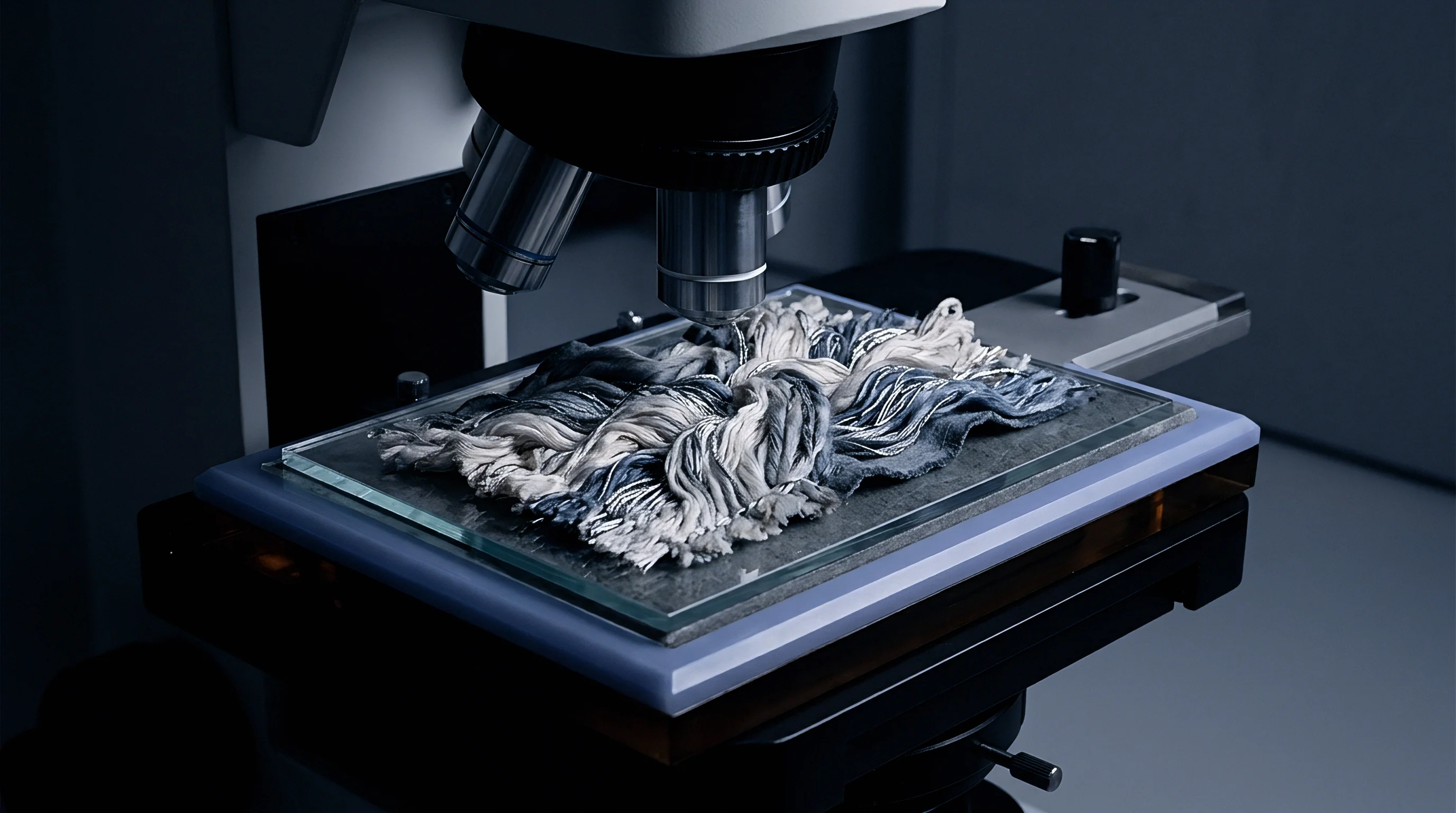
Quantifying colorant distribution within high-twist plied yarns requires high-resolution analytical techniques capable of isolating sub-micron fiber zones. Simple visual inspection or surface reflectance spectrophotometry fails to detect ring dyeing because surface color reading measures only the outer yarn perimeter. Advanced microscopic cross-sectioning combined with digital color analysis delivers quantitative depth profile data.

Micro-Spectrophotometric Radial Profiling across Yarn Cross-Sections
Embedding dyed yarns in soft paraffin wax permits ultra-thin cross-sectional slicing using standard rotary microtome instruments. Slices prepared at thicknesses between three and five micrometres are mounted on glass slides for transmission light microscopy or micro-spectrophotometric analysis. Digital imaging software measures light absorption across concentric radial zones from the outer perimeter to the center.
Microscopic cross sections reveal internal color depth gradients.
Quantitative testing confirms the extent of core dye ingress.
Relative color depth is calculated using the Kubelka-Munk K/S function, where K represents absorption coefficient and S represents scattering coefficient. Comparing K/S values at the yarn center against K/S values at the outer boundary yields the radial penetration ratio. A ratio of 1.0 represents uniform penetration, while values below 0.4 indicate severe ring dyeing.
- Cross-sectional slicing protocol mandates thin sectioning below five micrometres to prevent optical distortion during light reflectance measurement.
- Kubelka-Munk reflectance mapping calculates relative color strength values across concentric radial zones from yarn perimeter to interior center.
- Gravimetric rate analysis tracks fluid uptake mass against the square root of wetting time to isolate pore radius contraction.
- Fastness correlation audit connects color depth gradient ratios directly to friction-induced crocking performance under standard laboratory testing.
| Ingress Ratio (K/S interior / K/S exterior) | ISO 105-X12 Dry Crock (Grade) | ISO 105-X12 Wet Crock (Grade) | ISO 105-C06 Wash Fastness (Grade) | ISO 12947-2 Abrasion Breakdown (Rubs) |
|---|---|---|---|---|
| 0.25 (Severe Ring Dyeing) | 2-3 | 1-2 | 3 | 18,000 |
| 0.45 (Moderate Ring Dyeing) | 3-4 | 2-3 | 3-4 | 24,000 |
| 0.65 (Acceptable Penetration) | 4 | 3-4 | 4 | 32,000 |
| 0.85 (Full Core Infiltration) | 4-5 | 4 | 4-5 | 38,000 |

Gravimetric Capillary Suction and Fastness Verification
Automated liquid uptake balances register weight gain over time to determine effective capillary radii under dynamic wetting conditions. Suspending a vertical yarn sample into a probe fluid registers mass accumulation driven by capillary absorption. Mathematical analysis of the slope yields mean effective capillary pore size.
Color fastness testing under ISO 105-X12 evaluates crock resistance by rubbing dry and wet white cotton test cloth against dyed woven surfaces. Samples exhibiting low radial penetration ratios fail crock testing rapidly because surface dye layers rub off under mechanical friction. High penetration ratios preserve color depth even after outer fibers experience surface abrasion.
Incorporating ISO 105-X12 dry crocking acceptance criteria of grade four into purchase contracts forces dyehouses to optimize pad diffusion dwell times.
Yield
Selecting wet-processing equipment directly dictates bath penetration depth, total energy consumption, and finished manufacturing costs per metre. Machinery design influences liquor flow velocity, dynamic squeeze pressure, and diffusion dwell time. The choice between continuous pad-steam ranges, cold pad-batch setups, and high-pressure jet dyeing vessels determines whether high-twist plied fabrics achieve full core dye penetration within commercial target budgets.
Process Route Selection and Machine Hydraulics
Continuous pad-steam ranges rely on brief mechanical dwell times, whereas package dyeing machines circulate pressurized liquor through stationary yarn packages. In continuous pad-steam dyeing, fabric passes through pad liquor troughs in two to four seconds before entering steam chambers. This short immersion period relies on mechanical nip rolls to force liquor into yarn voids.
Cold pad-batch processing conserves thermal energy.
High jet pressure drives liquor deep into fabric structures.
The rate of dyestuff fixation governs overall levelness.
Uncontrolled yield losses directly inflate production costs.
Cold pad-batch dyeing extends diffusion dwell time by batching padded fabric rolls on rotating frames for sixteen to twenty-four hours at ambient room temperature. The long dwelling period allows dye molecules to migrate slowly through narrow inter-filament capillary networks without requiring thermal energy during fixation. High-pressure jet machines employ turbulent liquor displacement, forcing fluid through moving fabric ropes under mechanical pump pressure.

Commercial Cost Impact and Specification Boundaries
Economic calculations compare capital expenditure, dyestuff fixation efficiency, and re-dyeing risks when specifying high-twist plied cotton builds. Assume a production order of thirty thousand metres of 2/100s high-twist plied cotton woven cloth weighing one hundred ten grams per square metre.
Under a continuous pad-steam route, brief sixty-second steam dwell times achieve a low core-to-sheath dye penetration ratio of zero point four two. Fixation yields reach seventy-two percent, while crock fastness peaks at grade three. High crock failure rates generate an eight point five percent re-dyeing or rejection penalty, bringing total landed finishing costs to one dollar and eighty-four cents per metre.
Executing the same order via cold pad-batch processing with twenty-four hours batching time elevates core penetration ratio to zero point six eight. Dyestuff fixation rises to eighty-four percent, dry crock fastness meets grade four, and rejection rates drop to one point two percent. Landed finishing costs drop to one dollar and sixty-two cents per metre due to reduced energy consumption and minimal re-work penalties.
Package dyeing yarns prior to weaving produces complete core infiltration with a penetration ratio of zero point eight eight and crock fastness reaching grade four to five. Additional winding, beaming, and sizing steps elevate total manufacturing cost to two dollars and fifteen cents per metre. Cold pad-batch processing provides the optimal balance of core penetration and cost efficiency for high-twist plied wovens.
Specifying cold pad-batch dyeing with extended dwell times yields superior shade fastness while maintaining processing costs within strict commercial boundaries.