Optimizing Wet Pickup Dynamics in Woven Twills
Optimizing wet pickup in woven twills demands balancing roll durometer and pad nip pressure against capillary pore architecture to cut energy and ensure level shade.
Nip
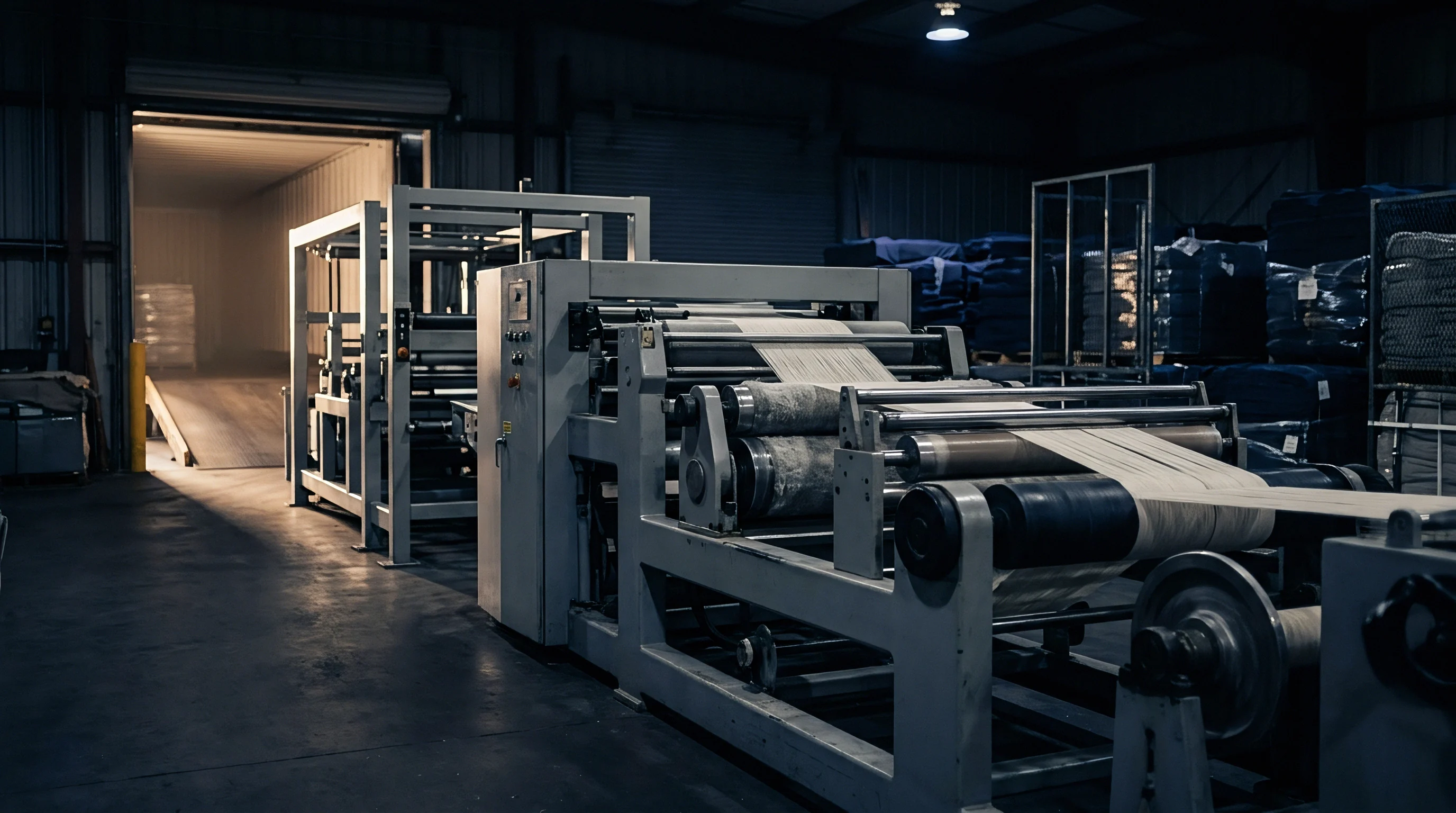
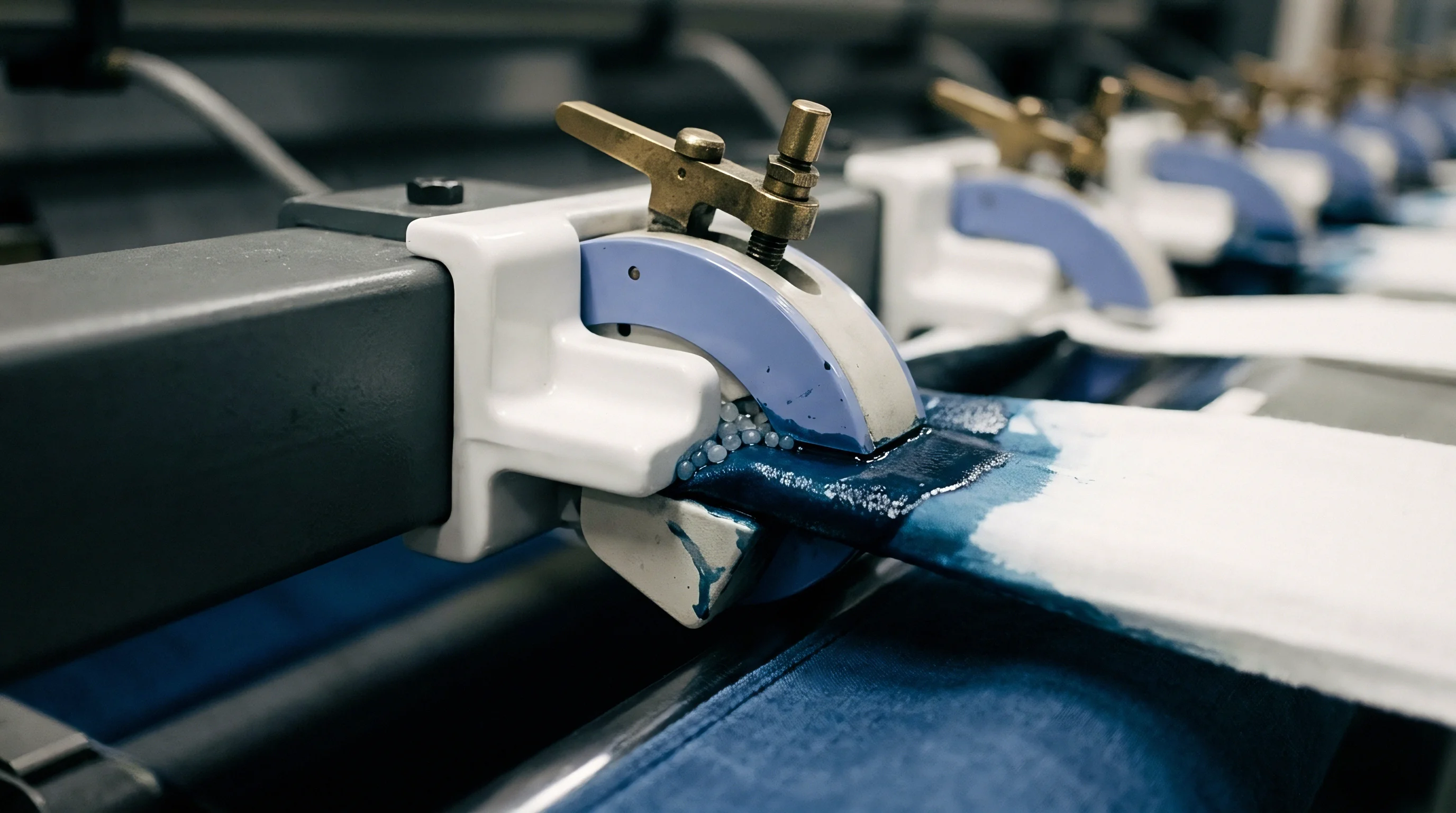
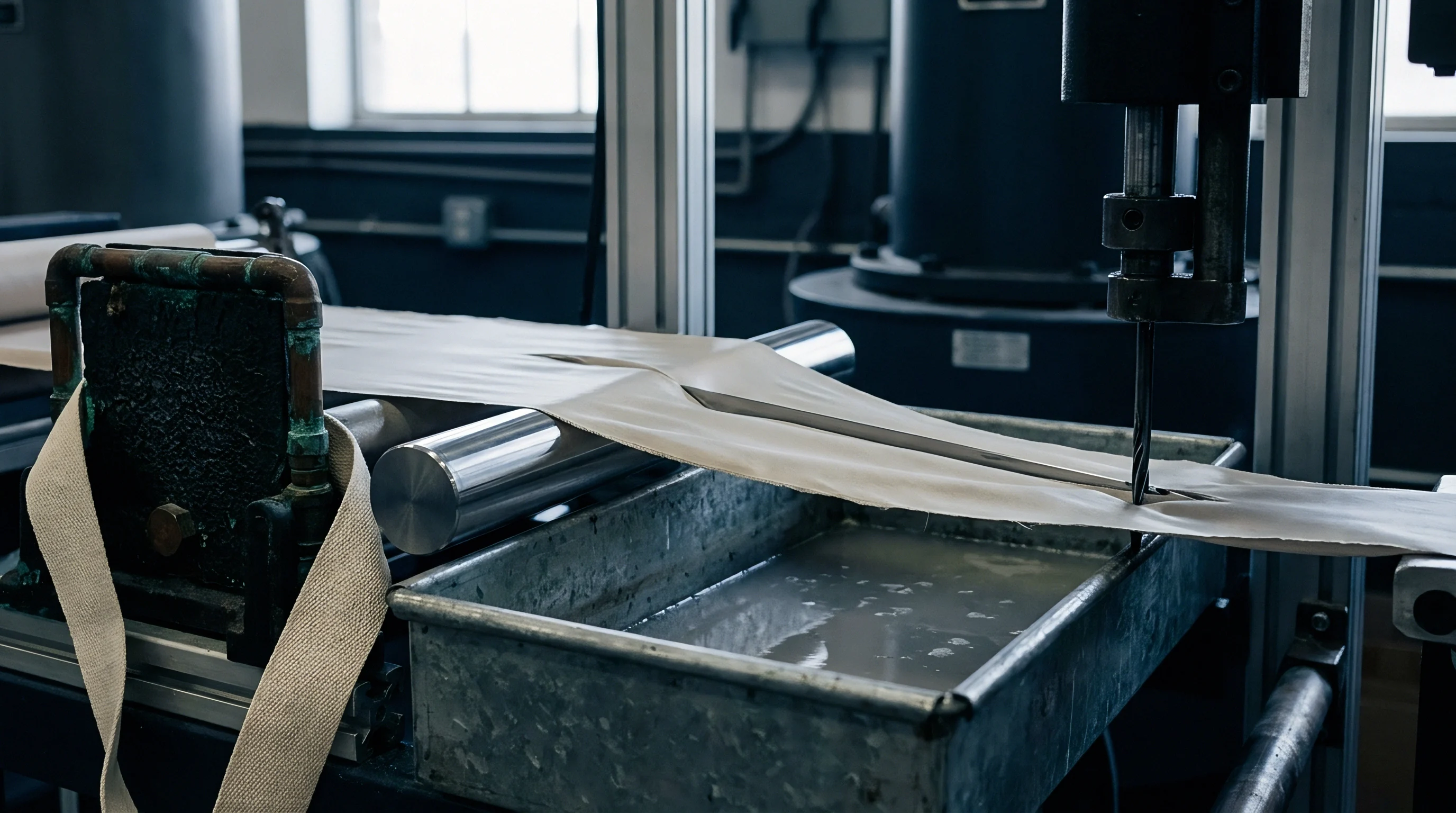
Padder pressure determines how much liquor stays trapped in a woven twill as it clears the trough. Squeeze rolls provide the primary mechanical force governing expression ~ the wet weight picked up relative to dry fabric mass. Because warp and weft floats sit asymmetrically in a twill weave, macroscopic ridges run parallel to microscopic voids between fiber bundles.
The mechanical objective across the nip is straightforward: force chemical liquor into yarn cores while shearing away surface excess to maintain uniform chemical add-on across the entire width.

Roller Hardness and Squeeze Uniformity
Durometer ratings on elastomeric bowl covers dictate nip width under hydraulic load. A softer roll covering of 65 to 70 Shore A yields under load, widening the contact zone and lengthening dwell time under compressive force. That broader contact zone pushes liquid out of inter-yarn voids while preserving fluid inside intra-yarn capillaries.
By contrast, a harder 85 to 90 Shore A roll creates a tight nip with sharp peak pressure that forces liquor deep into yarn cores. If the cover is excessively hard, however, it crushes raised twill ridges, creating density variations that show up as uneven shade after fixation.
| Fabric Build | Roll Covering Hardness (Shore A) | Linear Pressure (N/cm) | Line Speed (m/min) | Wet Pickup Range (%) |
|---|---|---|---|---|
| 100% Cotton 3/1 Twill, 280 gsm | 70 Shore A | 150 N/cm | 35 m/min | 68.5 ± 1.2% |
| 100% Cotton 3/1 Twill, 280 gsm | 85 Shore A | 150 N/cm | 35 m/min | 58.0 ± 1.0% |
| 65/35 Poly-Cotton 2/1 Twill, 210 gsm | 70 Shore A | 200 N/cm | 45 m/min | 54.2 ± 0.8% |
| 65/35 Poly-Cotton 2/1 Twill, 210 gsm | 85 Shore A | 200 N/cm | 45 m/min | 46.1 ± 0.7% |
| Data measured under lab conditions at 20°C bath temperature using ISO 3801 mass determination after conditioning at 65% RH for 24 hours. | ||||
Deflection Control across Broad Fabrics
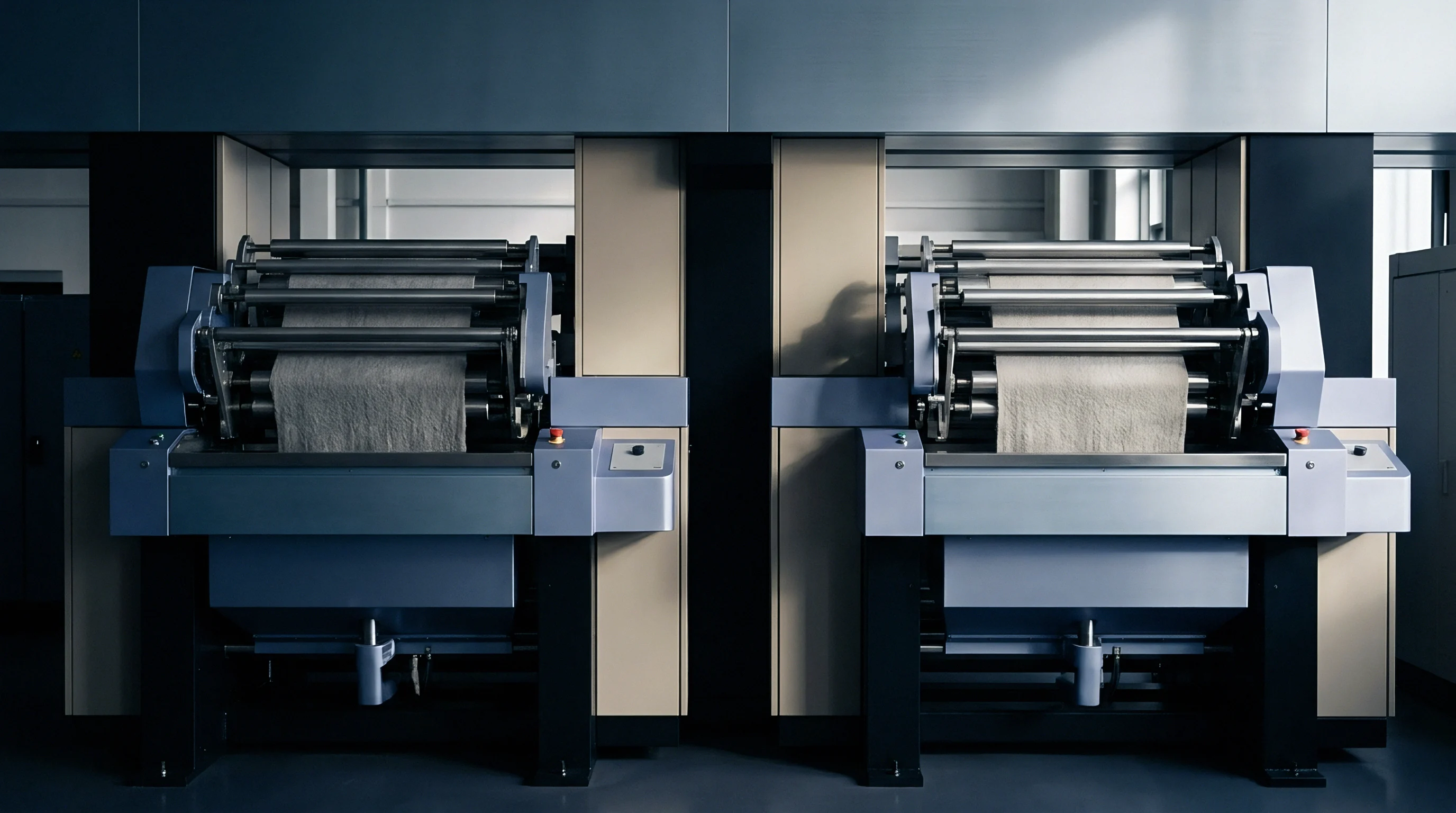
Grinding a crown into stainless steel or rubber rolls compensates for beam deflection under heavy loading. Because pneumatic or hydraulic cylinders load roll journals exclusively, the center bows away from the nip. Without corrective crowning or deflection-compensating rolls, pressure drops across the center relative to the drive and non-drive ends, producing center-to-edge shade variations.
On wide twills over 1.8 meters, that center pressure loss can lift wet pickup by 6% to 10% through the middle third of the web. Modern continuous ranges counter this by using swimming rolls, where internal hydraulic chambers apply counter-pressure against a fixed central shaft to keep the nip gap uniform from edge to edge.
An incorrect pressure setting or an uneven profile on an un-crowned roll produces center-to-edge pickup differentials that cause listing and tailing across production runs, readily turning entire lots into scrap when shaded fabric reaches the cutting room.

Capillarity
The geometry of a twill weave establishes directional channels that control wetting rates during rapid pad immersion. How warp and weft interlace governs both the volume and spatial layout of internal pore spaces. A 2/1 twill packs differently than a 3/1 or 2/2 construction, altering the distribution of interstitial voids.
In every case, fluid moves across two separate regimes: the larger inter-yarn gaps separating adjacent threads, and the tight intra-yarn capillaries formed within the spun fiber bundles themselves.
Float Length Effects on Pore Volume
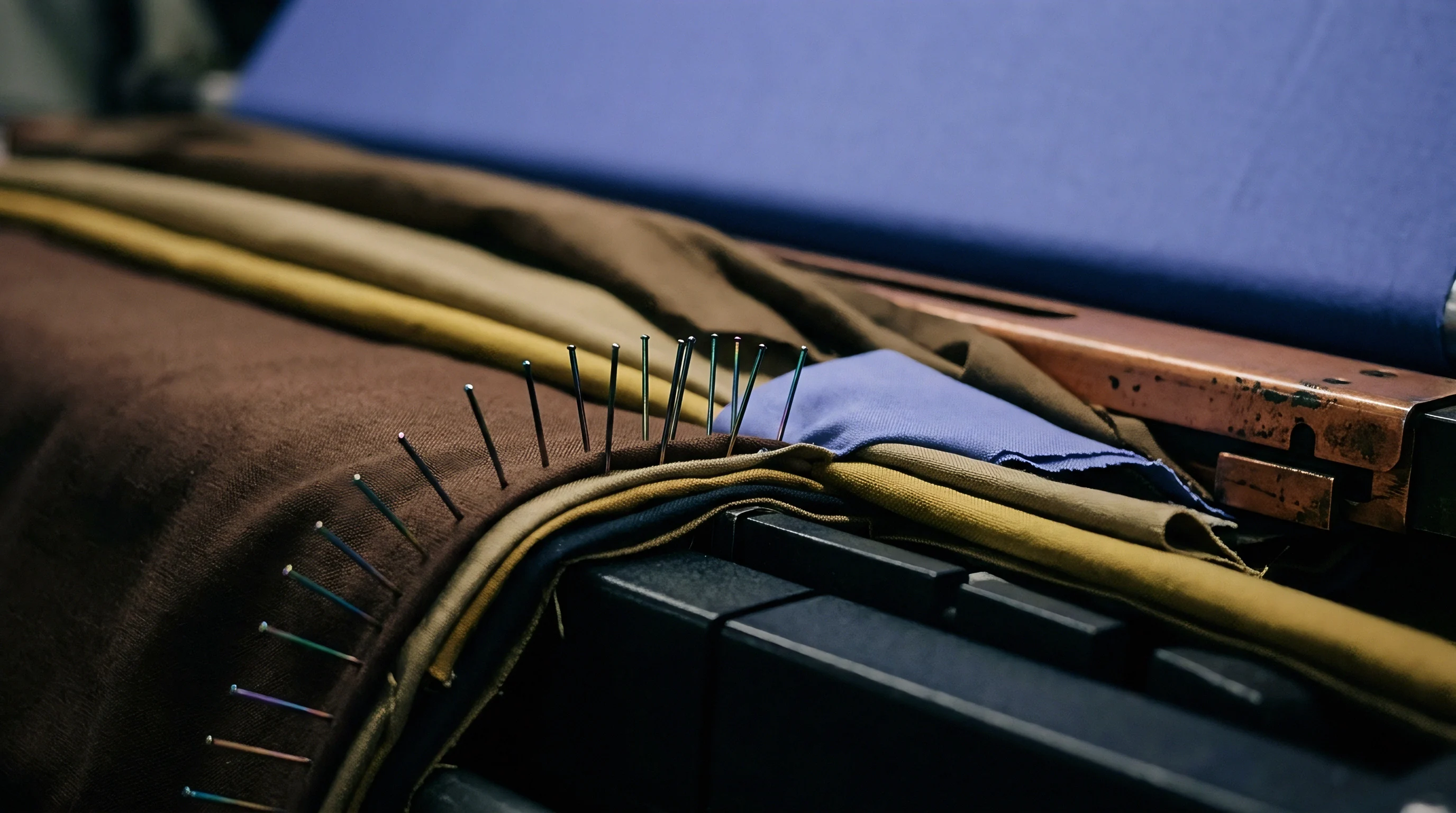
In a 3/1 construction, yarn floats pass over three perpendicular ends before ducking under one, creating an inherently unbalanced surface. Long warp floats lower the crimp frequency per square centimeter and leave broad, open channels running uninterrupted along the diagonal wale. These floating yarns pull in surface liquor by capillarity far more quickly than the crimped threads of a plain weave.
Fluid absorption is distinctly two-sided: the face exposes predominantly long warp floats, while the reverse presents a tight ground of weft interlacings.
A lower thread count with longer yarn floats accelerates liquid ingress while simultaneously increasing total void volume within the uncompressed web.
Directional Wetting in Asymmetrical Weaves
Liquid travels faster along the diagonal twill line than across perpendicular yarn crossovers. Capillary advance follows the path of uninterrupted fiber alignment, which offers the advancing fluid front little resistance along the wale. At plant speeds above 40 meters per minute, fabric spends less than 1.5 seconds submerged in the pad trough.
Unscoured or poorly prepared cotton cannot wet out in that window on its own. If incoming liquor floods the open inter-yarn channels before penetrating the bundles, air is trapped inside the intra-yarn capillaries.
- Inter-yarn Air Trapping occurs when elevated bath viscosity caps outer pore openings before air can escape from interior yarn crossovers.
- Face-to-Back Imbalance develops on heavy 3/1 twills when line speeds prevent liquor from penetrating completely through the thickness of the cloth.
- Channeling Along Float Lines diverts fluid along diagonal float paths, producing local concentration gradients in dense weave regions.
- Differential Swelling Interference occurs when cellulosic fibers swell on first contact with water, narrowing intra-yarn capillaries before core hydration is complete.
Higher yarn twist slows capillary uptake by packing fibers tighter together; soft-spun yarns draw in bath chemistry quickly but give up liquor more easily under nip pressure.

Viscosity
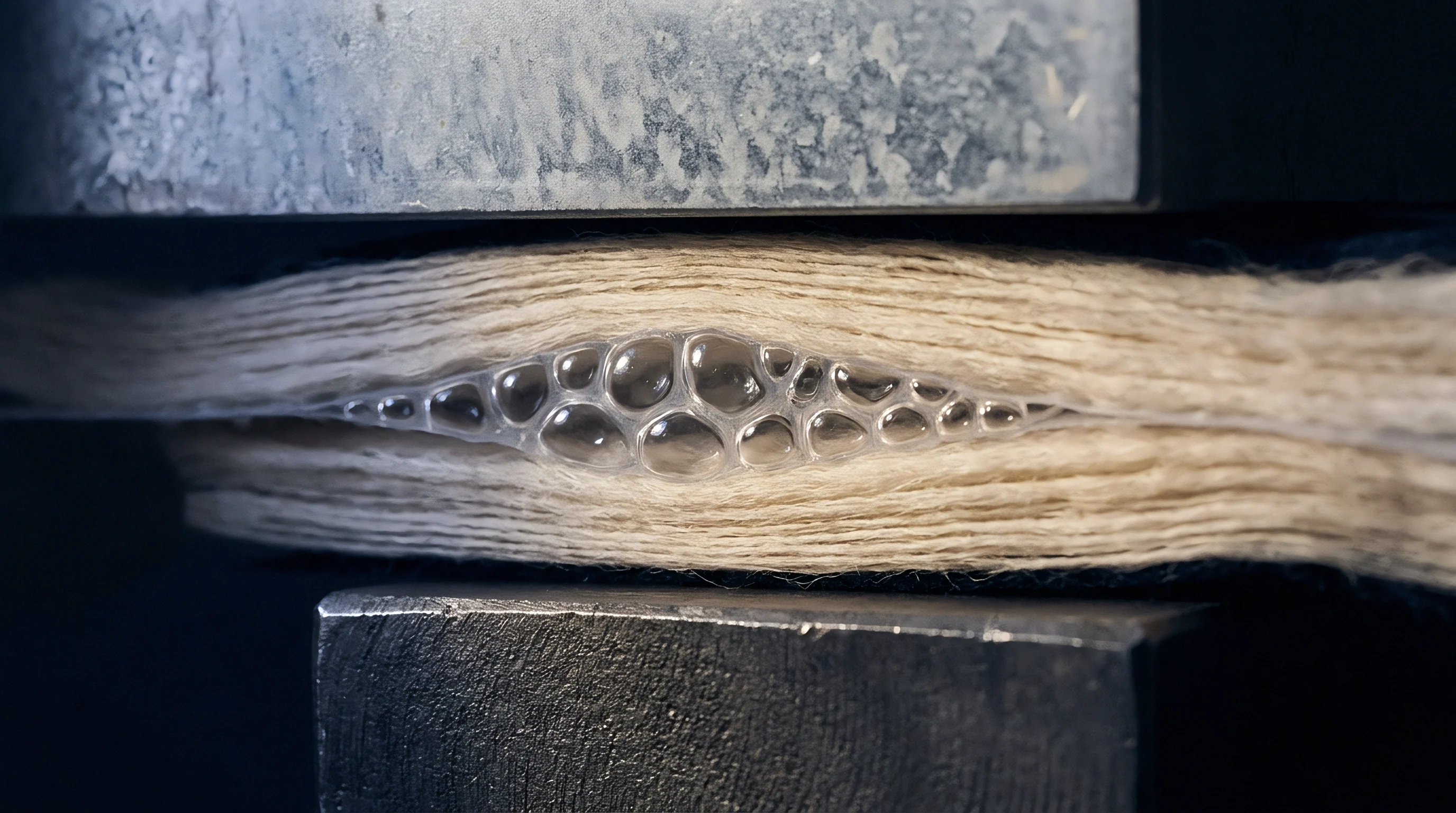
Bath rheology dictates the boundary layer thickness that forms against the moving web at operating speeds. Formulations in the pad box combine dyes, finishing polymers, crosslinkers, and wetting auxiliaries, each shifting dynamic viscosity and surface tension. When viscosity runs high, liquor struggles to enter small capillary radii, forcing operators to slow the line or increase nip pressure to avoid heavy surface deposition.
Surfactant Chemistry and Contact Angles
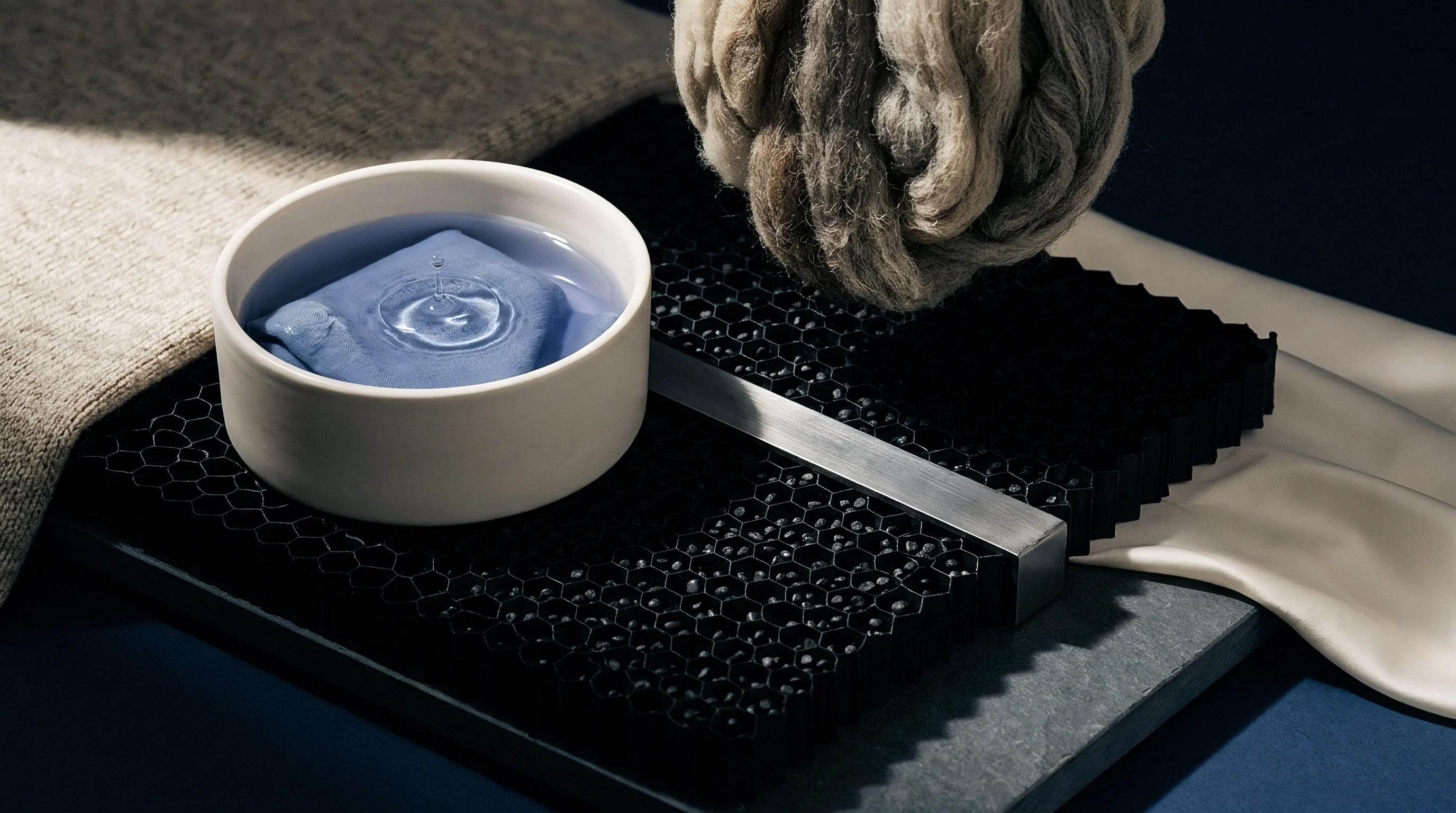
Dropping bath surface tension below 30 dynes per centimeter speeds penetration into greige yarns. Non-ionic ethoxylated alcohols and anionic sulfonates pull the contact angle toward zero degrees, wetting out raw cotton or synthetic fibers almost instantaneously. Wetting rate hinges on surfactant molecular weight and branching: faster-migrating chemistries reach fresh liquid interfaces during the fraction of a second the web spends submerged.
Using low-foaming surfactants avoids air entrainment that would otherwise build up foam banks right at the nip entry.
When Does Pore Saturation Limit Chemical Absorption?
High bath solids can choke internal void spaces before liquor reaches the yarn core. Heavy finishing recipes ~ such as flame retardants or resin baths formulated above 250 grams per liter ~ behave non-Newtonian, thinning under shear in the nip. As the fabric leaves the squeeze zone and shear collapses, viscosity rebounds sharply, trapping chemistry near the surface instead of letting it wick inward through the bundle.
Maintaining bath dynamic viscosity below twenty millipascal-seconds ensures rapid fluid migration into internal yarn capillaries during short immersion windows.
Take a 300 gsm 3/1 cotton twill running at 40 meters per minute through a bath at 12 mPa·s viscosity and 28 mN/m surface tension, targeting 65% wet pickup. If an increase in solids pushes bath viscosity to 28 mPa·s while wetting agent levels remain unchanged, hydrodynamic drag thickens the boundary layer on the entering cloth. A constant roll load of 180 N/cm can no longer clear the excess, and pickup climbs to 74%.
That 9% overshoot puts an extra 27 grams of water on every square meter of fabric, forcing a slowdown at the stenter to avoid delivering damp goods.
Poor core penetration and surface frosting on heavy twills stem primarily from elevated bath viscosity and sluggish dynamic surface tension reduction during high-speed immersion, rather than faulty greige preparation or residual sizing oils.
Stenter
Drying conditions inside the stenter determine how applied finishes distribute through the fabric cross-section. Evaporation starts the moment the web hits the first heated bay. High wet pickup requires substantial thermal input simply to bring moisture to its vaporization point.
As water flashes off outer yarn faces, capillary pull draws internal liquor toward the exterior, carrying dissolved solids along with the drying front.
Infrared Pre-Drying and Solute Migration
Infrared pre-drying immobilizes active chemistries before forced-air convection can shift them. Medium-wave emitters target water molecules directly, heating moisture throughout the twill structure without blowing air across the face. Bringing web temperature to 60°C under infrared reduces wet pickup by 15% to 20% through flash evaporation, setting dissolved dyes and resins in place within the fibers.
Without this step, high-velocity air nozzles in the opening stenter bays strip surface moisture too fast, pulling dissolved solids toward the exposed warp floats and causing migration frosting.
- Check web moisture with non-contact microwave sensors immediately as cloth clears the squeeze rolls.
- Adjust pneumatic roll pressure to hold target wet pickup within plus or minus two percent.
- Run infrared emitter output between 60% and 80%, matched to line speed and cloth weight, to set dissolved solids without skinning the surface.
- Ramp chamber temperatures progressively from 110°C at entry to 170°C in central curing zones to prevent blistering and skinning.
- Balance exhaust dampers to preserve the chamber humidity profile that optimizes heat transfer while venting evaporated moisture.
- Track delivery moisture using residual moisture meters to hit commercial regain targets without over-drying.
Standard contract terms stipulate that finished fabric weight tolerances of plus or minus five percent are evaluated against dry conditioned greige mass plus nominal chemical solids add-on.
Thermal Energy Balances in Moisture Extraction
Vaporizing water consumes roughly 2,200 kilojoules per kilogram. A heavy 350 gsm workwear twill exiting the nip at 75% wet pickup brings 262.5 grams of water per square meter into the stenter. Dialing nip pressure in to cut pickup to 55% lowers that water load to 192.5 grams per square meter.
That 70-gram drop trims evaporation demand by 155.8 kilojoules per square meter, allowing line speed to rise by up to 25% on the same burner output.
Closed-loop control remains difficult at high line speeds: regulating infrared emitter output quickly enough to compensate for sudden absorbency shifts in incoming greige continues to challenge standard sensor setups.
Metric
Gravimetric testing relies on weighing fabric swatches immediately before entering the pad box and right after leaving the squeeze nip. Precision balance checks remain the baseline for calibrating wet pickup across the plant. Circular cutters punch swatches to an exact surface area, usually 100 square centimeters, which are sealed immediately in airtight glass jars to prevent evaporation before reading on an analytical balance calibrated to four decimal places.
Gravimetric Pickup Determination Standard
Conditioning under standard laboratory atmospheres establishes the dry mass baseline before chemistry is applied. ISO 3801 governs mass-per-unit-area procedures, requiring samples to condition at 20°C and 65% relative humidity. Pickup percentage follows the standard expression:
Wet Pickup (%) = ((Wet Mass – Dry Mass) / Dry Mass) × 100
Accuracy depends on preventing moisture loss between the nip rolls and the balance pan. Because dielectric response varies by fiber, moisture meters require individual blend calibrations. On production ranges, online sensors run alongside periodic manual sampling to feed automated pressure adjustments.
| Measurement Method | Underlying Mechanism | Precision Level | Operational Constraints |
|---|---|---|---|
| Off-line Gravimetric Sampling | Mass differential on precision balance | ± 0.2% pickup | Destructive, time-delayed, subject to evaporation errors |
| Microwave Absorption Sensor | Dielectric constant shifts from liquid water | ± 0.5% pickup | Requires calibration per fiber blend and fabric density |
| Radiofrequency Mass Gauge | Attenuated RF energy transmission across web | ± 0.8% pickup | Sensitive to ambient humidity and yarn conductivity variations |
| Beta-Ray Attenuation Meter | Isotopic radiation absorption by total web mass | ± 0.4% pickup | Demands strict radiological safety procedures and licensing |

Online Radiofrequency and Microwave Sensors
Non-destructive electromagnetic sensors map moisture levels across the running cloth. Traversing scanner heads carry microwave transmitter-receiver arrays across webs as wide as three meters every thirty seconds, generating real-time pickup profiles that flag local variation before shade or finish levels drift out of tolerance.
- Sampling Frequency Calibration must sync with line speed so spatial resolution catches pickup swings across intervals shorter than 50 centimeters.
- Temperature Correction Algorithms adjust for elevated liquor temperatures that shift dielectric properties away from ambient baseline values.
- Multi-Fiber Blend Adjustments compensate for differences in bound moisture capacity between hydrophilic cellulosics and synthetic fibers.
- Zero-Point Tare Verification zeros out drift caused by frame thermal expansion or moisture condensation on the scanner heads.
Continuous wet pickup monitoring across full production runs prevents shade listing and maintains chemical application boundaries within prescribed specification limits.
Specifications referencing ISO 105-Z11 restrict wet pickup variation to within four percentage points of the target mean across a lot; wider swings expose the mill to customer price penalties or full reprocessing costs.
Margin
Energy consumed during drying represents the largest variable cost on a continuous finishing range. Fuel for steam or direct-fired stenter ovens makes up as much as 40% of overall plant operating expense. Tightening nip performance to lower initial pickup directly cuts gas or steam consumption per meter of fabric.
Lower pickup also curtails bath waste and effluent treatment costs when dumping the padder between runs.
Steam Consumption Economics
Evaporation energy scales directly with the mass of water entering the oven. Take a production run of 50,000 meters of 250 gsm 3/1 cotton twill (12,500 kg bone-dry weight). At a typical 75% pickup, the stenter must evaporate 9,375 kilograms of water.
Adjusting roll durometer and crown profile to bring pickup down to 58% drops that water load to 7,250 kilograms ~ eliminating 2,125 kilograms of water across the order.
Assuming 80% boiler efficiency and an effective demand of 2,600 kJ per kg of evaporated water (accounting for enclosure radiation losses), that difference saves 6,906,250 kilojoules. With natural gas priced at $0.03 per kilowatt-hour ($0.00000833 per kJ), direct fuel savings total roughly $57.53. The larger return comes from productivity: shedding 2,125 kg of water allows line speed to accelerate from 30 m/min to 38.7 m/min, trimming runtime for the 50,000-meter batch from 27.7 hours to 21.5 hours.
At an operating rate of $180 per hour, running 6.2 hours faster saves $1,116 in machine time, producing a combined margin gain of $1,173.53 on that single order.
Low-Pickup Mechanical Alternatives
Vacuum extraction slots strip unbound interstitial water before fabric enters the dryers. Operating at 20 to 40 kilopascals of suction, vacuum slots draw excess liquor out of the weave structure, bringing wet pickup on heavy twills down to 40% or 45% without flattening surface texture. Spray application systems bypass the pad trough altogether, atomizing concentrated chemical formulations onto the cloth face to deliver uniform add-on at pickup levels as low as 30% to 35%.
Shifting to low-pickup equipment requires recalibrating bath recipes to higher active solids concentrations, since less carrier water reaches the fiber. Mills weigh these chemical formulation adjustments against fuel savings and higher stenter throughput before investing capital in vacuum or spray retrofits on existing ranges.