Torsional Sley Shaft Deflection and Electronic Let off Compensation Dynamics in Broad Width Air Jet Loom Production
Dynamic sley twist on wide air jet looms attenuates center beat-up force, causing pick spacing variations that require dual let-off and rigid sley shafts.

Shaft
Torque transmission across a continuous rock shaft spanning 3400 millimeters or more produces measurable angular twist between the drive conjugate cams and the reed holders at the loom centerline. In high-speed broad width air jet weaving operating between 700 and 950 picks per minute, the cyclical acceleration of the sley mass generates inertial resistance that opposes the driving moment during beat-up. Torsion alters beat-up timing.
Peak mechanical resistance peaks exactly when the reed strikes the fell of the cloth. At this precise crank angle, commonly positioned between 355 and 360 degrees, the angular lag of the center reed holders relative to the driven shaft ends reaches between 0.35 and 0.85 degrees on single-end drive systems, depending on the outer diameter and wall thickness of the tubular cross-section.
Mass creates inertia. When the driving cam boxes sit exclusively at the loom frames, the center of the reed arrives late at the fell line. This microsecond delay shortens the dwell time at maximum forward displacement, diminishing the actual mechanical pressure applied to the incoming filling yarn in the central third of the weaving width.
A hollow steel rock shaft with an outer diameter of 90 millimeters and an 8-millimeter wall exhibits double the center deflection of a 110-millimeter shaft with an 11-millimeter wall under identical sley holder spacing and sub-nozzle loads. Dual drives reduce this displacement. Looms configured with synchronized bilateral cam boxes distribute the input torque from both frame sides, shifting the maximum torsional deflection point from the center to two quarter-span nodes of significantly smaller amplitude.
| Nominal Reed Width | Drive Architecture | Shaft Dimensions Outer Wall | Peak Torsional Twist | Linear Reed Phase Lag |
|---|---|---|---|---|
| 1900 mm | Single Sided Conjugate Cam | 75 mm by 6 mm Steel | 0.18 degrees | 0.28 mm |
| 2800 mm | Single Sided Conjugate Cam | 90 mm by 8 mm Steel | 0.42 degrees | 0.66 mm |
| 3400 mm | Single Sided Conjugate Cam | 90 mm by 8 mm Steel | 0.78 degrees | 1.22 mm |
| 3400 mm | Bilateral Synchronized Cams | 100 mm by 10 mm Steel | 0.24 degrees | 0.38 mm |
| 3900 mm | Bilateral Synchronized Cams | 110 mm by 12 mm Alloy | 0.31 degrees | 0.49 mm |
Air jet looms run profiled reeds fitted with an array of intermediate relay nozzles that cycle compressed air at 0.45 to 0.65 megapascals throughout filling insertion. The additional mass of these nozzle manifolds, supply blocks, and flexible pneumatic piping mounts directly to the oscillating sley. When the loom accelerates toward terminal velocity, the distributed dynamic mass exacerbates the natural bending and torsional modes of vibration.
Finite element calculations and stroboscopic laser vibrometry demonstrate that sley rock shafts experience dynamic torsional resonance frequencies between 24 and 32 hertz. These frequencies coincide uncomfortably with third-order harmonics of the loom rotational frequency at 800 picks per minute, amplifying the peak dynamic deflection beyond static torsional calculations.
Dynamic torsional displacement at the reed center reaches 1.22 millimeters on a 3400-millimeter single-drive rock shaft operating at 850 picks per minute under standard relay nozzle loading.
Bilateral drive systems resolve a substantial portion of this angular phase lag, yet they introduce symmetrical twist curves where both selvedges lead the beat-up while the exact mechanical midpoint lags. Machinery builders frequently market wide frames as drop-in expansions of standard narrow designs, asserting that modern high-modulus alloys eliminate the physical consequence of shaft elasticity.


Feed
Electronic warp delivery mechanics control tension stability as the weaver’s beam drains from a full 1000-millimeter flange diameter down to a 150-millimeter barrel core. In broad width manufacturing, the mechanical inertia of wide beams containing 12,000 to 18,000 ends creates severe rotational hysteresis. Twin beams reduce inertia.
Splitting the warp into two independent half-width beams mounted on common or independent let-off servomotors permits differentiated rotational acceleration. On single solid beams spanning 3400 millimeters, the dead weight of the wound yarn package exceeds 900 kilograms. Accelerating and decelerating this mass during machine stop-start cycles or heavy shedding transitions overwhelms standard proportional-integral-derivative servo loops unless forward-looking feedforward algorithms actively anticipate the shed opening.
Load cells register peak strain. Tension sensors positioned on the whip roll or backrest assembly measure the aggregate normal force exerted by the tensioned yarn sheet. In a solid full-width backrest, load cells located at the side housings record only the edge tension, entirely missing cross-sheet tension drops caused by warp beam deflection and central sley lag.
Servomotors correct the delivery rate. When the central warp ends experience reduced beat-up displacement due to sley twist, their cyclical crimp interchange differs from the selvedges, leading to a flatter structural profile in the greige fabric core.
What Restores Dynamic Warp Tension Symmetry?
Active compensation requires integrating dual load-cell inputs with segmented backrest mechanisms. When the machine controls tension through independent left and right let-off servomotors, the electronic let-off system adjusts beam rotation per quadrant, balancing overall tension against varying package diameters. These control routines interface directly with the main drive processor using deterministic industrial fieldbuses operating at millisecond cycle times.
- Dynamic Load Cell Filtering removes mechanical vibration harmonics induced by backrest oscillation before passing the actual yarn tension signal into the motor control algorithms.
- Rotational Inertia Feedforward injects predictive torque values into the AC servo drives based on instantaneous beam package radius calculated from continuous hall-sensor feedback.
- Shedding Height Coordination modulates the let-off displacement rate precisely during the opening of high-lift dobby shafts to prevent cyclic warp starvation at peak shed geometry.
- Electronic Brake Synchronization applies calibrated holding torque during emergency stop cycles to prevent warp relaxation and subsequent start-up stop marks.
Backrest assemblies on broad machines act as mechanical low-pass filters for tension peaks. A rigid, unyielding whip roll transfers every micro-deflection of the sley directly into the warp sheet, causing fatigue breaks on fine combed cotton or low-denier filament yarns. Soft spring-mounted or pneumatic damper backrests absorb peak beat-up impulses, yet excessive compliance permits the fell line to wander backward by up to 2 millimeters, accentuating pick spacing irregularities.
Balancing this spring constant against the servomotor frequency response fixes the physical boundaries of process stability.
A spring rate exceeding 45 Newtons per millimeter on the broad whip roll damper induces warp yarn fatigue breaks along the reed center.
The unresolved question remains whether high-speed electromechanical let-off actuators can physically react fast enough within a single pick cycle of 70 milliseconds to counteract local micro-slackening induced by center sley deflection, or whether compensation must remain purely predictive over multi-pick horizons.

Variance
Discrepancies in pick density across the cut width correlate directly with the combined mechanical deflection of the sley shaft and the warp tension profile. Pick spacing widens mid-reed. At the fabric selvedges, where the reed holder connects rigidly near the cam drive boxes, the full kinetic energy of the beat-up motion transfers into the interlacing yarns.
At the mid-span of a broad machine, torsional flexure dampens the forward stroke. The reed recedes before the incoming weft yarn is compacted completely against the preceding pick, leaving the central weave structure slightly more open.
Is Center Beat-Up Force Measurably Attenuated?
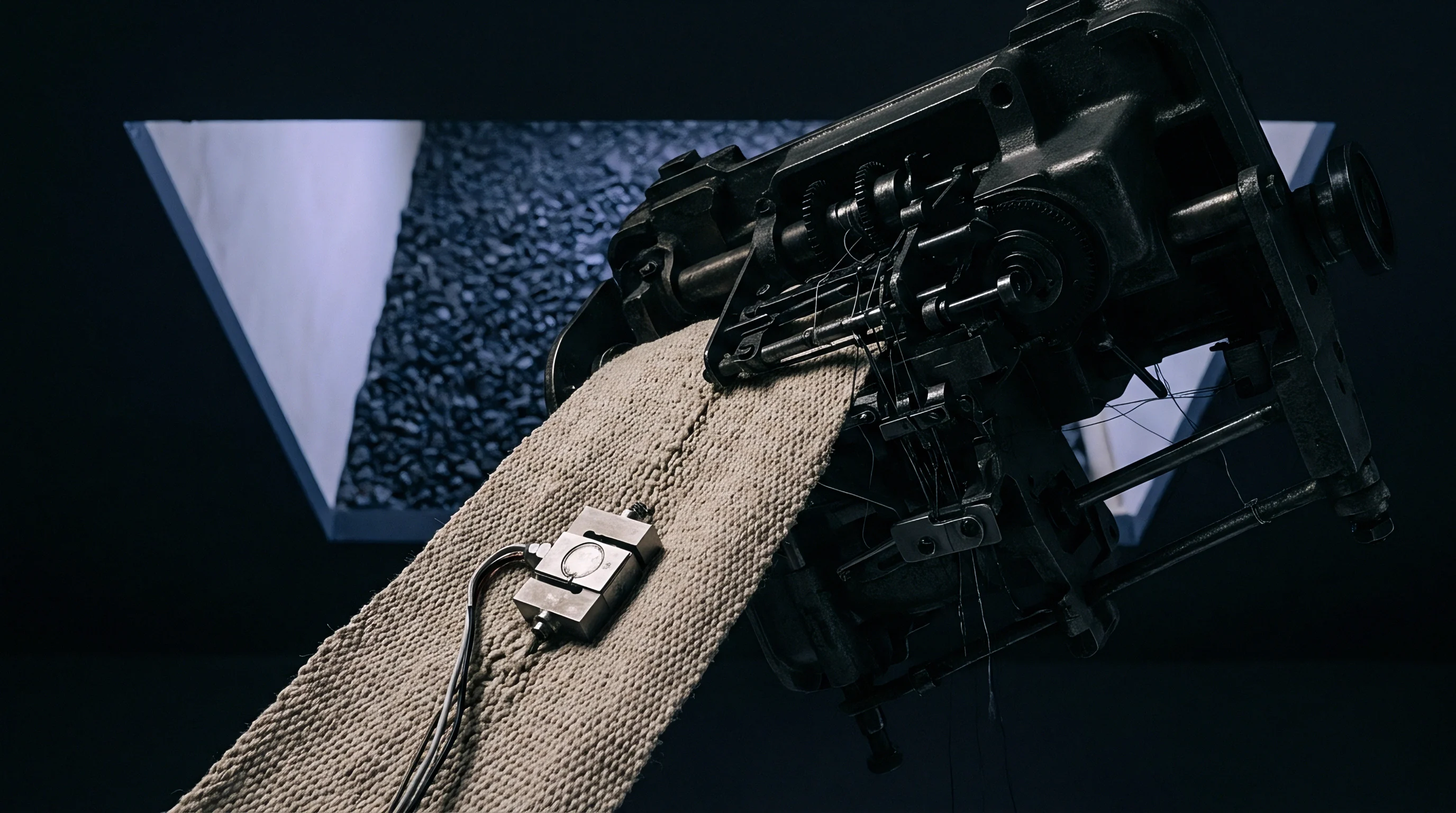
Force transducers embedded across trial reeds record peak fell impact forces of 140 Newtons per centimeter near the driven loom frame, compared to 105 Newtons per centimeter at the geometric center during the production of dense percale constructions. Tension drops at the center. This 25 percent reduction in localized compaction pressure alters the pick count over measurable distances.
When weaving a nominal 200-pick-per-inch downproof cambric on a 3600-millimeter machine, off-loom pick glass analysis reveals 202 picks per inch within 200 millimeters of the temple cutters, falling steadily to 194 picks per inch across the center 1200 millimeters.
| Measurement Position | Actual Picks Per Inch | Warp Tension (cN per end) | Warp Crimp Ratio | Weft Crimp Ratio |
|---|---|---|---|---|
| Left Selvedge (0 to 200 mm) | 112.5 | 38.2 | 8.6 percent | 6.2 percent |
| Left Quarter (750 to 950 mm) | 110.0 | 35.4 | 7.9 percent | 6.8 percent |
| Center Width (1600 to 1800 mm) | 107.5 | 32.1 | 7.1 percent | 7.6 percent |
| Right Quarter (2450 to 2650 mm) | 110.5 | 35.6 | 8.0 percent | 6.7 percent |
| Right Selvedge (3200 to 3400 mm) | 112.0 | 37.9 | 8.5 percent | 6.3 percent |
Crimp distribution mirrors the beat-up force disparity. Because the edge warp yarns experience intense forward compaction from the stiff reed ends, they are forced into higher amplitude undulations around the straight weft yarn. Warp crimp reaches 8.6 percent at the edges, whereas at the center, the lower compaction pressure allows the warp ends to remain straighter, yielding a warp crimp of only 7.1 percent with an inversion in weft crimp.
This physical imbalance directly changes fabric weight per unit area, air permeability, and tensile resistance across the width.
Structural distortion produces distinct visual and functional downstream defects. Uneven tension degrades dye take-up. When greige goods woven with variable crimp profiles enter continuous wet processing, differences in yarn packing density generate differential dye liquor strike rates.
Center-to-selvedge shading, commonly described as listing, frequently originates at the broad loom rather than in the continuous padder or stenter frame. Stenter heat locks the skew. Attempting to compensate for cross-width pick variations during scouring, bleaching, and stentering creates severe residual tension, leading to curved weft bowing and diagonal skewing when the finished roll is subsequently slit into narrower consumer widths.
- Center-to-Edge Shading manifests during continuous dyeing as an apparent color depth variance between the dense selvedges and the looser central weave body.
- Bow and Skew Distortion occurs when unequal internal stresses relax unevenly through washing, creating curved weft lines exceeding ASTM limits.
- Differential Dimensional Stability causes finished sheets or cut components to shrink unevenly during laundry cycles, producing severe edge curl and puckering.
- Puckered Seams appear during high-speed garment stitching because tension recovery across the loose fabric center differs from the stiff edges.
Failure to correct for rock shaft deflection and tension gradients across wide weaves causes entire rolls to fail finished inspection criteria, leading directly to rejection by commercial converters who discover that slit panels cut from the middle of the bolt fall outside performance tolerances.
Inspection
Verifying broad goods requires strict off-loom and finished-state examination protocols conducted according to international standards. Off-loom counts reveal structural drift. A construction specification that defines picks per centimeter must specify the testing locations across the usable width.
Measuring pick density solely within one meter of the outer edge masks center sley deflection. Conforming protocols apply ISO 7211-2 or ASTM D3775 across at least five distinct transversal zones: left edge, left quarter, center, right quarter, and right edge. The sampling rule establishes that each test point sits at least 150 millimeters inward from the trimmed fringe to avoid temple distortion.
A multi-point inspection plan mandates recording pick counts across five transversal zones to capture mechanical sley deflection before releasing greige rolls to wet finishing.
Tolerances define acceptable bulk. Standard industrial contracts frequently tolerate a plus or minus 2.5 percent variance in pick count on narrow goods. On widths over 3000 millimeters, a 2.5 percent variation represents an unacceptable five-pick spread on a 200-pick specification.
The resulting fabric exhibits an eight percent variance in air permeability tested per ISO 9237 at 100 Pascals differential pressure, directly disqualifying the material from downproof bedding or technical filtration applications. Fabric weight verified under ISO 3801 must reflect conditioned mass per square meter taken from full-width cross-cut sweeps, weighed independently across outer and inner zones.
- Verify greige dimensions by conditioned measuring under ISO 22198 after 24 hours of standard atmospheric relaxation at 20 degrees Celsius and 65 percent relative humidity.
- Map thread density gradients across five lateral zones using calibrated optical pick counters to isolate center fell-line lag from uniform let-off drift.
- Conduct strip tensile tests according to ISO 13934-1 on warp and weft specimens cut from center and edge zones to quantify crimp-related strength discrepancies.
- Evaluate dimensional stability under ISO 5077 following three cycles of domestic washing at 60 degrees Celsius per ISO 6330 procedures.
- Inspect weft distortion in accordance with ASTM D3882 to verify that combined bow and skew remain within 1.5 percent of total usable fabric width.
Contractual documentation between greige mills and finishing converters must account for structural mechanics. Standard delivery agreements incorporate the ASTM D5430 four-point inspection method, assigning penalty points to continuous barre and pick variation. Where the contractual language explicitly states that pick count tolerances apply uniformly across every individual 100-millimeter lateral segment of the certified usable width, the buyer retains legal cause to issue an immediate commercial debit for rolls exhibiting center-to-selvedge density drops, shifting the financial burden of loom mechanical flexure back to the primary weaver.
Cost
Operating broad width air jet machinery involves trade-offs between linear output gains and landed manufacturing cost. Wide looms consume capital. A 3400-millimeter air jet machine commands an initial capital purchase price approximately 45 to 60 percent higher than a standard 1900-millimeter machine.
Auxiliary equipment, including dual electronic let-off servomotors, reinforced bilateral cam boxes, high-capacity compressor networks, and wide-span inspection frames, increases the total installation expenditure. While weaving two 150-centimeter fabric widths side-by-side or producing single seamless 320-centimeter hotel sheeting raises volume per operator hour, the mechanical overhead scales nonlinearly.
Pneumatic consumption drives hourly operating expenses. Relay nozzles on a 3400-millimeter profile reed consume between 18 and 28 cubic meters of compressed air per hour per machine, compared to 10 to 14 cubic meters on standard widths. Compressed air generation accounts for roughly 65 percent of electrical consumption on the weaving floor.
Converters invoice on delivered width. If center sley deflection forces a mill to reduce machine speed from 850 picks per minute down to 680 picks per minute to control pick density variation and fabric barre, the capital productivity advantage rapidly deteriorates.
| Operational Parameter | Dual 1900 mm Single Looms | Single 3400 mm Broad Loom | Operational Variance |
|---|---|---|---|
| Installed Machine Cost | $110,000 Total | $82,000 | Minus 25.5 percent |
| Operational Speed | 950 picks per minute | 780 picks per minute | Minus 17.9 percent |
| Power and Air Consumption | 6.2 kW combined | 8.4 kW | Plus 35.5 percent |
| Greige Downgrade Rate | 1.2 percent | 3.8 percent | Plus 2.6 percentage points |
| Effective Production (m/hr at 30 picks/cm) | 38.0 linear meters | 31.2 linear meters | Minus 17.8 percent |
| Net Weaving Cost per Finished Meter | $0.48 | $0.54 | Plus 12.5 percent |
Margins evaporate on downgraded rolls. When greige rolls fail pick count consistency across the middle section, secondary market liquidations or downgrade penalties wipe out the mill’s operating margin. Wet processing plants often refuse to take liability for shading defects on wide goods unless the greige specification sheet demonstrates verifiable pick count uniformity.
Buying wide broadcloth demands calculating the fully loaded cost of quality, including testing overhead and potential reject rates, rather than accepting machine nominal output ratings at face value.
Weave room efficiency on broad widths depends fundamentally on maintaining mechanical rigidity under load rather than driving maximum linear pick insertion speeds.