Determining Polymeric Fibre Moisture Regain Using Gravimetric Oven Drying Methods
Gravimetric oven drying determines accurate polymeric fibre regain by measuring dry mass after removing volatile moisture at specified temperatures.
Bond
Polymeric Sorption Dynamics and Moisture Kinetics
Water molecules interact with accessible functional groups along polymer backbones through dipole forces, establishing a thermodynamic equilibrium between atmospheric water vapor and solid synthetic structures. Polymeric fibres absorb water at specific active sites: primary hydroxyl groups in regenerated cellulose, amide linkages in polyamides, and carboxyl end-groups in polyesters. Chemical architecture governs both total moisture uptake capacity and the rate at which water penetrates the fibre core.
Polar functional groups form hydrogen bonds with water molecules to yield a tightly bound primary monolayer, after which secondary and tertiary multilayers accumulate within amorphous polymer domains.
Polymer morphology splits internal fibre volume into crystalline and amorphous regions. Dense intermolecular packing in highly ordered crystalline zones excludes water molecules completely, whereas free volume inside amorphous zones allows water vapor to enter and condense. Regenerated cellulose, including viscose and modal, features an open amorphous network with abundant hydroxyl groups, driving elevated moisture absorption.
Polyethylene terephthalate has a highly crystalline structure with sparse ester sites, resulting in minimal water uptake under standard ambient conditions. Hydrophobic synthetic polymers rely almost exclusively on surface adsorption and mechanical fluid entrapment within surface crenulations rather than molecular absorption into the polymer matrix.
Water alters polymer chain mobility. Absorbed water acts as a molecular plasticizer, lowering the glass transition temperature of polymers containing polar bonds. In polyamides like nylon 6,6, water molecules break interchain hydrogen bonds between adjacent carbonyl and amine groups.
This structural interruption increases chain flexibility, alters tensile modulus, and expands amorphous volume. Lower glass transition temperatures accelerate moisture diffusion rates through the polymer matrix. Accounting for these kinetic mechanisms is essential when setting thermal parameters for gravimetric drying, as bound water requires significantly more kinetic energy to remove than free capillary water.

Distinguishing Regain from Moisture Content
Precision testing requires absolute mathematical clarity regarding mass ratios. The textile trade uses two distinct metrics to quantify water held within polymeric materials: moisture regain and moisture content. Conflating the two causes severe commercial valuation errors and invalidates laboratory compliance reports.
Moisture regain defines the mass of water in a material expressed as a percentage of its dry mass. The mathematical formula sets dry mass as the reference denominator:
R = ((Ww – Wd) / Wd) 100
In this equation, R represents moisture regain expressed as a percentage, Ww represents the initial wet or conditioned mass of the fibre sample, and Wd represents the clean, bone-dry mass measured after complete thermal evacuation of water. Moisture regain values can theoretically exceed 100 percent in highly absorbent materials or hydrophilic hydrogels, whenever the mass of absorbed water exceeds the dry baseline denominator.
Moisture content defines the mass of water expressed as a percentage of the total original wet or conditioned mass of the specimen. The formula establishes total initial mass as the baseline denominator:
M = ((Ww – Wd) / Ww) 100
In this expression, M represents moisture content. Moisture content values can never exceed 100 percent. The mathematical relationship converting moisture content to moisture regain is direct:
R = (M / (100 – M)) 100
A viscose fibre specimen exhibiting a moisture content of 11.5 percent possesses a calculated moisture regain of 13.0 percent. In commercial transactions, contracts specify moisture regain to calculate commercial invoice mass, whereas analytical chemists frequently track moisture content during drying rate studies. Maintaining clear boundaries between these two formulas prevents multi-thousand-dollar settlement errors during bulk fiber lot transfers.
The equilibrium moisture regain of regenerated cellulose at standard testing atmosphere reaches 13.0 percent, whereas polyethylene terephthalate stabilizes at 0.4 percent under identical conditions.

Sorption Isotherms and Structural Enthalpy
The relationship between relative humidity and equilibrium moisture regain follows a sigmoidal curve, classified as a Type II sorption isotherm for most hydrophilic polymeric fibres. At low relative humidity levels, water adsorption occurs rapidly as high-energy primary sites fill. The enthalpy of sorption in this initial zone significantly exceeds the latent heat of vaporization of pure water, reflecting the strong exothermic hydrogen bonding between water molecules and polymer functional groups.
Evaporating this bound water during gravimetric oven drying demands higher energy input than evaporating bulk free water.
| Polymer Type | Dominant Functional Groups | Crystallinity Degree (%) | Equilibrium Regain (%) | Primary Water Binding Enthalpy (kJ/mol) |
|---|---|---|---|---|
| Viscose Rayon | Hydroxyl (-OH) | 35 – 40 | 12.5 – 13.5 | 68.5 |
| Polyamide 6,6 | Amide (-CONH-) | 45 – 50 | 4.0 – 4.5 | 54.2 |
| Acrylic (Acrylonitrile) | Nitrile (-CN) | 60 – 70 | 1.5 – 2.0 | 46.0 |
| Polyester (PET) | Ester (-COO-) | 55 – 65 | 0.4 – 0.5 | 44.1 |
| Polypropylene | Aliphatic Hydrocarbon | 60 – 70 | 0.0 – 0.1 | 40.7 |
As ambient relative humidity moves into intermediate ranges, secondary multilayer absorption takes place inside the amorphous matrix. The binding energy of these secondary layers approaches the enthalpy of condensation for free water vapor. At high relative humidity levels above 80 percent, capillary condensation dominates within micro-voids in the fibre structure.
Water held within capillaries exhibits minimal interaction with the polymer chains and evaporates rapidly during initial thermal exposure inside a gravimetric drying oven.
Temperature alters sorption isotherm equilibrium. Increasing ambient temperature shifts isotherms downward, reducing total equilibrium moisture regain at any given relative humidity. Thermal agitation increases kinetic energy within the polymer chains, breaking weaker hydrogen bonds and driving water vapor out of the amorphous domains into the surrounding atmosphere.
Precise temperature control within analytical gravimetric ovens is therefore mandatory; fluctuations of just a few degrees disrupt the vapour-pressure equilibrium and induce significant mass errors.
Failing to account for bound water removal energy leads directly to incomplete specimen drying, artificially inflated dry mass readings, and understated commercial regain values that erode margins during trading disputes.
Chamber

Forced Convection and Vacuum Oven Dynamics
Precision gravimetric testing relies on forced-draft thermal enclosures maintained within tightly controlled temperature tolerances. Air circulation velocity across test specimens must remain high enough to purge boundary-layer water vapor continuously without dislodging delicate fibre samples from weighing containers. Gravimetric drying ovens use high-capacity heating elements coupled with motorized impellers to maintain uniform thermal distribution throughout the interior chamber volume.
Temperature gradients inside the drying space cannot exceed plus or minus 2 degrees Celsius from the setpoint specified in ISO 6741 or ASTM D2654 standards.
Standard forced-convection ovens pull ambient air, pass it over heating elements, drive it across test specimens, and vent the saturated exhaust out of the facility. The moisture content of incoming ambient air directly influences the theoretical drying limit inside the chamber. Supplying an oven with high-humidity ambient air prevents complete removal of residual bound water from hydrophilic polymers.
Advanced testing laboratories feed forced-draft drying ovens with conditioned, desiccated intake air possessing a controlled absolute humidity below 0.2 grams of water per kilogram of dry air, guaranteeing complete removal of volatile moisture.
Vacuum drying ovens provide a low-pressure environment that lowers the boiling point of water. Lower pressure enables rapid moisture evacuation at reduced temperatures. Vacuum systems prove essential when analyzing heat-sensitive synthetic polymers, including polyurethane elastanes, low-melting polypropylene blends, and bio-based polymers such as polylactic acid.
Subjecting these heat-labile materials to standard 105 degrees Celsius convection temperatures induces thermal degradation, chain scission, and chemical decomposition. Weight loss from thermal degradation corrupts the gravimetric dataset, falsely inflating the calculated moisture regain value.
Specimen Containers and Balance Calibration Integration
Specimen container selection dictates measurement integrity. Laboratory operators use thin-walled aluminum weighing cans or high-silica glass weighing bottles fitted with ground-glass stoppers. Containers must withstand repeated thermal cycling without undergoing structural oxidation, dimensional distortion, or mass drift.
Aluminum weighing cans offer rapid thermal equilibration and high impact resistance, whereas glass containers eliminate potential oxidation reactions when testing chemically treated or acid-dyed fibre lots.
Tare mass stability is a fundamental requirement in gravimetric analysis. Empty weighing containers absorb ambient moisture rapidly when removed from thermal drying chambers. An open glass weighing bottle can gain up to 0.0020 grams of atmospheric water vapor within 60 seconds of exposure to standard laboratory ambient conditions.
Sealing containers immediately upon extraction from the thermal chamber prevents atmospheric moisture re-absorption prior to weighing. Ground-glass stoppers must fit tightly without hydrocarbon lubricants, as sealing greases vaporize inside drying ovens and contaminate specimen fibres.
Analytical balances integrated directly into gravimetric drying systems require specialized thermal isolation. Modern automated drying ovens feature internal balance pans suspended inside the heated drying chamber via non-conducting mechanical linkages connected to an external weighing cell below. Keeping the weighing cell outside eliminates heat transfer to delicate balance electronics, preventing thermal zero-drift and optical sensor miscalibration.
Analytical balances used for gravimetric testing must provide a resolution of 0.0001 grams and undergo daily calibration using traceable Class E2 mass standards certified under ISO/IEC 17025 protocols.
Thermal Boundaries and Polymer Stability
Selecting the correct drying temperature requires balancing thermal moisture kinetic drives against polymer degradation limits. Standard gravimetric protocols specify a drying temperature of 105 to 110 degrees Celsius for common natural and synthetic polymers, including cotton, wool, viscose, polyamide, acrylic, and polyester. At 105 degrees Celsius, water vapor pressure within the fibre matrix exceeds atmospheric vapor pressure, driving rapid evaporation without inducing thermal scission of primary polymer backbones.
| Polymer Classification | Standard Drying Temp (°C) | Vacuum Assisted Setpoint (°C) | Maximum Heating Duration (Hours) | Thermal Degradation Threshold (°C) |
|---|---|---|---|---|
| Regenerated Cellulose (Viscose) | 105 ± 2 | 60 ± 2 | 4.0 | 140 |
| Polyamide 6,6 (Nylon) | 105 ± 2 | 60 ± 2 | 3.0 | 125 |
| Polyurethane Elastane (Spandex) | 70 ± 2 | 40 ± 2 | 6.0 | 85 |
| Polylactic Acid (PLA) | 70 ± 2 | 45 ± 2 | 5.0 | 90 |
| Polypropylene (PP) | 90 ± 2 | 50 ± 2 | 3.0 | 105 |
Exceeding recommended drying temperatures triggers secondary chemical reactions. Regenerated cellulose undergoes slow thermal oxidation above 120 degrees Celsius, releasing volatile pyrolytic byproducts including carbon dioxide, water, and low-molecular-weight aldehydes. Polyamides experience oxidative thermal degradation when exposed to hot dry air above 110 degrees Celsius for extended durations, resulting in yellowing and physical mass loss from volatile amine evolution.
Polyurethane elastane bonds hydrolyze and decompose rapidly above 80 degrees Celsius, rendering standard high-temperature convection ovens unusable for regain analysis of elastomeric yarns.
Buoyancy effects within thermal drying chambers introduce subtle mass measurement errors that require systematic correction. Air density inside a heated drying oven maintained at 105 degrees Celsius measures approximately 0.93 grams per liter, whereas ambient room air at 20 degrees Celsius exhibits a density of 1.20 grams per liter. A hot weighing container weighed directly inside a heated chamber experiences an upward buoyant lift force that reduces its apparent mass relative to its true ambient mass.
Weighing containers sealed hot and weighed outside the chamber on an external room-temperature balance experience convection-induced air currents along container walls, creating upward thermal drag forces. Cool weighing containers completely inside a desiccator prior to placing them on balance pans to eliminate convection currents and buoyant discrepancies.
Several physical mechanisms frequently compromise oven drying accuracy during routine laboratory operation:
- Thermal Gradient Discrepancy uneven heating elements create localized hot spots within the oven chamber, exceeding polymer degradation limits while adjacent zones remain below effective drying temperatures.
- Exhaust Boundary Saturation insufficient forced-convection airflow velocity allows saturated water vapor to accumulate around specimen baskets, stalling moisture evaporation kinetics.
- Ambient Intake Infiltration unconditioned high-humidity intake air continuously reintroduces moisture into the chamber atmosphere, preventing complete extraction of bound water.
- Tare Mass Drift unsealed weighing containers absorb atmospheric moisture during specimen transfer, adding false mass to dry specimen weight readings.
- Convection Lift Interference weighing hot containers directly on analytical balance pans generates upward thermal air currents that alter precision mass readouts.
Extended six-hour bake cycles at 115 degrees Celsius are sometimes applied to drive out deep core moisture, but high heat volatilizes low-molecular-weight elastomeric oligomers and causes unexpected regain drops in elastane-blended yarns.

Transit
Sampling Protocols and Environmental Exposure
Core specimens pulled from dense bales undergo rapid moisture exchange with ambient air during handling. Obtaining a representative sample requires strict adherence to standardized sampling patterns designed to bypass surface effects. Outer layers of a compressed fibre bale adjust quickly to shipping container humidity, whereas core fibers retain the moisture state present during initial baling.
Pulling samples exclusively from outer bale surfaces guarantees distorted regain measurements that fail to reflect lot composition.
ISO 6741 and ASTM D2495 prescribe core-sampling procedures using motorized rotary coring tubes fitted with sharp stainless-steel cutting tips. Technicians drive coring tubes deep into the compressed bale, extracting cylindrical fiber cores across the entire dimensional depth. Core samples drawn from multiple random bales across a commercial shipment are immediately transferred into hermetically sealed, vapor-proof containers.
These containers must feature non-permeable wall materials, rubber gaskets, and heavy-duty locking clamps to prevent moisture gain or loss during transit from the warehouse floor to the testing laboratory.
Environmental exposure during specimen handling and cutting alters regain values within seconds. Fine dtex fibers possess high specific surface area, accelerating moisture exchange kinetics. Cutting a loose fiber mass in an unconditioned room operating at 80 percent relative humidity increases specimen moisture mass prior to initial balance recording.
Laboratories must run core-cutting and weighing operations inside conditioned testing atmospheres maintained strictly at 20 plus or minus 2 degrees Celsius and 65 plus or minus 4 percent relative humidity, as specified in ISO 139.
Non-Aqueous Volatiles and Spin Finish Interference
Gravimetric oven drying measures total volatile mass loss occurring at elevated temperatures. Thermal testing assumes that this loss consists exclusively of evaporated water. Commercial polymeric fibers, however, carry non-aqueous volatile organic compounds, including synthetic spin finishes, coning oils, antistatic agents, knitting lubricants, and residual monomer fractions.
Subjecting finished industrial or textile fibers to gravimetric drying drives off both water and low-molecular-weight finish components simultaneously. Treating combined mass loss as pure moisture overstates true moisture regain, creating systematic commercial errors.
Spin finish loadings on synthetic filaments range from 0.3 percent to 2.5 percent by dry weight, depending on target yarn processing operations. Lubricating coning oils applied during texturing or winding exhibit high volatility at standard 105 degrees Celsius drying temperatures. A texturized nylon yarn carrying 1.5 percent coning oil can lose up to 0.8 percent of its oil weight during a three-hour oven exposure.
Without pre-extraction, the laboratory reports a regain value 0.8 percent higher than true moisture content, misrepresenting fibre yield and material purity.
Isolating pure moisture regain from non-aqueous volatile loss requires a dual-stage extraction protocol. The laboratory extracts processing finishes using organic solvents prior to thermal drying, or determines total finish content independently via solvent extraction to apply a mathematical correction factor. Organic solvents must selectively dissolve finishes without attacking the underlying polymer matrix.
Petroleum ether, t-butyl methyl ether, and dichloromethane serve as standard solvents for extracting hydrocarbon oils, fatty acid esters, and silicone finishes from synthetic substrates.
Isolating pure moisture regain from finished synthetic fibres via Soxhlet solvent extraction prior to final gravimetric oven drying requires a precise quantitative sequence:
- Weigh a representative fibre specimen immediately upon removal from its sealed vapor-tight container to record initial wet mass W1 to 0.0001 gram precision.
- Place the weighed specimen inside a pre-extracted, dry cellulose Soxhlet extraction thimble.
- Load the thimble into a Soxhlet extraction apparatus fitted with a round-bottom flask containing analytical-grade dichloromethane.
- Reflux the solvent continuously for 20 extraction cycles at a cycle rate of 6 to 8 siphonings per hour, stripping all soluble spin finishes, oils, and waxes.
- Extract the thimble and specimen, allowing residual solvent to evaporate under a certified chemical fume hood at room temperature.
- Transfer the pre-extracted specimen into a pre-weighed, clean aluminum weighing container with the lid removed.
- Place the container and specimen into a forced-draft convection drying oven set to 105 degrees Celsius for 3 hours.
- Seal the weighing container inside the oven chamber, transfer it to a glass desiccator containing active silica gel, and cool for 45 minutes to room temperature.
- Weigh the sealed container on an analytical balance to determine clean dry specimen mass W2.
- Calculate the corrected pure moisture regain by referencing the solvent-extracted dry mass baseline, eliminating non-aqueous volatile errors.
Spin finish volatilization during gravimetric drying overstates true moisture regain by up to 0.8 percent on textured nylon filament yarns unless solvent extraction protocols are executed first.
Hot solvent extraction requires absolute temperature regulation because overheating low-grade solvents degrades sensitive polymer additives, modifying total dry mass stability.

Calculus

Deriving Dry Mass and Commercial Mass Mechanics
Converting raw laboratory weights into invoice values depends on systematic mathematical formulas. Commercial trading relies on calculating commercial mass, also termed official invoice weight. Commercial mass represents the absolute clean dry polymer weight of a shipment combined with an officially recognized standard moisture regain allowance agreed upon by international industry bodies such as BISFA and IWTO.
Determining commercial mass requires establishing the clean oven-dry mass of the fibre lot. Clean oven-dry mass represents the weight of polymer completely freed from moisture, spin finishes, grease, and non-polymeric sizing materials. Commercial mass is calculated using the general relationship:
Mc = Md (1 + (Rc / 100)) (1 + (Fc / 100))
In this formulation, Mc represents commercial mass, Md represents total clean oven-dry mass calculated from gravimetric oven testing, Rc represents the agreed official commercial moisture regain percentage, and Fc represents the standardized allowance for commercial finish or processing lubricants expressed as a percentage.
When multi-fibre blends are tested, calculating the effective commercial regain allowance requires a weighted mass fraction formula. For a binary fibre blend, the composite commercial regain allowance depends on the relative clean dry mass contributions of each constituent fibre:
Rcb = (w1 Rc1) + (w2 Rc2)
Here, Rcb represents the combined commercial regain allowance for the blend, w1 and w2 represent the relative mass fractions of Fibre 1 and Fibre 2 expressed as clean dry ratios summing to 1.0, and Rc1 and Rc2 represent the official individual commercial regains for the pure polymers. Performing blend calculations using initial wet weight fractions rather than clean dry mass fractions introduces significant errors because the hydrophilic component carries a disproportionate share of initial wet mass.
Comprehensive Worked Case Study
Consider a bulk commercial transaction involving a declared 10,000.00 kilogram shipment of intimate blended yarn declared as 65 percent Polyethylene Terephthalate (Polyester) and 35 percent Viscose Rayon. The commercial purchase agreement specifies a delivered price of 3.80 Euros per kilogram based on official commercial mass. The contract stipulates commercial regains under BISFA rules: Polyester commercial regain Rc1 set at 0.40 percent, and Viscose commercial regain Rc2 set at 13.00 percent.
The contract permits a standard finish allowance Fc of 1.00 percent.
Upon arrival at the port warehouse, core sampling is executed across 10 percent of the delivered yarn packages in accordance with ISO 6741 protocols. Sealed core samples arrive at the testing laboratory. Laboratory technicians immediately weigh the gross wet core specimen mass, recording an initial total specimen wet mass Ww of 500.000 grams.
The specimen undergoes quantitative chemical separation under ISO 1833 protocols using 75 percent sulfuric acid to dissolve the viscose component, coupled with parallel Soxhlet solvent extraction to measure spin finish loading. Solvent extraction establishes a spin finish content of 1.20 percent based on initial mass. Chemical dissolution confirms the clean dry composition ratio: exactly 65.00 percent Polyester polymer and 35.00 percent Viscose polymer by dry mass.
The unextracted parallel core specimen undergoes forced-draft oven drying at 105 degrees Celsius until reaching constant mass. Constant mass is declared when successive weighings taken at 15-minute intervals differ by less than 0.05 percent of specimen mass. The final recorded unextracted oven-dry mass measures 445.000 grams.
The core calculations determine true clean dry mass, true regain, commercial mass, and financial settlement adjustments:
Step 1: Calculate total uncorrected moisture loss from initial gravimetric oven drying.
Total Volatile Loss = Ww – Wdry_unextracted
Total Volatile Loss = 500.000 g – 445.000 g = 55.000 g
Uncorrected Apparent Regain = (55.000 g / 445.000 g) 100 = 12.360 percent.
Step 2: Correct dry mass for volatile finish loss using the solvent extraction baseline. Total finish mass contained in the original 500.000 gram specimen equals 1.20 percent of initial mass:
Finish Mass = 500.000 g (1.20 / 100) = 6.000 g
True Clean Oven-Dry Mass (Md) = Total Dry Unextracted Mass – Residual Volatiles
Given that 4.000 grams of finish volatilized during 105 degrees Celsius drying while 2.000 grams remained as non-volatile residue in the oven-dry mass, the true clean polymer dry mass Md of the specimen is calculated:
Md = 445.000 g – 2.000 g = 443.000 g clean polymer dry mass.
True Moisture Mass = Initial Mass Ww – Clean Dry Mass Md – Total Finish Mass
True Moisture Mass = 500.000 g – 443.000 g – 6.000 g = 51.000 g pure water.
Step 3: Calculate true specimen moisture regain (Rtrue).
Rtrue = (51.000 g / 443.000 g) 100 = 11.512 percent true moisture regain.
Step 4: Calculate composite official commercial regain allowance (Rcb) for the 65/35 PET/Viscose blend using dry mass fractions.
Rcb = (0.6500 0.40%) + (0.3500 13.00%)
Rcb = 0.2600% + 4.5500% = 4.8100 percent composite commercial regain.
Step 5: Determine clean dry mass factor for the entire 10,000.00 kilogram physical delivery lot.
Dry Mass Ratio = Clean Dry Specimen Mass Md / Initial Specimen Wet Mass Ww
Dry Mass Ratio = 443.000 g / 500.000 g = 0.88600
Total Clean Dry Mass of Delivered Lot (Mlot_dry) = 10,000.00 kg 0.88600 = 8,860.00 kg clean dry polymer.
Step 6: Calculate official commercial mass (Mc) of the shipment including commercial regain and contract finish allowance (1.00 percent).
Mc = Mlot_dry (1 + (Rcb / 100)) (1 + (Fc / 100))
Mc = 8,860.00 kg (1 + (4.8100 / 100)) (1 + (1.00 / 100))
Mc = 8,860.00 kg 1.048100 1.0100
Mc = 8,860.00 kg 1.058581 = 9,378.93 kilograms commercial mass.
Step 7: Calculate commercial invoice adjustment and final monetary settlement.
The supplier invoiced the shipment at the nominal scale weight of 10,000.00 kilograms at 3.80 Euros per kilogram, asserting a total invoice amount of 38,000.00 Euros.
The tested commercial mass verifies that the true deliverable billable weight equals 9,378.93 kilograms.
Corrected Commercial Invoice Value = 9,378.93 kg 3.80 Euros/kg = 35,639.93 Euros.
Financial Adjustment Claim = 38,000.00 Euros – 35,639.93 Euros = 2,360.07 Euros reduction.
| Tested Specimen Moisture Mass (%) | Calculated True Clean Dry Mass (kg) | Effective Commercial Mass (kg) | Revised Shipment Value (€) | Financial Claim vs Nominal (€) |
|---|---|---|---|---|
| 8.00 | 9,080.00 | 9,611.92 | 36,525.30 | – 1,474.70 |
| 10.20 (Actual) | 8,860.00 | 9,378.93 | 35,639.93 | – 2,360.07 |
| 12.50 | 8,630.00 | 9,135.55 | 34,715.09 | – 3,284.91 |
| 14.00 | 8,480.00 | 8,976.77 | 34,111.73 | – 3,888.27 |
The sensitivity analysis demonstrates that every 1.0 percent increase in excess moisture present in raw delivered fibre translates directly to a loss of approximately 1,000.00 Euros on a standard 10-ton truckload if uncorrected by gravimetric testing. Commercial buyers must verify clean dry mass rather than relying on gross physical scale weights at the receiving dock.
Standard moisture regain allowances drive commercial mass calculations directly, but what specific scientific mechanism accounts for the persistent weight discrepancies observed when comparing forced-convection oven results against vacuum-oven data on identical acrylic core samples?
Dispute

Hysteresis Effects and Sorption History Interference
Discrepancies between buyer and seller test reports frequently stem from uncalibrated environmental conditions. Polymeric fibres exhibit sorption hysteresis, meaning a fibre’s equilibrium moisture regain at a specific relative humidity depends directly on whether the material approached equilibrium from a wet state (desorption) or a dry state (adsorption). The hysteresis loop proves particularly pronounced in cellulosic and protein fibres, where regain values during desorption sit 1.5 to 2.5 percentage points higher than regain values reached via adsorption under identical ambient temperature and humidity.
When an exporter conditions a fibre lot in a saturated humid climate prior to testing, the specimen follows the upper desorption branch of the sorption isotherm. If the importing laboratory pre-dries the incoming specimen before conditioning, the specimen follows the lower adsorption curve. Both laboratories execute ISO 139 conditioning protocols perfectly, yet return significantly different equilibrium moisture initial weights prior to oven drying.
Standardizing specimen pre-conditioning history remains essential to eliminate hysteresis bias.
ISO 139 stipulates that all specimens exhibiting high initial moisture must undergo pre-conditioning in a dry atmosphere possessing a relative humidity between 10 and 25 percent at a temperature not exceeding 50 degrees Celsius for a minimum of 4 hours. Pre-conditioning forces the specimen to approach final standard laboratory equilibration exclusively along the adsorption isotherm, guaranteeing consistent initial mass baselines across opposing testing facilities.
Why Do Paired Testing Laboratories Return Conflicting Regain Percentages?
Inter-laboratory variance regularly sparks commercial contract conflicts. Paired testing facilities analyzing split samples drawn from identical yarn packages often report regain differences exceeding 0.5 percent, pushing results past contract tolerance limits. Identifying root causes requires systematically auditing environmental, mechanical, and human variables across both facilities.
Balance calibration and buoyant air dynamics create systematic testing offsets. A laboratory operating an open-pan balance directly underneath air conditioning supply vents experiences aerodynamic drag on the balance pan, inducing random weight fluctuations up to 0.0050 grams. Conversely, placing hot weighing cans on cold balance pans generates thermal updrafts that decrease recorded specimen mass, producing artificially elevated regain figures.
Thermal decomposition of unstable polymer additives generates additional laboratory divergence. High drying temperatures volatilize low-molecular-weight plasticizers, antioxidant packages, and dye carriers incorporated into synthetic fibres. One facility drying polyamide samples at 108 degrees Celsius for 4 hours will volatilize heat stabilizers, whereas a second facility drying at 102 degrees Celsius for 2 hours preserves those additives.
The first laboratory reports an artificially high moisture loss due to additive destruction, sparking an unjustified commercial claim against the fibre manufacturer.
Inter-laboratory verification reveals up to a 1.8 percent mass discrepancy caused entirely by differential desiccant depletion rates inside cooling vessels between processing shifts.
Desiccant efficiency inside cooling vessels introduces silent measurement drift. Silica gel or anhydrous calcium chloride desiccants exhaust their drying capacity after absorbing ambient air introduced during frequent container opening cycles. Spent desiccant fails to maintain 0 percent relative humidity inside the cooling chamber.
Dry specimens stored inside an exhausted desiccator re-absorb moisture from the internal air mass before weighing, leading directly to understated dry weights and inflated regain metrics.
Auditing inter-laboratory regain testing disputes to locate source errors involves a systematic sequence:
- Pre-Conditioning Path Audit verify whether both laboratories implemented 50 degrees Celsius low-humidity pre-drying to align specimens along the adsorption isotherm.
- Chamber Air Humidity Check measure absolute humidity of forced-convection intake air to ensure external atmospheric conditions do not saturate the oven atmosphere.
- Desiccant Activity Assay check color indicators of silica gel inside cooling desiccators to confirm zero-humidity storage conditions prior to specimen weighing.
- Volatile Solvent Baseline run Soxhlet extraction on parallel specimens to isolate spin finish mass loss from pure moisture evaporation.
- Balance Convection Isolation verify that specimen containers cool completely to room temperature inside sealed vessels before placing them on analytical balance pans.
Standard purchase contracts incorporating IWTO Rule 31 stipulate that when inter-laboratory regain results differ by more than 0.4 percent, arbitration testing must be executed by an accredited neutral laboratory using vacuum oven drying over phosphorus pentoxide desiccant, with costs borne by the losing party.

Ledger
Harmonized System Classification and Tariff Implications
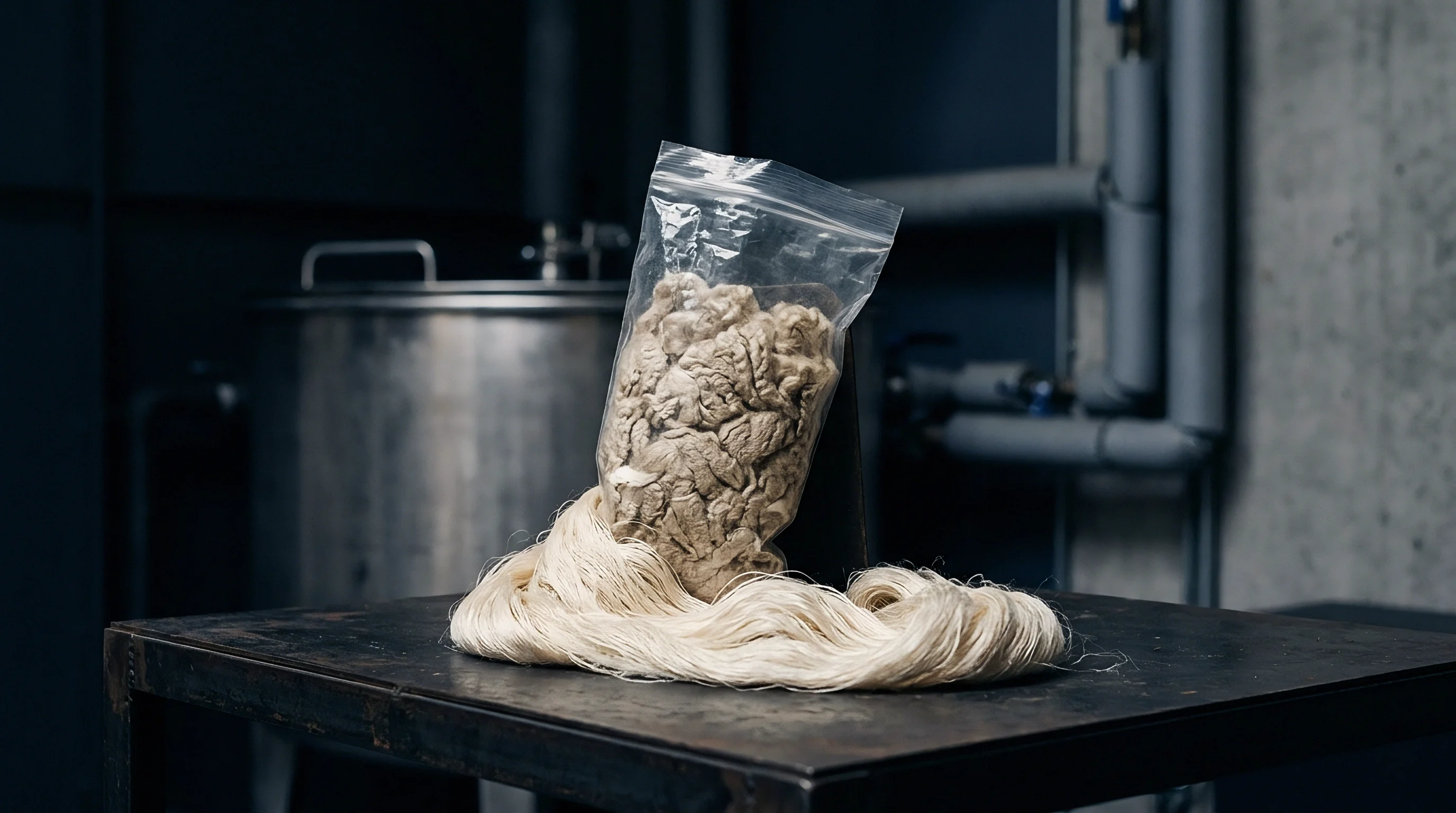
Financial settlements for commercial fibre shipments depend entirely on clean oven-dry mass assertions. International trade compliance enforces composition declarations based strictly on dry mass ratios. Customs authorities across major importing jurisdictions classify blended textile products under the Harmonized System (HS) according to the chief weight principle specified in Section XI, Note 2A of the Tariff Schedule.
Under chief weight rules, a fibre blend is classified under the specific heading covering the textile material that predominates by clean dry weight.
Slight shifts in calculated dry mass ratios alter tariff classification headings, triggering dramatic changes in applicable duty rates. Consider a blended fabric containing declared proportions of 52 percent carded wool and 48 percent combed polyester filament. Raw unwashed wool carries a high natural regain and grease burden, whereas polyester carries negligible moisture.
If an importer declares tariff entry using initial wet weight, the wool component predominates overwhelmingly, placing the shipment under HS Heading 5112 with an ad valorem duty rate of 12.0 percent.
Executing quantitative gravimetric analysis under ISO 1833 changes the outcome. Removing natural wool grease and volatile moisture reveals the clean dry mass composition: 49.0 percent wool and 51.0 percent polyester polymer. The polyester component predominates by clean dry weight.
The material must be reclassified under HS Heading 5407, carrying a reduced duty rate of 6.5 percent. Accurate gravimetric regain determination and clean dry mass separation protect importers from misclassification penalties while minimizing legally applicable tariff burdens.
| Polymer Fibre Type | Official Commercial Regain Rc (%) | Standard Regain ASTM D1909 (%) | Primary HS Tariff Chapter | Chief Weight Entry Threshold (%) |
|---|---|---|---|---|
| Scoured Wool | 17.00 (IWTO) | 13.60 | Chapter 51 | > 50.0 Dry Mass |
| Cotton (Combed) | 8.50 (BISFA) | 7.00 | Chapter 52 | > 50.0 Dry Mass |
| Viscose Rayon | 13.00 (BISFA) | 11.00 | Chapter 55 | > 50.0 Dry Mass |
| Polyamide (Nylon 6,6) | 5.75 (BISFA) | 4.50 | Chapter 54 / 55 | > 50.0 Dry Mass |
| Polyester (PET) | 0.40 (BISFA) | 0.40 | Chapter 54 / 55 | > 50.0 Dry Mass |
Contractual Specifications and Sourcing Dossiers
Protecting commercial capital during international yarn and fibre procurement requires embedding explicit gravimetric testing clauses into sales contracts. Vague contract lines specifying weight alone invite severe commercial claims when bulk shipments absorb water during sea transit. Sourcing dossier documentation must mandate that invoice weights resolve strictly to certified commercial mass calculated from clean gravimetric oven-dry testing.
A legally binding moisture settlement clause defines sampling protocols, testing standards, commercial regain values, finish allowances, and dispute tolerances. Buyers must insist that laboratory testing occur at the port of entry using accredited independent facilities certified under ISO/IEC 17025. Specifying exact testing protocols eliminates ambiguity and prevents suppliers from submitting unverified mill reports generated using uncalibrated drying equipment.
A commercial sourcing compliance dossier requires several mandatory documentation components to defend custom entry declarations and enforce invoice weight adjustments:
- Certificates of Sampling official records signed by licensed marine surveyors detailing core sampling locations, bale numbers, and hermetic sealing dates.
- Oven-Dry Test Reports accredited laboratory certificates detailing initial wet mass, constant dry mass, drying temperatures, and duration parameters under ISO 6741.
- Solvents Extraction Dossiers quantitative reports documenting spin finish or coning oil removal percentages via Soxhlet extraction protocols.
- Chief Weight Computations certified worksheets demonstrating individual constituent polymer dry mass calculations for tariff classification validation.
- Commercial Mass Statements final invoice balance adjustments calculating deliverable billable mass based on contractual commercial regain allowances.
Commercial contracts specifying bulk synthetic yarn purchases include a standardized moisture regain adjustment clause reading: Invoices shall be rendered based on Commercial Mass calculated in accordance with ISO 6741 protocols; where delivered test mass differs from nominal invoice mass by more than 0.5 percent, the total invoice value shall be adjusted proportionally based on clean dry polymer weight plus official BISFA commercial regains.
Legal enforceability of mass adjustments depends on maintaining an unbroken chain of custody for core samples, verifying that sealed moisture containers remained unopened prior to laboratory registration. Modern sourcing practice merges chemical composition verification, precise gravimetric moisture determination, and trade law compliance into a unified operational discipline. Mastering these gravimetric oven drying fundamentals ensures that procurement managers pay strictly for pure usable polymer mass rather than ambient water, securing structural margin integrity across global supply chains.