How Declining Repeat Volume Alters Wet Processing Route Selection Rules
Declining repeat volume forces shifts from continuous to exhaust routes, driving up unit setup waste, expanding liquor ratios, and requiring wider shade tolerances.
Scale
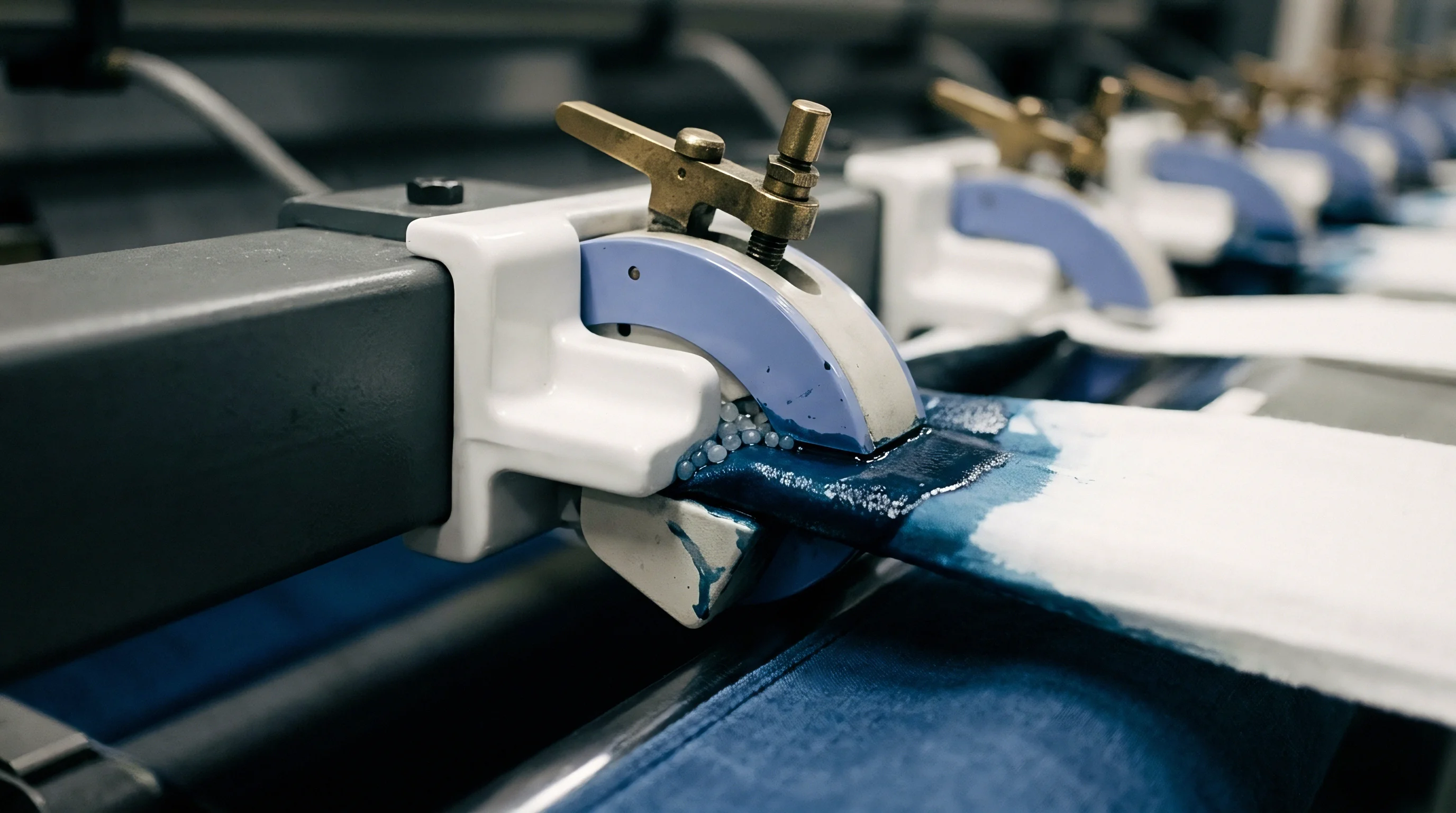
Continuous dyeing equipment demands fixed linear yardage to prime chemical baths and establish thermal equilibrium across drying chambers. On high-speed continuous pad-steam ranges operating at 60 meters per minute, the physical volume required to fill pad troughs, run lead-in leader fabric, and stabilize infrared pre-dryers creates unrecoverable setup scrap. When an order measures 10,000 meters, a 120-meter setup scrap represents an acceptable 1.2 percent material loss.
If repeat order volumes contract to 800 meters, that same 120-meter fixed waste consumes 15 percent of the grey cloth input. The cost of grey fabric, dye chemistry, and machine run time consumed before the line reaches equilibrium must be absorbed across the finished meterage, altering the financial break-even point between continuous ranges and batch exhaust equipment.

Continuous Processing Limits
High-speed continuous pad-steam ranges run under strict hydrodynamic and thermal constraints. The pad trough holds a minimum standing volume of dye liquor, usually between 25 and 45 liters, which requires constant replenishment to prevent shade tailing. Tailing occurs when preferential dye fiber absorption depletes specific dye components from the trough faster than fresh liquor feeds in.
At high fabric speeds, the liquor turnover rate stays fast enough to maintain concentration equilibrium. Lowering line speed to conserve fabric during short runs increases immersion dwell time, altering pick-up percentages and causing dye bath hydrolysis on reactive systems.
| Equipment Class | Fixed Setup Scrap | Liquor Volume Range | Minimum Viable Run | Yield Efficiency at Minimum Run |
|---|---|---|---|---|
| Continuous Pad-Steam Range | 120 to 180 m | 35 to 60 L | 3,000 m | 94.3% |
| Thermosol Continuous Line | 150 to 220 m | 40 to 70 L | 5,000 m | 95.6% |
| Cold Pad-Batch (CPB) Range | 30 to 50 m | 15 to 25 L | 1,000 m | 95.0% |
| Overflow Jet Exhaust Vessel | 5 to 15 m | 600 to 1,800 L | 150 m | 90.0% |
| Airflow Exhaust Vessel | 5 to 10 m | 300 to 900 L | 100 m | 93.0% |

Break-Even Volume Shifts
Fixed length losses during startup routinely push short-run production toward semi-continuous or exhaust batch machinery. Cold pad-batch dyeing presents an intermediate alternative for woven cellulosic fabrics. The trough on a cold pad-batch line holds a smaller liquor volume, often under 20 liters, reducing priming loss.
Fabric passes through the padder at ambient temperature, squeezing liquor into the yarn core at 60 to 80 percent wet pick-up before winding onto a batch roller under controlled tension. Winding onto the batch beam eliminates the lengthy heating zones of thermosol or pad-steam ranges, holding lead-in waste below 40 meters. The batch beam then rotates slowly in a sealed chamber for 8 to 24 hours to fix the reactive dye.
When repeat volumes drop below 1,000 meters, even cold pad-batch processing encounters yield penalties related to beam-end waste and chemical dosing instability. At this volume threshold, exhaust dyeing in jet or airflow machines becomes the primary viable production path despite higher water and energy consumption per kilogram of cloth. The transition from continuous to exhaust routes alters the structural performance of the fabric, shifting yarn mobility, hand feel, and surface hairiness.
A failure to recalculate setup losses when transferring a 600-meter order from a jet exhaust route to a continuous pad-steam line results in a 22 percent cost overrun on raw grey goods alone.

Liquor
Exhaust dyeing machinery relies on controlled bath volumes to drive dye uptake into the amorphous regions of the fiber. Jet vessels are charged to preset liquid levels determined by pump priming requirements rather than total fabric mass. When an order batch size drops from a nominal 300-kilogram vessel capacity to a partial load of 100 kilograms, the liquor ratio expands significantly.
A machine operating at a 1:6 liquor ratio under full load expands to a 1:18 liquor ratio under a one-third load unless liquor volume scales down proportionally, which drops pump pressure.

How Does Batch Truncation Shift Liquor Ratio Stability?
Partial vessel loading alters bath hydraulics and chemical concentration dynamics in jet equipment. High liquor ratios increase the physical distance between dye molecules and fiber active sites, depressing exhaustion rates for reactive and direct dyes. To compensate, dye technicians often increase electrolyte concentrations, adding sodium sulfate or sodium chloride to force dye onto the substrate.
The higher salt load alters bath viscosity and changes exhaustion kinetics, heightening the risk of unlevel dyeing along the fabric length.
Unfilled exhaust vessels force dye molecules into accelerated exhaustion rates that destabilize shade levelness across the length of the rope.
Rope movement speed inside the jet tube must match pump pressure to prevent mechanical damage and surface abrasion. In under-loaded vessels, fabric ropes slip on the drive reel because the fabric mass lacks the friction needed to engage the winch. Slippage leads to local chafing, surface pilling, and uneven dye penetration.
- Submerged pump cavitation occurs when low bath levels pull air into the circulation impeller, causing pressure surges that disrupt liquor flow uniformity across the venturi nozzle.
- Hydrostatic drag variation alters fabric speed through the delivery tube, resulting in varying dwell times in the bath and localized shade bands.
- Substrate rope creasing increases when light fabric loads fold along static crease lines inside large-diameter storage J-boxes without sufficient liquor floatation.
- Exhaust rate acceleration happens when fixed chemical dosing schedules dump alkali into undersized liquor masses, driving rapid pH spikes that lock dye prematurely onto surface fibers.
Dye Bath Dynamics in Partial Loading
Alkali addition schedules demand precise adjustment when converting production from full vessels to truncated batches. In reactive dyeing on cotton knitwear, alkali drives the covalent bond formation between the dye molecule and the hydroxyl groups of the cellulose fiber. Adding alkali according to standard full-capacity dosing profiles into an under-loaded vessel raises the bath pH too quickly.
Rapid fixation prevents dye molecules from migrating through the fiber bundle, resulting in surface ring dyeing and poor rub fastness under ISO 105-X12 testing.
Short-run batch shade variation is frequently attributed to raw yarn lot inconsistency, though unadjusted pump circulation rates and uncalibrated liquor-to-fabric ratios in under-loaded vessels remain the primary physical causes.

Frame
Dimensional stabilizing equipment requires thermal equilibrium across heating zones before fabric enters the entry pin rails. An industrial stenter frame drying woven or knitted fabric applies heat, mechanical cross-web tension, and longitudinal overfeed to set finished weight, width, and residual shrinkage. Short production runs disrupt this equilibrium.
When a 300-meter batch passes through a six-chamber stenter at 30 meters per minute, the fabric resides in the heating zones for only 10 minutes. The housing loses heat each time the entry doors open to load a new batch, causing temperature fluctuations across the initial 50 meters of the run.
Stenter Thermal Equilibrium
Heating chambers experience temperature drops when changing over fabric batches with different moisture content or fiber composition. A continuous 5,000-meter run allows heat exchangers to maintain setpoint temperatures within a narrow margin of plus or minus 1 degree Celsius. A truncated run finishes before the air circulation nozzles achieve steady-state heat transfer across the entire web width.
Variations in chamber air temperature yield uneven resin crosslinking on easy-care finishes and inconsistent heat-setting on synthetic blends. Residual shrinkage results measured per ISO 5077 vary by up to 3.5 percent between the head end and tail end of a short batch.
| Physical Property | Standard Long Run Tolerance | Short Batch Variance | Primary Physical Mechanism | Corrective Parameter |
|---|---|---|---|---|
| Finished Width (ISO 22198) | +/- 1.0 cm | +/- 3.2 cm | Thermal contraction on rail exit | Increase rail entry overfeed by 2% |
| Mass Per Unit Area (ISO 3801) | +/- 3.0 g/m² | +/- 8.5 g/m² | Unstable tension along pin chain | Dampen entry tension load cells |
| Warp Shrinkage (ISO 5077) | +/- 1.5% | +/- 3.8% | Incomplete heat set dwell time | Reduce line speed by 15% |
| Bow and Skew (ISO 3631) | Under 1.5% | Up to 4.2% | Manual pin engagement alignment | Engage optical weaver tracking |
Finish Pickup and Width Drift
Pad trough immersion times vary during the acceleration and deceleration phases of short finishing runs. Finishing agents like water repellents, softeners, and flame retardants apply via a wet-on-dry pad mangle positioned at the stenter entry. As the stenter ramps up to target speed, fabric spends more time in the pad liquor, absorbing an excess of chemical finish.
Excess chemical pickup stiffens the fabric hand, alters tear strength measured under ISO 13937, and increases chemical costs.
A twenty-meter lead-in tail under three-percent stenter overfeed yields width variances exceeding two centimeters across short finishing runs.
Edge trim waste claims a higher percentage of total fabric area on short runs. Stenter pin chains grip 1.5 to 2.5 centimeters of fabric selvedge on each side to hold cross-web tension. This edge material suffers mechanical damage and chemical contamination from high-temperature pin plates.
On a 10,000-meter order, selvedge trimming represents a fixed, minor surface loss. On a 200-meter order, the length of lead-in cloth required to thread the pin chain consumes up to 8 percent of the total batch. Fabric entry tension must remain balanced across short runs to prevent diagonal bow distortion.
High overfeed settings applied to short batches without reaching thermal equilibrium cause elastic memory recovery in the cutting room.

Friction
Financial overhead escalates rapidly when small order volumes break the standard production cadence of vertical mills. Dyehouses build their fee structures around equipment utilization, labor efficiency, and chemical bulk purchasing power. Short runs disrupt machine schedules, increase setup frequency, and generate higher proportion of lab-dip matching cycles per finished meter.
Converter surcharges reflect these hidden operational expenses.

Converter Surcharges and Unit Landed Cost
Minimum order thresholds established by dyeing facilities protect operating margins against setup inefficiencies. When an order drops below the Minimum Color Quantity (MCQ), the dyehouse assesses a small-batch surcharge. This surcharge offsets machine wash-down costs, chemical trough dumping losses, and lab color matching labor.
Lab-to-bulk scaling factors grow less reliable with small order volumes. A lab dip recipe developed on a 5-gram fabric sample in a beaker uses precise liquid dispensing systems. Translating that recipe to a 1,500-kilogram production vessel follows predictable scaling curves.
Translating the same recipe to a 60-kilogram sample vessel introduces machine-specific variables like liquor spray impact, pump flow rate, and pipe surface area heat loss that deviate from lab conditions.
- Evaluate raw grey fabric inventory availability to confirm weave construction compatibility with jet exhaust mechanical action.
- Calculate total setup waste percentage by adding leader cloth, pad trough priming volume, and stenter threading lengths.
- Compare unit landed cost estimates across jet exhaust, cold pad-batch, and continuous pad-steam processing options.
- Select final production route based on total landed cost inclusive of small-batch surcharges and projected physical waste allowances.
Worked Sourcing Cost Comparison
Direct evaluation of production expenses reveals how route selection alters finished fabric cost per meter. Direct comparison requires holding raw grey material, yarn count, and fabric construction constant. Take a 100 percent cotton 3/1 twill construction, 240 gsm, measuring 150 centimeters finished width, sourced across two different volume profiles.
Consider a baseline continuous order of 6,000 meters versus three split repeat orders of 800 meters processed via jet exhaust dyeing. The baseline continuous order uses grey fabric priced at $2.10 per meter. Continuous wet processing charges equal $0.80 per meter.
Fixed line setup fees total $400. Setup waste equals 120 meters of grey cloth valued at $252. Total order cost equals $17,812, resulting in a unit landed cost of $2.97 per finished meter.
The split order of 800 meters uses the same grey fabric at $2.10 per meter. Jet exhaust dyeing charges run higher at $1.35 per meter due to energy and water demands. Small-batch surcharges add $250 per colorway, totaling $750 across three orders.
Machine setup waste for each 800-meter batch equals 25 meters, totaling 75 meters valued at $157.50. Total cost for 2,400 meters equals $11,187.50, yielding a unit landed cost of $4.66 per finished meter. The unit cost increases by 56.9 percent solely due to order volume collapse and wet processing route reassignment.
Contractual minimum color quantity clauses impose flat-rate surcharges that shift unit economics whenever dye lot volumes drop below two thousand meters.
Standard purchase order terms must incorporate the following wording: Small-batch surcharges apply exclusively when order volumes drop below the agreed Minimum Color Quantity of 1,500 meters, and such surcharges fully cover all line setup, color matching, and chemical wash-down fees without altering the contracted physical tolerance limits specified in the fabric technical dossier.
Divergence
Shade consistency across separate small-batch runs degrades when equipment selection moves from continuous ranges to exhaust vessels. Continuous dyeing fixes dye molecules across thousands of meters in a single uninterrupted run under constant pressure and temperature. Exhaust dyeing divides the same total order into multiple distinct dye lots processed in individual vessels.
Batch-to-batch variation becomes an ongoing operational challenge.

Colorimetry and Metamerism Shifts
Spectrophotometer measurements under multiple illuminants reveal shade shifts between independent dye batches. A dyehouse processing small repeat volumes often reformulates dye recipes to accommodate different machine capacities or to utilize alternative dye classes suitable for exhaust application. A recipe using reactive dyes on a continuous thermosol range produces a specific spectral reflectance curve.
Transferring that shade to an exhaust jet vessel may force the dye technician to swap specific dye components to match exhaustion rates.
| Evaluation Metric | Test Method | Continuous Pad-Steam | Cold Pad-Batch | Jet Exhaust |
|---|---|---|---|---|
| Batch-to-Batch Color Difference | ISO 105-J03 (ΔE CMC) | Under 0.6 | 0.8 to 1.2 | 1.2 to 1.8 |
| Color Fastness to Washing | ISO 105-C06 (Grade) | 4-5 | 4-5 | 3-4 |
| Rubbing Fastness (Dry / Wet) | ISO 105-X12 (Grade) | 4 / 3-4 | 4 / 3-4 | 3-4 / 2-3 |
| Levelness / Side-Center-Side | Visual / Spectro (ΔE) | Under 0.4 | Under 0.5 | 0.6 to 1.1 |
Metamerism occurs when two fabric samples match under primary light sources like D65 daylight but diverge under secondary sources like F11 store lighting or A tungsten illumination. Dye recipe adjustments made during short-run route shifts frequently introduce metameric index spikes if dye component spectral characteristics differ from the original master shade standard.
Fastness Properties in Batch Systems
Laundering performance measured according to ISO 105-C06 degrades when exhaust dyeing fails to strip unfixed reactive dye thoroughly from the fiber core. Continuous washing ranges pass fabric through multiple high-temperature cascade rinse tanks with aggressive mechanical agitation and counter-current water flow. Jet vessels perform rinsing by repeatedly filling and draining the main chamber, consuming large volumes of water while providing less efficient unfixed dye removal.
Residual hydrolyzed dye remaining in the yarn interior lowers washing fastness by half a grade on the ISO grey scale.
Continuous thermosol fixation produces uniform surface ring-dyeing whereas exhaust jet systems achieve deep core penetration.
- Substrate absorptivity indexing verifies grey fabric absorbency using sink time tests before selecting short-run pad chemistry.
- Spectral match verification confirms color coordinates under D65, TL84, and A illuminants to prevent metameric jumps.
- Fixation temperature windowing establishes precise dwell time boundaries to prevent thermal yellowing during short stenter passes.
- Rinse cascade scaling defines minimum wash-off bath cycles in exhaust vessels to guarantee wash fastness levels.
Which specific spectrophotometer tolerance band balances commercial shade acceptance against small-batch production reality without triggering constant lot rejections?
Reconciliation
Technical specifications for fabric purchases demand adjusted tolerance parameters when batch sizes shrink below factory nominal capacity. Contracts written for large-scale continuous orders impose tight physical and colorimetric limits that small-batch exhaust routes cannot consistently meet. Sourcing practices adjust acceptance thresholds to reflect the physical realities of truncated processing.
Contracted Quality Tolerances
Commercial purchase agreements specify allowable variance ranges for weight, width, shrinkage, and shade matching. When order volumes shift from continuous ranges to exhaust jets, the contracted shade tolerance band measured under ISO 105-J03 expands from a ΔE CMC of 0.8 to 1.5 relative to the approved master standard. Expecting jet-dyed short batches to maintain continuous-run shade limits leads to re-dyeing cycles that degrade fabric tensile strength measured under ISO 13934.
Acceptance Sampling for Truncated Lots
Standard statistical inspection tables apply different sampling ratios to small shipments. Under ISO 2859-1 general inspection level II, a lot size of 500 meters requires a sample size of 50 meters, representing 10 percent of the entire order. Inspecting 10 percent of a short run increases quality control labor costs per meter compared to inspecting 200 meters out of a 10,000-meter lot.
Defect classification standards under the 4-point system require minor adjustment to account for increased end-stick marks and pin-hole occurrences typical of short-run stenter engagement.
Buyers managing declining repeat volumes align their commercial expectations with physical machine limits by accepting wider shade bands, accounting for higher setup waste percentages, and budgeting for small-batch surcharges. The operational shift from continuous wet processing to exhaust batch systems preserves production viability at low volumes while changing the technical profile of the finished cloth.