Predictive Mass Balance Modeling for Wet Processing Shrinkage and Ocean Moisture Regain Variance
Predictive mass balance modeling isolates wet processing yield shifts from transit moisture regain to eliminate landed weight claims on bulk fabric orders.


Fibre
Thermodynamic Regain Baselines in Cellulosic and Synthetic Polymers
Cotton, viscose, wool, and synthetic filaments exhibit distinct equilibrium moisture regain capacities dictated by their macromolecular structure and amorphous zone volume. Standard commercial regain values defined in ISO 139 establish atmospheric baseline conditions at 20°C and 65% relative humidity. Polymer chains containing accessible hydroxyl or amide functional groups attract ambient water molecules through hydrogen bonding.
Hydrophobic synthetic structures like polyethylene terephthalate possess minimal amorphous sorption sites, maintaining flat sorption isotherms across wide humidity swings.
Textile mills purchasing greige yarn or raw fiber pay for invoiced weight calculated under standard regain assumptions. When raw material enters wet processing, initial oven-dry mass differs from commercial mass due to varying ambient transport conditions. Synthetic fibers maintain dimensional and mass stability under shifting humidity, whereas regenerated cellulosics demonstrate extreme moisture sensitivity.
Viscose rayon absorbs up to twice its oven-dry weight in water before reaching liquid saturation. That sorption capacity creates substantial mass variance between yarn receipt, greige weaving, and wet processing entry.
Standard commercial moisture regain for combed cotton yarn is set at 8.5% under ISO 139 test conditions.
Structural differences between native cellulose I in natural cotton and regenerated cellulose II in viscose alter the physical volume of internal pore networks. Highly crystalline synthetic polymers limit liquid penetration to surface adsorption. Amorphous cellulosic regions permit water molecules to disrupt inter-molecular bonds, forcing lattice expansion.
Mass balance models missing these thermodynamic baselines fail before wet processing steps begin.
Hygroscopic Sorption Isotherms across Shipping Micro-Climates
Sorption isotherms follow sigmoidal curves where water uptake accelerates non-linearly above 70% relative humidity. Containerized maritime freight routinely experiences temperature cycles between 15°C and 48°C alongside relative humidity fluctuations spanning 50% to 95%. Under these conditions, fabric packed at ex-factory equilibrium continues exchanging moisture with air trapped inside polyethylene inner liners or corrugated master cartons.
| Fiber Type | ISO 139 Commercial Regain (%) | Equilibrium Regain at 85% RH (%) | Saturation Limit (%) | Sorption Mechanism |
|---|---|---|---|---|
| Combed Cotton | 8.50 | 12.20 | 24.50 | Cellulose I amorphous hydroxyl bonding |
| Viscose Rayon | 13.00 | 19.80 | 35.00 | Cellulose II regenerated structure |
| Nylon 6,6 | 4.50 | 7.10 | 11.00 | Amide inter-chain hydrogen capture |
| Polyester (PET) | 0.40 | 0.70 | 1.20 | Surface hydrophobic adsorption |
| Linen (Flax) | 12.00 | 16.50 | 30.00 | Lignocellulosic capillary pore action |
Desorption and adsorption paths do not align on the same physical curve. Hydrodynamic hysteresis dictates that a fabric drying down to target moisture content retains more mass than an identical fabric absorbing water up to that same target humidity. Predictive mass modeling calculates historical processing direction to anticipate whether bulk cloth enters transit on an adsorption or desorption curve.
Natural fiber shipments moving through tropical sea routes gain measurable weight when humidity inside the container micro-climate exceeds factory stenter exit conditions.
Sorption kinetics determine the speed of weight gain during ocean voyages.

Finishing

Dimensional Contraction and Mass Shifts in Wet Processing
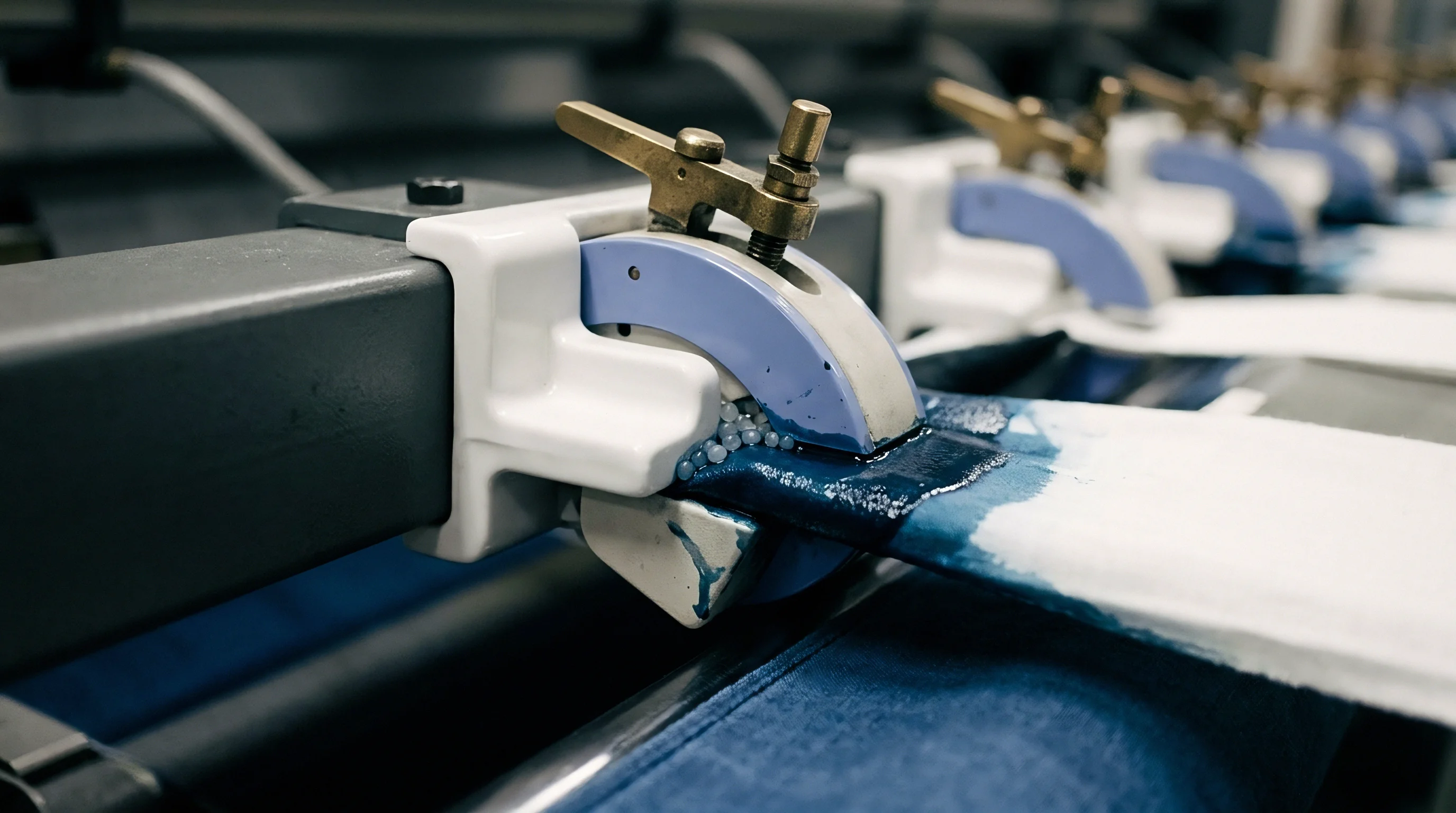
Sizing materials, warp oils, and spinning lubricants account for 4% to 12% of raw greige fabric weight. Continuous desizing, scouring, and bleaching operations strip these non-cellulosic impurities from the yarn matrix, causing immediate dry mass reduction. Wet processing simultaneously induces mechanical relaxation shrinkage in warp and weft directions as weaving tensions collapse inside aqueous baths.
The physical compression of thread count per centimetre increases structural density while total linear roll length contracts.
Compacting units, stenter frames, and sanforizers manipulate fabric dimensions through controlled overfeed and steam injection. High overfeed rates compress warp yarns, reducing longitudinal length while forcing real mass per square metre upward. Chemical additions during finishing replace a portion of lost greige weight.
Durable press resins, water repellents, softeners, and flame retardants add solid dry mass directly onto the fiber surface. Mass balance equations track dry greige input against scoured weight, finishing liquor pickup, and final stenter yield.
Continuous caustic scouring removes up to 6% of greige cotton weight through wax saponification and pectin solubilization.
Uncontrolled stenter speed or excessive chain tension stretches the web, artificially boosting linear yield while diminishing fabric mass per square metre. When the cloth subsequently encounters ambient air or laundry washing, internal relaxation stresses release. The resulting dimensional shrinkage contracts the web, causing unexpected area density spikes in downstream garment manufacturing.
- Desize Mass Stripping occurs when enzymatic or oxidative baths dissolve warp starch and polyvinyl alcohol without accurate mass accounting.
- Scour Extractable Loss reduces raw weight as natural fats, waxes, and residual seed coat fragments wash out in alkaline liquor.
- Elastane Thermal Degradation reduces elastomeric tension inside core-spun yarns during high-temperature stenter heat-setting, altering recovery force.
- Resin Bath Volatilization causes cross-linking formaldehydes and catalysts to evaporate in curing ovens, lowering calculated dry solids pickup.
- Mechanical Over-Stretching temporarily extends web length at the stenter exit, masking true structural dimensional shrinkage until wet relaxation occurs.
Chemical Add-On Calculations versus Volatiles Evaporation
Pad-dry-cure finishing routes apply chemical formulations through squeeze rollers operating at calculated wet pickup percentages. A pad bath running at 65% wet pickup with a 5% solid resin concentration deposits 3.25% dry chemical add-on onto the dry fabric web. Oven drying removes carrier water, while baking at 160°C induces polymerization along with partial loss of volatile organic compounds and carrier emulsifiers.
Mass balance modeling splits wet pickup into non-volatile solids and volatile liquids. Dyes, cross-linking agent backbones, and inorganic flame retardants remain on the substrate as permanent dry mass. Water, glycol solvents, and unreacted monomer residues exit through the stenter exhaust stacks.
Mills confusing wet pickup rates with net dry chemical add-on miscalculate final fabric weight targets by substantial margins.
A mill technician off-hand claims that unexpected bulk weight loss stems entirely from yarn lint shedding inside the jet dyeing machine.

Dock

Ocean Freight Micro-Climates and Container Moisture Mechanics
Shipping containers stacked on vessel decks experience direct solar radiation during daytime hours, driving internal air temperatures above 50°C. Nighttime cooling drops ocean container wall temperatures rapidly, reaching dew point and creating inner ceiling condensation. That cycle, known in ocean freight logistics as container rain, dripping directly onto master cartons or poly-wrapped rolls, alters cargo weight distribution.
Fabric packed at standard factory conditions absorbs or desorbs moisture to reach thermodynamic equilibrium with air trapped inside the ocean freight container. A 40-foot container loaded with 18,000 kilograms of cotton woven cloth carries approximately 1,500 kilograms of bound water at 8.5% standard regain. If internal relative humidity rises from 60% to 90% during transit through equatorial ocean passages, the total moisture capacity of that same cotton mass increases toward 13%, adding over 800 kilograms of water mass to the consignment without adding a single metre of fiber.
- Initial Roll Moisture Content establishes the vapor pressure baseline inside closed polyethylene packaging films at the point of origin stuffing.
- Desiccant Pole Allocation controls ambient air humidity inside the container volume, capturing excess water before wall condensation drops onto carton packaging.
- Container Deck Placement exposes cargo to direct thermal radiation when stowed above deck or ambient sea-water cooling when stowed below waterline.
- Transit Route Duration governs the total time available for moisture exchange through corrugated packaging and rolls.
Desorption and Adsorption Hysteresis under Variable Salinity Air
Maritime transport exposes packaged goods to ambient air containing elevated sodium chloride aerosol particles. Ocean salt particles deposited on outer packaging materials act as hygroscopic agents, lowering the relative humidity threshold at which localized air reaches saturation. Inside the container, fabric rolls exchange water vapor through porous outer wrappers depending on local vapor pressure gradients.
Hysteresis behavior means fabric entering the container at 10% moisture content following an adsorption cycle behaves differently than fabric dried down to 10% from a wet finishing wet-out. The adsorption curve exhibits lower equilibrium moisture regain at identical relative humidity compared to the desorption curve. Accurate mass balance models track whether the finishing stenter output leaves the fabric on a drying or wetting curve.
Skipping container desiccant load checks leads to roll mold growth, weight disputes at port discharge, and immediate consignment rejection.

Calculus
Mathematical Formulations for Net Dry Mass Balance
Predictive mass balance modeling separates total wet fabric weight into dry fiber mass, net dry chemical add-on mass, residual non-cellulosic impurity mass, and moisture mass. The fundamental equation resolves total final mass as:
Mfinal = Mgreige × (1 – Lscour – Ldesize) + Mchemical + Mmoisture
Where Mgreige represents incoming dry greige mass, Lscour represents fractional mass loss during alkaline scouring, Ldesize accounts for starch removal, Mchemical represents dry solid add-on from finishing formulations, and Mmoisture represents water mass determined by absolute moisture regain. Dimensional shrinkage enters the area density calculation through warp and weft length contraction ratios.
When fabric undergoes length shrinkage Sw in the warp direction and Sp in the pick or weft direction, the finished fabric surface area per linear metre decreases. The finished mass per square metre (Gfinished) relates to greige mass per square metre (Ggreige) through the dimensional contraction factor:
Gfinished = fracGgreige × (1 – Ltotal) + Gadd-on(1 – Sw) × (1 – Sp) × frac100 + Rfinal100 + Rgreige
Where Ltotal is total fractional process mass loss, Gadd-on is dry chemical weight added per square metre, Rgreige is initial moisture regain percentage, and Rfinal is final conditioned moisture regain percentage.
| Process Stage | Total Linear Metres (m) | Fabric Width (m) | Area Weight (g/m²) | Moisture Regain (%) | Calculated Total Stage Weight (kg) |
|---|---|---|---|---|---|
| Greige Loom State | 10,000 | 1.60 | 240.0 | 7.50 | 3,840.0 |
| Desized & Scoured | 9,700 | 1.55 | 242.1 | 6.00 | 3,640.2 |
| Dyed & Stenter Finished | 9,400 | 1.50 | 262.5 | 5.00 | 3,701.3 |
| Conditioned Ex-Factory | 9,400 | 1.50 | 271.25 | 8.50 | 3,824.6 |
| Ocean Port Discharge | 9,400 | 1.50 | 278.75 | 11.50 | 3,930.4 |
The matrix demonstrates how 10,000 linear metres of greige cloth contracting to 9,400 finished metres experiences a net weight drop during scouring, recovers dry weight via dye and resin solids, and subsequently gains 105.8 kilograms of water weight during ocean transport due to moisture regain shift from 8.5% to 11.5%.
What Drives Fabric Weight Discrepancies between Mill Invoice and Port Arrival?
Discrepancies arise when mill invoices report weight based on immediate post-stenter exit conditions where moisture content sits artificially low between 3% and 5%. During ocean ocean transit inside humid container environments, the fabric reabsorbs ambient moisture until reaching equilibrium between 10% and 12%. The buyer receives a container weighing significantly more than the factory packing list specified, while the actual linear metres of usable fabric remain unchanged.
Conversely, fabric packed over-conditioned in tropical dyehouses loses water mass when ocean routes move through cold, dry climates, generating shortages against invoiced bill-of-lading weights.
How much unrecorded volatile matter escapes during resin baking without registering on weight sensors remains a challenge for real-time mass balance accounting systems.
Audit
Standardized Moisture Testing Methods and Calibration Standards
Verification of mass balance calculations demands precise measurement of actual moisture content using standardized laboratory protocols. ISO 6330 governs washing and drying dimensional procedures, while ISO 3801 defines methods for determining mass per unit area. Direct moisture measurement relies on oven-drying techniques specified in ISO 2060 or electronic high-frequency capacitance meters calibrated against specific fiber blends.
Oven drying methods weigh fresh fabric samples before heating them to 105°C ± 2°C until consecutive weighings show less than 0.05% mass change. The mass lost represents absolute moisture content. Portable pin-type or dielectric moisture meters offer rapid non-destructive testing on packaging lines, provided calibration curves match the exact fiber density, dye class, and finishing resin load of the tested web.
- Cut ten full-width fabric strips located at least one metre from roll ends across three distinct rolls per batch.
- Seal cut samples immediately inside airtight aluminum foil containers to prevent moisture flash-off or ambient pickup during transport to the lab.
- Record gross wet mass on a calibrated analytical balance accurate to 0.001 grams under ISO 139 standard atmosphere.
- Dry samples inside a ventilated oven at 105°C until reaching constant dry mass across two consecutive weighings spaced twenty minutes apart.
- Calculate absolute moisture regain using dry mass as the base denominator and compare results against the bill-of-lading moisture declaration.
ISO 3801 Method 5 dictates that fabric mass determination requires full-width specimen conditioning for 24 hours at 20°C and 65% relative humidity prior to cut weighing.
Failure to condition samples before weighing results in erroneous area density figures that fail to withstand commercial legal arbitration.
Contractual purchase orders incorporating standard ISO 139 conditioning clauses mandate that final payment terms settle exclusively against standard-conditioned mass, disallowing gross packed scale weight claims.

Claim
Commercial Mass Settlement and Landed Cost Risk Adjustment
Raw fabric procurement contracts frequently specify commercial weight allowances to mitigate moisture regain disputes. When fabric is bought by weight rather than linear length, a mill supplying material under target regain delivers less physical fiber than contracted. Conversely, fabric shipped wet forces the buyer to pay freight charges on excess water weight while suffering yield loss during subsequent cutting room operations.
Commercial mass calculation uses standardized regain percentages to adjust gross scale weight back to invoice baseline mass. The commercial mass (Mc) is derived from oven-dry mass (Md) through:
Mc = Md × left(1 + fracRc100right)
Where Rc is the official commercial moisture regain percentage assigned to that specific fiber type. If an arrival inspection reveals an actual moisture regain Ra differing from Rc, the landed invoice value requires financial adjustment according to the net dry mass delivered.
- Oven-Dry Test Certificate provides independent third-party laboratory proof of absolute dry fiber weight per lot.
- Bill of Lading Gross Weight Record establishes official weight logged at origin port container stuffing.
- Container Temperature Log documents micro-climate exposure history across voyage transit duration.
- Linear Metre Stenter Report verifies original ex-factory length prior to transport moisture gain.

Reconciliation Mechanics for Ocean Transit Regain Variance
Port arrival weigh-ins regularly conflict with origin mill invoices. Discrepancies within ± 1.5% total mass are typically absorbed as standard ocean transit variance under international trade customs. When weight variance exceeds 2.0%, formal financial claims open between converter, freight forwarder, and buyer.
A structured mass balance model isolates dimensional yield changes from pure water gain. If linear roll length and full fabric width match approved production tolerances, weight spikes are attributed entirely to moisture absorption during ocean transit. The buyer calculates net fiber mass received by applying oven-dry moisture tests to arrival weights.
Financial deductions apply when net dry mass falls below contracted specifications, regardless of scale weight increases.
Integrating predictive mass balance equations into supply chain management software allows buyers to hedge against ocean transit regain variance, align landed cost calculations with real dry mass yield, and stop overpaying for transported water.