Predictive Modeling Limitations for Radical Scavenger Depletion Rates in Variable Warehouse Storage Environments
Predictive models fail when Arrhenius assumptions ignore non-linear volatilization, humidity-driven phosphite hydrolysis, and warehouse thermal stratification.
Kinetics
Thermal degradation models for stabilized technical yarns assume a uniform Arrhenius relationship across storage cycles, yet warehouse temperatures shift hourly beneath corrugated metal roofs. Standard predictive software calculates radical scavenger depletion by treating the additive package as a homogenous reservoir operating against a single activation energy. In polyolefin geotextiles and high-tenacity polypropylene webbings, primary hindered phenolic stabilizers and secondary phosphites do not consume at identical rates under fluctuating heat.
Real storage facilities generate diurnal swings between 14 degrees Celsius at night and 48 degrees Celsius during peak afternoon solar loading. The mathematical assumption of a constant reaction velocity ignores the non-linear acceleration of peroxide decomposition when ambient conditions cross 40 degrees Celsius. Thermal gradients accelerate this loss.
Primary hindered phenols scavenge alkylperoxyl radicals through hydrogen donation, yielding a stable phenoxyl radical that terminates polymer chain cleavage. Secondary organophosphites reduce hydroperoxides to inactive alcohols while converting to inert phosphates. When Arrhenius parameters rely on high-temperature accelerated oven aging at 90 to 110 degrees Celsius, the derived activation energy typically settles between 85 and 105 kilojoules per mole.
Projecting that single figure downward into warehouse fluctuations between 20 and 45 degrees Celsius introduces profound kinetic distortions.
Consolidated testing indicates activation energy shifts by twelve kilojoules per mole when temperatures cross polymer glass transition boundaries.
Below the glass transition temperature of the polymer matrix or near secondary relaxation thresholds, amorphous chain mobility drops, which restricts stabilizer diffusion toward active radical sites. Conversely, during afternoon heat spikes in unconditioned warehouses, local temperatures approach the melting points of low-molecular-weight additive components. The reaction shifts from diffusion-limited radical capture to rapid physical sublimation.
Standard predictive equations calculate chemical consumption while entirely missing physical mass transport into the surrounding air layer. The resulting predictive curve overstates remaining active chemistry by several hundred percent over twelve months of unconditioned storage.
Predictive errors compound when technical fabrics incorporate elastomeric filaments or functional coatings. Polyurethane coatings contain residual metal catalysts and ester linkages that generate localized acidic byproducts under ambient heat. These byproducts act as autocatalytic agents, consuming hindered amine light stabilizers before atmospheric oxygen initiates chain scission.
An Arrhenius projection calibrated on neat yarn fails entirely when applied to finished, coated, or laminated roll goods held in variable dock staging environments. The resulting failure appears months later as unpredicted tensile drop at the cutting table.

Pallet
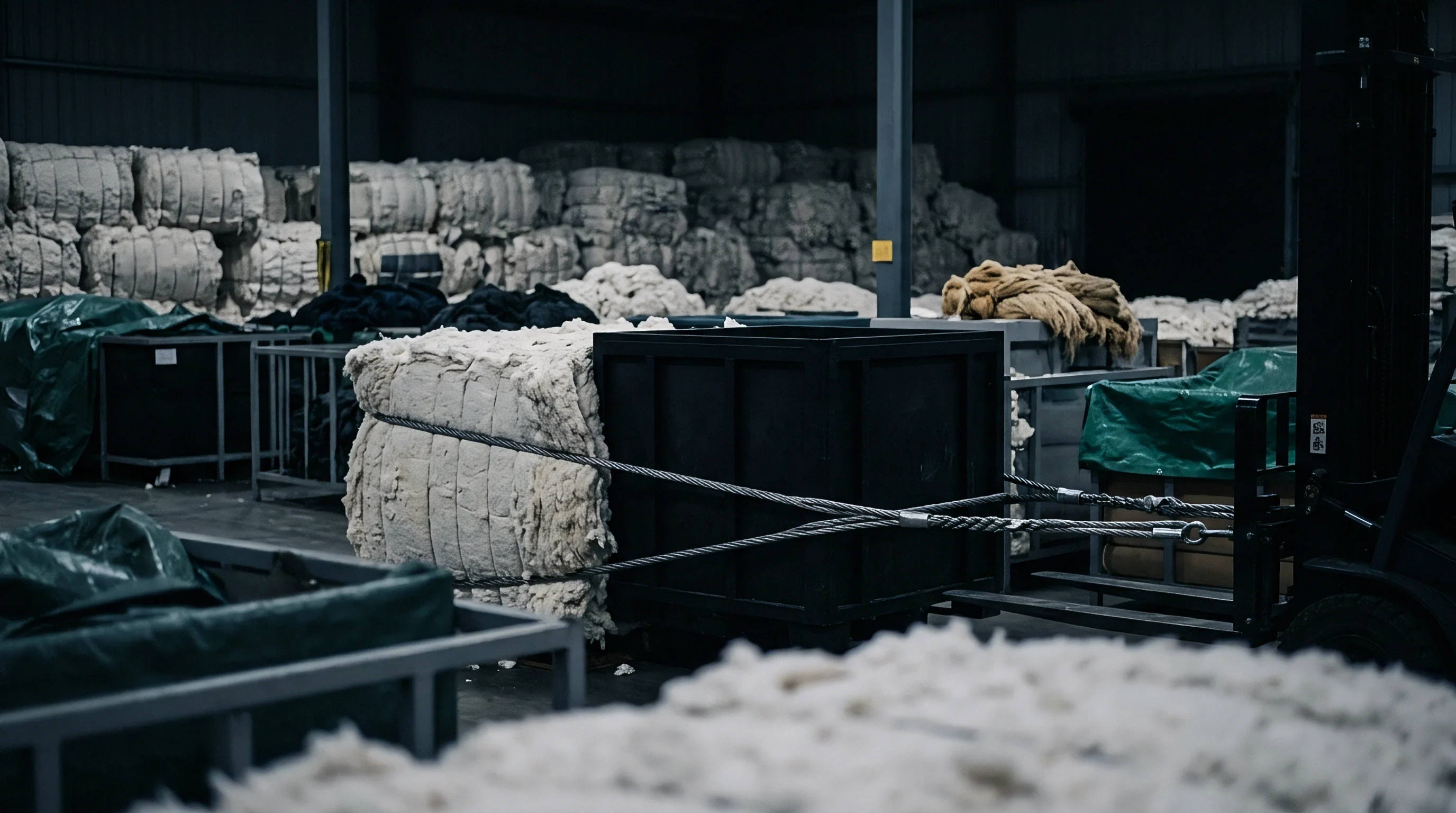
Vertical racking configurations create macro-environmental stratification that renders single-point warehouse monitoring useless for predictive stabilization planning. Air stagnation between stacked timber frames produces distinct temperature and oxygen microclimates. Temperature logs from distribution facilities confirm an eighteen-degree Celsius differential between ground level concrete slabs and upper storage tiers directly beneath uninsulated ceilings.
Outer wraps fail first.
Can Static Chamber Testing Replicate Stack Convection?
Laboratory weathering chambers test swatches under uniform airflow, yet bulk textile rolls experience constrained convective boundary conditions. A standard pallet holding five-hundred-kilogram rolls of woven polypropylene slit-film geotextile restricts air exchange within inner wraps while exposing roll edges to continuous drafting. Edge exposures experience rapid additive volatilization, while inner layers retain volatilized chemistry within dead air volumes.
Slab temperatures remain stable.
The boundary layer resistance around tightly stretch-wrapped roll goods governs the evaporation rate of phenolic scavengers. When packaging polyethylene stretch wrap sits in direct contact with finished roll surfaces, low-molecular-weight stabilizers migrate across the polymer-polymer interface. Partition coefficients between polypropylene technical textiles and low-density polyethylene wrapping film favor additive transfer into the packaging.
The stabilizer leaves the technical textile without reacting with a single radical. Modeling packages assume additives remain inside the target substrate until radical quenching consumes them.
| Pallet Elevation | Mean Summer Temperature | Peak Daily Cycling | Phenolic Loss After 180 Days | Tensile Retention ISO 13934 |
|---|---|---|---|---|
| Tier 1 Slab Level | 21.4 deg C | +/- 3.2 deg C | 6.8 percent | 98.5 percent |
| Tier 3 Mid Level | 29.8 deg C | +/- 7.5 deg C | 18.4 percent | 94.1 percent |
| Tier 5 Eaves Level | 46.2 deg C | +/- 14.1 deg C | 54.2 percent | 76.3 percent |
Stack geometry alters mechanical pressure on stored fabrics. Bottom rolls on stacked pallets sustain pressures exceeding thirty kilopascals under load. Compressive stress alters free volume within synthetic fibers, accelerating stabilizer exudation toward yarn surfaces where mechanical shear damages stabilizer films during transit.
The core remains cooler.
Standard warehouse storage contracts disclaim all responsibility for chemical additive migration driven by unconditioned ceiling heat.
Converters discovering brittle outer wraps on top-tier stock receive formal notices stating storage conditions complied with basic dry-shelter terms without temperature guarantees.

Volatility
Additive loss from commercial fabrics proceeds through two distinct mechanisms: chemical consumption during radical termination and direct physical volatilization into the environment. Distinguishing between these mechanisms requires high-performance liquid chromatography coupled with mass spectrometry, yet commercial operations rely almost exclusively on standard oxidation induction time measurements. Standard oxidation induction time under ISO 11357-6 measures total stabilization capacity at two-hundred degrees Celsius in pure oxygen.
It yields a single time value in minutes. This test fails to distinguish whether stabilizer depletion occurred because the additive scavenged peroxides or because it evaporated from the fiber surface.
Vapor pressures climb exponentially. Hindered phenols such as butylated hydroxytoluene exhibit vapor pressures high enough to sublime completely from open-weave polyester and polypropylene fabrics within ninety days at thirty degrees Celsius. Higher-molecular-weight stabilizers, including pentaerythritol tetrakis(3-(3,5-di-tert-butyl-4-hydroxyphenyl)propionate), provide lower volatility, but surface blooming occurs rapidly when additive concentration exceeds polymer solubility limits.
Once an antioxidant blooms to the fiber perimeter, warehouse drafts sweep the additive away. Airflow strips surface stabilizers.
Polymer morphology dictates additive solubility. In semi-crystalline fibers like nylon 6,6 and polypropylene, stabilizers reside exclusively in amorphous domains. Biaxial orientation during yarn drawing increases crystallinity from forty percent in greige chips to sixty-five percent in industrial filaments.
This mechanical alignment compresses amorphous zones, reducing thermodynamic solubility limits and forcing additive molecules to phase-separate toward fiber boundaries. Kinetic models that treat the polymer as an isotropic medium overestimate solubility and underestimate evaporation rates by a factor of four.
Evaluation procedures for bulk shipments require clear baseline tracking. Sourcing operations verify stabilizer integrity by executing a structured chemical qualification:
- Baseline additive extraction establishes initial loading using solvent extraction in boiling toluene followed by reversed-phase liquid chromatography to quantify hindered phenols and phosphites separately.
- Accelerated thermal desorption screening determines pure volatilization rates by heating yarn samples under inert nitrogen flow at forty degrees Celsius without oxygen presence.
- Oxidation induction temperature testing under ASTM D3895 verifies the remaining chemical radical scavenging capacity after desorption steps complete.
- Differential scanning calorimetry checks whether processing heat or storage annealing altered the amorphous-to-crystalline ratio of the fiber.
Consider an unconditioned inventory lot of thirty thousand linear metres of heavy polypropylene slit-film fabric. The specified stabilizer package contains 0.45 percent by weight of a high-performance hindered phenol and 0.45 percent organophosphite. Ambient testing across ninety days of warehouse storage reveals a decrease in total stabilizer concentration down to 0.22 percent.
Conventional Arrhenius modeling predicts that this degree of depletion signifies severe oxidative attack, implying structural chain scission and imminent tensile failure. Chemical analysis reveals ninety percent of the missing phenol evaporated into dead air volumes inside the stretch wrap, while polymer molecular weight remains completely intact. Can analytical procedures separate pure surface sublimation from active peroxy radical scavenging when examining aged bulk inventory under field conditions?

Gas
Combustion exhaust from internal warehouse equipment introduces reactive atmospheric contaminants that interact with radical scavengers. Propane-powered forklift trucks discharge nitrogen monoxide and nitrogen dioxide directly into enclosed storage aisles. These nitrogen oxides react with phenolic antioxidants before normal autoxidation initiates within the polymer matrix.
Forklift exhaust drives yellowing.

Will Ambient Nitrogen Oxides Accelerate Phenolic Yellowing?
Nitrogen dioxide attacks the sterically hindered phenolic ring, transforming colorless antioxidants into quinoid chromophores such as stilbenequinones. This reaction depletes the radical scavenger reserve while creating intense yellow staining across pale shades, whites, and greige roll faces. The reaction does not require elevated temperatures; it proceeds rapidly at ambient warehouse levels where nitrogen oxide concentrations reach 0.5 to two parts per million.
Standard predictive kinetic models omit atmospheric pollutant concentrations, treating thermal aging in clean air as the sole degradation vector.
Moisture triggers rapid decomposition. Relative humidity in coastal storage terminals routinely exceeds eighty percent, creating moisture films across stored fabrics. Secondary organophosphites, specifically tris(2,4-di-tert-butylphenyl) phosphite, undergo hydrolytic cleavage in the presence of water vapor.
Hydrolysis destroys the molecule.
A warehouse humidity shift from fifty to eighty-five percent relative humidity increases the phosphite hydrolysis rate threefold at thirty degrees Celsius.
Hydrolytic degradation converts active trivalent organophosphites into acidic dialkyl phosphites and substituted phenols. These hydrolysis products possess no radical-scavenging activity against peroxy radicals and can accelerate dye fading in acid-dyed polyamide goods. When warehouse storage exposes stabilized polyamide webbings to combined humidity and forklift emissions, stabilizer life drops by seventy percent compared to clean-room projections.
Warehouse staging practices establish chemical longevity. Sourcing contracts that fail to regulate atmospheric contaminants yield stock rejections at the factory door. Technical fabric performance preserves best when storage facilities isolate goods from combustion equipment, seal fabric rolls in gas-tight vapor barrier films, and control ambient moisture below sixty percent relative humidity.

Tolerance
Procurement specifications for technical textiles frequently stipulate ten-year outdoor design lives while failing to establish receiving limits for stabilizer retention. Converting mills order greige yardage eighteen months ahead of industrial cut-and-sew operations, allowing stock to age in uncontrolled transit warehouses. When fabric arrives at the coating line with forty percent of its radical scavenger reserve lost to warehouse sublimation and hydrolysis, downstream UV stabilization fails ahead of warranty milestones.
Sourcing contracts must bind suppliers to verifiable additive floors upon arrival, not merely off-loom chemical loading.
| Test Parameter | Standard Designation | Target Finished Tolerance | Arrival Floor Threshold |
|---|---|---|---|
| High-Pressure OIT | ASTM D5885 | 800 +/- 50 min | 550 min minimum |
| Standard OIT | ISO 11357-6 | 60 +/- 5 min | 35 min minimum |
| Active Phenol Content | HPLC-UV Extraction | 0.30 +/- 0.03 wt% | 0.20 wt% minimum |
| Active Phosphite Content | HPLC-UV Extraction | 0.20 +/- 0.02 wt% | 0.12 wt% minimum |
| Gas Fading Resistance | AATCC TM23 | Grade 4-5 | Grade 4 minimum |
A rigorous fabric specification protects procurement teams by stating minimum chemical floors alongside mechanical limits. Sourcing documents require specific analytical documentation attached to each lot dossier:
- Liquid chromatography reports identifying active concentrations of unoxidized phenolic and phosphite additives extracted directly from inner and outer roll wraps.
- High-pressure oxidation induction time records proving secondary stabilizer stability under oxygen at thirty-five bar pressure.
- Warehouse environmental tracking logs documenting temperature, humidity, and atmospheric nitrogen dioxide exposures across all intermediate storage locations.
- Lot retention swatches sealed in moisture-barrier aluminum foil laminate bags at twenty degrees Celsius to provide reference baselines during disputes.
Discrepancies between off-loom chemistry and cutting-room arrivals disappear when purchase agreements incorporate specific inspection criteria. International sourcing terms clarify responsibility when the contract states that delivered fabric lots exhibiting an oxidation induction time decline greater than twenty-five percent from the approved pre-shipment dossier warrant outright rejection and carrier debiting.