Quantifying Fiber Waste Rates in Commercial Air Jet Spinning
Air jet spinning waste ranges from three to nine percent, driven by short fiber index and nozzle pressure, directly shifting yarn yield and blend ratios.
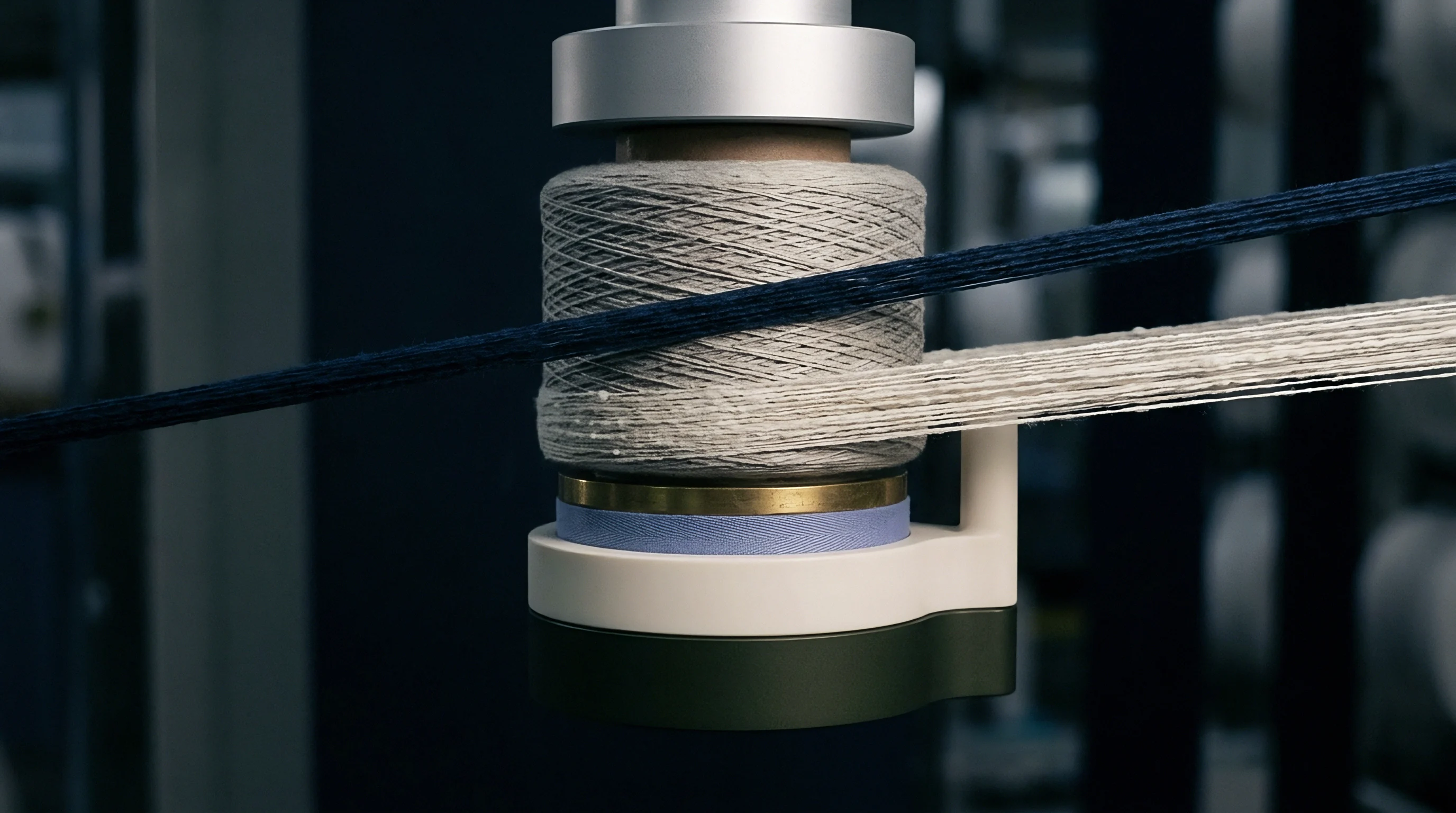
Nozzle
Inside the vortex chamber, swirling air strips loose staple ends from the main strand during twist insertion. As drafted sliver enters the high-velocity air field, injector orifices generate a spiral whirlpool around the hollow spindle tip. Fibers with tail ends not locked into the core are swept outward by centrifugal force and accelerating air, passing into the collection chamber as primary nozzle fly.
Measuring this loss accurately requires isolating pneumatic ejection from upstream mechanical drafting waste.
Operating at delivery speeds over four hundred meters per minute, pneumatic jet spinning subjects the open fiber bundle to heavy kinetic forces. Main nozzle pressure typically sits between zero point three five and zero point five five megapascals; higher pressures increase twist density and yarn tenacity, but they also force more short fibers out through the exhaust ports. With target nozzle pressures reaching five bars, managing this trade-off directly determines overall line yield.

Aerodynamic Separation Forces
High-velocity compressed air generates a spiral flow that wraps outer fibers around a central parallel core. Fibers too short to bridge the gap between the front drafting rollers and the spindle nozzle tip cannot anchor into the false twist. Centrifugal force throws these loose fragments against the chamber walls, where continuous exhaust draws them into the central suction ductwork.
Ejection rates depend directly on nozzle pressure, injector orifice angle, and fluid velocity within the swirl zone.
Downstream secondary air injectors adjust the fluid balance inside the spinning nozzle. Increasing secondary air flow shifts the static pressure gradient near the spindle tip, altering how cleanly fiber ends wrap or dislodge. Main nozzle air pressure settings dictate the kinetic energy transferred to the fiber stream, whereas injector orifice angles between forty-five and sixty degrees establish the swirl torque.
If air velocity climbs past the critical transport speed for short staple segments, waste rates surge without any gain in yarn structure.

Swirl Air Chamber Pressure Dynamics
Injector orifices angled between forty and sixty degrees focus kinetic energy onto incoming drafted sliver. Internal pressure differentials draw loose fibers off the core strand before false-twist conversion binds them into the yarn body, so higher short-fiber content noticeably increases lint production. On multi-position production frames, pressure fluctuations across individual heads lead to localized variations in waste, making stable supply pressure essential for preventing position-to-position yield drift.
| Fiber Composition | Staple Length (mm) | Nozzle Pressure (MPa) | Drafting Waste (%) | Nozzle Waste (%) | Total Waste Rate (%) |
|---|---|---|---|---|---|
| 100% Combed Cotton | 31.8 | 0.42 | 0.65 | 3.80 | 4.45 |
| 100% Carded Cotton | 28.5 | 0.45 | 1.20 | 7.10 | 8.30 |
| 65/35 Poly/Combed Cotton | 38.0 / 31.8 | 0.40 | 0.40 | 2.80 | 3.20 |
| 50/50 Poly/Viscose | 38.0 / 38.0 | 0.38 | 0.30 | 2.10 | 2.40 |
| 100% Micro-Denier Polyester | 38.0 | 0.35 | 0.25 | 1.60 | 1.85 |
Excessive waste building up inside the nozzle cavity causes frequent end breaks and minor slub defects. To keep loose lint from clinging to the delivered yarn, mills run continuous vacuum sweepers around the nozzle discharge zones. Equipment builders often point out that waste rates exceeding six percent stem from poor sliver preparation rather than overly aggressive chamber pneumatics.


Fraction
Fiber length distribution determines which staple segments stay bound in the spinning core and which get drawn off into suction ducts. Length uniformity matters far more in air jet spinning than in ring or rotor systems. Fibers under twelve point seven millimeters simply lack the length needed to span the gap between the front drafting nip point and the spindle tip while accepting false twist.
A high short-fiber ratio leads directly to increased pneumatic waste. As sliver loaded with short staple enters the nozzle, the air vortex easily sweeps these unanchored fragments clear. Advanced Fiber Information System profile measurements track short fiber content by weight and count, allowing accurate forecasting of material loss on the spinning floor, where combed sliver helps stabilize final yarn tenacity.
Short Fiber Index Impact
Cotton lots tested on high-volume instruments show elevated waste when fiber under twelve point seven millimeters exceeds ten percent by weight. The short fiber index directly governs how much material is thrown off as nozzle fly, whereas synthetic options like polyester staple better resist centrifugal loss. Cotton fibers below critical length lack the friction required to hold together in the drafting zone during high-speed delivery, so enforcing strict length limits on raw stock is essential for protecting yield.
Carded cotton sliver exhibits a wider fiber length distribution than combed stock, generating considerably more waste on pneumatic spinning machines. Upper half mean length measures the average length of the longer fiber fraction, while the short fiber index tracks the proportion of short elements. As that index rises, mass balance shifts toward greater pneumatic lint extraction.
The Fiber length uniformity ratio acts as a secondary gauge, with values below eighty-two percent signaling probable waste spikes inside the nozzle chamber.
Sliver presented with tight staple length distribution yields predictable waste rates regardless of minor fluctuations in ambient mill humidity.
Controlling raw material inputs requires setting strict minimum length parameters before opening bales in the blowroom. Tests on fiber beards using photoelectric measuring devices show that each one percent increase in short fiber content by weight adds zero point four5 percent to nozzle waste on air jet frames running at five hundred meters per minute.

Combed versus Carded Sliver Input
Removing short staple during preparation stabilizes the downstream mass balance. Combing clears out fibers under sixteen millimeters alongside residual trash and neps, creating a parallel fiber array ideal for air jet wrapping mechanics. Although carded sliver lowers preparation costs, the resulting waste spike at the nozzle on air jet frames quickly offsets those initial savings.
Choosing between carded and combed preparation fundamentally alters spinning economics. The parameters below highlight specific failure modes driven by poor staple length distribution in air jet systems:
- Excessive Short Fiber Ratio drives high nozzle fly generation when short fiber content by weight exceeds nine percent on high-volume instrument testing.
- High Nep Concentration causes localized airflow disruptions inside the vortex nozzle, forcing neighboring healthy fibers into the exhaust airstream.
- Wide Fiber Length Variance disrupts outer wrap alignment, creating rough yarn surface texture and elevating collector box mass accumulation.
- Elevated Trash Content chokes injector air orifices, altering internal chamber pressure and causing spikes in unattached fiber ejection.
Sliver preparation quality sets the floor for process waste. When carded cotton sliver is run on air jet frames, total waste routinely exceeds eight percent; combed cotton sliver of equivalent staple length keeps total waste under four point five percent under identical pneumatic settings.


Collector
Pneumatic channels move ejected fly from individual spinning positions to a central filter house. Calculating accurate waste rates across a production floor depends heavily on the condition of this vacuum collection system. Air leaks, pressure drops, or restricted transport ducts introduce major errors into mass balance audits, which is why standardized testing relies on isolated checks at individual heads or dedicated filter boxes.
Collection systems must maintain steady negative pressure to capture all ejected fibers, with standard atmospheric conditions governing every weighing step. Shifts in central suction velocity reduce efficiency, allowing heavy lint to settle in transport piping or light fly to escape back into the room. Regular calibration of filter box scales and pressure gauges is critical for reliable gravimetric data.

How Does Suction Velocity Alter Waste Collection Accuracy?
Maintaining static vacuum levels at the filter box keeps blown lint from drifting back into the spinning zone, as sudden suction drops distort scale measurements. If duct air velocity falls below twelve meters per second, heavier fibers drop out of the airstream and settle in pipe elbows. This lag delays accurate waste recording ~ under-reporting losses during brief test runs, then causing artificial spikes when trapped lint suddenly purges into the filter box.
Installing dedicated collection bags directly on individual nozzle exhaust ports eliminates transport duct lag. Weighing individual position collectors over set time periods gives an exact measurement of fiber ejection per spindle hour. Static vacuum pressure kept between eighteen hundred and twenty-two hundred pascals prevents backpressure build-up, while exhaust duct velocity must stay above fifteen meters per second to prevent settling.
Filter screen density rated at one hundred mesh traps fine lint without choking airflow.
| System Parameter | Target Specification | Acceptable Tolerance | Operational Failure Mode |
|---|---|---|---|
| Filter Box Vacuum | 2,000 Pa | ± 100 Pa | Backpressure spikes, lint buildup in nozzles |
| Transport Duct Velocity | 16.5 m/s | ± 1.5 m/s | Fiber settling in elbows, sudden mass purges |
| Mesh Screen Density | 100 Mesh (149 µm) | Fixed | Fine lint passage through exhausted filter air |
| Collection Bag Tare Precision | 0.01 g | ± 0.02 g | Gravimetric measurement inaccuracy on small samples |
Scale calibration must account for ambient dust and oil residue on collection screens. Technicians perform tare weigh-outs before and after every test batch to maintain zero-point accuracy across multi-head sampling cycles.

Filtering Systems and Extraction Calibration
Differential pressure gauges mounted across intake screens track lint buildup during extended production runs. As fibers coat the primary mesh, rising air resistance alters suction velocity at individual spinning nozzles. Automated mechanical scrapers clean the filter screens at timed intervals to keep pressure differentials constant across the duct system.
- Isolate the target air jet spinning frame positions by shutting air valves on adjacent non-test spindles.
- Clean all intermediate collection piping with a high-pressure pneumatic lance to remove residual lint deposits.
- Mount pre-weighed, oven-dried filter collection bags directly onto the exhaust outlets of the test spinning heads.
- Record initial line pressure, vacuum level, and motor speed, verifying that all operational parameters meet specification limits.
- Run the test positions for exactly one hundred and twenty minutes at constant delivery speed while collecting all yarn produced.
- Remove filled collection bags, seal them immediately in moisture-impermeable containers, and transfer them to the laboratory.
- Weigh captured fly on an analytical balance precise to zero point zero one grams after moisture equilibrium conditioning.
Contracts referencing ISO 9001 quality frameworks specify that uncalibrated suction balances void all mill waste allowance guarantees.
Standardizing physical recovery ensures that measured waste figures reflect true machine performance rather than sampling error. Vacuum stability checks should always precede official mass balance audits.


Balance
Calculating net material efficiency requires balancing incoming sliver weight against clean yarn output and collected pneumatic lint. A complete mass account tracks every gram entering the drafting system, covering delivered yarn, waste fractions, moisture shifts, and invisible loss. Moisture regain variance remains one of the largest sources of error in commercial inventory accounting.
Fibers absorb or release moisture during high-speed drafting and pneumatic transport. Expanding compressed air in air jet nozzles strips moisture from the strand during twist insertion, and because tare weights rely on dry filter screens, comparing raw sliver at eight percent moisture to spun yarn at six percent creates an artificial mass loss. Without correcting to dry mass baselines, this shift gets wrongly misclassified as invisible material waste.

Gravimetric Protocol Execution
Conditioning incoming sliver rolls and outgoing yarn packages under standard atmospheric conditions establishes a shared moisture baseline. Per ISO 6741 standards, commercial mass determination requires either drying samples to an oven-dry state or conditioning them at twenty degrees Celsius and sixty-five percent relative humidity for twenty-four hours. Converting raw field weights to standardized commercial mass prevents moisture discrepancies from distorting yield calculations.
The standard moisture regain allowance for cotton is eight point five percent, whereas polyester carries a baseline allowance of zero point four percent. Oven-dry mass determination removes ambient humidity variation by drying samples at one hundred and five degrees Celsius until mass stabilizes. Commercial mass calculation then re-applies standard regain values to dry fiber weights.
Finally, Invisible loss quantification accounts for uncollected fly, micro-dust, and volatile oils driven off during processing.
Cotton sliver containing a short fiber index above twelve percent generates air jet nozzle waste exceeding eight point five percent under standard drafting tensions.
Establishing a true material balance requires tracking four output streams: clean yarn mass, nozzle exhaust fly, drafting area fly, and uncollected invisible loss. The sum of these output fractions must match the conditioned mass of input sliver within a strict tolerance window of zero point five percent.

Worked Calculation of Mass Yield Loss
Evaluating a twenty-tonne spinning run illustrates the gap between nominal sliver input and delivered package weight. Consider a commercial order using combed cotton sliver to produce Ne 30 air-jet yarn. The incoming sliver batch weighs twenty thousand kilograms at a measured field moisture content of seven point two percent, against the standard cotton moisture regain of eight point five percent.
To determine the standardized commercial input mass, calculate the oven-dry mass first: dry mass equals twenty thousand divided by one point zero seven two, yielding eighteen thousand six hundred and fifty-six point seven two kilograms. Applying standard eight point five percent regain gives a commercial input mass of twenty thousand two hundred and forty-two point fifty-four kilograms. After processing, gravimetric collection records nineteen thousand one hundred and ten kilograms of delivered yarn, seven hundred and eighty kilograms of nozzle exhaust waste, and one hundred and twenty kilograms of drafting fly, all weighed at standardized commercial regain conditions.
| Stream Category | Field Mass (kg) | Moisture Content (%) | Oven-Dry Mass (kg) | Commercial Mass (kg) | Share of Input (%) |
|---|---|---|---|---|---|
| Input Combed Sliver | 20,000.00 | 7.20 | 18,656.72 | 20,242.54 | 100.00 |
| Delivered Ne 30 Yarn | 17,800.00 | 6.10 | 16,776.63 | 18,202.64 | 89.92 |
| Captured Nozzle Fly | 850.00 | 4.50 | 813.40 | 882.54 | 4.36 |
| Drafting Roller Fly | 140.00 | 5.00 | 133.33 | 144.66 | 0.71 |
| Invisible Loss / Dust | — | — | 933.36 | 1,012.70 | 5.01 |
Total recorded outputs equal nineteen thousand two hundred and twenty-nine point eighty-four kilograms of commercial mass. The remaining difference of one thousand and twelve point seventy kilograms represents invisible loss from micro-dust, extracted trash, and ultra-fine lint escaping the filter screens. As percentages of commercial input mass, net yarn yield is eighty-nine point ninety-two percent, nozzle waste is four point thirty-six percent, drafting waste is zero point seventy-one percent, and invisible loss is five point zero one percent.
Failing to properly calibrate incoming moisture regain against pneumatic waste weights artificially inflates material loss, causing buyers to pay unearned yield adjustments.

Yield
Commercial yarn pricing incorporates baseline waste allowances negotiated between raw material classers and spinning managers. Because air jet spinning creates more inherent waste than ring spinning when running short staple fibers, mills adjust conversion pricing to reflect nozzle losses. Modeling this loss accurately prevents margin erosion on high-volume orders.
Waste generated during air jet processing retains commercial value, albeit at a steep discount compared to virgin sliver. Ejected nozzle fly consists mostly of short fibers, fine lint, and broken fragments, which nonwoven fabric makers and open-end rotor mills purchase as low-cost stock. Crediting waste resale against initial fiber expenditures establishes the true net manufacturing cost.

Financial Integration of Waste Recoveries
Selling ejected pneumatic fly to nonwoven pad manufacturers helps offset raw material expenditures. If raw combed cotton sliver costs two dollars and sixty cents per kilogram and nozzle waste sells for fifty cents per kilogram, a five percent waste rate adds roughly eleven cents per kilogram to the effective fiber cost of delivered yarn. Mill controllers factor these recovery rates directly into monthly spinning yield ledgers.
Recovery value varies with fiber cleanliness, length, and contamination levels. Combed nozzle fly commands higher prices than carded fly because of its lower trash content, while high-speed opening lines can recycle long-staple drafting fly straight back into coarse rotor blends. Segregating waste streams preserves material purity and maximizes salvage value on secondary markets.
Customs Tariff and Fiber Content Verification
Differential waste rates between blended components alter the percentage ratio of delivered yarn relative to incoming sliver proportions. In intimate blends like polyester and cotton, cotton loses a higher proportion of fiber weight through nozzle ejection than synthetic staple. Consequently, a sliver blended at sixty-five percent polyester and thirty-five percent cotton can yield a finished yarn containing sixty-seven percent polyester and thirty-three percent cotton.
This blend ratio shift impacts customs classifications under the Harmonized System, where duty rates hinge on chief weight thresholds. Where crossing a fifty or sixty-five percent synthetic threshold alters applicable duties, a two percent shift from preferential cotton ejection can reclassify a shipment into a higher tariff bracket. Importers audit sliver ratios and perform quantitative chemical analysis on finished yarn under ISO 1833 to verify that declared compositions match physical shipments.
Composition declarations on customs entries must reflect the final fiber blend ratio verified by quantitative chemical test report rather than the initial sliver blend specification.
Customs authorities require accurate material declarations backed by quantitative chemical testing. Fiber composition drift caused by differential nozzle ejection creates real compliance risk if finished yarn analysis strays outside statutory tolerance limits from manifest descriptions. Whether automated online optical sensors can eventually replace manual gravimetric weigh-outs across multi-frame mills remains a subject of active shop-floor debate.