Commercial Mass Determination in Regenerated Cellulosic and Synthetic Mixtures
Commercial mass determination reconciles clean dry polymer mass with official regain allowances to secure precise customs compliance and financial settlement.


Moisture
Thermal drying of mixed textile fibers establishes the baseline for calculating all commercial quantities. Buying raw yarn or finished fabric on an unadjusted gross weight basis carries substantial financial risk in global trade. Regenerated cellulosics like viscose, modal, and lyocell have high equilibrium regain values because of accessible hydroxyl groups in their amorphous regions.
Synthetics such as polyester, acrylic, and aliphatic polyamides are hydrophobic and take up little ambient water. When these two fiber types are blended in a yarn or woven fabric, settling contract weights requires separating physical water mass from oven-dry polymer mass.
Determining clean oven-dry mass in the laboratory relies on standardized conditioning equipment under strict atmospheric control. ISO 6741 specifies drying test specimens in a ventilated oven at 105 degrees Celsius plus or minus 2 degrees. Air circulation inside the chamber removes evaporated moisture until weighings at specified intervals show less than 0.05 percent mass variation.
Weighing directly inside the heating chamber prevents ambient moisture re-absorption during transfers. External balance setups instead use desiccators with activated silica gel or phosphorus pentoxide to cool specimens before recording mass.
Oven dry mass governs commercial settlement. Determining this mass under controlled humidity prevents atmospheric sorption during weighing. Exposure to dry air stops regenerated cellulosics from picking up ambient vapor during transfer.
A delay of twenty seconds between oven removal and reading the balance increases the apparent mass of a dried viscose sample by up to 0.3 percent in standard humidity. Sealed weighing containers prevent ambient contamination as samples move between ovens and micro-analytical balances.

Thermal Equilibrium and Desiccation Procedures
Reaching a true anhydrous state requires strict control over oven temperature and exposure time. Regenerated cellulosics hold bound water in fine capillaries through hydrogen bonds. Removing all moisture takes enough thermal energy to break these weak secondary bonds without degrading the cellulose polymer chain.
Exposure to temperatures above 110 degrees Celsius causes oxidative depolymerization, reducing fiber mass as low molecular weight fractions volatilize. Synthetics have their own thermal limits: polyamide 6 and polyamide 6,6 oxidize slowly in hot air over long periods, and elastomeric polyurethanes can suffer soft-segment softening and structural damage.
Ambient air drawn into drying ovens contains moisture, so standard test methods specify feeding ovens with air conditioned through desiccation towers or refrigeration units. The air entering the drying chamber must have an absolute humidity below 0.1 grams of water per kilogram of dry air to guarantee complete drying. Without a dry air supply, specimens reach equilibrium with residual humidity in the oven air, understating actual water content by 0.1 to 0.4 percent depending on room conditions.
Relative humidity inside testing enclosures directly alters final mass determinations before solvent extraction begins.
Container design affects drying kinetics. Perforated aluminum weighing bottles allow water vapor to escape quickly from dense fiber assemblies during heating. Compacted filament packages or tightly woven fabrics restrict internal airflow and slow down desorption.
Technicians open dense yarn structures manually before placing them in the oven to maximize surface exposure. Drying continues until two consecutive weighings taken fifteen minutes apart match within microbalance tolerance.
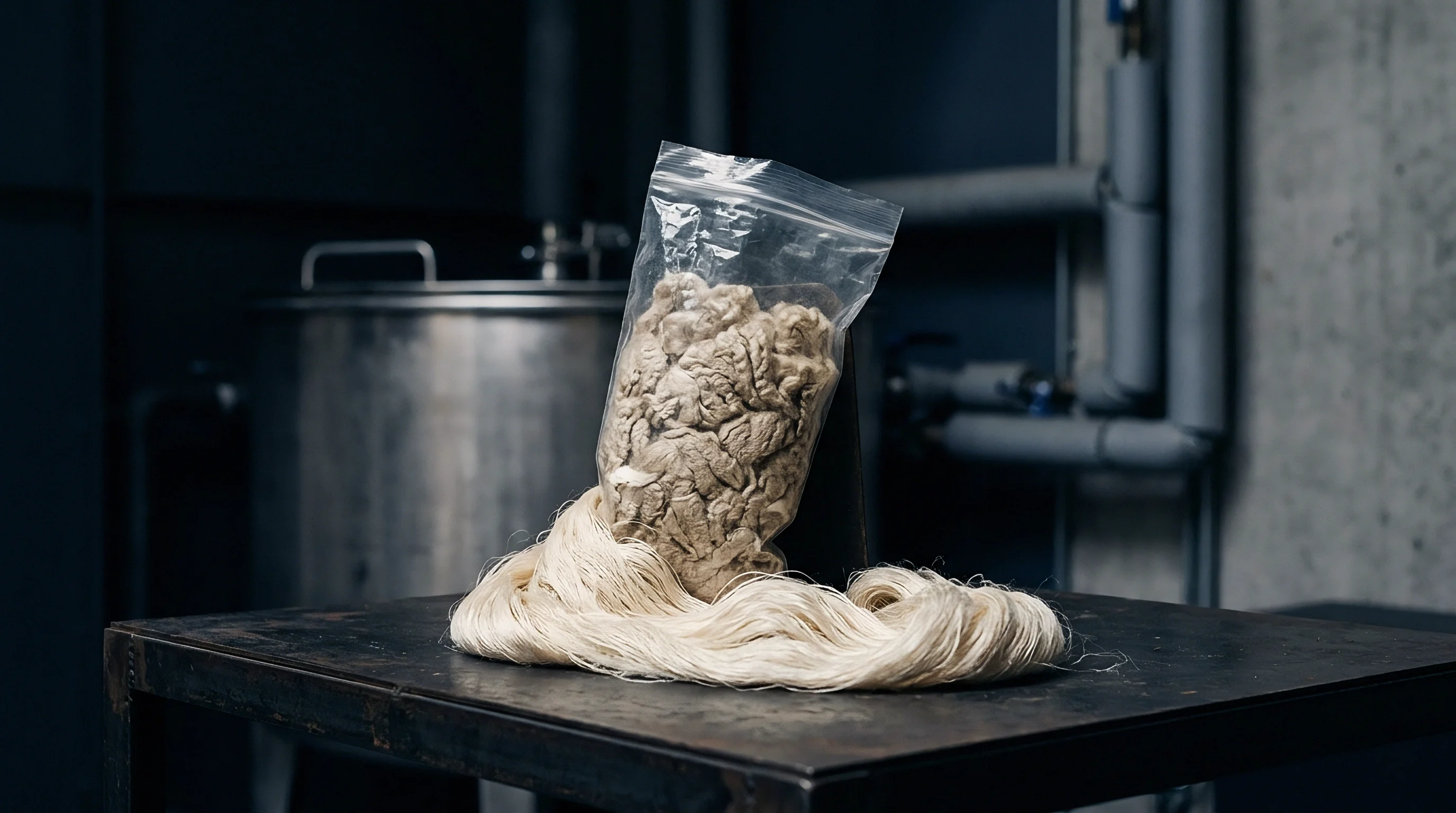
Regain Differential between Cellulosic and Synthetic Polymer Networks
Molecular structure dictates how much water a polymer retains. Viscose rayon, made via the xanthate process, has a porous structure and low crystallinity compared to native cotton. Hydroxyl groups along its chains attract water dipoles, giving it an official commercial regain of 13.0 percent.
Lyocell, produced by direct dissolution in N-methylmorpholine N-oxide, has higher crystalline orientation and an official regain of 11.5 percent. Modal falls between the two in crystalline structure, carrying an official regain benchmark of 11.5 percent under international agreements.
Synthetic polymers show much lower affinity for moisture. Polyethylene terephthalate polyester has an aromatic backbone without polar functional groups, setting its official regain allowance at 1.5 percent under Bureau for the Standardization of Man-Made Fibres standards. Polyamide 6,6 contains amide linkages that can hydrogen-bond with water, giving it an official regain allowance of 6.25 percent.
Polyacrylonitrile acrylic holds minimal water at an official regain of 2.0 percent, while polyolefin fibers like polypropylene absorb no measurable moisture, rated at 0.0 percent.
Where cellulosic fibers absorb atmospheric water, synthetics repel liquid phase accumulation. Calculating the theoretical regain of a binary yarn containing 60 percent viscose and 40 percent polyester by dry mass uses straightforward weighted arithmetic. The combined official regain equals 60 percent multiplied by 13.0 percent plus 40 percent multiplied by 1.5 percent, giving an official weighted regain allowance of 8.4 percent.
Commercial invoices apply this factor to clean dry mass to calculate final payable weight.
| Fiber Type | Chemical Structure | Official Commercial Regain (%) | Standard Oven Temperature (°C) | Thermal Degradation Limit (°C) |
|---|---|---|---|---|
| Viscose Rayon | Regenerated Cellulose | 13.00 | 105 – 109 | 120 |
| Modal | High Wet Modulus Cellulose | 11.50 | 105 – 109 | 125 |
| Lyocell | Solvent-Spun Cellulose | 11.50 | 105 – 109 | 130 |
| Polyester (PET) | Polyethylene Terephthalate | 1.50 | 105 – 109 | 150 |
| Polyamide 6,6 | Polyhexamethylene Adipamide | 6.25 | 105 – 109 | 130 |
| Acrylic | Polyacrylonitrile | 2.00 | 105 – 109 | 115 |
| Elastane | Segmented Polyurethane | 1.50 | 105 – 109 | 110 |
Errors during desiccation skew commercial mass determinations. Incomplete removal of spinning oils, sizing agents, and finishing auxiliaries before thermal drying introduces systematic offsets. Because volatile finishing agents evaporate along with moisture in the oven, technicians can easily misidentify lost non-fibrous matter as water content.
Solvent extraction before drying removes these volatile processing oils first.
- Incomplete Drying Cycles cut thermal treatment short before dense package centers reach anhydrous equilibrium, understating internal moisture content.
- Uncalibrated Balance Systems introduce systematic linear drift during high-temperature mass readings inside drying chambers.
- Desiccator Saturation occurs when spent desiccant fails to maintain low vapor pressure while samples cool prior to weighing.
- Thermal Depolymerization degrades heat-sensitive elastomeric components during extended drying above recommended temperature ceilings.
When commercial shipments show mass discrepancies on arrival, claims frequently assert that moisture absorbed during transit accounts for any gain beyond tolerance limits. That argument ignores the fact that closed container doors prevent moisture transport into wrapped bulk packages; actual weight variations usually reflect shifts in fiber blend composition rather than environmental water absorption.

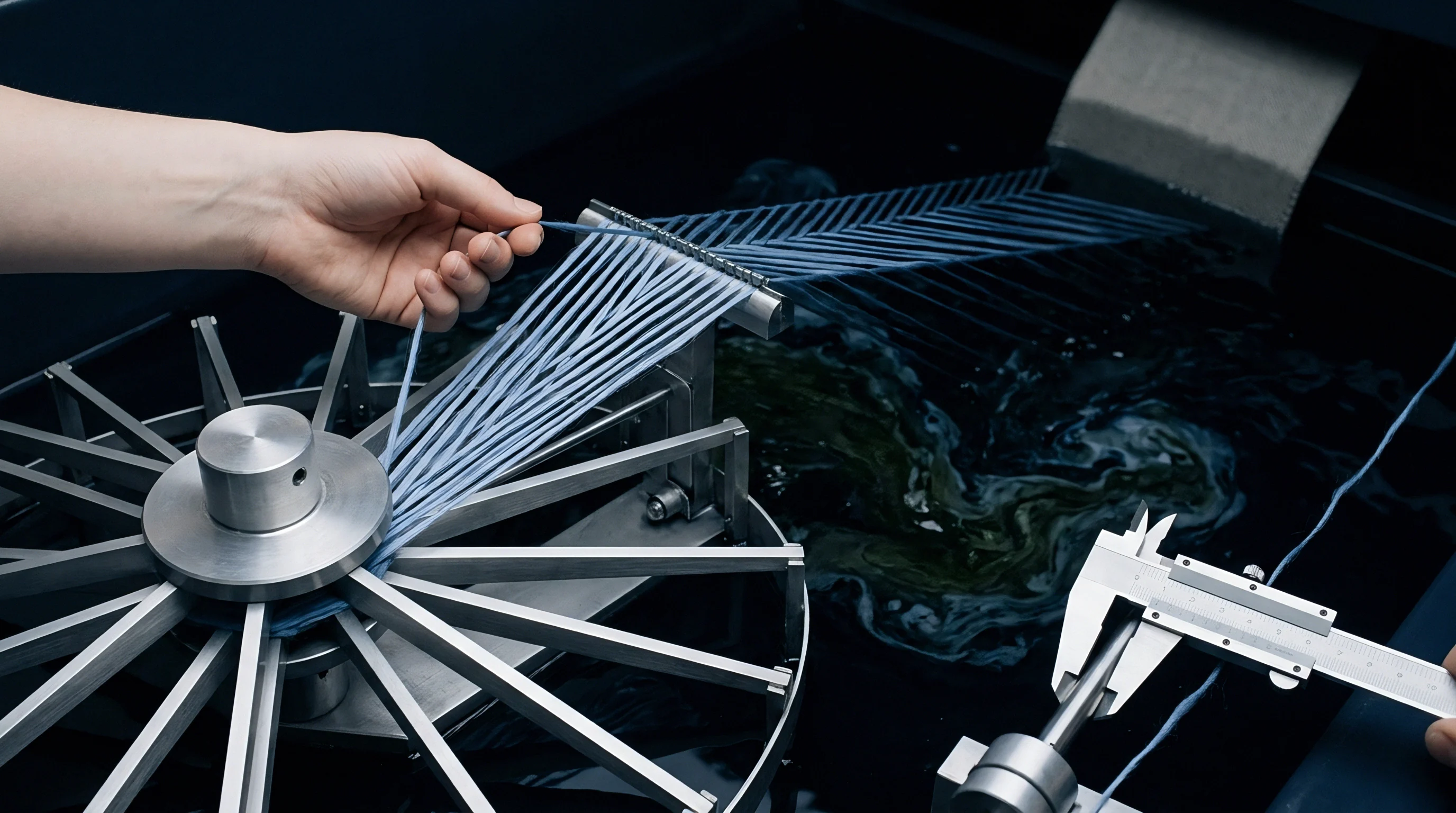
Dissolution
Chemical reagents selectively isolate target polymers within mixed yarn assemblies. Quantitative chemical analysis of regenerated cellulosic and synthetic blends relies on differences in solubility between polymer families. ISO 1833 details the reagents, dissolution temperatures, agitation periods, and correction factors needed to separate binary and ternary fiber combinations.
Choosing the right solvent system dissolves the target fiber completely without altering the mass of the insoluble residue.
Separating regenerated cellulose from synthetics requires reagents that break glycosidic bonds or disrupt hydrogen networks in cellulosic chains while leaving synthetic backbones untouched. Standard choices include concentrated formic acid mixed with zinc chloride, cold 75 percent sulfuric acid, or basic sodium zincate. Synthetic polymers stay inert in these environments under controlled exposure times.
Organic solvents like acetone or dimethylformamide instead dissolve specific synthetic components such as acetate, triacetate, or acrylic, leaving the cellulosic residue intact.
Solvents act with high selectivity, but getting accurate results requires clean, pre-treated samples. Submitting raw binary fiber directly to chemical dissolution without removing non-fibrous matter distorts test figures. Spin finishes, knitting lubricants, sizing agents, and functional coatings alter solvent penetration and add non-polymeric mass to weighing containers.
Extraction with petroleum ether or dichloromethane removes these lipophilic processing aids before reagents touch the fiber surfaces.

Selective Chemical Reagents and Solvent Systems
A mixture of formic acid and zinc chloride, specified in ISO 1833-6, dissolves regenerated cellulosic fibers ~ including viscose, modal, and lyocell ~ without attacking cotton, polyester, or polyamide. The standard reagent is prepared by dissolving 20 grams of anhydrous zinc chloride and 68 grams of anhydrous formic acid in water to reach a total mass of 100 grams. Immersing a pre-weighed dried specimen in this solution at 40 degrees Celsius for 2 hours breaks the cellulosic matrix into soluble fragments.
Grade 2 glass frit filter crucibles then separate the insoluble synthetic residue from the liquid phase.
Cold 75 percent sulfuric acid, governed by ISO 1833-11, offers another route for separating regenerated cellulosics from polyester. Preparing the reagent requires adding 700 milliliters of concentrated sulfuric acid slowly to 350 milliliters of distilled water, cooling the vessel in an ice bath to avoid thermal degradation from the exothermic reaction. The solution must cool to 15 degrees Celsius before adding the specimen.
Shaking the mixture at room temperature for 1 hour dissolves viscose, modal, and lyocell while leaving polyester unaffected. Filtering through glass crucibles, washing thoroughly with dilute acid and water, and neutralizing with dilute ammonia returns the polyester residue to an inert state for drying.
Sodium zincate solutions work well for separating regenerated cellulosics from acrylic or elastomeric components. Dissolving zinc oxide in concentrated sodium hydroxide creates a strongly alkaline reagent that cleaves cellulose hydrogen bonds without hydrolyzing polyacrylonitrile backbones. Maintaining exact concentration ranges and temperatures is critical to avoid dissolving part of the synthetic substrate or leaving unextracted cellulose behind.
- Dry the pre-extracted specimen in an oven at 105 degrees Celsius to constant mass.
- Transfer the dried specimen to a glass-stoppered flask containing the designated volume of solvent.
- Agitate the flask in a temperature-controlled water bath for the exact duration specified by the standard.
- Decant the solvent mixture through a pre-weighed sintered glass filter crucible under vacuum suction.
- Rinse the insoluble residue with fresh solvent, neutralizing agents, and distilled water.
- Dry the crucible and residue at 105 degrees Celsius to constant mass, record the final weight, and compute insoluble mass fractions.
Quantifying Non-Fibrous Residue and Mass Corrections
Chemical solvents attack insoluble fiber fractions slightly during separation. Low molecular weight fractions of the insoluble fiber may dissolve, or reagents can bind to the fiber surface, altering final mass measurements. Protocols apply a correction factor ~ the d-value ~ to account for this systematic variation.
The d-value is the ratio of clean dry mass of the insoluble fiber before and after exposure to the specific reagent system under standard test conditions.
Determining the d-factor involves treating pure control samples of the insoluble fiber with the exact reagent concentrations, temperatures, and exposure times used in the blend test. If pure polyester loses 0.5 percent of its mass in cold 75 percent sulfuric acid, its d-factor is 1.005. Correcting the mass of insoluble polyester residue means multiplying the measured dry residue by 1.005.
If a reagent instead binds to the fiber network and increases its dry mass by 1.0 percent, the d-factor becomes 0.990.
| Fiber Blend Combination | Target Dissolved Fiber | Reagent System | Test Temp (°C) | Exposure Time | Insoluble Residue d-Factor |
|---|---|---|---|---|---|
| Viscose / Polyester | Viscose Rayon | 75% Sulfuric Acid | 15 – 20 | 60 min | Polyester: 1.00 |
| Modal / Polyamide 6,6 | Modal | Formic Acid / Zinc Chloride | 40 ± 2 | 120 min | Polyamide: 1.01 |
| Lyocell / Acrylic | Lyocell | Sodium Zincate | 20 ± 2 | 45 min | Acrylic: 1.01 |
| Acetate / Viscose | Acetate | Acetone (Cold) | 20 ± 2 | 30 min | Viscose: 1.00 |
| Polyester / Elastane | Elastane | Dimethylformamide (DMF) | 95 ± 2 | 60 min | Polyester: 1.01 |
Calculating the dry mass percentage of each fiber component accounts for both non-fibrous content removal and the d-factor correction. Let m0 represent the initial clean dry mass of the blended sample, and m1 the dry mass of the residue left after selective chemical removal of the dissolved component. The corrected mass of the insoluble component mi equals m1 × d.
The clean dry percentage of the insoluble component Pi follows the formula Pi = (mi / m0) × 100, while the dry percentage of the dissolved component Pd equals 100 – Pi.
Ternary Blend Separation Sequence for Viscose Polyester Elastane Assemblies
Modern functional textiles often combine regenerated cellulosics, synthetics for strength, and elastomeric components in woven or knitted structures. Analyzing a ternary mixture of viscose rayon, polyethylene terephthalate polyester, and elastane requires a multi-stage sequential extraction. Applying solvents in the wrong order leads to cross-dissolution, destruction of elastomeric components, or incomplete removal of the cellulosic matrix.
Significant divergence occurs when pre-treatment steps omit non-fibrous finish removal on elastic blends. Silicone lubricants and knitting oils form physical barriers around individual filaments that prevent aqueous reagents from reaching the inner core. Extraction with ether or solvent in a Soxhlet apparatus for 16 reflux cycles removes non-polymeric coatings without degrading polyurethane elastomeric chains.
Step one of the ternary separation isolates elastane. Dimethylformamide at 95 degrees Celsius selectively dissolves elastomeric polyurethane without affecting viscose rayon or polyester. A 2.5000 gram specimen of clean dry ternary mixture is treated in 150 milliliters of dimethylformamide for 60 minutes.
The mixture is filtered through a glass crucible, rinsed with fresh warm solvent, washed with hot water, and dried to constant mass. The resulting residue mass m1 measures 2.3750 grams, indicating an elastane loss of 0.1250 grams.
Step two dissolves viscose rayon from the remaining residue. The dried residue m1 is placed in a flask with cold 75 percent sulfuric acid at 15 degrees Celsius for 60 minutes under continuous mechanical agitation. Viscose rayon dissolves completely into the acid.
Filtration leaves an insoluble polyester residue mass m2 of 1.1875 grams. Standard correction factors (d1 = 1.01 for polyester exposed to dimethylformamide, d2 = 1.00 for polyester exposed to sulfuric acid) adjust the measured residue to reflect clean polymer dry weights.
Mathematically processing the raw test measurements reveals the true clean dry proportions of the ternary blend assembly:
Initial clean dry mass m0 = 2.5000 g.
Corrected mass of polyester residue mPET = m2 × d1 × d2 = 1.1875 g × 1.01 × 1.00 = 1.1994 g.
Dry mass percentage of polyester PPET = (1.1994 / 2.5000) × 100 = 47.98%.
Residue mass after elastane removal m1 = 2.3750 g. Total mass loss in step one equals m0 – m1 = 2.5000 – 2.3750 = 0.1250 g.
Dry mass percentage of elastane PELA = (0.1250 / 2.5000) × 100 = 5.00%.
Dry mass percentage of viscose rayon PVIS = 100 – (PPET + PELA) = 100 – (47.98 + 5.00) = 47.02%.
Using chemical reagents outside prescribed temperature ranges alters separation kinetics, leading to incomplete polymer extraction and pushing declared fiber percentages beyond commercial tolerances.


Correction
Commercial invoices convert laboratory clean dry mass into payable weight using official regain factors. Standard commercial mass is defined as the clean dry mass of a fiber lot plus an additional mass corresponding to its official commercial moisture regain, along with any permitted non-fibrous content allowance. Buying mixed fiber consignments based on raw scale readings without converting to commercial mass introduces systematic financial error, since atmospheric conditions during weighing inflate or deflate apparent delivered weight.
International trade bodies including the International Bureau for the Standardization of Man-Made Fibres (BISFA) and the International Organization for Standardization (ISO) define the mathematical equations used to calculate commercial mass. Standard ISO 6741-4 provides the legal framework governing commercial mass calculations for yarn and fabric deliveries. These equations combine clean dry fiber mass, official moisture regain percentages for each blend component, and standard manufacturing allowances for residual spin finishes or oils left after scouring.
Calculating standard commercial mass Mc for a binary blend of fiber component A and fiber component B utilizes the following equation:
Mc = Md × left(1 + fraca100right) × left(1 + fracPA × RA + PB × RB10000right)
where Md represents the total clean dry mass of the consignment, a is the commercial allowance for non-fibrous matter expressed as a percentage, PA and PB are the dry mass percentages of components A and B, and RA and RB are their respective official commercial regain values.

Mathematical Application of Official Regain Allowances
Applying standard regain factors to a bulk yarn transaction shows the financial impact of commercial mass adjustments. Consider a lot of spun yarn with a gross scale weight of 10,000.0 kilograms delivered at an ambient moisture content of 6.0 percent. Laboratory testing shows a non-fibrous finish content of 1.2 percent and a dry composition ratio of 65.0 percent modal rayon and 35.0 percent polyester.
Step one calculates the clean dry mass of the shipment. Removing the ambient moisture (6.0 percent) and non-fibrous finish oils (1.2 percent) yields the clean dry polymer mass Md:
Md = 10000.0 kg × left(1 – frac6.0 + 1.2100right) = 9280.0 kg
Step two computes the weighted commercial moisture regain allowance Rw for the 65/35 modal/polyester dry blend ratio. Official BISFA regain standards assign modal an RA value of 11.5 percent and polyester an RB value of 1.5 percent:
Rw = frac(65.0 × 11.5) + (35.0 × 1.5)100 = frac747.5 + 52.5100 = 8.00%
Step three applies the official weighted commercial regain (8.00 percent) and the standard commercial non-fibrous allowance a (0.60 percent for spun yarn under BISFA rules) to the clean dry mass Md to derive the final billable commercial mass Mc:
Mc = 9280.0 kg × left(1 + frac0.60100right) × left(1 + frac8.00100right) = 9280.0 kg × 1.006 × 1.080 = 10082.47 kg
Comparing the delivered physical scale mass (10,000.0 kilograms) with the calculated standard commercial mass (10,082.47 kilograms) reveals an invoice deficit of 82.47 kilograms. Paying strictly against scale weight without converting to commercial mass undercounts delivered fiber value by 0.82 percent, transferring value from seller to buyer.
Contractual commercial mass calculations must apply official BISFA regain rates directly to clean dry polymer residues to settle open balance accounts.

Customs Tariff Classification and Chief Weight Thresholds
Cross-border customs authorities classify blended textile products under the Harmonized Commodity Description and Coding System (HS) based on chief weight. Section XI Note 2(A) of the WCO Harmonized System nomenclature states that goods classifiable in Chapters 50 to 55 containing two or more textile materials are classified as if consisting wholly of whichever textile material predominates by weight over any other single component.
Customs duties track dry weight, so threshold shifts alter duty liabilities. When an imported yarn contains 50.5 percent polyester filament and 49.5 percent viscose rayon on an anhydrous clean dry basis, customs regulations classify the product under HS Heading 5402 as synthetic filament yarn. If unadjusted testing methods or moisture variations misstate the composition as 49.5 percent polyester and 50.5 percent viscose rayon, customs reclassifies the cargo under HS Heading 5403 as artificial filament yarn, triggering different tariff schedules, origin rules, and anti-dumping exposures.
| Declared Blend (Dry Basis) | HS Code Classification | Base Tariff Duty Rate (%) | Trade Agreement Origin Rule | Financial Risk Exposure |
|---|---|---|---|---|
| 51% Viscose / 49% Polyester | 5508.10 (Artificial Staple) | 8.00 | Single Transformation | Standard Import Duty |
| 49% Viscose / 51% Polyester | 5509.21 (Synthetic Staple) | 12.00 | Double Transformation | 4% Tariff Jump Surcharge |
| 50% Viscose / 50% Polyester | 5509.51 (Synthetic Dominance Rule) | 12.00 | Double Transformation | Classification Rejection Risk |
| 85% Viscose / 15% Polyester | 5510.11 (Pure Artificial Staple) | 6.50 | Single Transformation | Duty Audit Re-assessment |
Customs authorities determine chief weight on a clean dry basis, ignoring temporary moisture. Importing a shipment with a lab report showing 51 percent viscose and 49 percent polyester at ambient conditions risks customs rejection if official oven-drying later shows an anhydrous ratio of 49.5 percent viscose and 50.5 percent polyester. Standard purchasing specifications define testing methodologies clearly to enforce compliance.
- Official Commercial Regain Values must match current BISFA or ISO 6741-4 regulatory tables attached as explicit schedules to cross-border supply contracts.
- Clean Dry Mass Verification protocols must require dual-chamber oven testing for all lots exceeding twenty metric tons total shipment weight.
- Non-Fibrous Finish Content Limits must cap billable finishing oil additions at 1.0 percent of total anhydrous polymer weight.
- Customs Duty Contingency Clauses must assign financial liability for tariff reclassifications from supplier blend drift directly to the seller.
Specifying in commercial contracts that delivered weights adjust to standard regain under ISO 6741-4 prevents disputes, provided both parties use identical chemical dissolution methods to determine initial clean dry proportions.
Divergence
Mass measurements returned by testing facilities frequently vary across identical cargo lots. Inter-laboratory discrepancies stem from differences in sampling, environmental controls, instrument calibration, reagent purity, and analytical technique. When a buyer and mill supplier receive conflicting test reports for the same fabric shipment, resolving the dispute requires evaluating the statistical tolerance bands established by international testing standards.
ISO 1833-1 defines explicit precision limits for quantitative chemical analysis of fiber mixtures. Repeatability limits represent the maximum allowable difference between two independent test results obtained on identical material using the same method, operator, laboratory, and equipment within a short interval. For most binary cellulosic and synthetic mixtures, the repeatability threshold r equals 1.0 percentage point.
Reproducibility limits R, representing differences between results from different laboratories, equal 2.0 percentage points.
A composition report showing 51.5 percent viscose rayon and 48.5 percent polyester is in statistical agreement with a second report showing 49.8 percent viscose rayon and 50.2 percent polyester. Both facilities fall within the 2.0 percentage point reproducibility window defined by ISO 1833. Claiming commercial default or non-compliance requires proving that compositional divergence exceeds these established inter-laboratory limits.

Where Do Laboratory Sampling Errors Creep In?
Sampling practices represent the largest source of variance in commercial mass determination. A 200-gram test specimen cut from a single roll is supposed to represent the chemical composition of a twenty-ton shipment, even though non-uniform blending during spinning causes composition drift across individual bobbins, spinning frames, and fabric rolls.
Drawing representative samples requires following the statistical protocols in ISO 5089 or ASTM D1441. Technicians cut sample swatches from at least ten separate rolls chosen randomly across the production lot and combine them into a composite laboratory sample. Failing to sample across multiple production units risks capturing localized blend variations that diverge significantly from the true lot average.
Flawed sampling produced a 1.8 percent weight discrepancy on a fifty-ton viscose blend cargo during winter transit. Inspectors drew specimens solely from outer box layers next to cold container walls, measuring localized condensation gradients rather than the true cargo average.
Specimen preparation errors compound sampling variations. Cutting fabric swatches with unraveling edges causes preferential loss of warp or weft yarns. In a fabric with viscose filament warp and textured polyester weft, losing warp threads during cutting skews the measured composition toward higher synthetic content.
Technicians seal edges or cut specimens diagonally across yarn axes to prevent fiber loss during extraction.

Hysteresis Effects and Ambient Transport Variations
Sorption hysteresis causes physical weight discrepancies between origin shipping weights and destination receiving weights. Hydrophilic polymers desorb water along a different vapor pressure curve than they absorb it. At 65 percent relative humidity, a viscose yarn lot reaching equilibrium from a dry state holds about 12.0 percent water, whereas the same lot reaching equilibrium from a saturated wet state holds roughly 14.5 percent.
Ocean transport exposes containerized shipments to extreme environmental shifts. Cargo loaded in humid tropical ports undergoes continuous condensation and evaporation cycles as ships cross temperature zones. Water evaporating from top cargo layers condenses against cold steel container ceilings and drips back onto top pallets.
Packages near container doors accumulate moisture at different rates than those on inner pallets.
Ambient relative humidity swings during maritime transit permanently alter unadjusted weigh-scale readings without changing anhydrous fiber mass.
Reconciling weight shifts requires separating temporary moisture absorption from physical mass losses. Calculating total anhydrous polymer mass on arrival eliminates hysteresis errors: if the total dry polymer mass matches what was measured at origin, the shipment contains its correct commercial quantity regardless of scale readings.
- Verify that both origin and destination test reports use identical chemical separation standards and reagent concentrations.
- Compare measured composition percentages against the 2.0 percentage point inter-laboratory reproducibility limit specified in ISO 1833.
- Extract clean dry mass figures from both certificates and convert all values to standard commercial mass using official BISFA regain factors.
- Evaluate whether measured weight variances exceed the contractual tolerance allowance defined in the purchase agreement.
- Authorize final invoice payment or file a formal commercial claim based on calculated standard commercial mass discrepancies.
How far can commercial contracts compress testing tolerance windows before standard inter-laboratory testing variations make compliance legally impossible to enforce?

Settlement
Final financial reconciliation depends on combining laboratory test certificates with agreed contractual allowances. Sourcing teams buying blended yarns or fabrics write precise commercial mass adjustments into purchase specifications to protect working capital. Contracts relying on ambiguous weight clauses invite disputes when moisture shifts or minor blend variations alter scale readings.
Commercial execution terms must define the testing protocols, sampling standards, regain tables, and formulas governing final payment. Specifying that yarns sell under BISFA rules or ISO 6741 standards establishes a clear legal basis for adjusting invoices against measured commercial mass. When contracts state that payable weight derives from dry polymer mass determined by accredited independent laboratories, scale discrepancies caused by transit conditions are neutralized.
Adjusting invoices to standard regain prevents financial friction. When laboratory certificates show that delivered dry mass falls below contract limits, automatic financial credit adjustments trigger according to predefined price-per-kilogram schedules.
Contractual Tolerance Drafting and Dispute Mitigation
Drafting commercial contracts requires clear composition and weight tolerance bands. A robust clause specifies an allowable composition drift range ~ typically plus or minus 1.5 percentage points around the nominal blend ratio. For a contract specifying a 60 percent viscose rayon and 40 percent polyester blend, delivered lots testing between 58.5/41.5 and 61.5/38.5 meet technical compliance without price adjustments.
Weight tolerance bands operate independently from blend ratio tolerances. Standard commercial contracts permit a total mass variation window of plus or minus 1.0 to 2.0 percent between invoiced commercial mass and delivered commercial mass. Variances within this neutral band settle at contract unit price, while variances exceeding it trigger pro-rata financial deductions or grant the buyer the right to reject sub-lots.
Dispute resolution clauses specify umpire laboratory protocols. When buyer and seller results diverge beyond the ISO 1833 reproducibility limit of 2.0 percentage points, a designated independent lab conducts binding testing on sealed duplicate samples drawn at the loading port. The umpire laboratory’s clean dry mass determination serves as the final authority for calculating billable commercial mass.

Financial Reconciliation Protocols for Bulk Deliveries
Financial settlement for bulk fiber cargo relies on a formal reconciliation ledger. The statement records initial gross scale mass, sampling results, non-fibrous extraction deductions, dry component ratios, applied commercial regains, and final calculated commercial mass. Unit contract prices apply solely to this final commercial mass figure.
Consider a transaction involving fifty metric tons (50,000.0 kilograms) of spun lyocell/polyester blended yarn priced at 3.50 Euros per kilogram. The purchase agreement specifies a nominal dry blend target of 70.0 percent lyocell and 30.0 percent polyester. Destination testing reveals an actual clean dry polymer mass of 44,100.0 kilograms, a non-fibrous finish content of 1.0 percent, and an actual dry composition of 67.0 percent lyocell and 33.0 percent polyester.
Calculating the final financial settlement proceeds through structured steps:
Step one determines the actual weighted official commercial regain Rw based on destination laboratory composition testing. Official regain for lyocell equals 11.5 percent, and polyester equals 1.5 percent:
Rw = frac(67.0 × 11.5) + (33.0 × 1.5)100 = frac770.5 + 49.5100 = 8.20%
Step two calculates the billable commercial mass Mc using the official non-fibrous allowance a (0.60 percent under BISFA spun yarn rules):
Mc = 44100.0 kg × left(1 + frac0.60100right) × left(1 + frac8.20100right) = 44100.0 kg × 1.006 × 1.082 = 48002.83 kg
Step three compares the calculated commercial mass (48,002.83 kilograms) against the contract baseline mass (50,000.0 kilograms). The delivered cargo shows a commercial mass deficit of 1,997.17 kilograms.
Step four computes the final financial adjustment. Multiplying the mass deficit (1,997.17 kilograms) by the contract price (3.50 Euros per kilogram) yields an invoice debit adjustment of 6,990.10 Euros in favor of the buyer.
Systematic commercial mass reconciliation guarantees paying strictly for true polymer value delivered, removing ambient water variations and finish oil loadings from financial settlements.
Purchasing raw yarn or finished fabric based on verified clean dry mass plus standard regain remains the most reliable defense against weight discrepancies in global textile trade.