Polymer Degradation Verification Protocols for Warehoused Textile Goods
Polymer degradation verification requires isolating molecular mass loss through solution viscometry and tear retention before processing aged inventory.

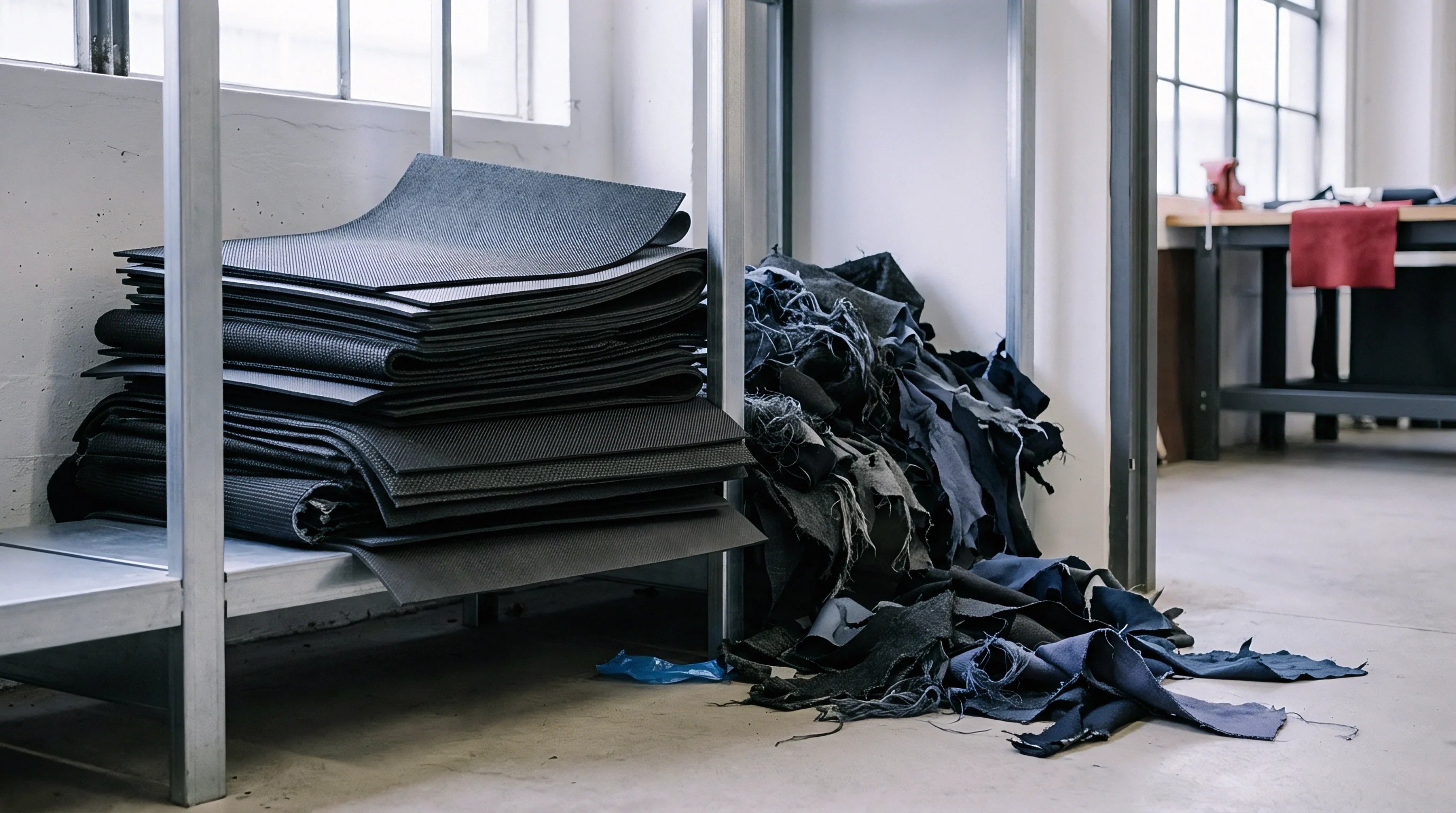
Rack
Storage bays in port-adjacent distribution facilities expose packaged textiles to chronic microclimate fluctuations. Ambient temperatures within metal-clad storage units swing across twenty-degree diurnal cycles, driving relative humidity from thirty percent to condensation thresholds within pallet cores. Polymer chains within synthetic and natural yarns respond to these thermal and moisture gradients through distinct chemical pathways.
In polyester goods, moisture trapped inside polyethylene film wrapping initiates hydrolytic cleavage of ester bonds. Polyamide yarns face oxidative attack along the aliphatic backbone when warehouse ventilation systems introduce ozone or nitrogen oxides from internal combustion forklifts. Polypropylene nonwovens undergo autoxidation, where tertiary carbon centres generate radical intermediates that induce chain scission.
Elastomeric polyurethane components experience soft-segment degradation, yielding loss of instantaneous elastic recovery and embrittlement of crosslinked networks.
Thermal gradients across high-density storage bays create uneven degradation profiles. Rolls positioned along upper mezzanine tiers absorb radiant heat from uninsulated roofing, regularly exceeding forty-five degrees Celsius during summer months. Lower tiers near concrete slabs remain cool but endure sustained relative humidity above seventy-five percent.
Moisture migration creates condensation pockets within secondary plastic sleeves. Hydrolysis proceeds unnoticed inside unbroken carton packaging. Amorphous regions of synthetic fibres suffer initial molecular breakdown because water molecules penetrate disordered inter-crystalline voids with minimal resistance.
| Polymer Substrate | Dominant Chemical Pathway | Trigger Threshold | Visible Manifestation | Typical Incubation Period |
|---|---|---|---|---|
| Polyethylene Terephthalate | Ester hydrolysis | 30°C at 70% RH | Oligomer blooming, chalky dusting | 12 to 24 months |
| Polyamide 6,6 | Photo-oxidation and nitrogen scission | 25°C with 50 ppb NOx | Warpwise yellowing, amine odor | 6 to 18 months |
| Polypropylene | Tertiary carbon autoxidation | 35°C ambient heat | Surface crazing, powdering | 3 to 9 months |
| Segmented Polyurethane | Soft segment hydrolytic cleavage | 28°C at 65% RH | Tacky hand, loss of elastic snap | 6 to 12 months |
| Plasticized PVC Coating | Phthalate migration and dehydrochlorination | 32°C contact heat | Oily exudate, coating hardening | 9 to 15 months |
Evaluating inventory integrity begins with physical inspection of roll geometries. Sagging roll profiles indicate tension loss caused by creeping polymer chains under continuous dead weight. Polyolefin goods display rapid degradation along roll edges exposed to ambient indoor lighting containing trace ultraviolet wavelengths.
Degradation pathways in dark warehousing follow defined chemical mechanisms:
- Hydrolytic ester cleavage splits carboxylate linkages within polyethylene terephthalate through water diffusion into amorphous regions, generating shorter oligomeric fragments and free carboxylic acid end groups.
- Nitrogen oxide scavenging targets secondary amine groups within aliphatic nylon matrices, creating diazonium intermediates that break the main structural spine and impart an uneven yellow cast across outer roll wraps.
- Free radical autoxidation attacks tertiary carbons on polypropylene backbones, abstracting hydrogen atoms to create hydroperoxides that decompose into alkoxy radicals and induce catastrophic embrittlement.
- Plasticizer phase separation forces monomeric phthalates out of polyvinyl chloride coatings toward the surface, leaving the core polymer brittle while creating a sticky liquid layer that transfers onto adjacent yardage.
Packaging choices dictate chemical survival rates inside shipping cartons. Perforated low-density polyethylene wraps allow ambient humidity to reach an equilibrium with textile goods, preventing condensation while accelerating moisture exposure during marine transit. Fully sealed bags trap processing moisture from steam finishing frames if cooling cycles run short at the finishing mill.
Residual moisture trapped at four percent in cellulosic blends or point-six percent in pure polyester drives micro-scale hydrolytic chambers when containers sit parked on sunny loading docks.
Roll tension accelerates creep. Goods wound under excessive brake force retain high internal stresses that lower the activation energy required for hydrolytic chain scission.
A sealed carton holding polyester filament at two percent moisture content initiates measurable ester cleavage when storage temperatures exceed thirty-five degrees Celsius for six continuous weeks.
Dark warehousing environments fail to protect fabrics from chemical decay when temperature cycles drive humidity exchange across permeable poly packaging. Heat drives kinetics without needing sunlight. The coolest corner of a steel shed protects yarn tenacity longer than an elevated rack beneath an uninsulated metal roof.

Viscosity
Molecular mass tracking offers definitive evidence of polymer backbone degradation long before fabrics display macroscopic strength losses. Solution viscometry measures the flow time of dissolved polymer through calibrated capillary tubes, isolating the hydrodynamic volume of individual macromolecules. As warehouse environments break covalent bonds, the average degree of polymerization drops, lowering the resistance of the dilute solution to shear flow.
Gel permeation chromatography complements viscometry by resolving the complete molecular weight distribution, separating polymer fractions by hydrodynamic size through porous gel columns.
Intrinsic viscosity measurements for polyester textiles follow ISO 1628-5, dissolving specimens in an equal-parts mixture of phenol and 1,2-dichlorobenzene at one hundred thirty degrees Celsius. Virgin apparel-grade polyethylene terephthalate fibres register intrinsic viscosity figures between 0.62 and 0.68 decilitres per gram. Industrial-grade technical filaments used in webbing or coated base cloths enter warehousing with baseline intrinsic viscosity values between 0.85 and 0.98 decilitres per gram.
Storage-induced chain cleavage reduces these figures. When intrinsic viscosity falls below 0.52 decilitres per gram in apparel cloth, mechanical integrity collapses during garment laundering.
| Fibre Classification | Solvent Matrix | Baseline Intrinsic Viscosity (dL/g) | Critical Rejection Boundary (dL/g) | Carboxyl End Groups (eq/10^6 g) |
|---|---|---|---|---|
| Polyethylene Terephthalate Textile | Phenol / o-Dichlorobenzene (50/50) | 0.64 to 0.68 | Under 0.54 | Above 38 |
| Polyethylene Terephthalate High Tenacity | Phenol / o-Dichlorobenzene (50/50) | 0.88 to 0.95 | Under 0.72 | Above 28 |
| Polyamide 6 | Sulfuric acid (96%) | 2.40 to 2.80 relative | Under 2.10 relative | Above 55 |
| Polyamide 6,6 | Formic acid (85%) | 45 to 55 RV | Under 36 RV | Above 60 |
| Polyacrylonitrile | Dimethylformamide (with 0.1M LiBr) | 1.40 to 1.70 | Under 1.15 | Not applicable |
Capillary testing procedures demand rigorous specimen desizing. Size residues, silicone softeners, and fluorochemical water repellents alter flow times through capillary apertures, creating false degradation signals. Technicians strip fabric swatches through sequential Soxhlet extractions using petroleum ether, followed by pure ethanol, drying the yarns to absolute dry mass before dissolution.
Dissolution times must avoid thermal degradation during preparation. Extended heating beyond forty-five minutes at dissolution temperatures breaks ester bonds artificially in the flask.
ASTM D7409 specifies potentiometric titration to quantify carboxyl end groups in polyester, establishing that values surpassing thirty-five equivalents per million grams indicate active hydrolytic degradation.
Fourier-transform infrared spectroscopy tracking provides direct detection of chemical functional groups generated by degradation reactions. Attenuated total reflectance accessories press dry textile samples against a diamond crystal, scanning spectral regions between 4000 and 650 reciprocal centimetres. In polyethylene terephthalate, the ratio of the aliphatic ester peak at 1715 reciprocal centimetres to the reference aromatic ring vibration at 1410 reciprocal centimetres defines the carbonyl index.
Rising ratios indicate chain cleavage accompanied by carboxylic acid formation.
Analytical laboratories screen suspect warehouse inventory through structured instrumental sequences:
- Solvent de-finishing extraction removes surface coatings, topical spinning finishes, and sizing agents using organic solvents inside automated Soxhlet extractors to isolate clean polymer filaments.
- Attenuated total reflectance scanning maps chemical bond changes, tracking hydroxyl accumulation around 3400 reciprocal centimetres and carbonyl stretching shifts near 1715 reciprocal centimetres.
- Ubbelohde capillary timing determines relative and intrinsic viscosity values across three distinct specimen concentrations within temperature-regulated water baths controlled to 25 degrees Celsius.
- Potentiometric end-group titration quantifies acidic and basic terminal groups to verify whether bond scission resulted from hydrolytic attack or photo-oxidative degradation pathways.
Gel permeation chromatography provides data that bulk solution measurements obscure. Polydispersity index figures, calculated as weight-average molecular mass divided by number-average molecular mass, expose non-uniform degradation. Warehoused goods displaying localized surface degradation exhibit bimodal distribution curves, where a low-molecular-weight shoulder develops alongside the primary polymer peak.
These short chains act as plasticizers initially, softening the handle of woven goods before inducing structural brittleness.
Solvent purity alters viscosity readings. Trace moisture in formic acid solutions cleaves nylon chains directly during measurement, distorting data unless acid concentrations are verified daily by acid-base titration. Ignoring solvent preparation standards produces false degradation reports that trigger ungrounded mill rejections, costing importers tens of thousands of dollars in cancelled freight dockets.

Rupture
Chemical degradation along polymer chains translates directly into reduced mechanical load capacity across warp and weft directions. Tensile strength loss occurs non-linearly relative to molecular weight decline. Yarns absorb stress through crystalline fibril alignment and tie-molecule bridging between crystallites.
Initial hydrolytic scission severs tie molecules located within amorphous zones without significantly disrupting crystalline packing. The fabric maintains its original weight, thread density, and basic dimensions while losing its capacity to transfer mechanical stress under high-strain conditions.
Tensile verification relies on ISO 13934-1 for strip methods and ISO 13934-2 for grab tests. Conditioned fabric specimens remain inside standard atmosphere rooms at twenty degrees Celsius and sixty-five percent relative humidity for twenty-four hours before testing on constant-rate-of-extension instruments. Degraded woven goods display jagged, premature failure curves on stress-strain diagrams.
Instead of exhibiting smooth plastic yielding followed by fibrillar strain hardening, degraded filaments snap across crystalline boundaries, cutting ultimate elongation by half.
| Fabric Build and Count | Fibre Chemistry | Nominal Mass (g/m²) | Warp Tensile Retention (%) | Tear Retention ISO 13937-2 (%) |
|---|---|---|---|---|
| Plain Woven 75D/72F × 75D/72F | PET Microfilament | 110 | 72.4 | 58.1 |
| Twill 2/1 150D/144F × 150D/144F | PET DTY | 185 | 84.1 | 69.3 |
| Ripstop Woven 210D × 210D | Polyamide 6,6 | 125 | 68.9 | 51.4 |
| Single Jersey 30s/1 Ne + 40D | Cotton / Spandex | 160 | 91.2 (Cotton) | 34.0 (Elastic snap) |
| Circular Knit Interlock 50D | PET Cationic Dyeable | 140 | 61.5 | 46.2 |
Tear strength evaluated through ISO 13937-2 trouser tear tests serves as an early mechanical indicator of degradation. Tear resistance depends on yarn mobility within the weave structure, allowing yarns to bunch together and share incoming shear forces. As polymers degrade, fiber-to-fiber friction rises due to oligomer crystallization on yarn surfaces.
Yarns fail to slide, forcing advancing tears to break individual threads sequentially. A ten percent decline in base polymer intrinsic viscosity produces a thirty to forty percent drop in trouser tear resistance across dense wovens.
Bursting strength evaluations through ISO 13938-1 apply pneumatic diaphragm pressure to circular specimen zones on knitted goods. Knits mask polymer degradation during manual handling because loop geometry accommodates low-level deformation without stressing individual yarns. Under hydraulic or pneumatic burst pressure, degraded multi-filament yarns break instantaneously along course contact points.
The diaphragm ruptures the specimen at pressures well below original purchase specifications, revealing advanced chain degradation.
Take a bulk shipment of 45,000 metres of plain weave polyester ripstop with a specification of 850 Newtons warp tensile strength and 45 Newtons trouser tear. After sixteen months in non-climate-controlled storage, testing reveals warp tensile strength of 680 Newtons, representing an acceptable twenty percent reduction under standard aging allowances. Trouser tear drops to 21 Newtons, representing a fifty-three percent loss that breaches the forty-Newton contract threshold.
The fabric passes visual inspection and grab tensile baselines, yet shears apart immediately during garment assembly sewing operations.
Tenacity drops sharply. Amorphous zones degrade first. The calculation assumes zero UV exposure inside closed cartons.
A thirty percent decline in trouser tear strength indicates advanced tie-molecule scission even when strip tensile figures remain within broad commercial tolerances.
Suppliers routinely dismiss tear strength failures in stored goods by claiming finish evaporation or low moisture equilibrium during testing rather than admitting backbone degradation. They maintain that running rolls through a standard steam tender frame restores original yarn flexibility and recovers specified mechanical performance.

Lot
Extracting representative test specimens from multi-tiered warehouse locations requires strict sampling plans. ANSI/ASQ Z1.4 and ISO 2859-1 govern sampling frequency based on total roll count, establishing normal inspection levels that prevent sample bias. In large inventories exceeding five hundred rolls, drawing material exclusively from accessible floor pallets conceals severe damage located along upper perimeter racks.
Field technicians deploy stratified random sampling algorithms, dividing the warehouse space into vertical zones and horizontal aisles to collect test rolls from every exposure tier.
Specimen extraction from individual rolls follows strict positioning rules. Surface wraps absorb environmental gases, light, and humidity fluctuations directly, experiencing significantly higher degradation rates than interior wraps. Technicians peel away and discard the outer five metres of fabric before cutting laboratory samples across the full width of the roll.
Core sampling proves equally critical. Residual moisture from wet processing migrates inward toward the cardboard core during storage, creating high-humidity pockets where inner wraps suffer severe mold growth and accelerated hydrolysis.
Four-point inspection systems per ASTM D5430 integrate with degradation sampling protocols. Rolls selected for analytical verification undergo visual screening on illuminated inspection tables running at speeds below fifteen metres per minute. Inspectors record localized color variations, edge yellowing, coating stickiness, and chalky surface blooming.
Rolls showing visual defect scores exceeding twenty-five points per one hundred square yards move directly into secondary analytical queues for molecular mass testing.
Secondary analytical testing follows defined qualification criteria:
- Visual defect thresholding routes any roll scoring over twenty-four penalty points per hundred square yards to capillary viscometry and mechanical tear testing.
- Elongation failure screening mandates solution chromatography whenever grab test elongation at break shows greater than a twenty percent reduction against initial production inspection certificates.
- Odor verification triggers initiate gas chromatography-mass spectrometry screening for volatile organic acids when rolls emit pungent sour scents upon unpackaging.
- Coating peel limits require immediate hydrostatic pressure testing if polyurethane laminates separate from base cloths at peel forces below twelve Newtons per fifty millimetres.
Sample conditioning governs the reproducibility of degradation testing. Standard testing atmospheres outlined in ISO 139 demand twenty degrees Celsius plus or minus two degrees, and sixty-five percent relative humidity plus or minus four percent. Testing dry fabric straight out of hot shipping cartons produces artificial tensile loss readings.
Synthetic yarns require a minimum of sixteen hours to reach moisture equilibrium, while cellulosic and blended goods demand twenty-four hours inside conditioning chambers equipped with continuous airflow.
ISO 2859-1 inspection level two establishes that a batch of twelve hundred rolls requires eighty individual roll extractions to achieve statistical verification of storage stability.
Whether accelerated chamber conditioning fully mirrors three years of slow ambient molecular reorganization remains an open technical dispute among textile technologists assessing aging inventories.

Claim
Commercial recovery for degraded inventory hinges on proving whether polymer chain scission occurred due to inherent manufacturing defects or improper warehousing stewardship. Latent defects present during manufacturing include inadequate heat-setting, excessive acid catalyst residues from finishing, and insufficient antioxidant stabilization packages in polyolefin extrusion. When these processing errors occur, polymer breakdown accelerates dramatically under standard warehouse environments, transferring financial liability back to the original weaving mill or finishing house.
Resolving commercial disputes demands baseline physical retaining swatches. International trade practice advises retaining five-metre sealed master samples from original production lots, stored inside dark climate-controlled vaults at twenty degrees Celsius and fifty percent relative humidity. When warehoused stock shows structural failure, laboratory teams test the vaulted master sample alongside the degraded warehouse goods.
Identical molecular weight distributions and carboxyl end-group levels in both samples prove that failure stemmed from original yarn production errors or finishing bath imbalances, eliminating warehouse storage conditions as the primary cause of damage.
Salvage valuations drop rapidly as molecular degradation advances. Fabrics exhibiting moderate intrinsic viscosity losses between ten and fifteen percent can be down-cycled into non-critical end uses, such as utility linings, pocketing, or low-stress decorative banners, recovering thirty to forty percent of invoiced fabric costs. Once tensile losses surpass twenty-five percent or coatings display plasticizer migration, fabric loses all commercial apparel utility.
Landfill disposal or industrial shredding for acoustic insulation represents the only remaining route, saddling the inventory owner with destruction fees and freight liabilities.
Contracts protecting fabric buyers against storage degradation incorporate precise technical limits. Standard commercial terms establish explicit storage endurance warranties guaranteeing that packaged goods retain at least eighty-five percent of initial mechanical specifications for twenty-four months when held within ambient temperatures below thirty-two degrees Celsius and relative humidity under seventy percent. Explicit contract terms stipulate that carboxyl end group counts exceeding thirty-two equivalents per million grams in polyester constitute prima facie evidence of sub-standard thermal stabilization during drawing, voiding storage liability waivers.