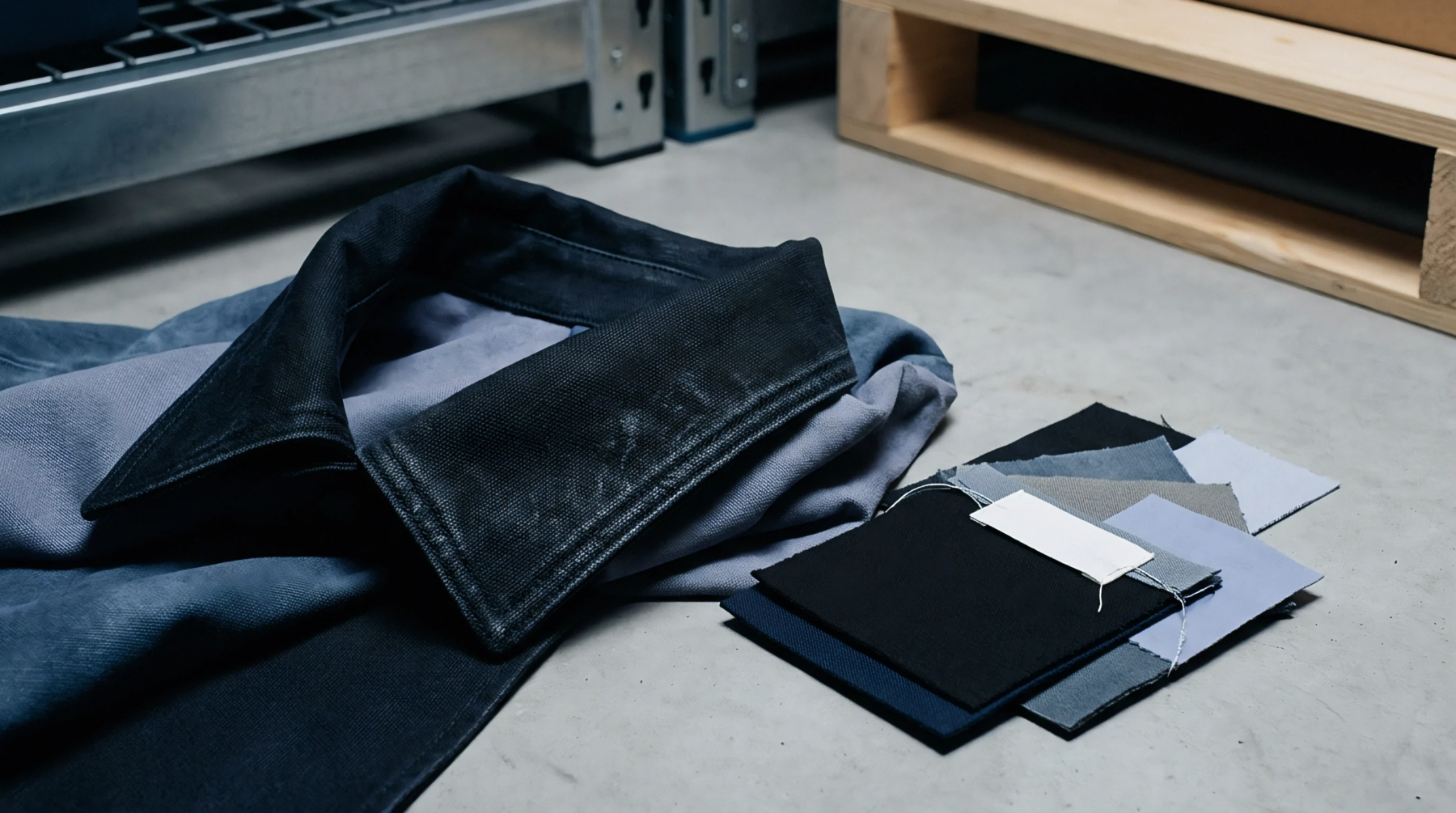
Standard Salt Dosing Schedules for Reactive Dyeing Heavy Cotton Canvas
Progressive exponential salt dosing prevents surface strike spikes and forces reactive dye penetration into heavy cotton duck yarn cores.
Cotton count number eight denotes a coarse staple spun yarn constructed from two plies twisted together for horizontal insertion during loom operation. Specifications for 8/2 Ne weft require precise control over mass per unit length to guarantee uniform pick density across the loom width. Mills calculate this yarn number by dividing the fixed yardage of eight hundred forty yards per pound by the multiplier two, resulting in four hundred twenty yards per pound of total linear yield.
This measurement belongs to the English cotton numbering system, applied commercially to staple spun yarns produced for heavy apparel and utility fabrics. Quality inspection protocols verify the linear density at the mill laboratory under standardized atmospheric moisture conditions, because ambient humidity alters moisture regain values and distorts mass measurements. Fabric strength depends directly on this linear density parameter, governing how tightly individual picks pack against warp ends during the beating motion.
Proper loom operation demands rigorous regulation of yarn delivery tension when 8/2 Ne weft enters the shuttle or projectile mechanism. Excessive pull stretches the cellulosic fibers beyond elastic limits, causing undesirable narrowing of the finished cloth width, whereas insufficient tension produces loose picks and irregular fabric edges. Technicians calibrate accumulator drums and spring brakes on the weaving machine to maintain constant force during high speed insertion cycles.
Warp friction and reed density influence the behavior of the yarn inside the shed, requiring careful adjustment of shedding timing to prevent filament abrasion. Laboratory testing equipment measures breaking load and elongation percentages on extracted picks to confirm that spinning mills deliver material capable of withstanding aggressive mechanical insertion without structural degradation.
Geometrical calculation of fabric cover relies heavily on the diameter and spacing of 8/2 Ne weft intersecting with warp yarns. Surface area coverage determines opacity, wind resistance and fluid permeability in industrial textiles and heavyweight cotton garments. Fabric designers compute cover factors by multiplying the ends per inch by the square root of the English cotton count, applying the identical mathematical formula to the pick direction.
Higher pick densities restrict light transmission through the interstices, creating a denser barrier against environmental elements. Commercial buyers reject shipments falling outside agreed cover tolerances because substandard filling density compromises the functional performance of the finished textile product.
Shrinkage behavior during wet processing and laundering correlates directly with the structural geometry established by 8/2 Ne weft within the woven matrix. Residual stresses imparted during sizing and spinning relax when fabrics undergo scouring, dyeing or home washing, resulting in dimensional shifts along the filling axis. Finishing plants counteract these tendencies by applying controlled compressive shrinkage through specialized machinery equipped with rubber belts.
Laboratory technicians subject conditioned fabric samples to standard wash cycles, measuring dimensional change percentages against pre-marked reference points to ensure compliance with apparel manufacturing specifications. Final garment durability rests upon the predictable relaxation of the yarn structure under standardized thermal and mechanical exposure.
Progressive exponential salt dosing prevents surface strike spikes and forces reactive dye penetration into heavy cotton duck yarn cores.
Expertise is a utility, not a secret. sentiention™ publishes its working knowledge as open reference: intelligence layer covering the materials it sources, the markets it enters, and the reference that serves both.