Warp and Weft Crimp Exchange Mechanics in High Density Weaving
Warp and weft crimp exchange in high-density weaving shifts structural waviness across processing, dictating finished sett, shrinkage, and air permeability.


Jam
Loom mechanics encounter rigid physical boundaries when pick density approaches theoretical yarn packing limits. In dense plain interlacing, cylindrical yarn geometries deform under mechanical contact pressure, shifting from circular profiles into elliptical or race-track cross-sections. When warp and filling systems crowd together, the space between adjacent yarns approaches zero.
At this point, known as the jamming point, further insertion of filling yarns cannot occur without displacing the interlacing warp ends into higher wave amplitudes.
The classical model developed by Frederick Thomas Peirce in 1937 established mathematical limits for yarn spacing based on circular geometries and uniform yarn diameters. Under Peirce geometry, the maximum sum of cover factors in cotton count systems reaches twenty-eight, representing a fractional cover of unity where yarns touch continuously without deformation. That calculation rested on static ring-spun cotton yarns measured without tension in laboratory conditions.
Yarn flattening under mechanical beat-up forces pushes actual commercial limits higher, allowing cover factor sums between thirty-one and thirty-two in tightly packed parachute cloth or downproof goods. The circular cross-section assumption collapses when high beat-up force forces filament bundles to spread sideways in the inter-yarn spaces.
Yarn flattening alters the theoretical jamming limit before the reed reaches the cloth fell.
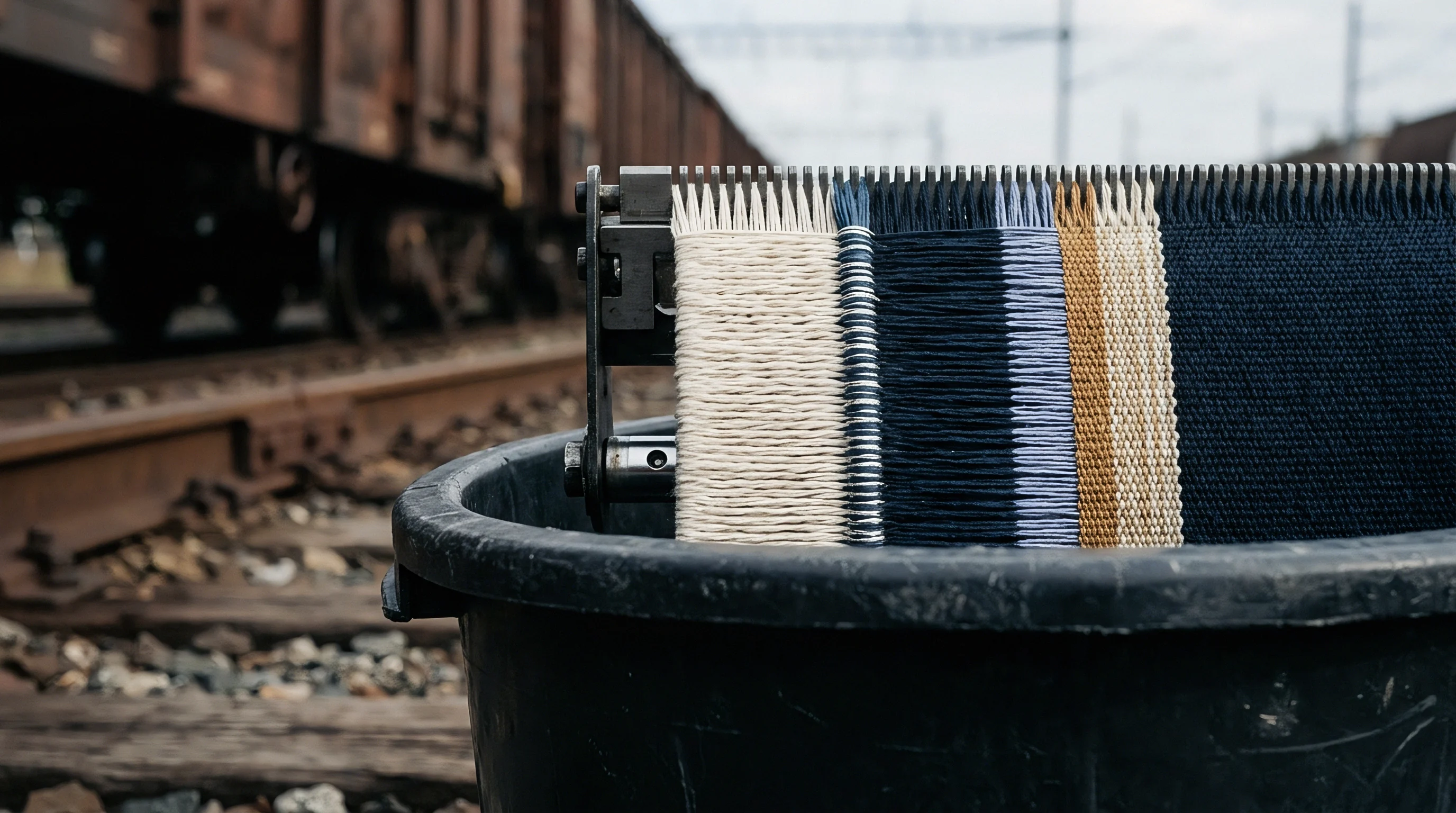
Peirce Model Boundaries in Dense Weaving
Calculations assuming incompressible circular yarn paths fail on industrial looms operating at seven hundred picks per minute. Ring-spun yarns and multi-filament synthetics exhibit transverse elasticity. The yarn diameter contracts under orthogonal compression while expanding laterally along the cloth plane.
When a dense plain structure reaches the jammed state, the warp ends cannot bend further around the filling picks without increasing the longitudinal crimp amplitude. If the warp system remains under extreme loom let-off tension, the filling yarn absorbs all the bending deformation. The filling yarn then exhibits high crimp while the warp ends remain straight.
Cover factor reaches sixty.
Commercial high-density plain constructions depend on this geometric distortion:
- Yarn packing coefficient sets the geometric limit for pick density before mechanical jamming occurs at the reed.
- Cross-sectional aspect ratio determines whether flat filament tape spreads wider than round spun ring yarn under beat-up pressure.
- Loom take-up tension governs initial warp extension prior to shed crossover.
Aspect Ratio Shifts under Reed Compression
Lateral flattening changes the effective inter-yarn clearance during beat-up. As filling yarns enter the shed, the mechanical blow delivered by the reed compresses each pick against the preceding pick through the intervening warp crossings. The ratio of yarn major diameter to minor diameter shifts from 1.05 in unconstrained yarn to 1.35 or 1.50 within dense structures.
This flattening reduces the vertical thickness of the cloth fell while widening the contact band between crossing systems. The reed forces compaction.
| Interlacing Density State | Warp Sett (ends/cm) | Weft Sett (picks/cm) | Warp Crimp (%) | Weft Crimp (%) | Jamming Ratio |
|---|---|---|---|---|---|
| Open Greige Standard | 44.0 | 32.0 | 6.2 | 8.4 | 0.74 |
| Intermediate Packed | 52.0 | 38.0 | 9.1 | 6.1 | 0.88 |
| High-Density Jammed Limit | 58.0 | 44.0 | 14.8 | 2.9 | 1.02 |
| Extreme Flattened Technical | 64.0 | 48.0 | 18.2 | 1.8 | 1.14 |
The weaving shed manager claimed that yarn flattening on high-modulus warps always shifts the theoretical limit without altering the agreed construction ticket.
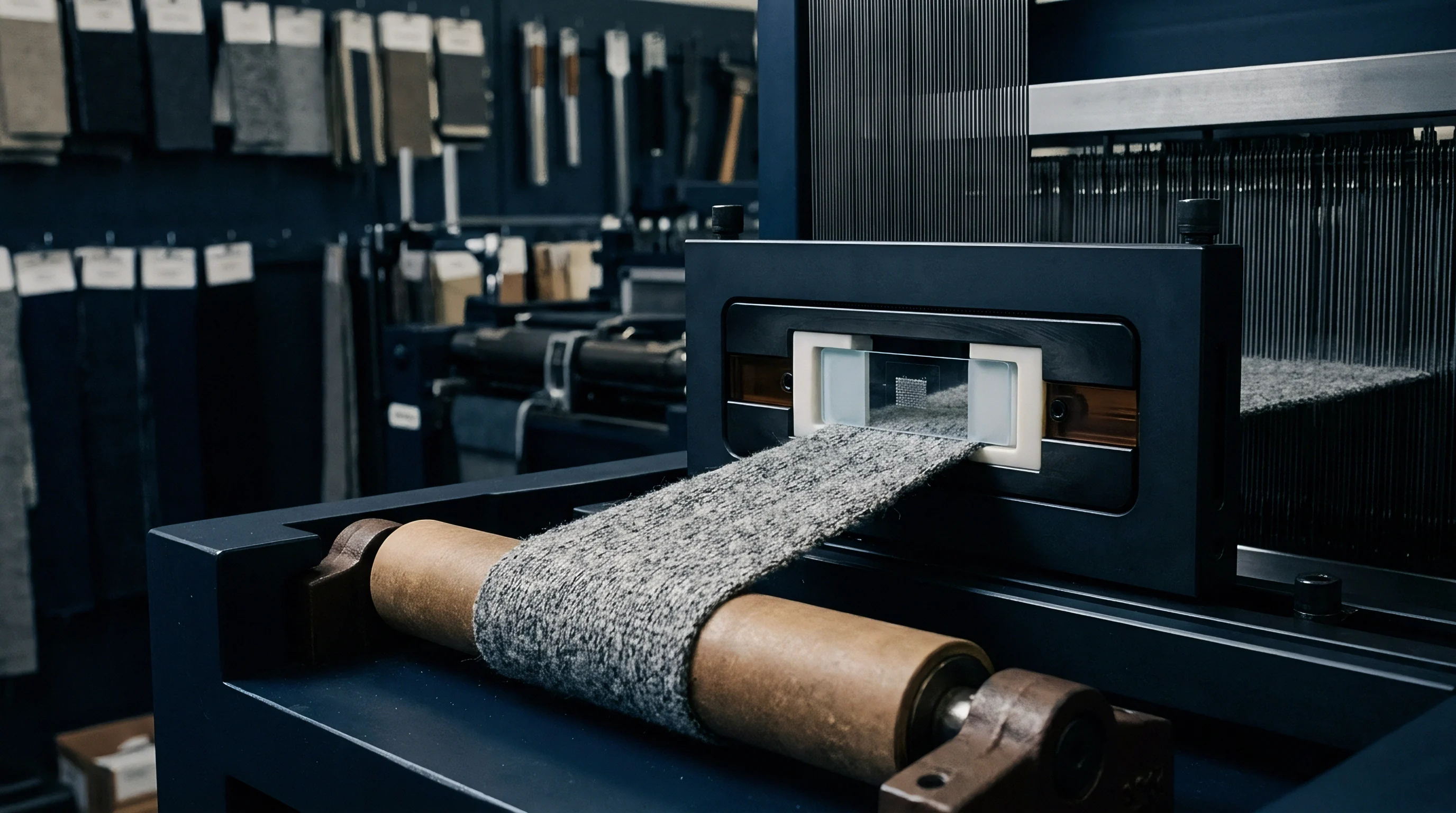
Fell
The cloth boundary shifts backward and forward along the loom axis during every cycle of the main drive shaft. When the reed advances toward front dead center, it strikes the newly inserted pick, driving both the pick and the existing interlacing line forward. This displacement creates a dynamic resistance force termed beat-up force.
In high-density goods, the beat-up force exceeds three hundred Newtons per meter of loom width. The picks resist displacement.
Warp tension oscillates violently between shed opening and beat-up arrival. During the beat-up phase, the warp sheet elongates under the forward momentum of the reed, storing elastic strain energy throughout the entire distance from the back rest roller to the front breast beam. If warp let-off mechanisms maintain excessive brake resistance, the warp cannot deflect around the newly arrived pick.
High warp tension flattens picks. The filling yarn yields under the crossing pressure, taking on deep undulations while the warp ends travel in nearly straight horizontal lines.
Warp crimp drops below three percent when machine tension exceeds ninety centinewtons per end during insertion.

Beatup Dynamics and Cloth Displacement
Forward displacement of the interlacing line reaches four to eight millimeters on industrial air-jet looms running dense filament constructions. As the reed recedes toward back dead center, the stored tensile energy in the warp sheet pulls the interlacing line rearward. This cyclic movement causes friction against the reed wires and the drop wires.
When the shed closes before the pick reaches its final position, the warp ends cross over while moving under high tension, trapping the pick in a partially jammed state.
- Shed opening timing creates peak tension on warp ends before the rapiers or air jets insert the filling yarn.
- Beat-up point arrival drives the pick against the fell while the cloth displaces backward into the harness zone.
- Crossover binding locks the yarn geometry under high compressive load, causing warp ends to buckle if weft tension remains loose.
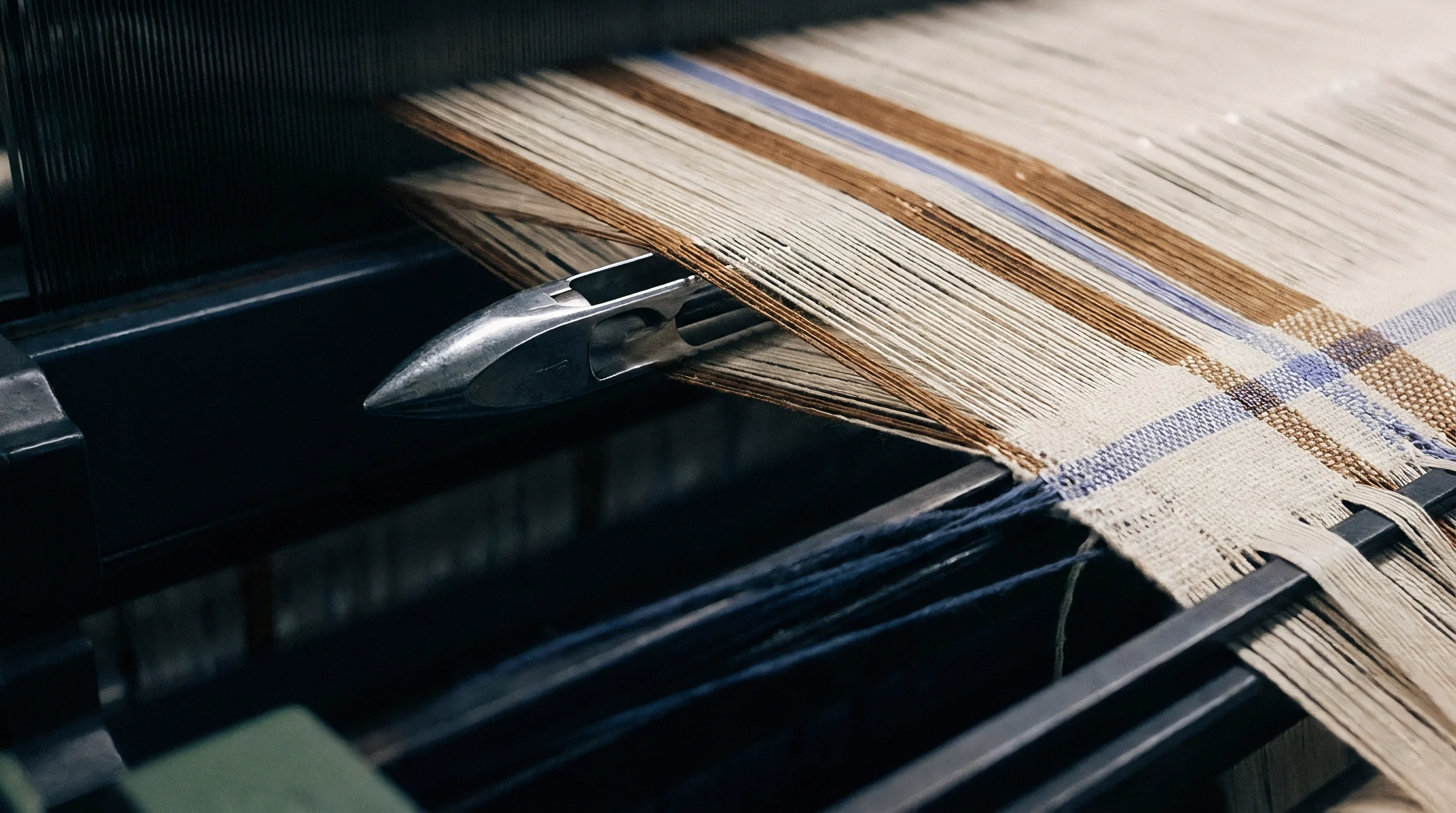
Tension Asymmetry between Yarn Systems
Unequal mechanical loading during interlacing establishes the starting crimp balance of the greige goods. Warp ends pass through heald eyes, drop wires, and reed dents, experiencing cumulative surface drag that elevates tension to eighty or one hundred centinewtons per yarn. In contrast, filling yarns enter the shed under accumulator air propulsion or lightweight rapier tape guidance, carrying minimal tension below fifteen centinewtons per pick.
Crimp transfers immediately. The yarn system under lower axial tension assumes the higher crimp percentage because it bends easily around the taut, loaded system. The loom fell advances forward.
Incorrect beat-up tension leaves terminal warp slackness that causes severe reed striping and rejects twenty thousand linear metres at final inspection.
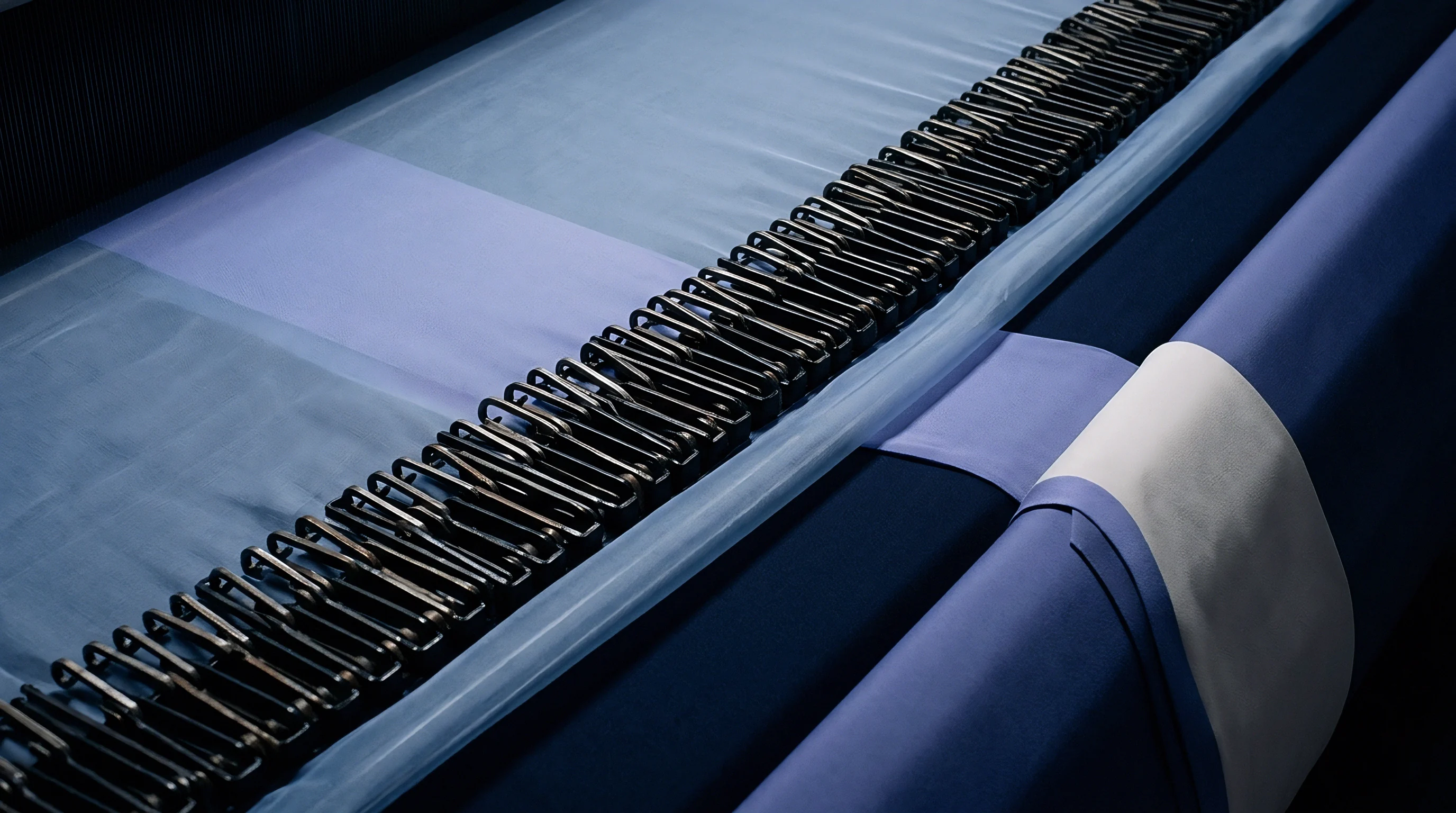

Exchange
When greige cloth leaves the loom take-up roll, stored elastic stresses begin to rebalance. On the loom, external tensile loads hold the warp system elongated and relatively flat, forcing the filling system to carry the majority of the interlacing wave. Once tension drops to zero off the loom, internal compressive forces generated by yarn bending initiate crimp interchange.
The taut warp ends contract longitudinally, pulling the filling picks into higher amplitudes and flattening the filling path. Tension differentials govern interchange.
Off-loom relaxation changes dimensions. In continuous wet processing, this interchange accelerates dramatically under aqueous swelling and thermal agitation. As water penetrates hydrophilic fibers such as cotton or viscose, radial swelling increases yarn diameter by fifteen to twenty-five percent.
Because the space between adjacent yarns is locked by the high sett, the swollen yarns can accommodate their increased bulk only by increasing their bending angles. If the cloth runs through wet processing under longitudinal warp tension, the warp remains flat, forcing all shrinkage into the width. Conversely, if the goods process in tensionless relaxation, the warp contracts, taking crimp from the filling system and driving lengthwise shrinkage.
Does Filament Modulus Inhibit Crimp Interchange?
High-tenacity synthetic yarns exhibit high initial tensile modulus, resisting the bending moments required for spontaneous crimp transfer. A forty-denier semi-dull nylon 6,6 filament yarn requires higher external compaction force to exchange crimp than a comparable cotton yarn of similar linear density. The internal molecular alignment of drawn synthetic polymers resists axial compression.
Consequently, synthetic greige goods remain frozen in their on-loom crimp state until elevated temperatures reach the polymer glass transition point during scouring or heat-setting.
Failure modes emerge across processing runs when crimp balance shifts uncontrollably:
- Filling skew develops when uneven stenter clip grip releases weft crimp unequally across the roll width.
- Differential width shrinkage occurs when high warp tension during jet dyeing pulls crimp out of the filling system.
- Reed mark persistence results from jammed warp ends failing to migrate into open inter-yarn spaces during aqueous relaxation.

Off Loom Relaxation and Aqueous Contraction
During open-width continuous scouring, the measured ratio of warp-to-weft crimp interchange shows seventy-two percent conversion efficiency. This figure rests on ISO 7211-3 crimp testing across thirty test swatches taken from three commercial lots in 2021. The value moves downward toward fifty-five percent if water temperature drops below eighty degrees Celsius or if machine line tension exceeds two hundred Newtons across the wash boxes.
Elevated liquor temperature reduces inter-filament friction within yarn bundles, allowing individual fibers to slide past one another and assume the lowest mechanical energy state. Aqueous baths swell cotton.
Worked Balance on a Downproof Plain Build
Assume a bulk order specifying a downproof 100 percent polyester micro-filament plain cloth. Take a one-thousand-metre greige lot woven at 160 centimeters width. Greige warp sett is 56.0 ends per centimeter using 50-denier (55.5 dtex) 72-filament yarn; greige weft sett is 42.0 picks per centimeter using 50-denier 72-filament yarn.
On-loom warp crimp measures 4.2 percent under tension, while on-loom weft crimp measures 11.5 percent.
During off-loom conditioning, warp ends relax, increasing warp crimp to 7.8 percent while weft crimp drops to 8.1 percent, contracting cloth length by 3.5 percent and narrowing greige width to 154.5 centimeters. The cloth enters continuous tensionless open-width washing at ninety-five degrees Celsius. Warp crimp expands to 12.4 percent, while weft crimp drops to 4.9 percent.
The finished sett shifts to 61.2 ends per centimeter and 40.5 picks per centimeter. The total length contracts by 7.9 percent relative to on-loom take-up, while finished width expands to 158.0 centimeters under width-controlled stenter pins. The mechanical balance exchanged 8.2 percentage points of crimp into the warp system, lowering air permeability from 18.5 cm3/cm2/s down to 3.2 cm3/cm2/s without adding chemical coatings.
Finished sett dictates performance.
Whether high-speed continuous jet processing can ever achieve balanced crimp without distorting individual pick paths across wide widths remains disputed by finishing specialists.
Stenter
Pin chains and air nozzles inside the drying enclosure provide the final mechanical control over yarn interlacing paths. As wet cloth enters the entry zone, divergent rail tracks grip the selvedges, pulling the filling yarns under lateral tension. This outward lateral pull directly removes weft crimp.
Because yarn interlacing points act as mechanical pivot nodes, removing crimp from the filling system forces the warp ends to take up the displaced path length, increasing warp crimp. The stenter fixes width.
Similar relaxation dynamics govern industrial wire mesh manufacturing for aerospace filtration, where mechanical rollers manipulate cross-wire waviness to achieve calibrated micronic aperture stability. On textile finishing lines, overfeed rollers deliver cloth onto the pin chain at speeds between two and twelve percent faster than the forward chain movement. This deliberate overfeed relieves lengthwise warp tension, allowing the hot air nozzles to collapse the warp ends into deep crimp waves.
Overfeeding the stenter transfers crimp into the warp while widening the chain relaxes the filling yarns.
Overfeeding the stenter transfers crimp into the warp while widening the chain relaxes the filling yarns.

Overfeed Manipulation across Continuous Chains
Controlled overfeed balances the residual shrinkage values demanded by apparel cutting rooms. When warp overfeed matches the natural relaxation shrinkage of the greige sheet, warp yarns dry without longitudinal stress. If the operator underfeeds the chain, longitudinal warp tension pulls the warp straight, reducing warp crimp to less than five percent.
That adjustment forces the filling yarns to increase their crimp, causing the finished goods to fail dimensional stability standards during post-cut domestic laundering. Dry finishing preserves balance.
| Process Stage | Machine Parameter | Warp Crimp Change (%) | Weft Crimp Change (%) | Residual Warp Shrinkage (%) | Residual Weft Shrinkage (%) |
|---|---|---|---|---|---|
| High Warp Tension Run | 0% Overfeed / Nominal Width | -3.8 | +4.2 | +5.8 | -1.2 |
| Neutral Relaxation Setting | +4% Overfeed / +1cm Width | +1.2 | -0.8 | +1.8 | +1.4 |
| Balanced High-Density Run | +8% Overfeed / +3cm Width | +4.5 | -3.1 | -0.4 | +0.6 |
| Excessive Shrink Lock | +12% Overfeed / -2cm Width | +7.1 | +1.5 | -2.8 | +4.2 |
| Data recorded after 5 wash cycles under ISO 6330 procedure 4N at 40 degrees Celsius followed by flat drying. | |||||

Thermal Setting in Synthetic Filaments
Polymer chains inside synthetic filaments undergo crystalline restructuring at elevated finishing temperatures. Running high-density polyester or polyamide goods through stenter zones at one hundred ninety degrees Celsius relieves internal bending stresses. Heat freezes the newly established crimp amplitudes into the polymer matrix.
When cooled below the glass transition temperature before leaving the pin chain, the yarns retain their geometric curvature permanently, preventing subsequent crimp transfer during garment wear or wet laundering.
Running warp tension loose through hot air chambers settles filling waviness without pulling the selvedges out of square.

Calender
Heavy heated steel bowls operating against elastic cotton or polyamide bowls deliver compressive loads exceeding two hundred kilonewtons per linear meter. This mechanical pressure flattens yarn crossover knuckles, forcing the highest points of both warp and filling crimp waves into a unified horizontal plane. The contact area between crossing yarns expands, generating high frictional resistance that locks the yarn geometry against further interchange.
Calender nips compress cross-overs.
Filament yarns flatten under pressure. Under extreme calender nip loads, cross-sectional distortion merges adjacent filament bundles into smooth microscopic barriers. The exact threshold of air permeability loss, measured under ISO 9237 at 100 Pa, attributed strictly to mechanical crimp collapse versus heat-induced filament fusion during high-pressure calendering cannot be isolated on commercial finishing lines, where published literature presents conflicting figures between 1.2 and 4.8 cm3/cm2/s.
A buyer facing this uncertainty specifies the finished air permeability with an absolute upper limit on Martindale pilling rather than relying on calender temperature guarantees.
Testing dimensional stability under ISO 5077 after five washes voids supplier credit when the purchase order omits finished crimp tolerances.

Compaction Pressures and Air Permeability Limits
Downproof down jackets and windproof shells require air permeability ratings below five cubic centimeters per square centimeter per second. Standard loom structures cannot achieve this density because mechanical jamming stops pick insertion before inter-yarn pore sizes drop below ten microns. Severe calendering crushes the crimped knuckles, spreading the synthetic filaments sideways into the interstitial apertures.
The resulting compaction lowers permeability, but reduces tear strength by thirty to forty percent along the yarn system that absorbs the highest crushing force.

Commercial Reconciliation and Finished Tolerances
Purchase orders based strictly on greige yarn counts fail in high-density production. Because crimp interchange alters both finished width and linear yield, mills frequently deliver goods that meet nominal greige sett while falling outside finished weight specifications. If the finisher runs the stenter with high longitudinal tension to maximize linear meterage, warp crimp drops, width narrows, and the finished cloth fails water-resistance or downproof testing.
Contracts must specify finished ends and picks per centimeter alongside crimp percentage ranges established under ISO 7211-3.
Inserting ASTM D3775 alongside ASTM D3883 directly into the master agreement bars the mill from substituting off-loom picks for conditioned finished counts.