Fabric Structural Crimp Mechanics and Linear Weight Cost Translation
Fabric structural crimp converts raw yarn length into finished fabric areal weight, driving yarn consumption ratios and landed linear metre costs.

Loom
Warp and weft yarn paths through woven structures deviate from straight line geometry as threads bend over each other during shed formation and beat-up. This undulating geometry, termed crimp, defines the physical relationship between raw yarn linear density, thread spacing, and final fabric areal mass. When yarn enters a weaving machine under tension, it travels a path longer than the final length of the finished fabric.
Quantifying this path length elongation provides the technical foundation for yarn purchasing calculations, fabric yield forecasts, and accurate linear weight costing.

Pierce Geometry Parameters and Undulation Vectors
Thread interlacing forces opposing yarn systems to follow sinusoidal wave paths across the fabric plane. In 1937, F. T. Pierce established the classical geometric model of woven fabric structure by assuming yarns maintain circular cross-sections and flexible, inextensible axes. The Pierce model relates thread spacing, yarn diameter, crimp height, and thread bending angle through strict trigonometric equations.
Modern fabric engineering builds upon this foundation by incorporating yarn cross-sectional flattening, which occurs naturally under beat-up pressure and finishing tension.
Because fibre type alters elastic recovery, high warp tension flattens the filling yarn cross-section while increasing filling crimp amplitude. Conversely, low filling tension allows warp yarns to remain relatively straight while filling yarns move around them. Understanding these geometric vectors allows production planners to calculate raw yarn requirements precisely rather than relying on empirical estimations.
Weave structure dictates the degree of crimp differential between warp and filling systems.

Warp and Weft Interlacing Distortion
High structural density in woven cloth alters yarn cross-sectional shapes from circular geometries into flattened ellipses. This flattening reduces the effective height of the wave path, allowing tighter packing of threads per unit length. When warp yarns suffer excessive tension during shedding, filling yarns absorb the structural crimp.
This crimp interchange mechanism changes the dimensional behavior of the cloth during subsequent wet processing and heat setting.
Woven cloth structures absorb structural extension through thread decrimping before individual fiber bundles experience tensile load.
Unbalanced crimp ratios create asymmetrical mechanical properties, altering tearing strength, tensile extension, and seam slippage resistance along orthogonal directions. Sourcing engineers evaluating fabric specifications monitor warp and filling crimp balance to avoid structural defects during garment conversion.
- Skewed dimensional recovery occurs when warp crimp exceeds filling crimp by more than four percent in plain woven cotton structures.
- Differential seam slippage manifests along the filling direction whenever low filling crimp permits yarn movement under lower applied loads.
- Unbalanced tearing strength emerges in heavy twill fabrics where crimp concentration on one thread system absorbs strain unevenly.
- Variable width contraction develops across roll widths during wet processing when warp tension pulls filling threads straight.
Whether modern high-speed air-jet weaving can suppress crimp variation across wide-width fabrics without increasing yarn breakage rates remains an active operational debate.

Contraction
Thread undulation generates a structural difference between the unspun yarn length before weaving and the final linear dimension of the woven sheet. The distinction between crimp percentage and yarn take-up factor determines how yarn mass converts into fabric dimensions. Production managers calculate both values to control yarn inventory feed rates and monitor loom efficiency across batch runs.

Crimp Percentage versus Take up Ratios
Calculations distinguishing yarn expansion from fabric shortening rely on two separate mathematical equations that express the same physical deformation. Crimp percentage measures the increase in yarn length when straightened out of the fabric, expressed relative to the woven fabric length. Yarn take-up factor, also termed weave contraction, measures the reduction in fabric length relative to the original un crimped yarn length.
Mathematically, if Lf represents the length of the woven fabric sample and Ly represents the straightened length of yarn extracted from that sample, crimp percentage (c) equals 100 times (Ly minus Lf) divided by Lf. Take-up factor (T) equals 100 times (Ly minus Lf) divided by Ly. Converting between these two values requires precise application of their algebraic relationship: T equals c divided by the sum of 1 and c.
Using the wrong formula in raw yarn estimation alters total yarn procurement volumes by several percentage points across commercial production lots.
| Weave Pattern | Warp Crimp (%) | Filling Crimp (%) | Warp Take-Up Factor | Filling Take-Up Factor |
|---|---|---|---|---|
| Plain Weave 1/1 | 7.5 ~ 9.5 | 5.0 ~ 7.0 | 0.070 ~ 0.087 | 0.048 ~ 0.065 |
| Twill 2/1 | 5.5 ~ 7.0 | 4.0 ~ 5.5 | 0.052 ~ 0.065 | 0.038 ~ 0.052 |
| Twill 3/1 | 4.5 ~ 6.0 | 3.5 ~ 4.5 | 0.043 ~ 0.057 | 0.034 ~ 0.043 |
| Satin 5/1 | 3.0 ~ 4.5 | 2.5 ~ 3.5 | 0.029 ~ 0.043 | 0.024 ~ 0.034 |
| Test condition note: ISO 7211-3 test tension set at 0.5 cN/tex following standard atmosphere conditioning at 20 degrees Celsius and 65 percent relative humidity. | ||||

Crimp Interchange Dynamics across Finishing
Applied mechanical tension along the length of a wet woven sheet flattens lengthwise thread bends while exaggerating transverse thread wave. During scouring, bleaching, and drying, grey cloth experiences structural relaxation. Finishing tension shifts warp crimp into filling crimp, driving fabric width contraction while increasing linear fabric length per unit mass.
Plain weave 100 percent combed cotton ring-spun fabrics exhibits a six to nine percent warp crimp range under standard weaving tension of 0.5 cN/tex.
Because finishing shrinkage alters crimp percentage, processing plants adjust tenter frame width and overfeed ratios to set final crimp parameters before batching. Failure to stabilize crimp interchange during finishing causes severe post-wash dimensional instability in finished apparel products.
Higher thread density on one yarn system forces greater crimp amplitude onto the opposing thread system.
Mass
Calculating finished fabric weight per unit area turns on converting nominal yarn linear densities into true crimped path lengths inside the interlaced matrix. Fabrics woven from identical yarn linear densities and thread counts exhibit differing areal weights if their structural crimp values diverge. Sourcing practice requires exact calculation models that bridge yarn linear density, weave density, and crimp percentage to predict bulk roll weights and landed linear metre costs.

Linear Weight Conversion Mechanics
Translating thread count and yarn thickness into delivered fabric mass per running metre requires precise determination of raw yarn length consumed per woven unit. The dry mass per square metre of a woven fabric equals the sum of warp yarn mass and filling yarn mass per unit area. Warp mass per square metre equals warp ends per centimetre multiplied by 100, multiplied by warp yarn Tex, multiplied by the quantity 1 plus warp crimp fraction, divided by 1,000.
Similarly, filling mass per square metre equals filling picks per centimetre multiplied by 100, multiplied by filling yarn Tex, multiplied by the quantity 1 plus filling crimp fraction, divided by 1,000.
The resulting raw dry mass must be adjusted for standard commercial moisture regain and chemical finish pickup to determine official billable linear mass, while reed width fixes warp spacing. Wool, cotton, viscose, and synthetic fibers carry distinct commercial moisture regain allowances governed by international standards. Calculating final billable mass without conditioning adjustments creates systematic accounting errors in bulk fabric purchasing.
- Determine thread density per centimetre for both warp and filling directions using a calibrated counting glass under standard lighting.
- Measure crimp percentage according to ISO 7211-3 by extracting twenty threads per direction and applying standard tension of 0.5 cN/tex.
- Calculate uncrimped length conversion factors for warp and filling threads by adding unity to the decimal crimp fraction.
- Multiply thread density per metre by the uncrimped length conversion factor and nominal yarn linear density in Tex to find unconditioned yarn mass per square metre.
- Sum warp and filling yarn masses then adjust for official commercial moisture regain based on fibre blend composition.
- Multiply total conditioned square metre mass by total usable fabric cut width to establish linear weight per running metre.
Worked Case Mechanics for Two System Consumption
Evaluating a standard commercial production lot demonstrates how individual structural parameters combine to establish final yield. Consider a 100 percent combed cotton woven cloth specified at 24.0 warp ends per centimetre and 20.0 filling picks per centimetre. The yarn linear density is 30.0 Tex for both systems, woven at a cut width of 150 centimetres.
Laboratory crimp analysis establishes warp crimp at 8.50 percent and filling crimp at 5.00 percent. Cotton carries an official commercial moisture regain allowance of 8.50 percent under ISO 6741 rules.
Warp yarn consumption per square metre calculates as 24.0 ends/cm multiplied by 100 cm/m, yielding 2,400 ends per metre width. Multiplying 2,400 ends by 1.0850 uncrimped length factor gives 2,604 metres of warp yarn per square metre of cloth. Multiplying 2,604 metres by 30.0 Tex and dividing by 1,000 yields 78.12 grams of dry warp yarn per square metre.
Filling yarn consumption per square metre calculates as 20.0 picks/cm multiplied by 100 cm/m, yielding 2,000 picks per metre length. Multiplying 2,000 picks by 1.0500 uncrimped length factor gives 2,100 metres of filling yarn per square metre of cloth. Multiplying 2,100 metres by 30.0 Tex and dividing by 1,000 yields 63.00 grams of dry filling yarn per square metre.
Combining dry warp mass (78.12 g/m²) and dry filling mass (63.00 g/m²) produces a total dry fabric mass of 141.12 grams per square metre.
Applying the 8.50 percent official moisture regain allowance increases the areal mass from 141.12 g/m² to 153.11 grams per square metre conditioned mass. Multiplying 153.11 g/m² by the 1.50 metre cut width establishes a finished linear weight of 229.67 grams per running metre. Small shifts in warp crimp or yarn linear density expand raw material consumption across volume mill orders.
Every increase in warp crimp percentage directly increases raw yarn purchase requirements while reducing running metre fabric output.
| Structural State | Nominal Tex | Warp Crimp (%) | Filling Crimp (%) | Areal Mass (g/m²) | Linear Weight (g/m) | Cost Variance (%) |
|---|---|---|---|---|---|---|
| Base Specification | 30.0 / 30.0 | 8.50 | 5.00 | 153.11 | 229.67 | 0.00 |
| Crimp Drift High | 30.0 / 30.0 | 11.00 | 6.50 | 157.10 | 235.65 | +2.60 |
| Yarn Coarsening | 31.5 / 31.5 | 8.50 | 5.00 | 160.77 | 241.16 | +5.00 |
| Combined Shift | 31.5 / 31.5 | 11.00 | 6.50 | 164.96 | 247.44 | +7.74 |
Failing to account for crimp expansion during yarn procurement leads to raw material supply shortfalls at the loom, leaving finishing schedules unfulfilled and driving up unit delivery costs.


Draft
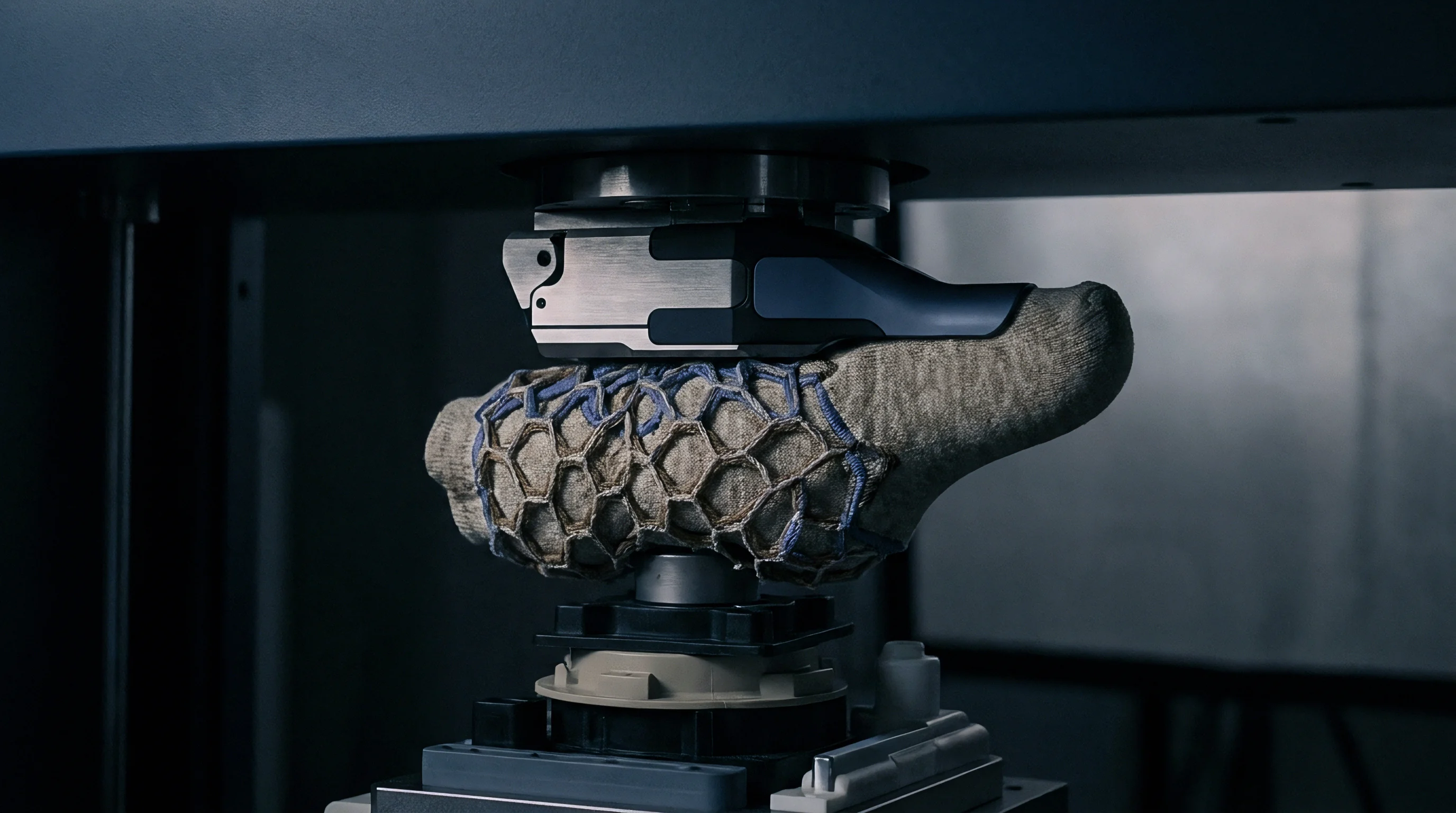
Accurate evaluation of yarn undulation depends on removing structural wave without inducing plastic elongation in individual filaments. Laboratory procedures must isolate mechanical crimp from fiber elasticity. Standardized testing frameworks define exact mounting tension parameters calculated directly from measured yarn linear density to ensure repeatable results across international testing facilities.
Laboratory Measurement under ISO 7211-3 Protocol
Extracting valid test specimens demands isolating twenty intact threads from both warp and filling directions at least one-tenth of the fabric width away from the selvedge. Technicians mark a precise initial length, typically 250 or 500 millimetres, onto the threads while held flat under minimal hand tension on the fabric surface. Threads are then carefully unraveled from the weave matrix to prevent twist liveliness or filament damage.
Individual extracted threads are mounted into a manually operated or automated crimp tester equipped with a moving clamp and force sensor. The operator applies a specific straightening force based on the yarn linear density in Tex. ISO 7211-3 mandates a standard force of 0.5 cN per Tex for conventional spun and filament yarns.
Elastomeric or high-stretch yarns require reduced tension levels to prevent core filament drafting. Once extended until the wave path disappears, the new distance between reference marks is measured to 0.5 millimetre precision.
- Atmospheric equilibration requires pre-conditioning fabric swatches at standard reference conditions of 20 degrees Celsius and 65 percent relative humidity for twenty-four hours.
- Thread path marking demands tracing a precise ten-inch gauge length across central warp and filling yarns using non-bleeding ink prior to specimen extraction.
- Tension application calibration mandates adjusting the crimp tester load scale to match exact yarn linear density at 0.5 cN/tex to prevent filament stretch.
- Straightened length recording involves extending the isolated yarn thread until the structural undulation disappears completely without altering twist structure.
Why Do Finishing Tension Changes Alter Landed Linear Metre Costs?
Tenter frame adjustment during final drying sets the final physical length of a fabric roll. Over-stretching warp yarns during finishing reduces warp crimp below nominal weaving design, extending fabric running length per loom batch. This temporary length gain contracts when the fabric encounters steam or laundering during garment manufacturing.
Fabric mills selling cloth on a linear metre basis gain yield by stretching warp threads, while buyers receive lower fabric mass per linear metre than specified. Standard quality audits measure mass per unit area under ISO 3801 alongside ISO 7211-3 crimp testing to detect artificially stretched delivery rolls before cut-make-trim conversion starts.
Excessive fabric weight and high yarn consumption often stem from uncalibrated warp beam tension during loom setup rather than natural fiber moisture absorption during transit.

Ledger
Commercial transactions for bulk woven fabric turn on precise alignment between agreed roll length, target weight per linear metre, and verified raw material allocation. When warp crimp drifts above contract targets, the mill consumes more yarn per linear metre of output than budgeted. If fabric contracts specify price per linear metre at a minimum mass per square metre, uncontrolled crimp expansion erodes mill margins.
Conversely, under-crimped stretched cloth causes garment sizing failures and post-wash shrinkage claims for brand buyers.
Yield Variance and Commercial Billing Mechanisms
Deviations between target fabric mass and delivered roll weights create immediate commercial disputes over total raw material usage. Bulk purchasing contracts frequently establish price adjustment clauses tied to mass per linear metre. When delivered fabric mass falls below minimum specification thresholds due to excessive warp tension, buyers execute price deductions calculated directly from mass shortfall percentages.
If delivered fabric mass exceeds contract target due to high crimp levels, mills attempt to bill buyers for extra raw material mass. Standard purchasing agreements reject weight surcharges unless the buyer explicitly requested elevated fabric mass. Commercial specifications establish narrow tolerance bands, typically setting mass limits at plus or minus 3.0 percent of target linear weight.
| Delivered Warp Crimp (%) | Delivered Weight (g/m) | Yarn Mass Shift (kg) | Raw Material Cost Impact ($) | Commercial Dispute Settlement Action |
|---|---|---|---|---|
| 6.50 (Stretched) | 225.43 | -42.40 | -212.00 | Buyer claim for dimensional instability risk |
| 8.50 (Contract Target) | 229.67 | 0.00 | 0.00 | Invoice paid at baseline contract rate |
| 10.50 (Elevated Crimp) | 233.91 | +42.40 | +212.00 | Mill absorbs yarn cost penalty; no surcharge paid |
| 12.50 (Excessive Crimp) | 238.15 | +84.80 | +424.00 | Batch rejection or mandatory price renegotiation |
Customs Tariff Valuation and Weight Allowances
Import duty assessments under Harmonized System Chapter 52 through Chapter 55 depend directly on declared fabric mass per square metre. Customs authorities verify weight declarations against actual shipment mass during border clearance. Misdeclaring fabric weight resulting from unmonitored crimp drift leads to customs holds, re-testing delays, and potential duty evasion penalties.
Incorporating ISO 3801 mass determination rules with fixed crimp tolerance bands into purchase contracts enables buyers to reject invoicing surcharges stemming from uncalibrated loom warp tension.
Customs classification limits often hinge on specific mass thresholds, such as 200 grams per square metre distinguishing light from heavy woven cottons. A fabric designed at 195 g/m² that drifts to 203 g/m² due to elevated warp crimp crosses into a different tariff subheading carrying higher import duty rates. Technical sourcing dossiers must include verified crimp analysis and conditioned areal mass test reports to defend declared tariff lines against customs audits.
Standard purchasing specifications incorporating ASTM D3883 crimp testing limits allow buyers to automatically deduct weight surcharges whenever delivered warp crimp exceeds target contracts by more than 1.5 percentage points.