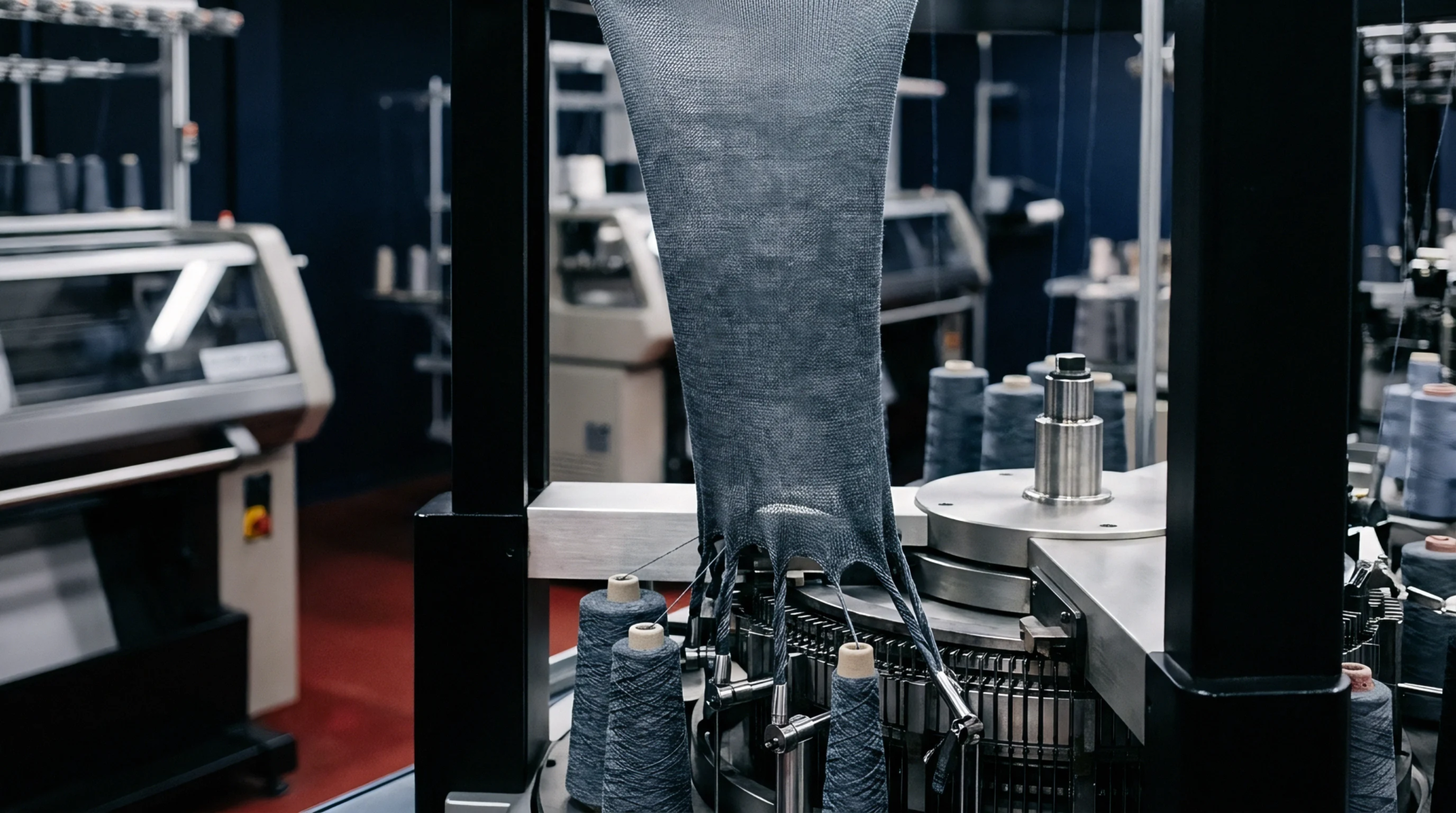
Geometric Deformation
Dimensional distortion represents the physical alteration of a loop structure within a knitted fabric matrix. Loop curvature describes the arc radius of a stitch as it moves from the sinker or needle hook to the adjacent interlock point. This measurement assesses the degree of strain placed upon a yarn during the mechanical formation of a textile.
High values indicate a tight or forced bend that potentially restricts yarn elasticity or induces permanent thinning at the point of contact. Precise control over this geometry prevents uneven tension across a production batch.
Mechanical Impact
Production speeds influence the bending force applied to a fibre during its transition through the knitting elements. Rapid oscillation of the needles prevents the yarn from settling into a neutral configuration within the cam system. Excess force causes the loop to skew, altering the intended aesthetic or physical performance of the final garment.
Machine settings must account for the specific modulus of the yarn to ensure stable geometry under high tension.
Material Constraint
Fibre rigidity dictates the resistance a yarn offers when forced into a rounded configuration. Synthetic filaments with high flexural stiffness maintain an open loop shape even after the removal of external tension. Natural fibres often collapse or deform under similar mechanical loads, leading to variability in density across the length of a roll.
Technicians track these variations during the wet processing stage because heat and moisture relax the internal stresses of the fibres. Changes in the yarn diameter force a shift in the arc measurement, requiring real-time adjustment of the stitch length to maintain uniformity.
Verification Standard
Quality control teams quantify this metric using optical inspection systems during the knitting cycle. Analysis of the image data provides an objective assessment of whether the loops remain within the tolerance zone defined by the technical specifications of the fabric. Deviations from the baseline curvature signal worn cam tracks or incorrectly calibrated yarn feed tensions.
Automated monitoring confirms that the production output matches the prototype dimensions before the fabric enters the finishing department. The maintenance of consistent loop geometry ensures the long term dimensional stability of the apparel.