Predictive Geometric Loop Length Control in Multi Layer Elastomeric Warp Knitted Technical Structures
Predictive geometric loop length control synchronizes electronic beam let-off with elastomeric draft mechanics to ensure absolute structural consistency.


Gauge
Predictive geometric loop length control in multi layer elastomeric warp knitted technical structures governs the delivered mass per unit area, dynamic modulus, and functional recovery of technical textiles. When knitters run three-bar or four-bar raschel and tricot arrangements incorporating bare elastane alongside high-tenacity filament yarns, loop length variation compounds across the textile layers. The calculation of runner length, defined as the millimeters of yarn fed per rack of 480 stitches, requires mathematical compensation for elastomeric draw ratios prior to knitting needle encroachment.
Traditional mechanical let-off systems rely on circumference-sensing followers that lag behind the tension peaks caused by rapid guide bar shogging. Modern electronic guide bar systems (EL) and electronic beam controls (EBC) eliminate this lag by matching real-time rotational delivery directly to predictive geometric models of the loop head, legs, and underlap.
Machine configuration dictates the structural limits of this predictive delivery. In an E 28 or E 32 gauge multi-bar tricot machine, needle spacing settles at 0.907 mm and 0.794 mm respectively. Introducing a 44 dtex or 78 dtex bare elastane on ground bar GB3 beneath 110 dtex textured polyester on GB1 and GB2 generates distinct compression stresses at the knock-over verge.
The elastomeric yarn does not form an independent spatial loop. It wraps around the base of the pillar or tricot loops formed by the rigid face yarns, altering their stitch density through post-knitting contraction. Fabric specifications that fail to separate the fully relaxed loop geometry from the on-machine stretched geometry produce rejectable rolls characterized by border curling, variable pore diameter, and cross-web compression gradients.
The nominal let-off value represents an unrelaxed intermediate state that collapses once the elastane exits the needle bed.
Control engineers establish the target loop length through modified Peirce geometry adapted for warp knitting. In standard multi-layer textiles, total stitch length splits into three distinct components: the needle loop head, the two loop legs traversing the fabric thickness, and the underlap connecting adjacent wales. The calculation of the theoretical loop length for an elastomeric underlap accounts for the yarn entry angle, the guide bar swing displacement, and the variable friction coefficient across the sinker nibs.
Predictive models calculate this path before the beam motor turns, adjusting yarn feed dynamically per knitting cycle rather than relying on corrective downstream feedback.
A typical high-performance raschel machine running at 1,800 courses per minute leaves less than 34 milliseconds per knitting cycle. Mechanical sensors cannot execute a corrective mechanical adjustment within that cycle window. The predictive control algorithm computes the required rotational angle of the warp beam ahead of needle descent, maintaining precise yarn length under variable machine speeds during ramp-up and ramp-down cycles.
A failure in predictive feed synchronization shifts the elastomeric yarn tension above the critical yield point, yielding structural barre defects that become visible only after heat setting and dyeing.


Draft
The draft ratio applied to elastomeric yarns during the warping and feeding stages dictates the spatial coordinates of every knit loop. Elastane packages wound under constant tension enter the warp preparation sequence with an initial elongation that must remain uniform across all beam sections. On direct warping units designed for technical warp knitting, draw frames draft the bare elastomeric filament between input draw rollers and the warping head, operating within precise draft ranges between 1.5 and 3.8.
The drafted yarn holds potential mechanical energy that releases only when the completed textile disengages from the knock-over bar and fabric takedown rollers.

Mathematical Prediction of Elastomeric Run-In
Calculating the true geometric loop length of an elastomeric yarn requires decoupling the machine run-in from the relaxed yarn length. The actual yarn length in a single loop equals the machine let-off per rack divided by 480, scaled by the total draft ratio. Let-off units measure the stretched length passing into the guide needles under line tension.
The actual unstrained loop length reflects the mass conservation of the elastomeric polymer, requiring continuous calculation based on input linear density, line tension, and instantaneous beam diameter.
The formula governing the unstrained elastomeric loop length incorporates the machine draft and the secondary knitting draft generated by the guide bar swing:
L_relaxed = L_delivered / (Draft_warping Draft_knitting)
When the machine draft reaches 3.0, an elastomeric run-in of 600 mm per rack delivers an unrelaxed stitch length of only 0.416 mm per loop. At this mechanical compression level, the elastane draws the adjacent ground loops inward, increasing the course count per centimeter by 30 to 65 percent following off-loom relaxation. Mill technicians who measure loop length directly off the knitting frame without accounting for this contraction commit systemic sizing errors in multi-layer spacer and technical compression fabrics.
| Structure Description | Machine Gauge | Yarn Composition Per Guide Bar | Theoretical Loop Length | Machine Run-in Per Rack | Applied Yarn Draft |
|---|---|---|---|---|---|
| Two-way stretch powernet | E 28 Raschel | GB1: 44dtex PA66 / GB2: 78dtex Elastane | GB1: 2.85 mm / GB2: 1.12 mm | GB1: 1368 mm / GB2: 538 mm | 2.85 |
| Four-bar technical spacer | E 22 Double Needle | GB1,4: 78dtex PES / GB2: 0.12mm Mono / GB3: 156dtex Elastane | GB1: 3.40 mm / GB3: 1.45 mm | GB1: 1632 mm / GB3: 696 mm | 2.10 |
| Three-bar medical compression | E 32 Tricot | GB1: 55dtex PA66 / GB2: 55dtex PA66 / GB3: 44dtex Elastane | GB1: 3.10 mm / GB3: 0.98 mm | GB1: 1488 mm / GB3: 470 mm | 3.40 |
| Reinforced locknit grid | E 24 Tricot | GB1: 167dtex PES / GB2: 44dtex Elastane | GB1: 4.15 mm / GB2: 1.60 mm | GB1: 1992 mm / GB2: 768 mm | 1.80 |
Operating outside these verified draft envelopes destabilizes the loop structure during loop transfer. If the elastomeric draft drops below 1.5, yarn slack induces guide needle mis-threading, dropping stitches across the needle bed. Conversely, exceeding a 3.8 draft ratio approaches the plastic deformation boundary of polyurethane filaments, causing unrecoverable filament necking and micro-void formation along the polymer backbone.
ISO 2062 breaking force testing on drafted elastane reveals permanent tensile loss when yarn elongation exceeds 380 percent during knitting.
Knitting plants avoid these failure thresholds by tying the dynamic beam motor drive to high-frequency load cell arrays mounted directly behind the tension rails. When an acceleration curve initiates, the controller alters the feed forward command, maintaining the loop length setpoint within a 0.5 percent tolerance envelope. This precise feed synchronization prevents loop distortion across the full width of multi-guide-bar machines.

Verge
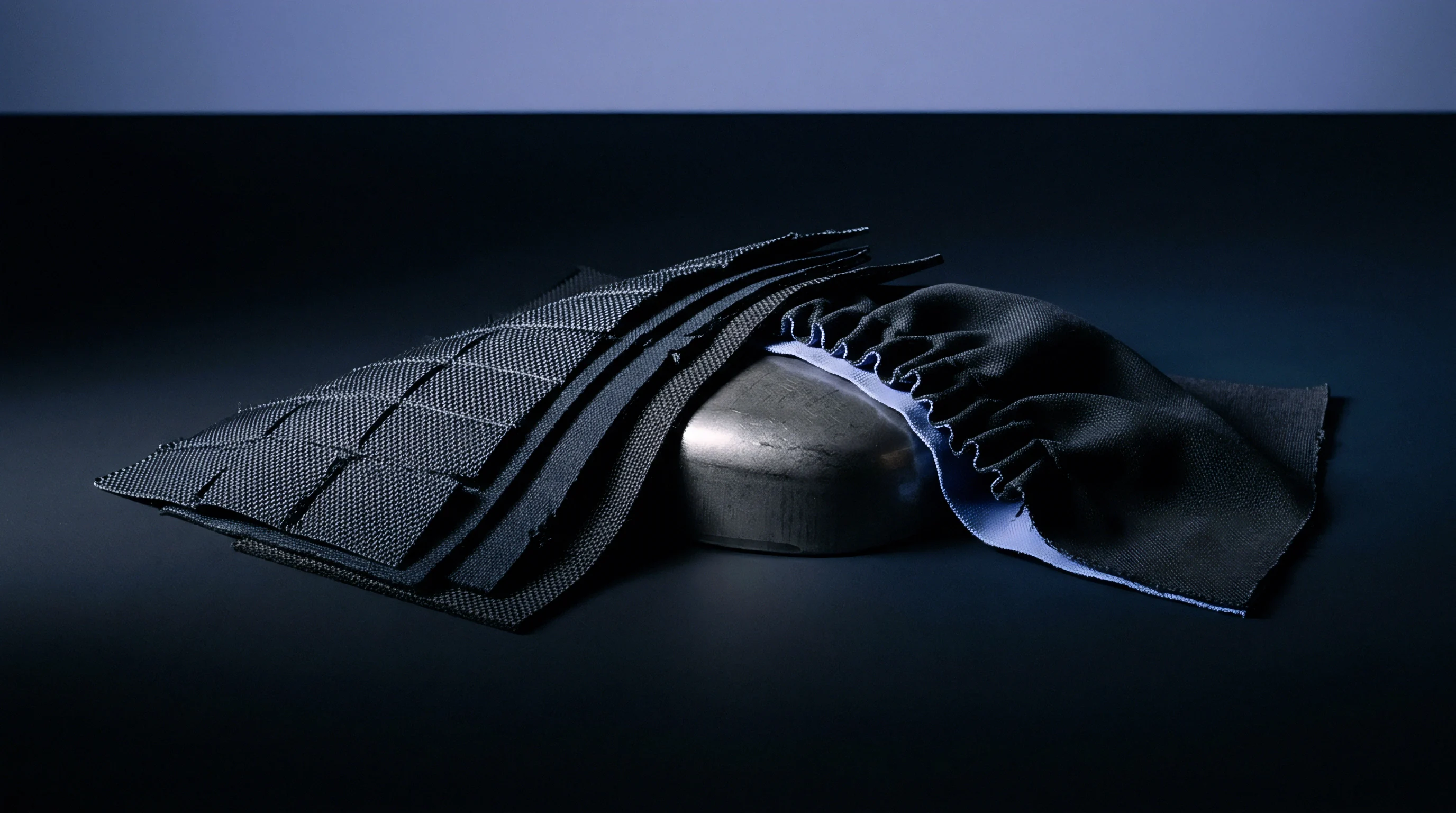
The mechanical interaction at the knock-over verge establishes the spatial geometry of the multi-layer knitted loop. As the needles descend toward the sinkers, yarn tensions across all active guide bars combine to dictate the three-dimensional stitch configuration. In multi-layer structures, rigid yarns occupying the front guide bars clear the needle latches earlier than the elastomeric yarn positioned on the rear bars.
This differential clearance timing creates frictional drag against the verge plates, pulling yarn backward through previously cleared stitches and corrupting predictive loop calculations.
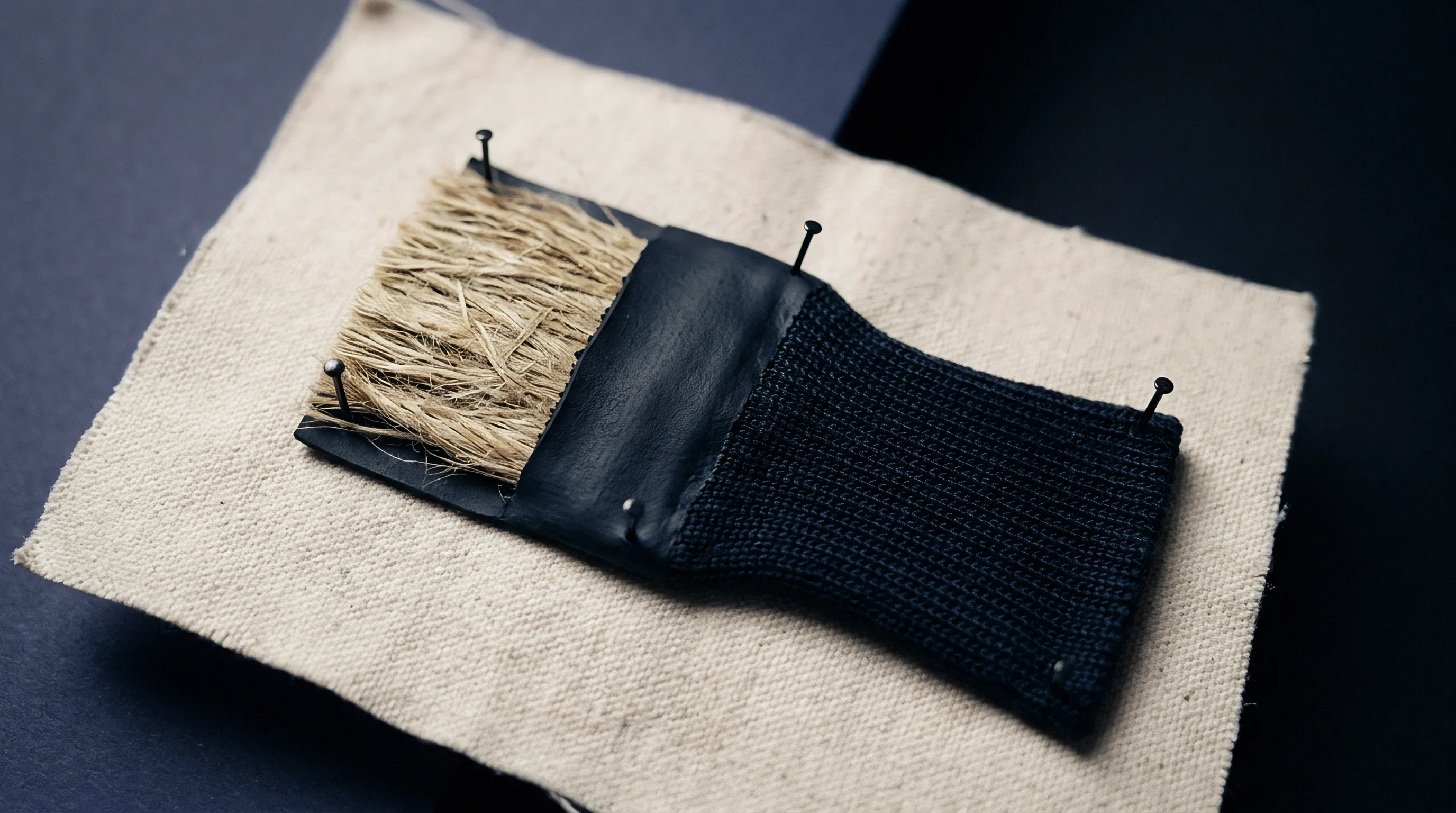
Needle and Sinker Dynamics in High-Speed Knitting
Compound needle systems provide superior loop geometry stability compared to traditional latch needles when handling elastomeric yarns. The compound needle slider closes the hook positively without relying on yarn inertia or fabric resistance. This positive closure isolates the newly formed yarn head from the retracting fabric web, preserving predictive stitch geometry even under high fabric takedown tensions.
The physical path of the elastomeric yarn through the knock-over verge requires precise sinker plate positioning:
- Sinker throat alignment prevents the elastomeric core from shifting laterally across the needle beard, stabilizing loop width within 0.05 mm tolerances.
- Verge plate clearance controls the physical pinching point of rigid loops against the inner elastomeric core, preventing shear fractures in multi-filament yarns.
- Knock-over depth adjustment establishes the final loop height, directly dictating whether the elastane embeds within the center plane of the fabric or remains exposed on the technical back.
- Takedown roller positioning maintains constant drawing-off angles, counteracting the elastic recovery force that seeks to pull fresh loops back into the knitting zone.
The guide bar swing arc presents a notable complication for multi-layer loops. As the guides pass through the needle gaps, the physical distance between the yarn guide eye and the needle hook fluctuates continuously. Rigid yarns accommodate this movement through low-friction spring-loaded tension rails.
Bare elastomeric yarns, possessing high surface friction against ceramic and polished steel guides, stretch during the forward swing and contract during the return swing. This hysteresis creates a cyclic discrepancy between the volume of yarn metered by the electronic beam drive and the yarn volume actually trapped by the needle hook.
Addressing this cyclic disparity demands mathematical predictive modeling within the electronic control software. By calculating the instantaneous geometric position of the guide bar throughout the 360-degree machine cycle, the motor drive applies micro-accelerations to the warp beam, neutralizing the spring-effect of the elastomeric yarn before the loop pulls through the sinker throat. Mills lacking these micro-acceleration controllers experience persistent course-line marks and variable fabric weight across their production lots.
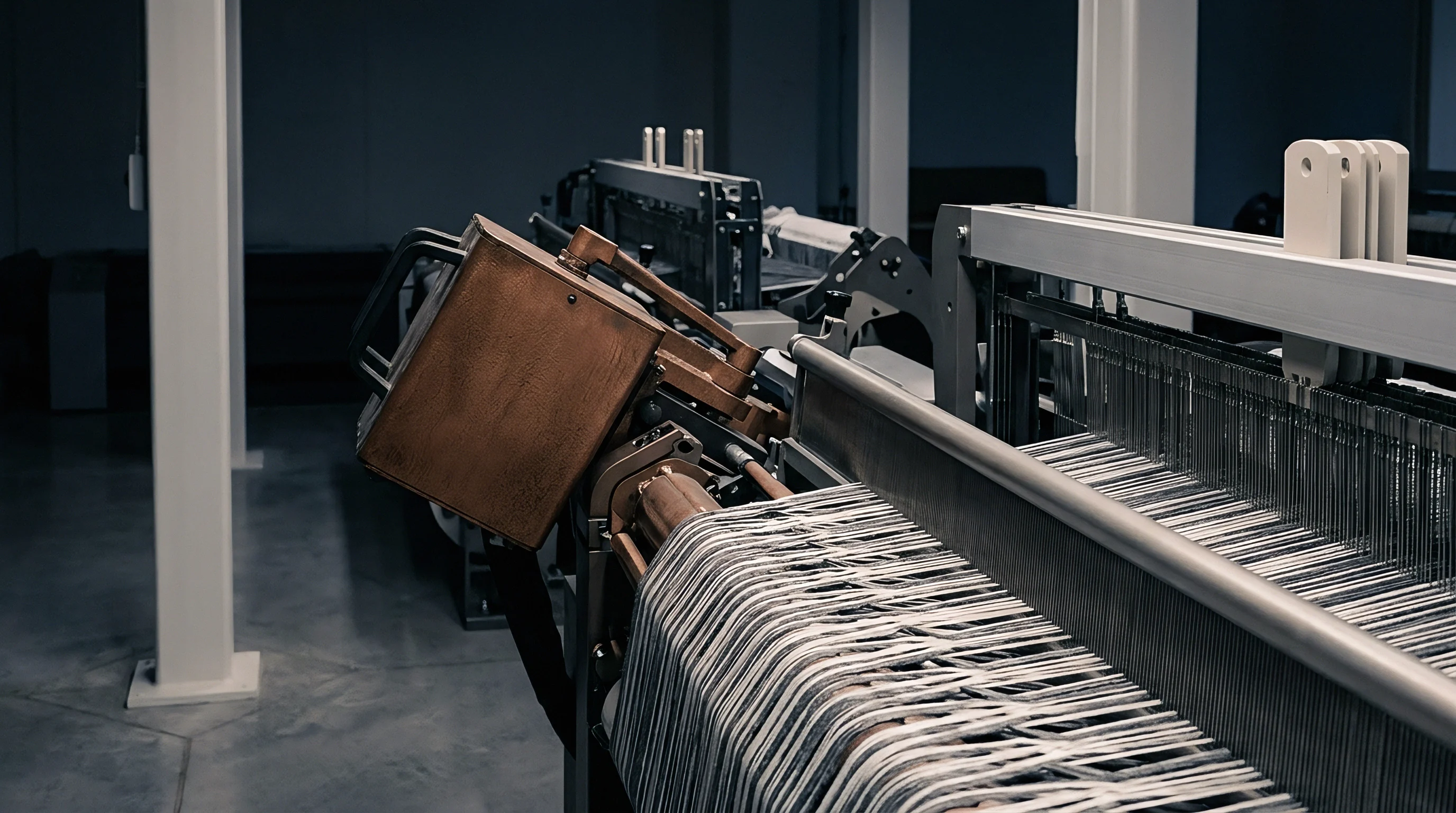
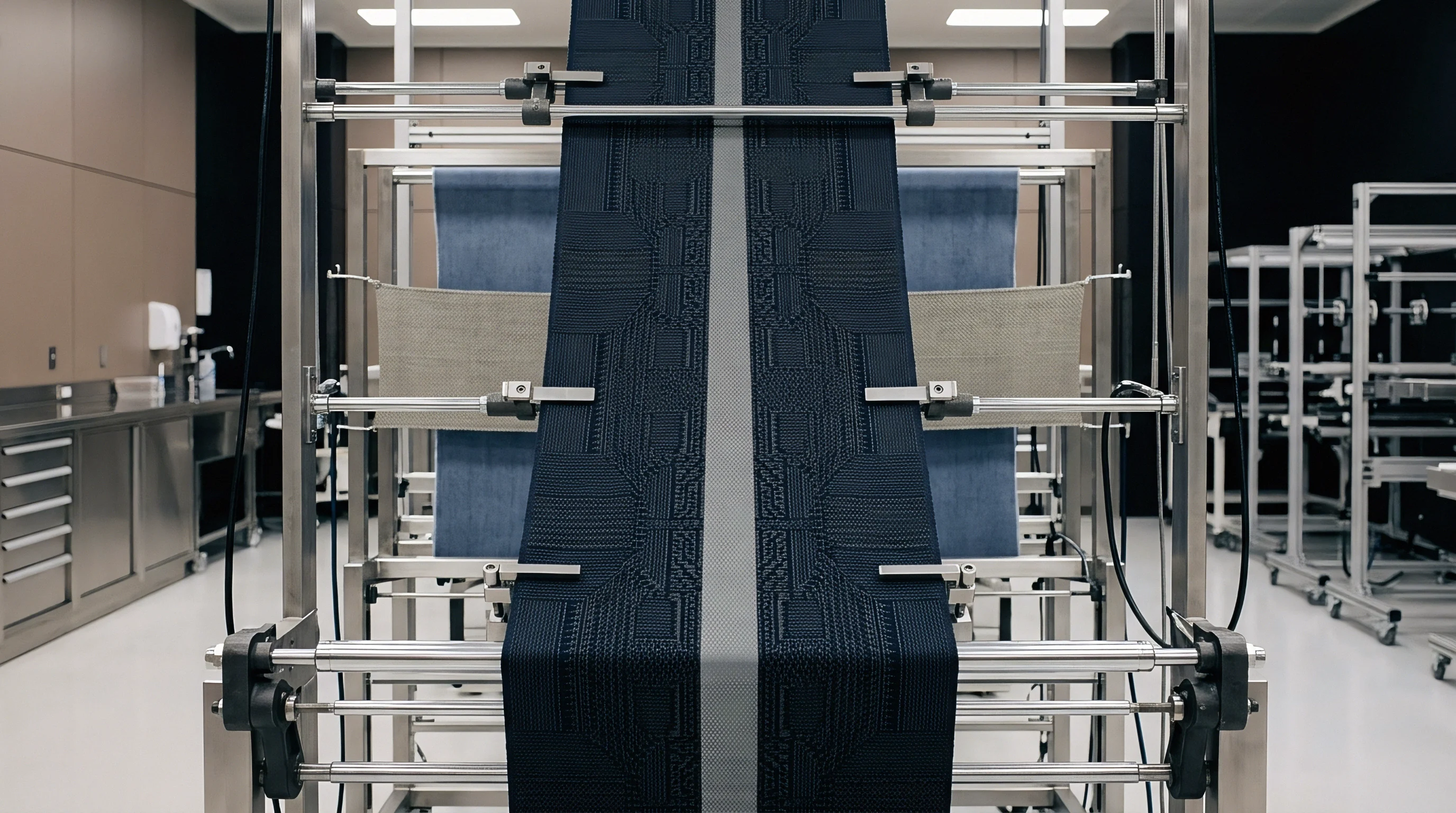
Kinetics
Dynamic loop formation forces determine the final physical properties of multi-layer technical structures. High-speed video analysis demonstrates that yarn tension peaks at the precise moment of cast-off, when the newly formed loop pulls through the old loop and passes over the sinker belly. In multi-layer structures containing elastomeric yarns, this cast-off tension peak reaches up to four times the nominal feeding tension.
The elastane stretches intensely at this moment, then snaps back as the needle rises for the subsequent stitch cycle.

Why Does Kinetic Elastic Recovery Distort Theoretical Loop Models?
Predictive geometric models based on classical Euclidean loop paths fail to predict elastomeric fabric parameters because they assume yarn dimensions remain constant throughout the stitch cycle. Elastane exhibits time-dependent viscoelastic relaxation. The strain applied during the 15 milliseconds of loop pulling does not recover instantaneously upon cast-off.
The newly formed loop retains an elongated state as it leaves the knitting point, contracting gradually across the next three to five knitting cycles under the influence of fabric takedown tension.
This kinetic lag causes the elastane to steal yarn length from adjacent stitches. As the fabric descends down the takedown zone, the contracted elastomeric loop pulls the underlaps of the face and back yarns through the loop heads, shortening the visible stitch height and expanding the stitch width. The structure undergoes three-dimensional reshaping directly on the machine frame, long before reaching finishing stenters.
Quantifying this kinetic transformation involves tracking the structural parameters across three distinct manufacturing states:
- Dynamic on-machine state: the yarn is under peak guide bar tension and hook extension, displaying maximum loop length and minimum linear density.
- Greige off-loom state: the fabric disengages from the takedown rollers, initiating primary viscoelastic recovery over an initial 24-hour conditioning period at standard atmosphere according to ISO 139.
- Thermally fixed state: the textile passes through stenter frame stabilization where heat setting locks the elastomeric network into permanent thermodynamic equilibrium.
Predictive geometric control algorithms must model all three states simultaneously. If the control system only optimizes for the dynamic on-machine state, the finished fabric fails dimensional stability specifications after wet processing. Greige specifications must explicitly mandate the calculated off-loom loop contraction factor, providing a true basis for beam let-off programming.
Contractual specifications that cite on-loom stitch density without tying values to ISO 5077 wash shrinkage tolerances permit unchecked dimensional drift between production lots.
Divergence between theoretical modeling and production reality widens when running multi-axial technical warp knits. Inserting zero-stretch laid-in yarns (such as aramid or carbon filaments) directly adjacent to elastomeric chain stitches restricts lateral fabric contraction. The elastomeric loop cannot pull the structure inward, forcing its kinetic recovery energy entirely into vertical compaction.
The resulting fabric exhibits extreme stitch density increases along the wales while retaining constant course dimensions, fundamentally altering the functional stress-strain curve of the technical product.

Stenter
Downstream finishing transforms the predictive loop geometry programmed on the knitting frame into a permanent textile structure. Off-loom elastomeric warp knits contain substantial internal stresses, manifesting as high fabric shrinkage, structural curl, and irregular stitch densities across the roll. The finishing stenter provides the thermal energy necessary to relax the semi-crystalline domains of synthetic ground yarns while setting the polyurethane hard segments of the elastomeric core.

Thermal Fixation Parameters and Geometric Distortions
Heat setting temperatures must be controlled within narrow processing windows. For standard polyamide 6,6 and elastane blends, thermal fixation proceeds between 190 and 195 degrees Celsius, maintaining fabric exposure between 30 and 45 seconds inside the stenter chambers. If the chamber temperature drops below 188 degrees Celsius, the elastomeric network retains its mechanical memory, producing post-finishing wash shrinkages that exceed 8 percent under ISO 6330 testing.
Exceeding 198 degrees Celsius initiates thermal degradation of the elastane polyurethane matrix, causing severe yellowing and permanent loss of elastic modulus.
Overfeed control on the stenter pin chain acts as the primary mechanical lever for fixing final loop geometry. Applying longitudinal overfeed (typically ranging from positive 15 percent to positive 35 percent) permits the knit loops to compress along the wales, releasing vertical tension before thermal pinning. Setting the cross-machine stenter rail width controls the horizontal loop expansion, fixing the finished mass per unit area.
| Substrate Class | Fixation Temperature | Dwell Time | Stenter Overfeed | Width Variation Tolerance | Residual Shrinkage (ISO 5077) |
|---|---|---|---|---|---|
| PA66 / Elastane Compression (E32) | 192 °C | 35 seconds | +22 % | ± 1.0 cm | < 2.5 % |
| PES / Elastane Spacer (E22) | 185 °C | 45 seconds | +12 % | ± 1.5 cm | < 3.0 % |
| PA6 / Elastane Powernet (E28) | 188 °C | 30 seconds | +28 % | ± 1.0 cm | < 2.0 % |
| Aramid / Elastane Grid (E24) | 195 °C | 40 seconds | +5 % | ± 0.5 cm | < 1.5 % |
Processing wet-chemical baths prior to stenter entry alters the physical loop length calculations. Scouring removes silicone-based warping oils and spinning lubricants from the elastomeric fibers. If these lubricants remain on the substrate during high-temperature thermal fixation, they cause irregular plasticization of the elastane yarn, introducing local tension differences that disrupt the geometric equilibrium established on the knitting machine.
Continuous washing ranges must maintain minimal bath tension to prevent cold-stretching the unrelaxed loops. Pulling wet elastomeric fabric over high-friction guide rollers stretches the technical ground stitches unevenly, producing bowing and skewing that the stenter pin chain cannot eliminate. A properly calibrated wet processing line relies on synchronized driven transport rollers that advance the wet fabric with zero applied longitudinal draft.
The dyehouse manager reads the ultimate success of the predictive loop calculation directly off the final stenter exit frame. When the predictive knitting model, machine draft, and finishing overfeed align correctly, the delivered fabric matches the specified mass per unit area and elongation targets without demanding excessive mechanical stretching on the pin chain. Achieving this equilibrium marks the boundary of stable textile manufacturing.


Yield
Commercial performance in technical warp knitting depends on continuous yield management across multi-mill conversion chains. In technical apparel, medical compression, and automotive seating applications, buyers specify fabric performance through minimum tensile recovery, air permeability, and strictly bounded mass per unit area tolerances. Variations in geometric loop length translate directly into square-meter yield drift, presenting immediate financial risk to converters and sourcing firms.
Economic Fallout of Geometric Drift
When an uncalibrated machine lets off an extra 0.05 mm of yarn per loop on an E 28 four-bar technical fabric, the cumulative run-in error shifts the finished fabric weight from an agreed 220 grams per square meter to 235 grams per square meter. In high-volume production lots running across five vertical knitting frames, this seven percent weight increase extracts substantial raw material over-consumption, draining converter margins on fixed-price contracts. For the apparel cutter, this variance shifts roll yields unexpectedly, altering garment marker layouts and reducing cut-part yield per purchased linear meter.
The chain of custody across technical production lines complicates quality attribution when dimensions fail inspection:
- Warping operations introduce hidden linear density variances if beam tension controls drift across multiple sectional warping sets.
- Knitting mills often run outdated let-off controls that attempt to hold yarn tension constant without actively calculating theoretical geometric run-in.
- Commission dyehouses stretch fabric excessively across drying cylinders to maximize billable linear yardage, masking knitting-side defects until finished goods reach the garment wash stage.
- Lamination facilities apply cross-linking polyurethane adhesives under high roll nip pressures, locking distorted loop geometries permanently into the composite matrix.
Mitigating these cross-mill liabilities requires binding technical agreements centered on strict structural metrics. Forward contracts for technical warp knits must define fabric yield not merely as a linear meter price, but as a bounded mass-per-surface-area specification measured at standardized moisture regain under ISO 3801. Specifying both courses per centimeter and wales per centimeter tolerances (holding both within plus-or-minus three percent of standard master targets) prevents dyehouses from achieving weight targets through artificial width manipulation on the stenter pin chain.
If physical testing reveals that finished fabric width can only be attained by exceeding a five percent dimensional shrinkage threshold under ISO 5077, the entire production lot fails commercial audit. When this dimensional disconnect occurs, responsibility traces directly back to inaccurate predictive loop length modeling during machine setup. The sourcing practice protects its commercial position by enforcing strict pre-production qualification runs, auditing machine let-off parameters directly against theoretical geometric calculations before issuing bulk yarn drawdowns.
The standard supply agreement clause governing technical warp knits establishes that any roll deviating beyond four percent of nominal finished areal density shall be credited at full replacement cost including accrued finishing charges.