Standard Tensile Testing Protocols for Core-Spun Elastomeric Yarns
Tensile verification of elastomeric-centered yarns demands capstan clamps, 0.01 cN/tex pretension, and five-cycle hysteresis logging to catch slippage.


Clamp
Pneumatic jaws fitted with smooth rubber faces isolate the tensile load on hybrid yarns without crushing the central polyurethane filament. Standard textile testing setups designed for rigid ring-spun cotton induce immediate stress concentrations when applied to elastomeric composite structures. The hard clamping plane shears the exterior staple sheath while allowing the internal polyurethane filament to slide unrestrained between the steel plates.
Grip slippage ruins tenacity calculations. When the elastomer retreats inside the fiber sheath during jaw acceleration, the resulting force-displacement curve exhibits false elongation values and artificially suppressed tenacity peaks. Isolating true tensile parameters demands a testing interface engineered around the dual-modulus behavior of elastane composites.
Universal tensile testing machines operating under ISO 2062 or ASTM D2256 evaluate single-end breaking strength by applying constant rate of extension crosshead movement. Applying these standards directly to elastomeric-filled singles produces severe experimental error unless the operator adjusts gripping mechanics and pretension protocols. The gauge length remains 250 millimeters.
ASTM D2256 specifies a nominal gauge length of 250 millimeters or 500 millimeters alongside an extension rate calibrated to break the specimen within twenty seconds. For non-elastic cotton singles, a crosshead speed of 300 millimeters per minute satisfies this parameter. For elastomeric composites reaching elongation values between 150 percent and 300 percent, that same speed extends testing durations past forty seconds, introducing creep artifacts into the measured tensile profile.
A pretension load of 0.01 centinewtons per tex establishes baseline gage separation without elongating the elastomeric center.
Jaw Geometry and Gripping Pressures
Contact surfaces coated with neoprene prevent yarn extrusion along the contact perimeter during sudden elongation spikes. Flat steel faces shear fine filaments. Mechanical screw clamps fail because manual tightening depends on operator discretion, producing erratic clamping forces across identical bobbin samples.
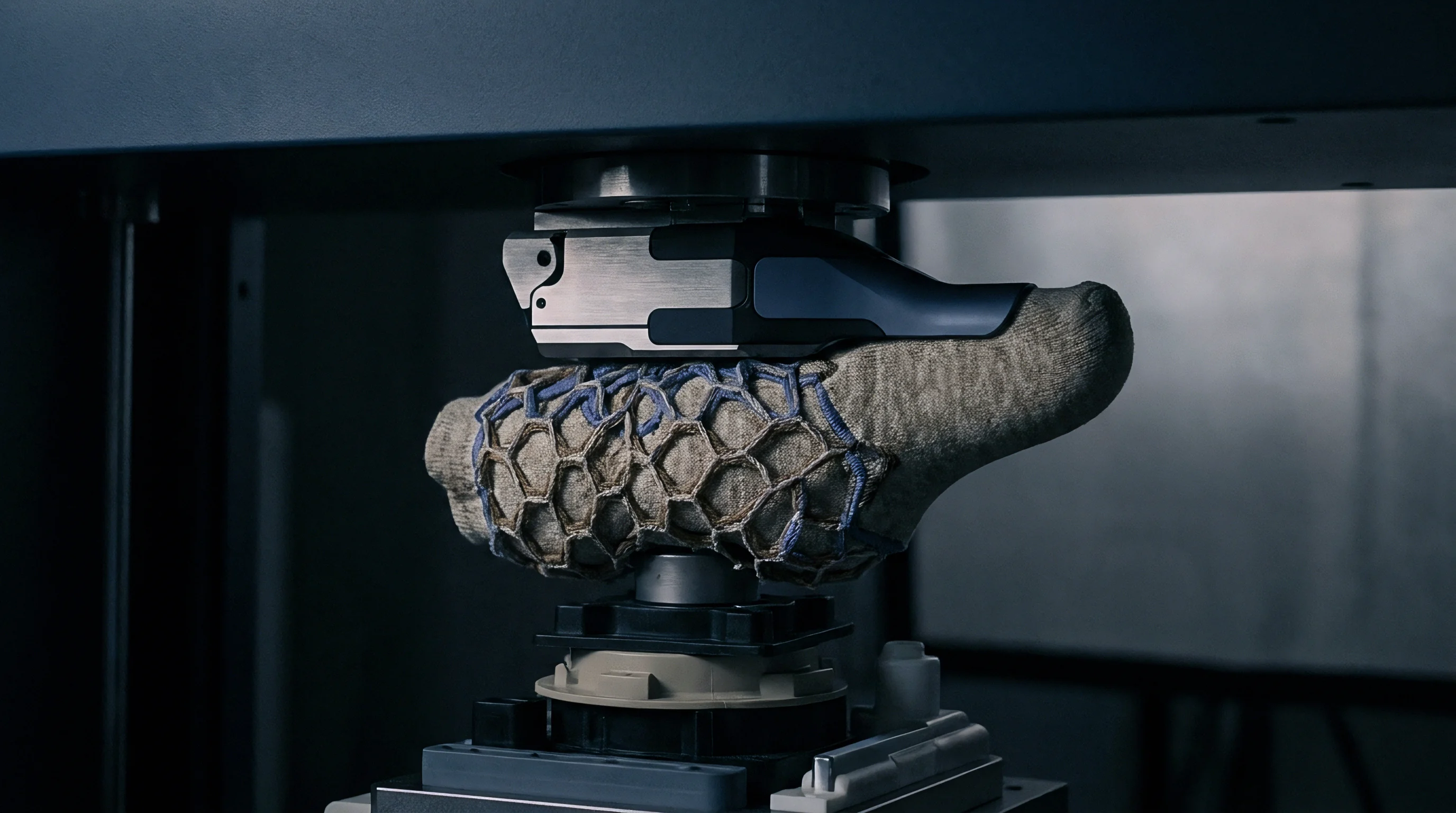
Pneumatic grips maintain continuous closing force throughout specimen elongation, compensating for the lateral diameter contraction that accompanies high axial stretch. Line pressures calibrated between 0.4 and 0.6 megapascals prevent jaw slippage while holding the yarn structure intact.
Capstan grips distribute clamping force along a curved bollard prior to final plate pinching. The specimen wraps around a smooth cylinder through 180 degrees, allowing frictional dissipation of tensile load according to the Belt friction principle. This configuration eliminates localized pinching at the gage line when testing high-denier elastomeric singles designed for stretch denim or heavy knitting applications.
When evaluating fine singles below 15 tex, capstan grips introduce friction drag that distorts low-load initial modulus readings. In those fine yarn counts, parallel flat pneumatic jaws lined with medium-durometer rubber deliver cleaner baseline accuracy.
- Pneumatic line pressure modulates between 0.4 and 0.6 megapascals to prevent jaw pinching while locking the polyurethane center.
- Smooth neoprene jaw faces absorb shock loads across high-speed crosshead travel and avoid sharp shear planes.
- Capstan bollard guides distribute tensile load around a curved radius when testing slippery continuous filament sheath varieties.
- Optical extensometer tracking captures true gage displacement without relying on mechanical jaw separation distances.
Pretension Thresholds for Elasticized Singles
Standard mechanical draw mechanisms initiate crosshead movement from a reference baseline calculated at 0.01 centinewtons per tex. Rigid cotton singles testing specifies 0.5 centinewtons per tex to remove yarn crimp before taking extension data. Applying 0.5 centinewtons per tex to an elastomeric composite stretches the central spandex filament by fifteen to twenty-five percent prior to jaw movement, destroying the true zero-point elongation reading.
BISFA rules governing elastane testing mandate a lower pretension load of 0.01 centinewtons per tex for elastomeric composites. This minute load straightens the specimen without initiating polymer chain extension in the polyurethane interior.
This 0.01 centinewtons per tex pretension value rests on BISFA 2010 interlaboratory round-robin trials using 44-dtex bare elastane filaments. The setting shifts upward when the sheath-to-filament linear density ratio surpasses twenty-to-one, because gravitational drape of heavy cotton fibers overpowers that minimal tension and introduces artificial slack. In heavy 50-tex denim filling yarns, technicians calibrate pretension to 0.02 centinewtons per tex to secure a straight vertical path between clamp faces.
Verifying this baseline prevents premature triggering of the load cell integration software.
| Standard Protocol | Gauge Length (mm) | Crosshead Speed (mm/min) | Pretension Setting | Targeted Failure Endpoint |
|---|---|---|---|---|
| ASTM D2256 | 250 | 300 | 0.5 cN/tex nominal | Total specimen rupture |
| ISO 2062 | 500 | 500 | 0.5 cN/tex +/- 0.1 | First peak breaking force |
| BISFA Chapter 6 | 100 | 500 | 0.01 cN/tex true | Tenacity at specified elongation |
| ASTM D6720 | 250 | 500 | 0.005 cN/tex minimal | Five-cycle residual recovery |
Incorrect jaw pressure generates jaw breaks that falsify elongation records, triggering unjustified yarn rejections and inflating laboratory testing overhead across the procurement cycle.

Draft
Spindle delivery units balance the draw ratio of the spandex filament against the delivery velocity of the roving sliver. During spinning, the central elastomeric filament enters the drafting zone behind the front delivery rollers under a predetermined draft ratio ranging between 2.5 and 4.2. As the drafted cotton roving twists around the tensioned filament at the ring spindle, the cotton fibers form a helical protective sheath.
When the completed composite package unrolls and relaxes, the tensioned central elastomer contracts, drawing the cotton wrapper into an accordion-like outer geometry. Polyurethane uncoils during the initial draft.
This mechanical interaction alters yarn behavior under pure tensile elongation. During the initial phase of extension, the yarn resists load primarily through the mechanical friction among compacted cotton fibers and the low-modulus uncoiling of the elastomer chains. Once extension straightens the helical cotton sheath fibers, the outer sleeve absorbs axial tension directly.
Staple fibers strip under uneven twist. At high strain levels, the tensile test measures the combined modulus of the extended staple fibers alongside the rubbery central elastomer up to catastrophic failure.
Cotton roving twist binds the sheath securely when the draft apron delivers uniform lateral pressure.

What Triggers Sheath Slippage during Extension?
Cohesion failures occur when the outer cotton staple bundle separates mechanically from the continuous synthetic filament inside. This phenomenon, known as barber-poling, arises from inadequate roving twist multiplier values or uneven apron pressures on the spinning frame. During tensile loading, the outer cotton sheath ruptures at a lower extension threshold than the polyurethane center.
If the frictional bond between layers lacks sufficient density, the broken cotton sheath bunches along the yarn axis while the elastane filament elongates nakedly across the test zone. Loose roving creates catastrophic barre striping.
Tensile testing logs this detachment mode through a distinct bimodal signature on the stress-strain trace. The initial peak represents the ultimate tensile strength of the cotton sheath, followed by a precipitous drop in recorded force as the cotton slips. The force trace then levels into a low plateau representing the tensile resistance of the bare polyurethane filament until ultimate rupture occurs at 250 percent strain.
When reviewing tensile charts from bulk yarn shipments, auditors reject lots exhibiting double-peak curves. Filament exposure causes immediate lot rejection.
- Barber-pole sheath displacement creates exposed elastane spirals along the package circumference during ring drafting.
- Roving twist starvation prevents the sheath fibers from binding mechanically against the central synthetic filament.
- Dual-feed tension mismatch forces the texturized carrier filament to buckle during ring bobbin winding.
- Apron slip vibration generates recurring thin spots where tensile force ruptures the outer cotton coat prematurely.

Dual Filament Reinforcement Mechanics
Combining an elastane component with a textured polyester partner yarn elevates tensile recovery while stabilizing the outer ring-spun cover. Modern stretch weaving incorporates dual-component elastomeric singles where a low-denier textured polyester or polyamide filament feeds alongside the elastane into the spinning triangle. The texturized partner filament acts as an internal physical buffer, limiting elastane over-extension during loom beat-up and wet finishing.
Tensile curves for dual-component yarns display three discrete deformation zones during elongation testing: initial elastomeric uncoiling, secondary polyester load engagement, and final cotton sheath rupture.
Testing these hybrid structures requires high-resolution digital load cells capable of detecting micro-ruptures across individual internal components. Tensile equipment calibrated for coarse single-component testing lacks the sample polling frequency needed to capture the rapid load transfers between the texturized filament and the elastomer. Laboratories operating load cells with data acquisition frequencies below 500 Hertz average out these discrete transitions, hiding internal filament breakages under a deceptively smooth stress-strain curve.
Spinning mills routinely attribute sheath slippage to aggressive yarn guide angles on customer winding equipment rather than admitting uneven roving apron pressure.

Hysteresis
Cyclic loading programs reveal internal molecular rearrangement within the elastomeric polymer chains across repeated mechanical extensions. Unlike rigid cotton or wool yarns evaluated solely for breaking tenacity and elongation at peak force, elastomeric composites function primarily as dynamic recovery components. Tensile strength alone provides no indication of whether a yarn returns to its starting dimension after repeated stretching.
Hysteresis loops generated through multi-cycle loading quantify elastic recovery, unrecovered elongation, and decaying retractive power across consecutive deformation cycles.
ASTM D6720 and BISFA Chapter 7 define the operational parameters for cyclic tensile testing of elastomeric singles. The universal testing frame exercises the yarn through five successive extension and recovery passes to a specified strain limit, typically eighty percent of total elongation. The crosshead travels downward to the extension limit, pauses for thirty seconds to measure immediate stress relaxation, and reverses direction at an identical speed to measure elastic retraction.
Work recovery drops after cycle three. Permanent set reaches nine percent quickly.
Testing according to BISFA Chapter 6 cancels lot penalties when the supplier proves ambient temperature during testing exceeded twenty-two degrees.
How Does Cycling Reveal Elastomer Fatigue?
Repeated loading runs diminish retractive force as the hard segment domains inside the polyurethane dissociate under persistent strain. Polyurethane consists of alternating soft polyether or polyester segments providing rubber-like elasticity and rigid urethane segments providing crystalline physical crosslinks. During the initial extension cycle, high axial strain disrupts these crystalline domains, causing permanent polymer chain slippage.
Subsequent loading passes require less mechanical force to reach the identical extension point. Similar cyclic fatigue profiles appear in automotive polyurethane suspension bushings exposed to continuous highway vibration. Textile engineers face identical polymer hysteresis challenges when elastane filaments undergo repeated stretch cycles.
The standard eighty percent cyclic strain ceiling rests on historical swimwear performance criteria established in ASTM D6720 back in 2018. That limit distorts performance rankings when testing modern activewear yarns intended for high-compression athletic apparel where goods experience localized strain surpassing 120 percent during body movement. For high-performance athletic applications, testing laboratories widen the cyclic envelope to 100 percent extension to verify that the central elastomeric filament avoids permanent plastic deformation under extreme operational stress.
Standardized Cyclic Program Parameters
Testing laboratories run five successive passes between zero and eighty percent extension to establish elastic recovery benchmarks. The work recovery value expresses the ratio of energy returned during yarn retraction to energy consumed during extension, calculated directly from the area under the hysteresis curves. High work recovery percentages correspond to garments that hold shape without bagging around joints.
A low unrecovered elongation value confirms that the internal polyurethane filament retains its mechanical memory after multiple laundry cycles.
- Condition yarn cones under standard atmospheric humidity for twenty-four hours before loading test packages into the creel.
- Clamp the yarn specimen between pneumatic jaws at a fixed distance of 250 millimeters under a pretension of 0.01 centinewtons per tex.
- Extend the yarn crosshead at 500 millimeters per minute to eighty percent elongation before pausing for thirty seconds at maximum stroke.
- Return the crosshead to zero position at the identical speed, recording the unrecovered length after a sixty-second relaxation interval.
- Cycle the specimen four additional times across the same strain envelope to compute permanent deformation.
| Yarn Architecture | Elastomer Draft Ratio | Cycle 1 Recovery (%) | Cycle 5 Recovery (%) | Permanent Set (%) |
|---|---|---|---|---|
| 20 Tex Cotton / 44 dtex Elastane | 3.5 | 91.2 | 84.5 | 7.8 |
| 30 Tex Polyester / 78 dtex Elastane | 3.8 | 94.1 | 88.3 | 5.9 |
| 15 Tex Polyamide / Dual Elastane | 4.2 | 96.5 | 92.1 | 4.1 |
| 50 Tex Viscose / 44 dtex Elastane | 3.2 | 88.4 | 81.0 | 9.6 |
| Values measured at 20 degrees Celsius and 65 percent relative humidity after 5 cycles to 80 percent strain under ASTM D6720. | ||||
Specifying ASTM D6720 Annex A1 shifts the commercial threshold for unrecovered elongation from eight percent to six percent, penalizing suppliers whose spinning speeds exceed nominal draft tolerances.

Variance
Statistical spreads across tensile break charts pinpoint sliver drafting irregularities occurring along the ring spinning frame. Ten packages represent the sample lot. When evaluating commercial yarn deliveries, single-cone spot checks provide zero visibility into the real performance envelope of a weaving or knitting lot.
Tensile data requires statistical grouping to isolate within-cone variance from cone-to-cone and machine-to-machine inconsistencies. Breaking force averages 14.2 centinewtons. A bulk consignment displaying uniform mean breaking strength can still fail completely during processing if the coefficient of variation for elongation exceeds critical thresholds.
High elongation variance creates irregular tension zones across the warper beam, generating uneven yarn draw during loom shedding and causing severe wavy selvedge defects in finished woven goods. In circular knitting, cones exhibiting high breaking elongation variance generate striping across adjacent feeds. Testing programs must calculate the mean, standard deviation, and coefficient of variation for both breaking force and elongation at break across at least twenty individual breaks per package.
Tensile testing machines register sheath failure as an immediate dip in load long before total specimen breakage occurs.
Worked Analysis of a Fifty Tex Hybrid Yarn
Evaluating ten bobbins from a commercial shipment exposes the spread in tenacity and ultimate extension under controlled lab conditioning. Take a 25-tonne procurement lot of 50-tex combed cotton yarn containing a 44-dtex elastane center spun at a 3.5 mechanical draft ratio. Assume twenty packages tested per pallet with twenty individual tensile breaks per cone under ISO 2062 conditioned parameters, yielding four hundred total test points.
Under nominal spinning conditions, the target breaking force is 710 centinewtons, corresponding to a breaking tenacity of 14.2 centinewtons per tex, with a mean breaking elongation of 185 percent. When the draft apron pressure across a spinning frame section slips by ten percent, the mechanical draft ratio drops from 3.5 to 3.15. This draft reduction increases the elastane mass inside the yarn by ten percent while decreasing fiber tension.
The measured breaking tenacity drops to 12.8 centinewtons per tex, while elongation at break expands to 215 percent. The lot-wide coefficient of variation for elongation spikes from an acceptable 4.8 percent to 11.2 percent. That elevated variance trips commercial quality rejection limits, proving that drafting slippage occurred upstream during spinning rather than during winding.

Stripped Filament Detection Criteria
Bimodal load curves on a tensile readout flag instances where the outer sheath ruptures prior to polyurethane failure. Dual-peak traces reveal internal filament rupture. Automated laboratory software packages calculate tenacity solely from the highest absolute force value recorded during crosshead travel.
When the cotton sheath slips, that absolute peak occurs at thirty percent elongation, while the final specimen rupture occurs at two hundred percent elongation. The software records the initial force spike as the break point, completely missing the extensive elastane extension that follows.
Technicians verify tensile profiles manually by auditing the displacement trace between the primary load drop and final separation. If the secondary force plateau exceeds fifteen percent of the initial peak, the specimen experienced sheath stripping. A lot showing more than two stripped breaks out of twenty tests indicates severe roving twist starvation, requiring mechanical adjustment of the spinning frame spindle speed.
- Ten package random extraction selects representative bobbins across the delivery container to isolate bobbin-to-bobbin variability.
- Individual break testing records twenty breaks per bobbin to build a statistically valid two-hundred-point population.
- Tenacity coefficient calculation flags drafting irregularities when the variance exceeds eight percent of the mean value.
- Tensile trace inspection catches internal elastane rupture spikes that invalidate standard commercial certification.
Yarn with a double peak on the tensile curve splits open during finishing whenever the elastane retreats from the cotton skin.
Dispatch
Consignments leaving the spinning mill undergo environmental relaxation during ocean container transit. Moisture shifts alter cotton sheath friction. Cones relax inside humid cargo containers.
The interior elastomeric filament remains under residual stress from high-speed bobbin winding. When packages sit inside steel shipping containers exposed to equatorial temperatures exceeding forty-five degrees Celsius, the polyurethane chains experience accelerated thermal stress relaxation. This thermal exposure drops residual tension and alters the initial tensile modulus of the yarn before the goods arrive at the destination mill.
The desk cannot verify the exact thermal degradation gradient inside cargo containers across varied carrier transit windows, where temperature and humidity data loggers show unpredictable fluctuations between thirty and sixty degrees Celsius. When unconditioned yarn cones move directly from ocean containers to testing frames, measured breaking elongation increases by six to twelve percent compared to mill-floor release records. Buyers protect commercial positions by incorporating a compulsory seventy-two-hour conditioning window into receiving protocols, insulating incoming verification tests from transit heat distortion.
Moisture Conditioning and Lab Accreditation
Atmospheric equilibrium according to ISO 139 specifies twenty degrees Celsius alongside sixty-five percent relative humidity. Testing yarn packages immediately upon unpacking produces false low tenacity and artificially high elongation values. Cotton moisture regain drops from a standard 8.5 percent to below 4.0 percent in hot container transit, severely embrittling the cellulosic sheath.
As cotton loses moisture, inter-fiber friction decreases, facilitating premature sheath slippage under tensile load.
Conditioning packages on open perforated shelves for a minimum of twenty-four hours restores moisture equilibrium, stabilizing the inter-fiber frictional forces that hold the composite structure together. Laboratories evaluating imported elastomeric composites must hold ISO 17025 accreditation with specific scope coverage for ISO 2062 and ASTM D6720. Testing facilities lacking accredited climate control chambers produce results that fail to survive commercial arbitration disputes.

Contractual Tolerances for Elastic Performance
Purchase agreements govern acceptable deviations in breaking force and elongation at peak rupture. Commercial contracts specifying core-spun elastomeric yarns must define explicit numerical bounds for breaking tenacity, elongation coefficient of variation, and five-cycle unrecovered set. Relying on generic trade tolerances intended for open-end or combed cotton singles exposes the procurement desk to severe quality disputes when goods arrive out of specification.
Standard commercial specifications allow a five percent tolerance on nominal yarn count, but accepting a five percent shift in elastane draft ratio alters finished cloth stretch by up to twenty percent. Tight purchase contracts cap the coefficient of variation for elongation at break at 6.5 percent while setting the maximum allowable unrecovered elongation after five cycles at 7.0 percent. Shipments failing these physical criteria face immediate return or negotiated price deductions before the yarn enters the creel.
The open question remains whether dry container transit permanently resets elastane recovery before the knitter mounts the yarn package on the circular creel.