Modeling Long Term Stress Relaxation Thresholds in Core Spun Jet Processed Elastic Fabrics
Modeling long-term stress relaxation thresholds in core-spun jet processed elastic fabrics requires balancing spinning core draft with stenter heat setting to prevent interfacial shear slip and retractive decay.
Rheology
Polyurethane Core Viscoelasticity
Polyurethane elastomeric filaments embedded inside cotton or synthetic staple sheaths carry the primary tensile load and suffer continuous stress decay when held at fixed extensions. Under deformation, initial retractive tension comes from soft polyether or polyester segments rapidly uncoiling along the polyurethane chain. Hard polyurethane blocks ~ bound by hydrogen bonds and aromatic ring stacking ~ function as physical crosslinks that maintain structural integrity over time.
Under prolonged strain, these non-covalent hard domains slowly slip and dissociate, allowing soft chains to reconfigure into lower-energy states and dropping retractive force without changing the yarn’s physical length.
Tracking this time-dependent decay requires models beyond simple Hookean spring equations. While a standard linear solid model ~ a spring parallel to a Maxwell element ~ gives a decent first-order approximation for short-term behavior, continuous relaxation over hundreds of hours requires a generalized Maxwell-Wiechert model using a spectrum of relaxation times. Total retractive stress over time then resolves into a sum of decaying exponential terms plus an asymptotic residual stress value:
Sigma(t) = Sigma_infinity + Sigma_1 exp(-t / Tau_1) + Sigma_2 exp(-t / Tau_2) +. + Sigma_n exp(-t / Tau_n)
In this expression, Sigma_infinity represents the permanent equilibrium stress, while individual Tau constants mark characteristic relaxation times for specific molecular mechanisms. Short time constants on the order of seconds correspond to localized motion in soft polyether chains; long constants spanning hundreds of hours reflect hard polyurethane crystallites physically disentangling and reorganizing under load.
In core-spun, jet-processed yarns, measured relaxation curves often depart from simple multi-exponential decay and fit the stretched exponential Kohlrausch-Williams-Watts model instead. This formulation accounts for the wide spread of relaxation rates created by uneven strain across the core-sheath interface:
Sigma(t) = Sigma_0 exp(-(t / Tau_effective)^Beta)
The fractional exponent Beta (between zero and one) reflects structural heterogeneity within the yarn. As Beta approaches one, stress across the elastomeric core remains uniform; lower values point to severe localized strain gradients caused by fluctuating sheath friction or uneven air-jet pressure.
Interfacial Sheath Friction and Slip Thresholds
How well a core-spun elastic yarn retains retractive force over time depends on both the viscoelastic decay of its elastomeric core and how tightly that core couples mechanically to the surrounding staple sheath. Air-jet spinning uses vortex air streams to wrap sheath staple fibers around the continuous filament, generating a radial clamping pressure that establishes static interfacial friction along the yarn.
Holding an elastic knit at thirty percent stretch for seventy-two hours at twenty-one degrees Celsius reduces original retractive force by eighteen percent.
When stretch fabrics are pulled, tensile load splits between the elastic core and the outer sheath. Because the sheath bundle’s elastic modulus is orders of magnitude higher than the elastomer’s, the sheath carries most of the early load until its crimp pulls out. Once the sheath reaches its physical limit, tension transfers directly to the inner filament.
If local stress surpasses the static friction holding the core, the filament slips inside the sheath envelope, bunching up locally and permanently dropping the fabric’s retractive force.
Static friction along the core-sheath interface follows modified Amontons-Coulomb behavior. The critical shear stress needed to initiate core slip depends on the sheath’s twist factor, staple fiber cohesion, and the radial clamping force created during air-jet formation:
Tau_critical = Mu P_radial + C_interlocking
Here, Mu is the kinetic friction coefficient between the polyurethane core and sheath fibers, P_radial is the inward clamping pressure from sheath twist, and C_interlocking covers surface roughness and fiber entanglement. When working tension exceeds Tau_critical, the elastomeric core slips inward at cut edges or loop intersections, causing fabric bagginess and permanent growth.
Stress keeps redistributing long after external loading stops. Over time, viscoelastic relaxation thins the inner filament through Poisson contraction. This drop in core diameter weakens the radial clamping pressure P_radial and lowers Tau_critical, meaning a yarn that resists slipping in short tests can still slip during long static extension as thinning degrades the frictional grip.
Uncontrolled relaxation leads to distinct failure modes during long-term storage and wear:
- Bagginess occurs when residual retractive stress falls below the critical threshold required to pull deformed stitch loops back to their original geometric matrix.
- Dynamic Hysteresis Loss develops as continuous hard segment dissociation permanently reduces the energy recovered during cyclic extension and recovery loops.
- Sheath Dislocation emerges when localized core relaxation relieves interfacial clamping pressure, allowing the staple sheath to slide freely along the elastomeric core.
- Unrecovered Creep Strain accumulates when long-term static strain converts elastic polymer domain alignment into permanent viscous flow.
Misinterpreting six-month stress relaxation constants on a core-spun denim run resulted in twenty-eight thousand dollars in remanufacturing expenses.
Nozzle

Hydrodynamic Forces in Jet Processing
Hydrodynamic shear inside jet dyeing vessels distorts core-spun yarn geometry, while hot dye liquor softens the polyurethane hard segments. Processing elastic fabrics in air-jet or overflow jet equipment exposes tensioned yarns to turbulent fluid flow, mechanical flexing over delivery reels, and sudden hydraulic acceleration through jet nozzles. While high-velocity liquor drives dye deep into dense staple sheaths, the fluid drag pulls hard on the yarn matrix along its length.
As core-spun elastic fabric passes through a jet nozzle venturi, liquor speeds reaching four hundred metres per minute generate intense surface shear. This fluid drag pulls against the outer staple sheath, threatening to strip it off the inner filament. If the nozzle gap is set too narrow or impact pressure runs too high, localized pressure drops disrupt the texturing alignment set during spinning.
Hot liquor and mechanical agitation speed up viscoelastic decay inside the core. Polyurethane soft segments soften rapidly above ninety degrees Celsius, lowering the energy barrier for chain motion so polyether segments reorient under much lower loads. If fabric transport tension stays high while bath temperatures peak, the inner elastic filament relaxes rapidly submerged in the dye bath.
Table 1 shows how nozzle geometry, fluid pressure, and bath temperature directly alter long-term stress relaxation and core slip in elastic fabrics.
| Jet Nozzle Orifice (mm) | Liquor Velocity (m/min) | Bath Temp (C) | Fabric Speed (m/min) | Retractive Force Loss at 100h (%) | Core Slip Rate (flaws/100m) |
|---|---|---|---|---|---|
| 140 | 220 | 80 | 150 | 8.4 | 0.12 |
| 120 | 310 | 98 | 220 | 14.2 | 0.85 |
| 100 | 420 | 120 | 280 | 22.6 | 3.40 |
| 90 | 480 | 130 | 320 | 31.8 | 8.10 |

Hydrolytic and Thermal Core Degradation
Polyurethane cores made with polyester polyols undergo severe hydrolytic cleavage in hot aqueous dye baths. Water attacks ester bonds in the soft segments, snapping polymer chains and permanently lowering the elastomer’s molecular weight. This degradation cuts recovery force and accelerates long-term stress relaxation, as shorter chains lack the entanglements needed to hold retractive tension.
Polyether-based polyurethane cores offer better resistance to hydrolysis, but can still suffer oxidative attack driven by heat and wet-processing chemicals. Hydrogen peroxide bleaching at high pH cleaves polyether chains if stabilizer packages break down during jet scouring. This chemical scission permanently lowers residual stress Sigma_infinity, causing the fabric to fail relaxation standards regardless of subsequent heat-setting.
Diagnosing fluid-induced core damage and mechanical displacement from jet dyeing requires a systematic evaluation procedure:
- Extract fifty metres of processed greige fabric immediately following jet scouring and jet dyeing before stenter heat setting.
- Unravel twenty individual core-spun yarn samples from both warp and weft directions, ensuring minimal manual strain during extraction.
- Mount each yarn specimen in an optical microscope equipped with polarized light to assess internal core continuity and sheath symmetry.
- Measure the frequency and longitudinal extent of elastomeric core voids where the core has snapped or retracted within the staple sheath envelope.
- Subject extracted core filaments to a thirty-minute micro-tensile load test at fifty percent elongation to verify retractive force retention against greige control yarns.
Elevated bath turbulence is required to ensure dye penetration across dense elastomeric weaves.
Stenter
Thermal Setting Kinetics
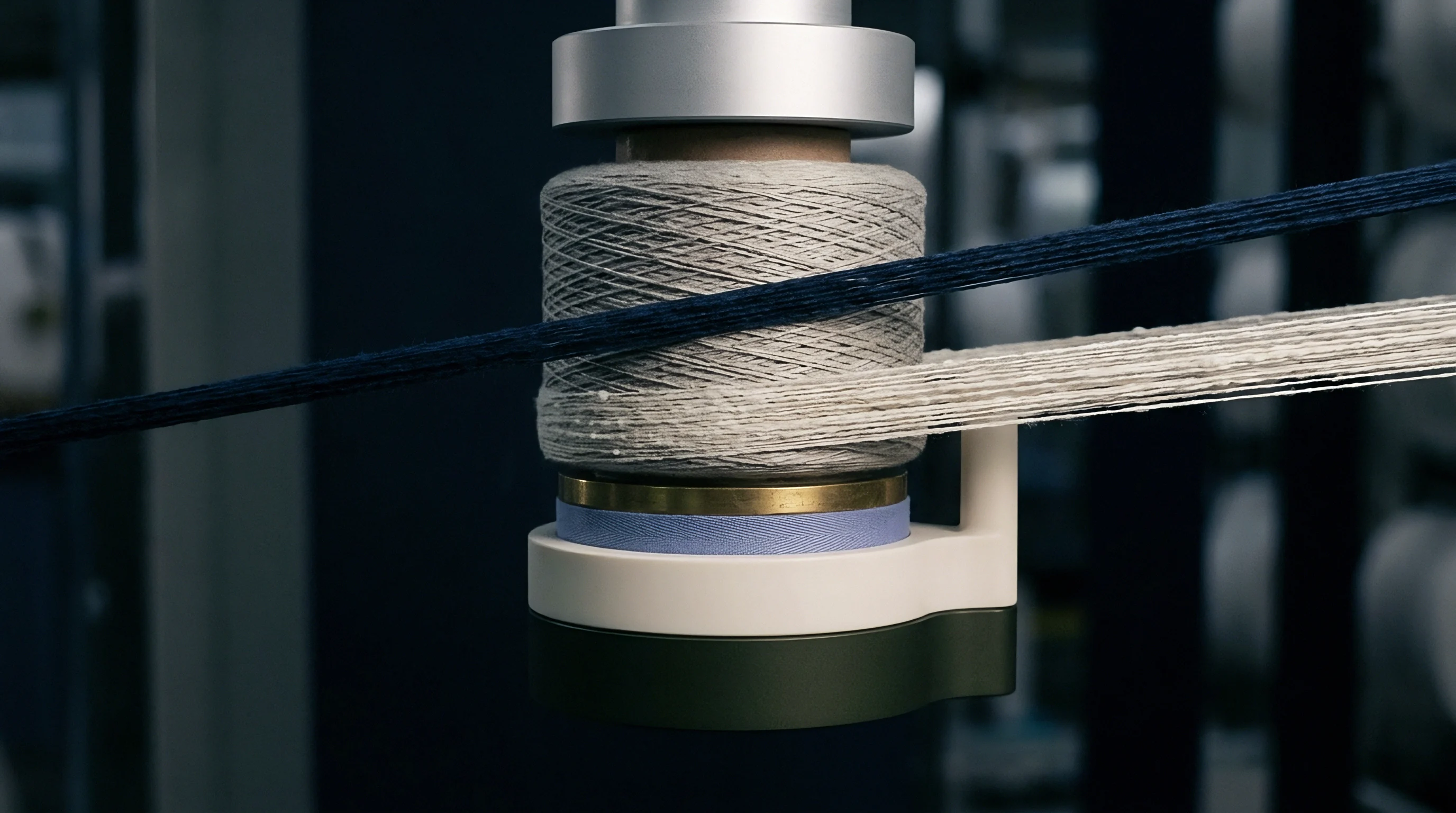
Heat-setting on hot-air pin frames resets the elastic memory of polyurethane cores by melting and recrystallizing polymer hard domains. Stenter processing is the critical step where finished fabric weight, dimensional stability, and stress relaxation thresholds are locked into the textile structure. As core-spun elastic fabric enters the drying chambers, high-velocity air streams rapidly transfer heat into the damp substrate.
When yarn temperature reaches the hard segment softening point ~ typically one hundred and eighty to one hundred and ninety-five degrees Celsius ~ hydrogen bonds inside hard crystallites break. This melting releases residual strains left over from spinning, weaving, or dyeing, letting the inner filament relax into a stress-free state matching the dimensions held by the stenter pin chain.
Heat-setting elastomeric woven goods at one hundred and ninety degrees Celsius for forty-five seconds achieves ninety-two percent dimensional stability after multiple wash cycles.
If stenter dwell time is too short or temperature falls below the hard segment melting point, internal strains remain trapped in the core. When the finished fabric stretches during wear, these trapped stresses combine with applied loads to drive rapid relaxation and garment bagginess. Excessive heat, on the other hand, degrades polyether soft segments through thermo-oxidative scission, permanently weakening retractive power.
Table 2 illustrates how stenter temperature, dwell time, and overfeed influence heat-setting efficiency and long-term stress relaxation in elastic fabrics.
| Temperature (C) | Dwell Time (s) | Warp Overfeed (%) | Weft Extension (%) | Heat-Setting Efficiency (%) | Stress Decay at 500h (%) |
|---|---|---|---|---|---|
| 175 | 30 | +2.0 | +1.0 | 68.4 | 28.5 |
| 185 | 45 | +4.0 | +2.5 | 84.2 | 19.1 |
| 195 | 45 | +6.0 | +3.0 | 93.8 | 12.4 |
| 205 | 60 | +8.0 | +4.0 | 76.1 | 34.2 |
Shrink-Tension Balance and Overfeed Controls
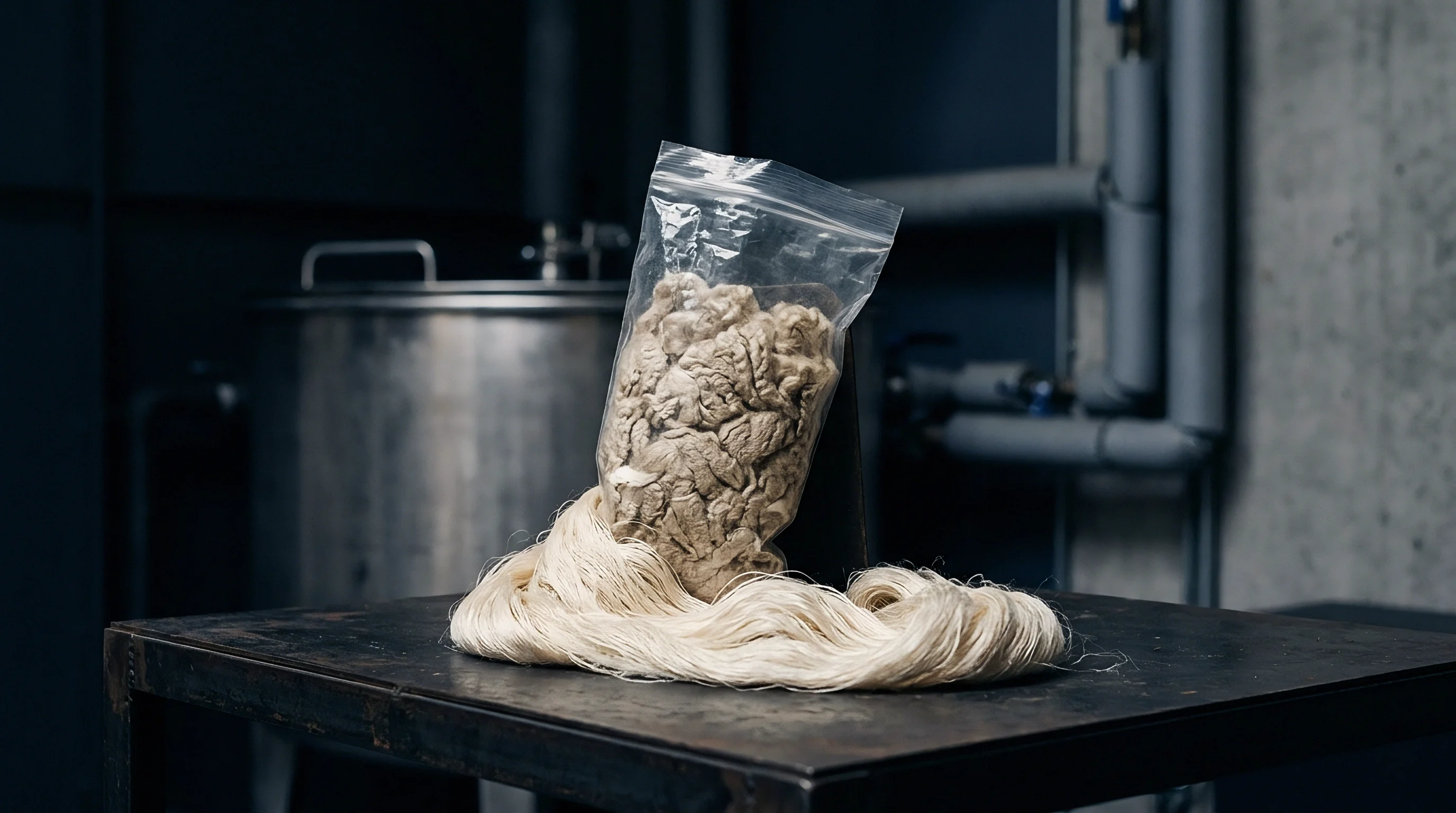
Controlling overfeed at the stenter entry balances tension and shrinkage in core-spun yarns. Overfeeding feeds extra fabric longitudinally into the drying chambers, introducing structural crimp into the warp. This controlled shrinkage increases thread count per unit length and fabric weight, ensuring the elastomeric core is not held under forced tension while hard domains recrystallize.
Without sufficient warp overfeed, the pin chain pulls the fabric tight through both heat and cooling zones, forcing the elastic core to recrystallize in a pre-strained condition. When released from the pins, this locked-in strain triggers continuous relaxation as polymer chains slowly settle toward equilibrium, leaving the finished cloth with higher decay rates and poor recovery.
Cooling zone conditions are just as critical. On leaving the heating zones, the fabric must pass immediately over cold air nozzles or chilled rollers to drop its temperature below the soft segment glass transition point. Rapid chilling locks aligned hard domains into place before winding tension can distort the core; slow cooling lets post-crystallization relaxation begin right on the take-up roll, creating tension gradients through the roll.
A 14,000-metre bulk order of stretch twill was rejected after six-hour relaxation testing showed a 12 percent drop in retractive force.
Under standard commercial contracts, failing baseline elastic recovery checks triggers technical remediation clauses:
Section 8.3 of the International Elastic Fabric Quality Standard dictates that finished stretch textiles exhibiting greater than fifteen percent retractive force loss after two hundred hours of static continuous extension at twenty percent strain shall be rejected at the mill’s expense, requiring complete re-processing or full credit allocation.
Draft

Spinning Draft Ratios and Core Friction
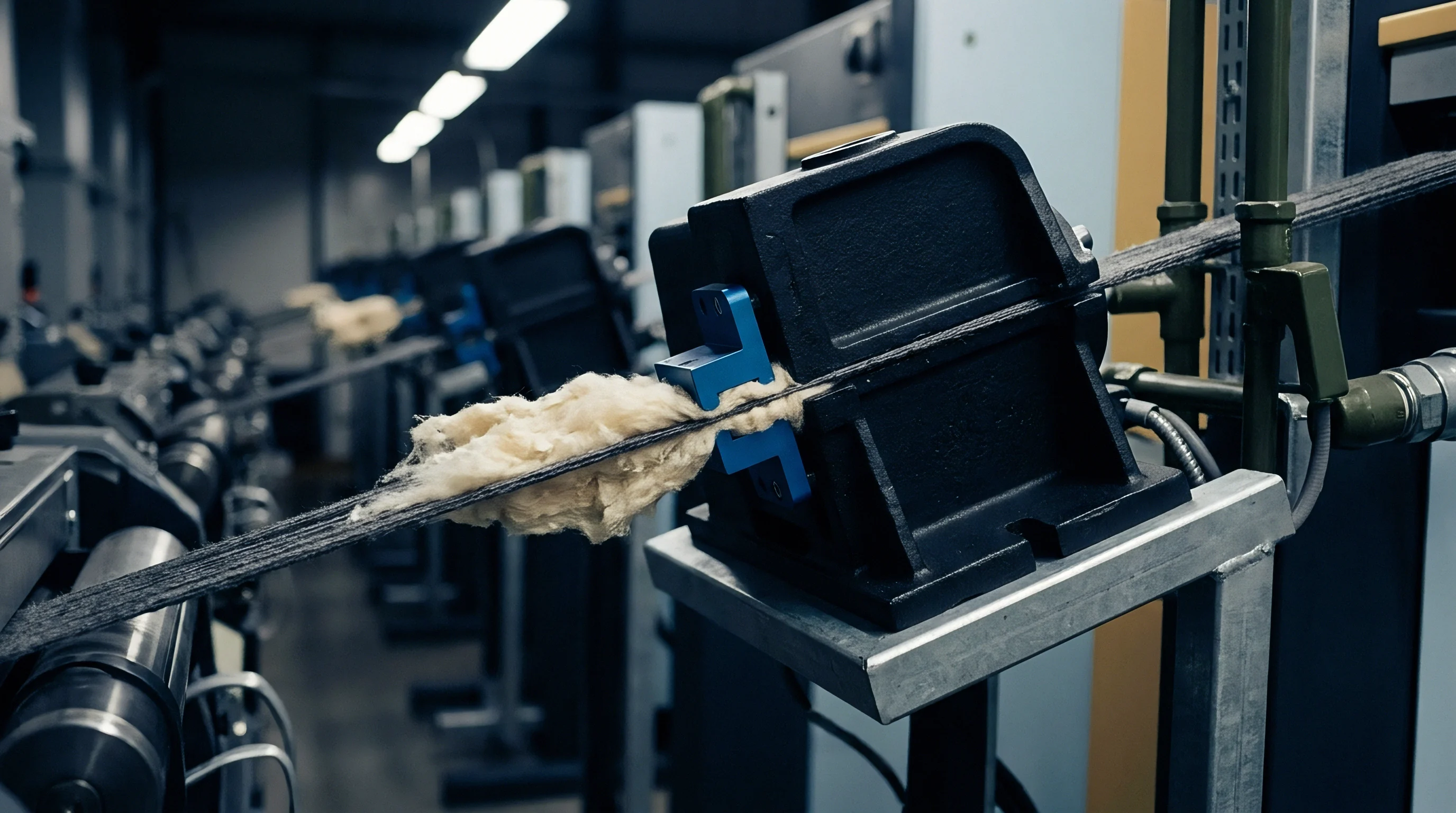
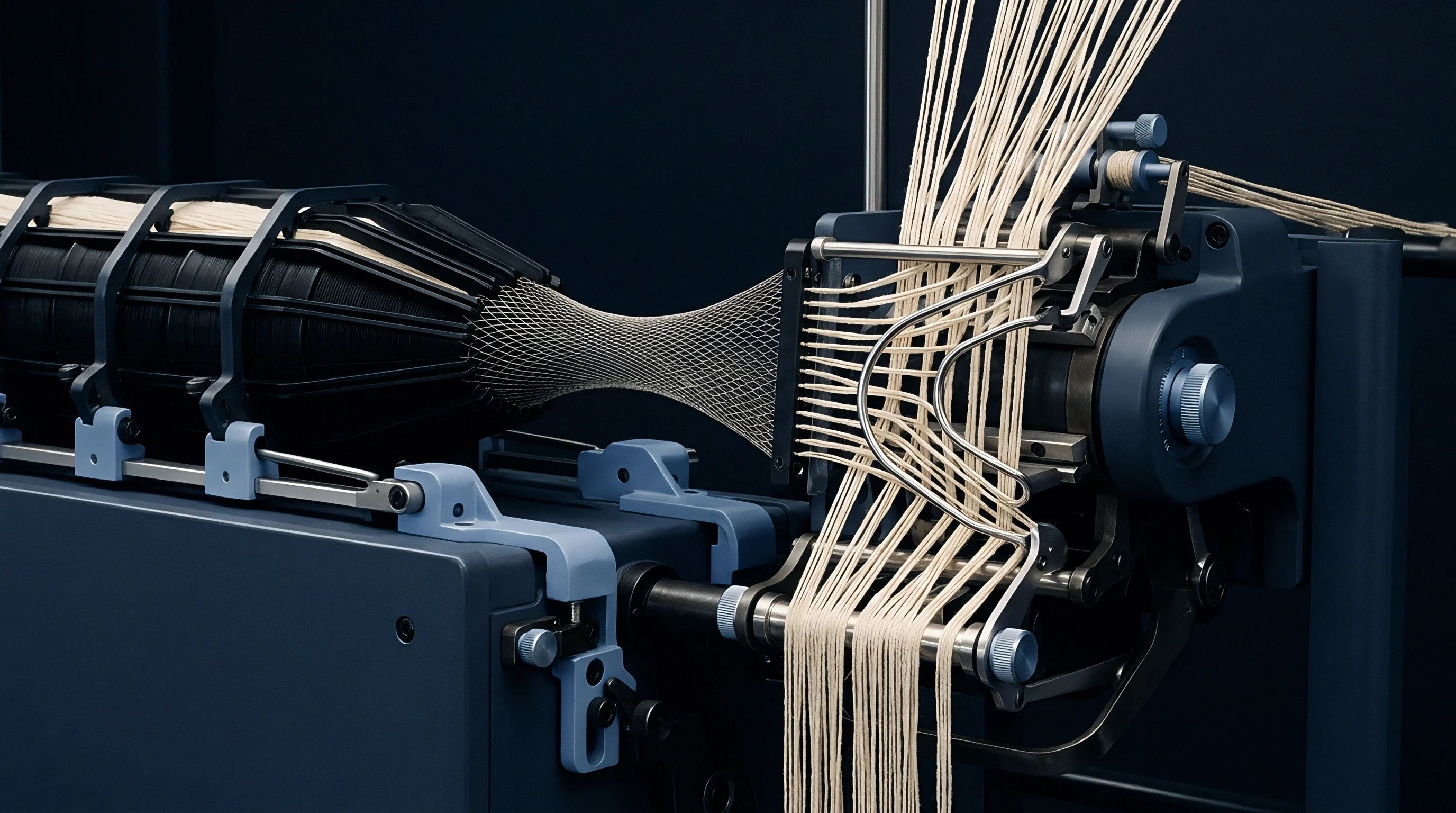
Draft ratios applied during spinning establish the internal stress trapped within finished elastic yarn. On modified ring or air-jet spinning frames, elastomeric filament feeds from a supply bobbin through positive delivery rollers into the drafting zone. The speed ratio between front delivery and elastane feed rollers defines the draft ratio, usually set between 2.0x and 4.5x for apparel yarns.
Higher draft ratios stretch the core further as the sheath wraps around it, lowering denier and saving raw material. However, higher draft locks more strain energy into the core. As the elastomeric filament thins via Poisson contraction, contact area between core and staple fibers drops, reducing interfacial shear resistance and raising the risk of core slip under downstream loading.
If draft exceeds what sheath cohesion can hold, the sheath loses its grip on the stretched core during weaving or knitting. During wet processing, heat lets an over-drafted core snap back inside the sheath, creating core-back defects where hard, inelastic yarn sections mingle with loose, hollow sheath loops.
Interfacial shear stress Tau_interface along a stretched core-spun yarn depends directly on the core draft ratio D_draft and sheath packing factor K_sheath:
Tau_interface = (E_core (D_draft – 1) Radius_core) / (2 L_contact K_sheath)
Here, E_core is the tensile modulus of the polyurethane, Radius_core is the un-drafted core radius, and L_contact is the effective contact length between sheath staples and core. When working tension drives Tau_interface above static friction limits, localized core slip begins, causing rapid stress loss.
Can Prolonged Static Strain Predict Core Shear Slip?
Subjecting core-spun elastic fabric to static extension over extended periods clarifies whether retractive force loss comes from pure viscoelastic relaxation or interfacial slip. Under pure relaxation, tension drops smoothly while the core-sheath bond holds. When strain drives interfacial stress past static friction limits, core shear slip occurs, showing up as sudden, step-like tension drops superimposed on the exponential relaxation curve.
Core-sheath shear slip occurs when localized tension gradients overcome the radial friction enforced by sheath twist.
Detecting core shear slip requires high-resolution force transducers to capture micro-scale tension drops during load testing. When slip occurs, the elastomeric filament slides inside the sheath, shifting strain to adjacent yarn segments. This structural damage permanently alters fabric mechanics, leaving later heat-setting unable to restore lost elastic performance.
To maintain core-sheath integrity and minimize stress relaxation, mills and engineers follow specific rules when setting spinning parameters:
- Draft Optimization selects a core draft ratio between 2.2x and 2.8x to balance retractive power against interfacial contact area, avoiding over-drafting induced core slip.
- Sheath Twist Selection increases the spinning twist factor by ten to fifteen percent above standard hard-yarn baselines to maximize radial clamping force P_radial on the inner elastomeric filament.
- Fibre Length Matching specifies staple sheath fibers with an average length exceeding thirty-eight millimetres to enhance physical fiber entanglement around the continuous elastic core.
- Jet Pressure Calibration adjusts air-jet texturing pressure to construct a tight, compact sheath architecture without imparting abrasive mechanical damage to the elastomeric center.
The exact threshold where viscoelastic relaxation turns into catastrophic sheath slip under multi-directional strain remains poorly defined for air-jet core-spun geometries operating above forty percent extension.
Decay
Threshold Determination Protocols
Long-term tension retention testing under ISO 20932-1 requires continuous load monitoring up to one thousand hours. Standard short-term test methods measuring cyclic recovery over five-minute intervals miss the slow molecular migration and hard-domain dissociation that cause fabric growth during extended storage or garment wear. Establishing accurate relaxation thresholds requires prolonged static extension testing in controlled environments.
Because heat speeds up viscoelastic decay, testing involves mounting calibrated fabric strips in constant-load or constant-extension frames inside environmental chambers held at twenty-one degrees Celsius and sixty-five percent relative humidity. Transducers record retractive force continuously at up to one kilohertz during initial loading, then shift to logarithmic sampling intervals for the rest of the run.
Separating viscoelastic relaxation from structural creep requires plotting the rate of force change dSigma/dt against logarithmic time log(t). Pure relaxation produces a constant slope on logarithmic axes, reflecting steady decay across the polymer’s relaxation spectrum. Any sudden break in slope signals structural damage, such as core slip, yarn pull-out, or staple fiber fracture.
Table 3 lists empirical stress decay constants, force retention figures, and relaxation thresholds across four elastic fabric constructions tested at thirty percent extension over one thousand hours.
| Fabric Build Specification | Elastane Denier / Draft | Initial Force (N) | 100h Retention (%) | 1000h Retention (%) | Relaxation Rate Constant (k) |
|---|---|---|---|---|---|
| Single Jersey 95/5 Cotton/Elastane | 40d / 3.1x | 12.4 | 78.2 | 64.1 | 0.082 |
| Air-Jet Core-Spun Twill 97/3 Cotton/Elastane | 70d / 2.5x | 18.6 | 84.5 | 75.3 | 0.054 |
| Air-Jet Core-Spun Poplin 98/2 Cotton/Elastane | 40d / 2.8x | 14.1 | 81.0 | 70.8 | 0.066 |
| Double Knit Interlock 90/10 Nylon/Elastane | 70d / 3.5x | 24.8 | 72.4 | 58.9 | 0.104 |
Empirical Worked Case Analysis
Evaluating long-term performance is best illustrated with test data from an air-jet core-spun stretch woven twill. Consider a 97 percent cotton, 3 percent elastane twill (finished weight two hundred and forty grams per square metre) built with 70-denier polyurethane core yarn drafted at 2.5x during spinning. To pass garment fit retention standards, a 50 mm fabric strip must maintain at least 10.0 Newtons of retractive force after five hundred hours of static extension at twenty-five percent elongation.
Initial loading generates an immediate peak retractive force Sigma_0 of 18.6 Newtons upon reaching twenty-five percent extension. Applying the Kohlrausch-Williams-Watts decay model to measured force retention gives an effective relaxation time Tau_effective of two hundred and forty hours and a fractional exponent Beta of 0.62. Using these parameters yields expected retractive force figures at progressive time intervals:
At t = 10 hours: Sigma(10) = 18.6 exp(-(10 / 240)^0.62) = 16.83 Newtons
At t = 100 hours: Sigma(100) = 18.6 exp(-(100 / 240)^0.62) = 13.25 Newtons
At t = 500 hours: Sigma(500) = 18.6 exp(-(500 / 240)^0.62) = 8.94 Newtons
At five hundred hours, retractive force drops to 8.94 Newtons ~ falling below the 10.0 Newton threshold. The fabric fails long-term relaxation compliance despite passing standard two-hour laboratory recovery checks. Correcting this requires either dropping the spinning draft ratio to 2.2x to reduce internal strain, or raising stenter heat-setting temperature by eight degrees Celsius to achieve fuller hard-segment recrystallization.
Isolating failure mechanisms relies on precise analytical verification steps:
- Strain Separation Testing differentiates elastic matrix extension from structural yarn translation by running comparative tests on removed individual yarn strands.
- Isochronous Stress-Strain Profiling constructs family curves across multiple time increments to pinpoint the precise transition from linear viscoelastic behavior to non-linear damage propagation.
- Thermal Modulated Relaxation Analysis evaluates retractive force loss across a temperature gradient from twenty to sixty degrees Celsius to calculate activation energies for polymer domain disentanglement.
- Microstructural Recovery Profiling utilizes digital image correlation to map local strain variations across stitch loops during extended extension cycles.
For technical stretch applications, pairing a lower core draft ratio with high heat-setting efficiency yields far better retractive retention than using heavier core deniers stretched at extreme draft ratios.
Yield
Commercial and Financial Realities
Commercial specifications for stretch apparel enforce tight dimensional tolerances to prevent garment deformation. Elastic textiles command higher prices than rigid fabrics, but carry elevated supply-chain risk. When core-spun fabric suffers unexpected relaxation failure, financial losses cascade from the cutting room to retail returns through rejected shipments and debit notes.
In the cutting room, rolls of core-spun elastic fabric require tensionless spreading and relaxation periods ~ typically twenty-four to forty-eight hours ~ before cutting. If cloth arrives from the mill carrying high residual tension in the core, it shrinks unpredictably on the cutting table once unrolled. Pattern pieces cut from unrelaxed fabric snap back to smaller dimensions, ruining garment sizing and rendering full production runs unsellable.
Uncontrolled stress relaxation in stretch woven rolls reduces usable marker width by up to four percent during automated cutting room spreading.
Yield losses directly affect raw material economics. Meeting target fabric weight and stretch percentage requires balancing yarn linear density, reed width, stenter overfeed, and heat-setting dimensions. Trying to gain extra fabric width by over-stretching goods on the stenter frame lowers mill cost per linear metre, but guarantees severe long-term relaxation ~ and any short-term savings disappear when garments sag in use.
Managing supply chain risk requires clear commercial agreements on technical tolerances before placing bulk orders. Contracts must define initial fabric weight and stretch, backed by long-term retractive retention limits verified by accredited laboratory testing.
Auditing stenter temperature calibration records, yarn spinning draft controls, and wet-processing tension controls establishes mill technical capability prior to issuing purchase orders for high-performance stretch programs.
A complete fabric purchase contract must explicitly define minimum retractive force retention after static loading, set strict limits on dimensional growth after washing, and detail the exact test protocols, environmental conditions, and sampling rates required for bulk lot release. If production lots fail relaxation thresholds during incoming inspection, the contract places full financial liability for recutting, remanufacturing, and air freight on the finishing mill.