Predictive Modeling of Carded Ring Spun Tensile Tenacity from Single Fiber Length Skewness Distributions
Single fiber length skewness dictates carded ring spun tenacity by governing floating fiber drafting waves and ineffective stress transfer lengths.

Tail
Carded ring spinning forces floating fibers through the drafting zone without the protective comb that removes short fiber mass. The skewness of the single fiber length distribution governs tensile load sharing across the resulting yarn cross section. When a length distribution exhibits high positive skewness, the population contains an excessive concentration of short fibers below twelve millimeters alongside a sparse population of staple-length fibers.
Standard mean length values conceal this asymmetric distribution. Two cotton lots possessing an identical Upper Quartile Length of 28.5 millimeters produce divergent yarn tenacity when their length skewness differs by more than 0.35 units.
High skewness reduces the effective gripping contact within the drafting apron zone. Shorter fiber fractions slip prematurely during roller drafting, creating localized mass thinning and irregular fiber alignment in the drafted strand. The longer fibers carry disproportionate tensile loads during tensile extension until they slip or rupture, initiating catastrophic strand failure at lower mean tenacity values.
A raw cotton blend exhibiting a length skewness above 0.85 generates carded ring spun tenacity losses exceeding 1.8 centinewtons per tex under standard drafting gauge settings.
Fiber length data collected via individual single-fiber testing arrays reveals distribution shapes that standard High Volume Instrument measurements compress into single indices. Modern Advanced Fiber Information System instruments record length distributions by number and by weight. The third standardized moment about the mean defines the skewness coefficient:
Skewness equals the expected value of the cubed standardized deviation from the mean length. The numerical sign and magnitude indicate the concentration and direction of length asymmetry:
| Mean Length (mm) | Upper Quartile Length (mm) | Length Skewness (Number) | Short Fiber Content (%) | Yarn Tenacity (cN/tex) | Yarn Elongation (%) |
|---|---|---|---|---|---|
| 23.4 | 29.2 | 0.42 | 18.5 | 16.8 | 6.4 |
| 22.8 | 28.9 | 0.68 | 22.1 | 14.9 | 5.8 |
| 21.9 | 28.5 | 0.94 | 27.4 | 12.7 | 5.1 |
| 21.2 | 28.1 | 1.22 | 33.8 | 10.9 | 4.6 |
Ignoring single fiber skewness during blend formulation leads directly to missed yarn tensile specifications, elevated spinning ends-down rates, and expensive re-spinning allowances in commercial supply contracts.


Mechanics
Tensile breakdown in carded ring spun yarn begins at cross sections starved of continuous load-bearing fibers. Fiber ends terminate within the strand, unable to transfer stress across their terminal slippage zones. The classical Gegauff and Hearle yarn mechanics equations establish that yarn strength depends on fiber length, fiber orientation, friction, and normal pressure generated by helical twist.

Is Skewness Predictive of Stress Transfer Length?
Single fiber length skewness dictates the proportion of fiber length dedicated to ineffective stress transfer. Each fiber end possesses an ineffective length where tensile stress builds from zero up to the full fiber load. For a cotton fiber of given linear density and surface friction, this critical grip length spans between three and five millimeters from each tip.
When short fibers dominate the distribution tail, a major fraction of total fiber mass resides within ineffective transfer zones.
The ineffective length fraction increases nonlinearly with positive skewness. In carded slivers, trailing and leading hooks generated during cylinder-doffer transfer exacerbate this mechanical deficit:
- Critical transfer length defines the minimal boundary distance from a fiber tip required to accumulate maximum axial load through surface shear stresses without pull-out.
- Effective load sharing mass constitutes the total cross-sectional fiber population whose continuous length exceeds twice the critical transfer length within a given yarn segment.
- Fiber hook orientation modulates effective staple length when trailing hooks feed backward into the ring spinning drafting zone, delaying stress transfer during axial extension.
- Inter-fiber friction coefficient establishes the normal force conversion efficiency under ring twist, dictating slip thresholds for fibers under twenty millimeters.
Inter-fiber slippage governs structural rupture whenever short fiber mass fractions exceed twenty percent of total cross-sectional volume.
Fiber migration within the spinning triangle establishes internal radial distribution. Longer fibers migrate toward the yarn core under tension, while short, skewed fractions concentrate on the yarn periphery. Peripheral fibers generate wild loops, fly, and loose hairiness rather than cohesive tensile strength.
The exact quantitative interaction between the spatial distribution of fiber ends and the local twist gradient across the spinning triangle remains an open theoretical problem in micromechanical yarn modeling.

Draft
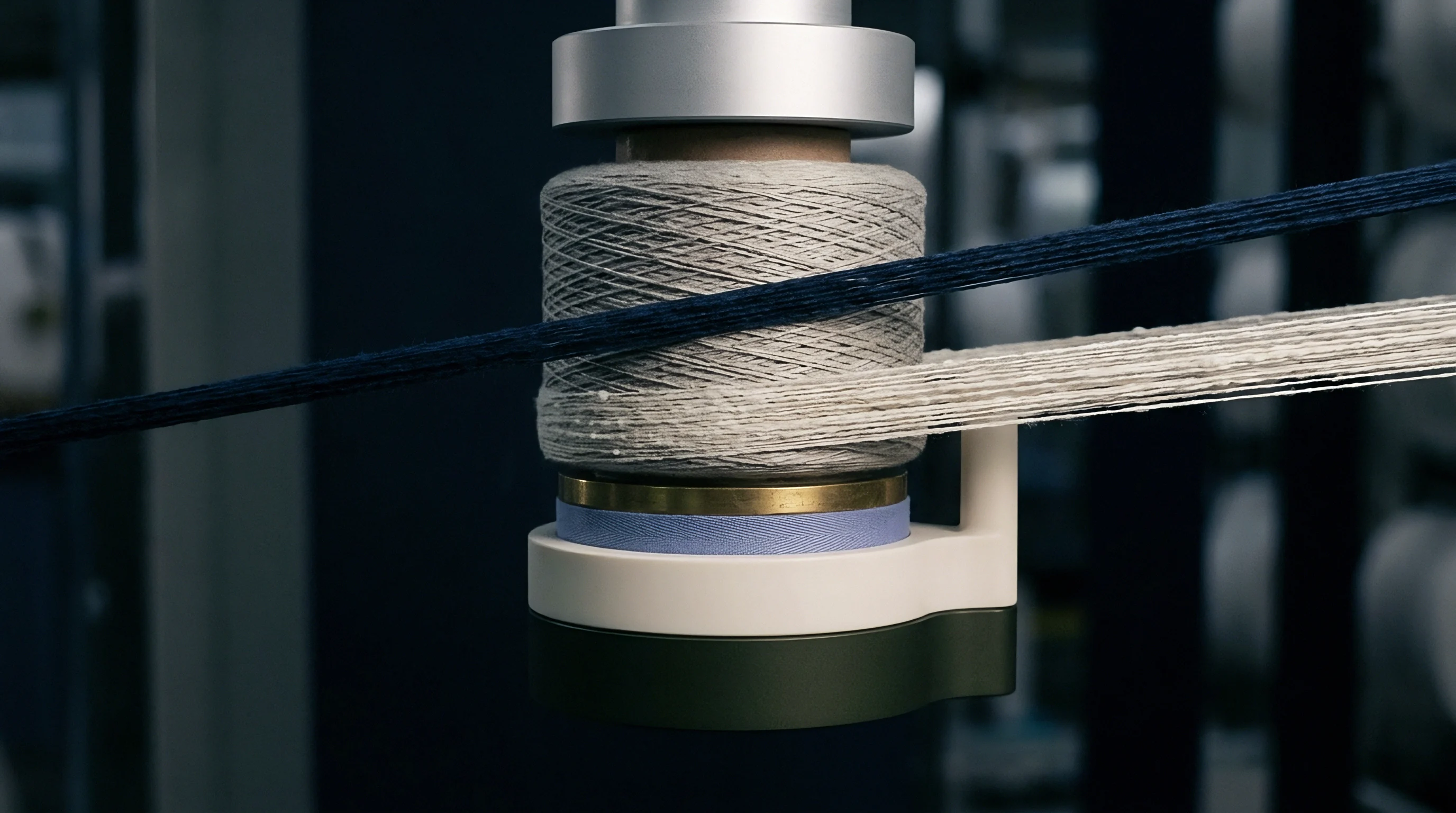
Drafting dynamics in ring spinning frames convert loose carded sliver into fine, cohesive strands. Floating fibers lack simultaneous nip contact with both back and front roller pairs. The motion of these floating fibers depends entirely on frictional contact with neighboring moving fibers.
Positive length skewness intensifies drafting wave formation. As short fibers cluster in the drafting apron zone, drafting waves produce severe cyclic mass variance, directly depressing minimum cross-sectional tenacity. Roller drafting amplifies initial sliver skewness into localized thin places where catastrophic yarn failure occurs during downstream weaving tension cycles.
| Drafting System | Total Draft Ratio | Apron Cradle Spacing (mm) | Sliver Length Skewness | Thin Places (-50% / km) | Tenacity CV (%) |
|---|---|---|---|---|---|
| Short Cradle 3-over-3 | 28.0 | 3.8 | 0.45 | 12 | 8.2 |
| Short Cradle 3-over-3 | 34.0 | 3.8 | 0.72 | 48 | 11.4 |
| Medium Cradle 4-over-4 | 38.0 | 4.2 | 0.91 | 115 | 14.1 |
| Medium Cradle 4-over-4 | 44.0 | 4.2 | 1.18 | 260 | 18.6 |
Controlling carded drafting requires matching apron gauge settings to the specific skewness profile of the raw blend. Spinning technologists adjust break drafts and roller pressures to stabilize floating fiber clusters before final front-roller nip delivery.
Cradle opening adjustments maintain drafting control only within tight boundaries of raw material length variance.
Higher twist levels compensate partially for elevated skewness by increasing normal inter-fiber pressure. This corrective measure lowers spinning frame delivery speeds, increases production costs, and stiffens final yarn handfeel.
Apron grip governs drafting stability whenever fiber length skewness shifts across raw material laydowns.

Modeling
Predictive tenacity algorithms link raw fiber distribution moments to spun yarn performance. Linear regression equations relying solely on micronaire and mean length fail when raw cotton blends contain high length variance. Non-linear formulations incorporate the third statistical moment to account for fiber slip mechanics.

Mathematical Formulation of the Skewness Augmented Tenacity Model
Empirical regression equations calculate single yarn tenacity through modified power-law formulations. A standard operational model expresses carded yarn tenacity in centinewtons per tex:
Tenacity equals the baseline bundle tenacity multiplied by length factor terms, twist efficiency factors, and skewness penalty coefficients. The predictive equation incorporates single fiber properties alongside process variables:
Yarn Tenacity = Fiber Tenacity (1 – Alpha Skewness) (1 – Beta / Mean Length) (1 – Gamma / Twist Multiplier)
Empirical calibration across medium staple carded cotton yields empirical coefficients: Alpha equals 0.22, Beta equals 6.4, and Gamma equals 0.85. The skewness term scales directly with short fiber accumulation.
- Raw material length acquisition extracts individual fiber length arrays using standardized electro-optical single fiber testers across twenty thousand individual fibers per laydown.
- Moment calculation computes the mean length, standard deviation, and skewness coefficient from the discrete length frequency distribution.
- Parameter calibration adjusts empirical coefficients against spinning frame gauge settings, draft ratios, and ring traveler mass profiles.
- Tenacity projection generates expected mean yarn tenacity and prediction intervals for specific English cotton counts.
Raw material suppliers frequently assert that carding flat settings alone correct for high short fiber content in cheap, highly skewed bales.

Customs
Yarn tensile tenacity directly impacts commercial valuation, landed costs, and international trade declarations. Single carded yarns failing minimum tenacity thresholds face rejection at destination knitting plants or trigger contractual penalties under international cotton trade rules.
Standard commercial trade contracts apply price discount schedules when delivered yarn tenacity falls more than five percent below agreed technical specifications.
Customs authorities classify cotton yarns under Harmonized System Chapter 52 based on fiber composition, linear density, and mechanical processing state. Single carded ring spun yarns classified under heading 5205 require precise verification of mechanical specifications when import duties correlate with technical yarn grades.
| Tariff Heading | Count Range (Ne) | Minimum Specified Tenacity (cN/tex) | Base Fiber Cost ($/kg) | Spinning Margin ($/kg) | Tariff Rate (%) |
|---|---|---|---|---|---|
| 5205.11 | Ne 1 to 14 | 12.5 | 1.65 | 0.85 | 5.2 |
| 5205.12 | Ne 14 to 43 | 14.0 | 1.85 | 1.10 | 6.5 |
| 5205.13 | Ne 43 to 52 | 15.5 | 2.10 | 1.45 | 7.0 |
| 5205.14 | Ne 52 to 80 | 17.0 | 2.45 | 1.90 | 8.5 |
Spinning mills purchasing raw cotton lots without distribution skewness parameters risk high product defect rates. A five percent drop in spun yarn tenacity shifts first-quality apparel yarn into discounted secondary industrial markets, erasing operating profit margins.
Under standard commercial sales contracts governed by the International Cotton Association bylaws, tensile strength deficiencies verified via ISO 2064 test protocols entitle the buyer to unilateral invoice deductions or outright lot rejection.