Preventing Filament Damage in Micro Denier Elastomeric Warp Knits
Preventing filament damage in micro denier elastomeric warp knits demands precise beam tension control, strict stenter thermal capping, and low-shear jet scouring.
Draft
Yarn path mechanics on high-gauge tricot machines govern how micro-filaments interact with polyurethane cores during warp preparation. When running micro-denier yarns below 0.8 dtex per filament alongside bare or covered elastane from 15 to 40 dtex, small tension swings can compromise structural integrity. Operating at 28, 32, 36, or 40 needles per inch, high-gauge frames subject incoming threadlines to severe dynamic friction.
Because polyamide 6,6 and polyethylene terephthalate (PET) micro-filaments lack bending stiffness, excess line tension drags them across steel drop wires, guides, and sinker beds. This shears individual micro-fibers while leaving the core bundle intact, causing latent sub-surface damage that surfaces later as fuzzing, micro-filamentation, or broken cores in dyeing and finishing.
Protecting fabric structure starts at the warping creel. Both direct and sectional warping of micro-denier elastomeric blends demand precise individual threadline tensioning. Standard synthetic yarns tolerate tension shifts of plus or minus two grams per tex, but micro-denier multi-filaments paired with elastomeric cores require control within plus or minus 0.3 cN per tex.
Exceeding that threshold stretches the elastomeric core past its yield point before reaching the needles, causing permanent set and uneven stretch recovery across the beam.

Mechanical Strain Profiles in Sub-Denier Yarns
Single filaments under 0.8 dtex present high surface friction relative to their tensile cross-section. A 0.5 dtex multi-filament yarn, for instance, has roughly three times the surface area of a 2.0 dtex yarn of equal linear density. That higher surface area increases mechanical and hydrodynamic drag across guide surfaces on the warping frame and knitting machine.
Passing over ceramic eyelets increases threadline tension exponentially per the capstan friction equation, where output tension scales with incoming tension, friction coefficient, and wrap angle in radians.
Micro-denier filaments snap quickly when tension varies.
During tension spikes, outer micro-filaments carry a disproportionate share of the load. Polyurethane cores elongate readily under low force and stretch during tension pulses, but surrounding micro-polyamide or micro-polyester filaments cannot match that stretch without exceeding their breaking strain. Filaments snap sequentially, forming tiny loops that gather behind needle latches or sinker fingers.
High-magnification inspection shows noticeable guide wear when micro-denier polyester runs continuously through ceramic eyelets.
Standard ceramic guide surfaces with roughness values exceeding Ra 0.2 micrometres induce rapid filamentation in sub-denier yarns.
To manage these variables, mills establish operational boundaries based on yarn linear density, guide bar geometry, and let-off rates. Table 1 outlines setup parameter limits for warping and knitting micro-denier elastomeric structures.
| Parameter | Micro-Polyamide (0.5-0.8 dtex) / Spandex | Micro-PET (0.4-0.7 dtex) / Spandex | Standard Nylon (1.5-2.2 dtex) / Spandex | Tolerance Standard |
|---|---|---|---|---|
| Warping Tension (cN/tex) | 0.8 to 1.1 | 0.7 to 1.0 | 1.4 to 1.8 | ISO 2060 |
| Creel Braking Torque (Nm) | 0.12 to 0.15 | 0.10 to 0.14 | 0.25 to 0.30 | Internal Mill Spec |
| Knitting Machine Gauge (E) | 32 to 40 | 32 to 40 | 28 to 32 | DIN 62125 |
| Guide Bar Let-Off Strain (%) | 2.5 to 3.2 | 2.0 to 2.8 | 4.5 to 5.5 | ISO 13934-1 |
| Needle Bar Displacement (mm) | 0.45 to 0.55 | 0.40 to 0.50 | 0.70 to 0.85 | Machine OEM Standard |
Guide Bar Friction and Tension Spikes
Continuous synthetic filaments running at speeds above 1,500 metres per minute wear micro-grooves into ceramic guides. These tiny channels form in titanium dioxide or aluminum oxide surfaces, turning smooth contact points into sharp edges. Running micro-denier elastomeric yarns over worn guides strips outer filaments from the bundle ~ a defect known as yarn skinning.
Plucked fibers accumulate as fly lint along guide bars, eventually clogging needle throats and breaking threadlines.
Sinker beds on high-gauge machines are another critical contact point. Sinkers control loop formation and holding-down action with needle-bed clearances below 0.10 millimetres. If sinker timing drifts by just 0.02 millimetres, sinker edges strike the micro-denier bundle during knock-over.
While the elastomeric core absorbs the impact by stretching briefly, outer micro-filaments shear against the steel sinker nibs.
Preventing mechanical degradation during processing requires targeted fixes for specific failure modes:
- Micro-filament shaving occurs when rough guides cut outer filaments; solved by fitting polished, plasma-coated ceramic eyelets with surface roughness values below Ra 0.05 micrometres.
- Elastomeric snap-back loops stem from high warp beam braking torque during stops, prevented by using electronic let-off drives linked to active dancer-roll tension feedback.
- Guide needle gouging caused by lateral misalignments between the guide bar and needle trick, corrected by aligning guide needles optically at full operating temperature.
- Section beam tension banding caused by varying package densities across creel positions during sectional warping, eliminated through continuous unwinding tension monitoring across all positions.
Correcting yarn delivery at the creel prevents compound defects downstream. Operators should check warp beam hardness across the barrel with a Shore durometer before mounting beams to the frame. Hardness variations exceeding five Shore D units across the width routinely cause longitudinal shade bands and tension streaks in finished fabric.
At production speeds, preserving yarn structure depends on maintaining uniform contact geometry along every millimetre of the threadline.
Smooth contact surfaces and shallow friction angles keep micro-filaments from shearing.
Heat
Stenter heat-setting sets fabric dimensions, but it exposes delicate polymers to tight thermal windows. Micro-denier elastomeric warp knits need precise temperature profiles to stabilize stitch geometry, reach target weight per unit area, and lock in elastic recovery. Polyamide 6,6 micro-filaments and polyurethane cores react differently to heat: polyurethane starts soft-segment relaxation above 165 degrees Celsius, while micro-polyamide filaments absorb heat rapidly due to their high surface area, where excessive temperatures trigger over-crystallization and degrade filament tenacity.
Pre-heat-setting greige fabric prevents creasing during jet dyeing and establishes baseline width. However, raw fabric entering the stenter carries residual spin finishes, warping lubricants, and knitting oils. Applying heat-setting temperatures to un-scoured goods bakes these mineral oils and silicone lubricants into the micro-polyamide matrix, causing permanent yellowing and brittle filaments.
Thermo-fixation profiles must balance molecular setting against oxidation risks.
Thermodynamic Limits of Polyurethane Cores
Polyurethane elastomer filaments rely on alternating rigid and flexible molecular segments for stretch and recovery. Hard segments built from diisocyanate and short-chain extenders form physical cross-links via hydrogen bonds, while long polyester or polyether soft segments provide elasticity. Between 185 and 195 degrees Celsius in the stenter, hydrogen bonds in the hard segments yield, letting polymer chains realign under tentering tension.
As the fabric cools, new hydrogen bonds reform to set dimensions.
Overheating causes elastane to lose its recovery memory.
Exceeding thermal limits degrades soft segments. Temperatures over 195 degrees Celsius induce thermo-oxidative cleavage in polyether chains, permanently destroying elastic recovery. Micro-denier constructions amplify this risk because thin fabric webs transfer heat almost instantly to the inner core.
While heavy-gauge structures have thicker outer yarns that shield the elastane, micro-denier knits reach full chamber temperature within three seconds of entering the drying zone.
Exceeding 192 degrees Celsius for longer than 35 seconds in the stenter causes a 14 percent loss in elastic recovery.
Loss of recovery force undermines garment shape retention and stretch modulus. Tensile testing of heat-exposed elastomeric yarns yields clear degradation curves. ISO 2062 single-end tensile tests show that exposure to 190 degrees Celsius for 45 seconds reduces bare elastane break elongation by up to 22 percent.
If testing relies on fewer than ten specimens per batch, high variance can obscure localized damage from uneven stenter nozzle temperatures.
Thermal exposure exceeding 190 degrees Celsius for longer than thirty seconds reduces polyurethane core elastic recovery below acceptable commercial limits.
Setting stenter parameters requires clear boundaries tailored to fiber chemistry and fabric weight. Table 2 details thermal processing limits for micro-denier warp knits.
| Fiber Combination | Target Temperature (°C) | Dwell Time Range (s) | Stenter Overfeed (%) | Max Allowable Elastic Loss (%) | Tenacity Threshold (cN/dtex) |
|---|---|---|---|---|---|
| Micro-PA 6,6 (0.6 dtex) / Spandex | 185 to 190 | 30 to 40 | +12 to +16 | 8.0 | 3.8 |
| Micro-PET (0.5 dtex) / Spandex | 190 to 195 | 25 to 35 | +14 to +18 | 10.0 | 3.4 |
| Standard PA 6 (1.5 dtex) / Spandex | 180 to 185 | 35 to 45 | +8 to +12 | 5.0 | 4.2 |
| Recycled Micro-PET / Spandex | 185 to 190 | 25 to 30 | +15 to +20 | 12.0 | 3.1 |
Stenter Dwell Time and Overfeed Dynamics
Chamber exposure time determines how much thermal crystallization occurs within synthetic multi-filament yarns. As stenter chains carry edge-pinned fabric through heated zones, air velocity must float lightweight goods without causing flutter. Fabrics weighing under 120 grams per square metre are sensitive to aerodynamic lift; excessive top-nozzle pressure creates ripples along the pin rail that stretch edges and snap individual filaments.
Thermal degradation quickly ruins stretch recovery.
Managing warp tension inside the stenter requires careful overfeed adjustment. Pinning fabric with positive overfeed ~ between plus 12 and plus 18 percent ~ allows warp yarns to shrink freely in the heat, relieving strain built up during warping and knitting. Without adequate overfeed, micro-polyamide filaments heat-set under high longitudinal tension, restricting warp stretch and thinning the elastomeric core.
Proper thermo-fixation requires systematic operational checks during finishing setup:
- Calibrate individual stenter zone temperature sensors with infrared pyrometers to keep cross-chamber variation within plus or minus 1.0 degree Celsius.
- Clean air nozzles and exhaust filters to keep top and bottom air velocity profiles balanced across all heating zones.
- Set pin chain width to match calculated greige width minus expected thermal shrinkage.
- Engage positive overfeed drives, checking that fabric pins smoothly without bowing or skewing.
- Maintain a steady line speed at entry to avoid dwell time shifts during roll changes.
- Run fabric through cooling zones immediately upon exiting the heating chamber to drop web temperatures below 60 degrees Celsius.
When mills experience elastomeric core failure, technical teams often attribute the flaw to raw material defects like low-tenacity elastane or internal voiding. However, laboratory cross-sections of damaged filaments usually reveal that poor temperature control in the stenter broke down the polymer matrix during finishing.
Bath
Jet dyeing subjects fabric ropes to hydraulic impact and chemical extraction forces. Micro-denier elastomeric knits degrade easily during wet processing. High-surface-area micro-filaments absorb dyestuffs and auxiliaries much faster than standard denier fibers, while mechanical agitation inside jet vessels exposes fabric ropes to high-velocity fluid, pipe friction, and rapid turns.
Protecting filament structure requires balancing liquor ratios, dye migration rates, and rope speed.
Thorough scouring is essential. Raw micro-denier knits carry significant amounts of silicone warping oils, anti-static lubricants, and needle oil. These hydrophobic residues block dye sites, causing unlevel shades, streaks, and poor color fastness.
Removing them requires surfactant formulations that emulsify non-polar oils at moderate temperatures without stripping protective surface coatings from bare elastane.
Which Surfactant Systems Minimize Filament Abrasion during Scouring?
Non-ionic scouring baths emulsify spin finishes and silicone oils without fully stripping protective surface films. Ethoxylated fatty alcohols with broad ethoxylation distributions extract grease efficiently while maintaining low interfacial tension. Anionic surfactants like secondary alkane sulfonates aid soil suspension, but high concentrations swell bare polyurethane cores, leaving them vulnerable to mechanical damage inside jet nozzles.
Wet friction easily snaps fine nylon filaments.
Adding wet lubricants to scouring and dye baths reduces fiber-to-fiber and fiber-to-metal friction. At rope speeds above 300 metres per minute, micro-filaments generate frictional heat as they pass through venturi tubes. Polymer lubricants made from high-molecular-weight polyacrylamides or fatty acid condensates form a protective film over the fabric rope, cushioning folds to prevent chafing, micro-filament plucking, and rope marks.
Bath pH also demands careful control. Polyurethane cores undergo hydrolytic degradation in hot alkaline conditions. Keeping the bath between pH 4.5 and 5.5 using buffered organic acids prevents chemical attack on ester or ether linkages in elastane soft segments.
Continuous pH monitoring guards against spikes from alkaline carryover in raw materials.
Surfactants reduce mechanical drag inside jet vessels.
The boundary layer dynamics that lubricate micro-filaments parallel hydrodynamic film behavior in high-shear marine thrust bearings. Both rely on thin polymer films to prevent solid-surface contact at high fluid velocities.
Excessive jet nozzle shear cuts delicate fibers.
Wet processing parameters require tight control at every step. Table 3 lists operational boundaries for wet processing chemistry and jet machine mechanics.
| Process Stage | Chemical System / Parameter | Mechanical Limit | Structural Failure Risk |
|---|---|---|---|
| Pre-Scouring | Non-ionic fatty alcohol ethoxylate (2.0 g/L) | Liquor Ratio 1:8 | Incomplete oil emulsification, silicone spots |
| pH Buffer Control | Acidic buffer system (pH 4.8 to 5.2) | Continuous dosing | Alkaline hydrolysis of polyurethane core |
| Jet Dyeing (PA 6,6) | 1:1 Acid dyes / Leveling agent (1.2 g/L) | Max Rope Speed 250 m/min | Chafing, surface fuzzing, dye streaks |
| Jet Dyeing (PET) | Disperse dyes / Anti-crease lubricant (2.5 g/L) | Nozzle Pressure 1.2 bar | Filament shear, core thermal degradation |
| Reduction Clear | Sodium hydrosulfite (2.0 g/L) / Soda ash (1.5 g/L) | Temp limit 70°C | Elastane degradation from harsh reduction |

Jet Nozzle Shear Forces and Mechanical Agitation
Liquor flow inside soft-flow jet tubes transfers kinetic energy directly to the fabric rope. Operators often boost nozzle pressure to move lightweight micro-denier fabrics through transport tubes without knotting, but that generates severe fluid shear. Passing fabric ropes through narrow venturi rings at pressures above 1.5 bar peels back outer micro-filaments, leaving visible frostiness and surface unlevelness.
Soft-flow and overflow machines fitted with wide nozzles reduce mechanical impact. Matching venturi nozzle diameter to rope volume prevents localized pinching. An undersized nozzle compresses the rope, driving internal elastomeric cores against outer micro-filaments and fracturing them.
An oversized nozzle causes fabric slip, where liquor bypasses the rope and leads to vessel blockages or heavy abrasion against reel surfaces.
Rope cycle times must align with bath heating rates. Heating faster than 1.0 degree Celsius per minute creates temperature gradients between outer and inner rope layers. That rapid heating induces uneven shrinkage in micro-polyamide yarns, locking elastomeric cores under variable tension.
Keeping the heating ramp between 0.5 and 0.8 degrees Celsius per minute ensures uniform thermal transfer throughout the rope.
Excessive jet nozzle hydraulic pressure creates fluid shear forces that slice surface micro-filaments, producing permanent optical frostiness.
Exposing a 15,000-metre production lot of 32-gauge micro-nylon spandex fabric to 2.2 bar fluid pressure from an uncalibrated jet nozzle regulator during dye dispersion cycles can trigger a 42,000 dollars loss in damaged goods.
Inspection
Quality checks on incoming warp-knit rolls are meant to catch structural defects before fabric reaches the cutting table, but micro-denier elastomeric knits complicate standard inspection. Visual inspection often misses sub-surface filament damage, latent elastomeric fatigue, or tiny loop formations. A roll can appear flawless under overhead lighting while carrying core damage that surfaces only when a finished garment stretches in use.
Catching these defects requires a combination of physical, optical, and mechanical tests. Four-point visual inspection under ASTM D5430 provides a baseline for surface faults, but micro-denier knits require specific sub-clauses for fine-filament failures. Penalty point calculations should account for filament breakage severity, elastomeric snap-backs, and streak density per linear metre.
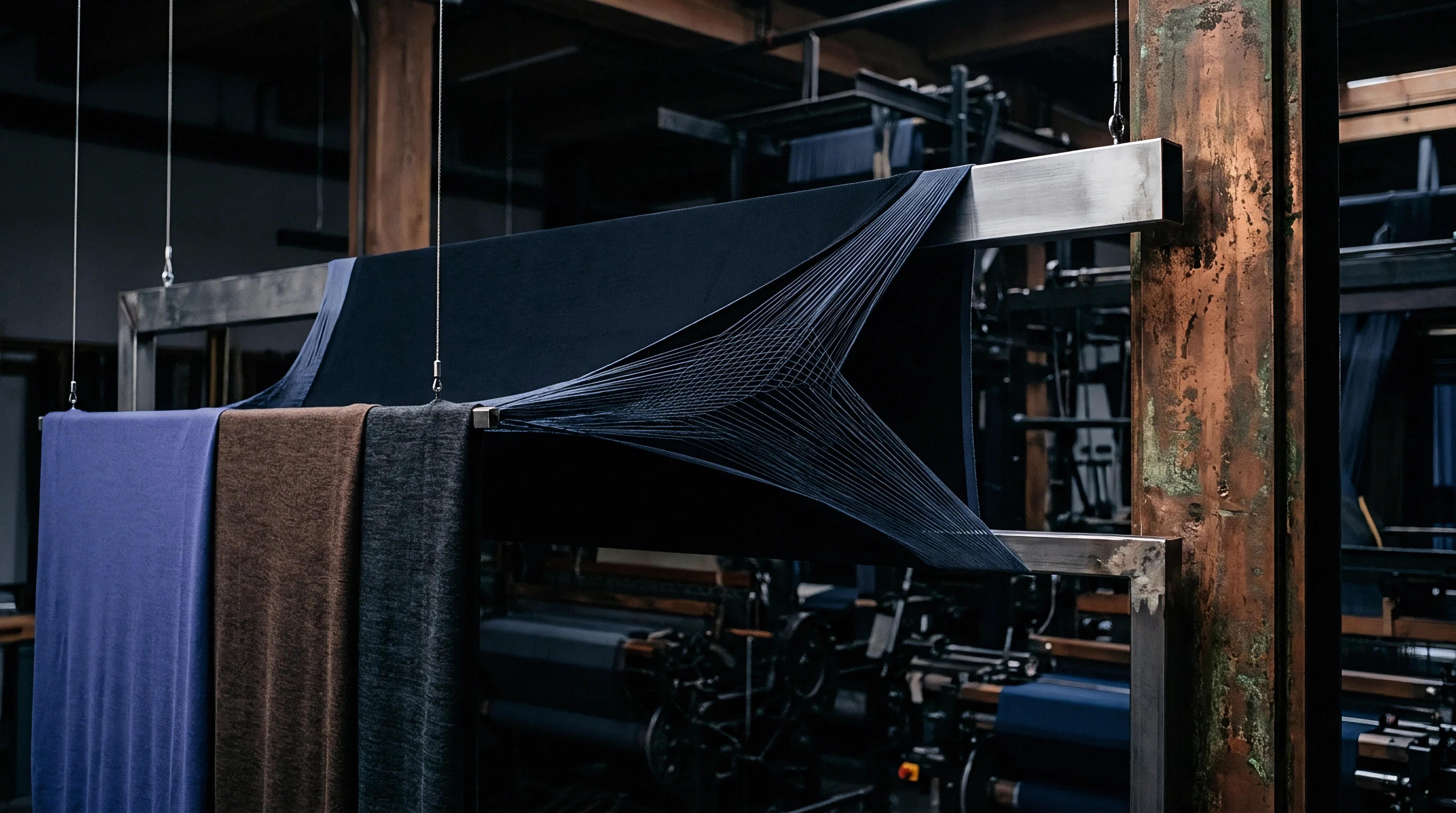
Optical Evaluation and UV Failure Mapping
Stereo microscopy reveals filament break patterns that daylight inspection misses. Examining damaged swatches under 40x to 100x magnification discloses multi-filament bundle structure: intact micro-filaments lie parallel in smooth loop arches, while damaged ones exhibit irregular crimping, frayed ends, and tangling around loop bases.
Inspection frames expose hidden core breaks under specialized lighting.
Ultraviolet (UV) lighting helps map broken elastomeric cores. Bare polyurethane absorbs UV light differently than semi-dull micro-polyamide or micro-polyester ground yarns. Passing rolls over an inspection table equipped with long-wave UV light (365 nanometer wavelength) causes continuous elastomeric lines to glow; where core filaments have snapped and retracted, dark gaps appear along the wales.
Counting these gaps per 100 square metres gives an objective core failure metric before cutting.
Physical testing must complement visual inspection. Pneumatic bursting strength tests under ISO 13938-1 measure multi-directional force capacity. For micro-denier stretch knits, pneumatic testing is preferred over hydraulic diaphragm methods because pneumatic pressure reduces sample distortion at clamps.
Drops in bursting strength below 250 kilopascals indicate structural filament damage or core degradation.
Stretch and recovery metrics under BS EN 14704-1 (strip test method) evaluate functional performance. Applying a 10 Newton load across fabric strips and measuring unrecovered elongation after 30 minutes of relaxation reveals structural loss. Unrecovered elongation exceeding 8.0 percent indicates thermal or mechanical core degradation.
Defect qualification requires systematic laboratory steps prior to bulk shipment release:
- Microscopic loop profiling requires cutting three swatches across the fabric width and counting broken micro-filaments per 100 loops under a stereomicroscope.
- Ultraviolet gap counting involves running rolls over a dark-room inspection frame fitted with 365 nm UV tubes to count elastomeric break gaps per 50 linear metres.
- Pneumatic burst testing requires testing five circular specimens per roll under ISO 13938-1, discarding rolls that drop below the kilopascal threshold.
- Elastic recovery verification requires conditioning test specimens for 20 hours under ISO 139 standards before cyclic testing on tensile frames.
Setting defect thresholds requires defining quantitative limits in commercial agreements so laboratory testing can identify compromised lots before cutting. Contract specifications often state that any bulk delivery showing more than three elastomeric core breaks per 100 linear metres under UV inspection entitles the buyer to reject the shipment lot at the mill’s expense.
Allowance
Scrap rate calculations determine whether micro-denier stretch fabric production remains profitable. These knits carry high landed costs per metre compared to standard synthetics. Sub-denier yarns and high-tenacity elastane command premium prices, while high-gauge knitting machines run at lower linear speeds, increasing machine-hour overhead.
When filament damage occurs, scrap and second-quality downgrades quickly erase margins unless mill yield allowances are accurately modeled and contractually protected.
Calculating true yield requires accounting for selvedge trim, thermal shrinkage, and test sampling. High-gauge stenters grip selvedges on pin chains, leaving 25 to 35 millimetres of pin-hole waste per side. On a nominal 1,500-millimetre fabric width, selvedge trim consumes up to 4.5 percent of total mass.
If micro-filament damage occurs near edges from pin unhooking or lateral tension, trimming width must expand, driving selvedge scrap above 7.0 percent.
Commercial Yield Loss and Scrap Calculations
Selvedge trim waste climbs rapidly when elastomeric tension drops near fabric edges. Beyond edge trim, thermal relaxation during heat-setting reduces overall length. High-gauge tricot fabrics typically shrink 12 to 18 percent in length during finishing.
Sourcing managers ordering greige goods must account for this contraction: an order of 10,000 linear metres of greige fabric yields roughly 8,300 metres of finished goods.
Uncontrolled yield loss directly increases landed fabric costs.
Second-quality downgrade limits must reflect how micro-defects impact automated cutting. Standard four-point inspection allows up to 40 penalty points per 100 square metres for first-quality fabric, but for premium micro-denier activewear or intimate apparel, that tolerance is overly permissive. A single 10-centimetre streak of broken micro-filaments or a snapped elastomeric core disrupts marker lays across the full width in automated cutting operations.
Technical specifications usually require tighter caps ~ typically 18 to 22 points per 100 square metres.
Risk modeling requires evaluating costs across each production phase. Table 4 breaks down the cost structure, yield losses, and financial exposure points across a typical micro-denier warp knitting supply chain.
| Production Step | Cost Component (% Total Landed) | Standard Yield Loss (%) | Filament Damage Risk Factor | Financial Exposure per 10k Metres ($) |
|---|---|---|---|---|
| Yarn Warping & Preparation | 28.0 | 1.5 to 2.5 | High (Tension spikes, friction) | 3,500 |
| High-Gauge Knitting (E36) | 22.0 | 2.0 to 3.0 | Critical (Needle/sinker shear) | 5,200 |
| Stenter Pre-Heat Setting | 12.0 | 1.0 to 1.5 | Critical (Polymer degradation) | 7,800 |
| Jet Dyeing & Scouring | 18.0 | 2.5 to 4.0 | High (Hydraulic shear, chafing) | 9,400 |
| Final Stenter Finishing | 10.0 | 4.0 to 7.0 (Trim) | Moderate (Edge pinning tear) | 4,100 |
| Quality Control & Packing | 10.0 | 1.0 to 2.0 | Low (Handling damage) | 1,800 |

Contractual Claim Clauses and Defect Thresholds
Purchase contracts must define acceptable quality limits for filament breakdown prior to yarn clearance. When sub-surface damage or core failure occurs, yarn suppliers, knitters, and dyehouses often dispute liability. Fiber producers point to aggressive jet dyeing, dyehouses cite uneven warping tension, and knitters blame stenter temperature profiles.
Resolving these disputes requires unambiguous contract terms that assign financial liability based on laboratory testing.
A commercial contract for micro-denier stretch fabrics requires five primary protective provisions:
First, cap micro-filament break frequencies at two breaks per linear metre under 50x magnification. Second, establish baseline elastic recovery under BS EN 14704-1 at a minimum of 92 percent after 30 minutes of relaxation, with failure triggering full roll credit. Third, enforce raw material batch traceability across all warp beams to link greige lots back to specific spinning batches.
Fourth, require commission finishers to record stenter temperatures and line speeds continuously using digital loggers and provide records on request. Fifth, define scrap credit formulas for cutting-room downtime caused by unmarked latent core breaks.
Contracts must also address potential long-term hydrolytic degradation in polyurethane cores. Accelerated aging tests ~ exposing samples to 70 degrees Celsius at 95 percent relative humidity for 72 hours ~ attempt to predict elastomeric lifespan, though correlation with actual wash life remains imperfect. To manage this risk, buyers frequently include a retention clause holding back five percent of order value for 90 days post-delivery to offset potential field failures.
How far should a buyer shift technical verification costs onto commission finishers when micro-denier filament damage occurs deep within internal core structures?