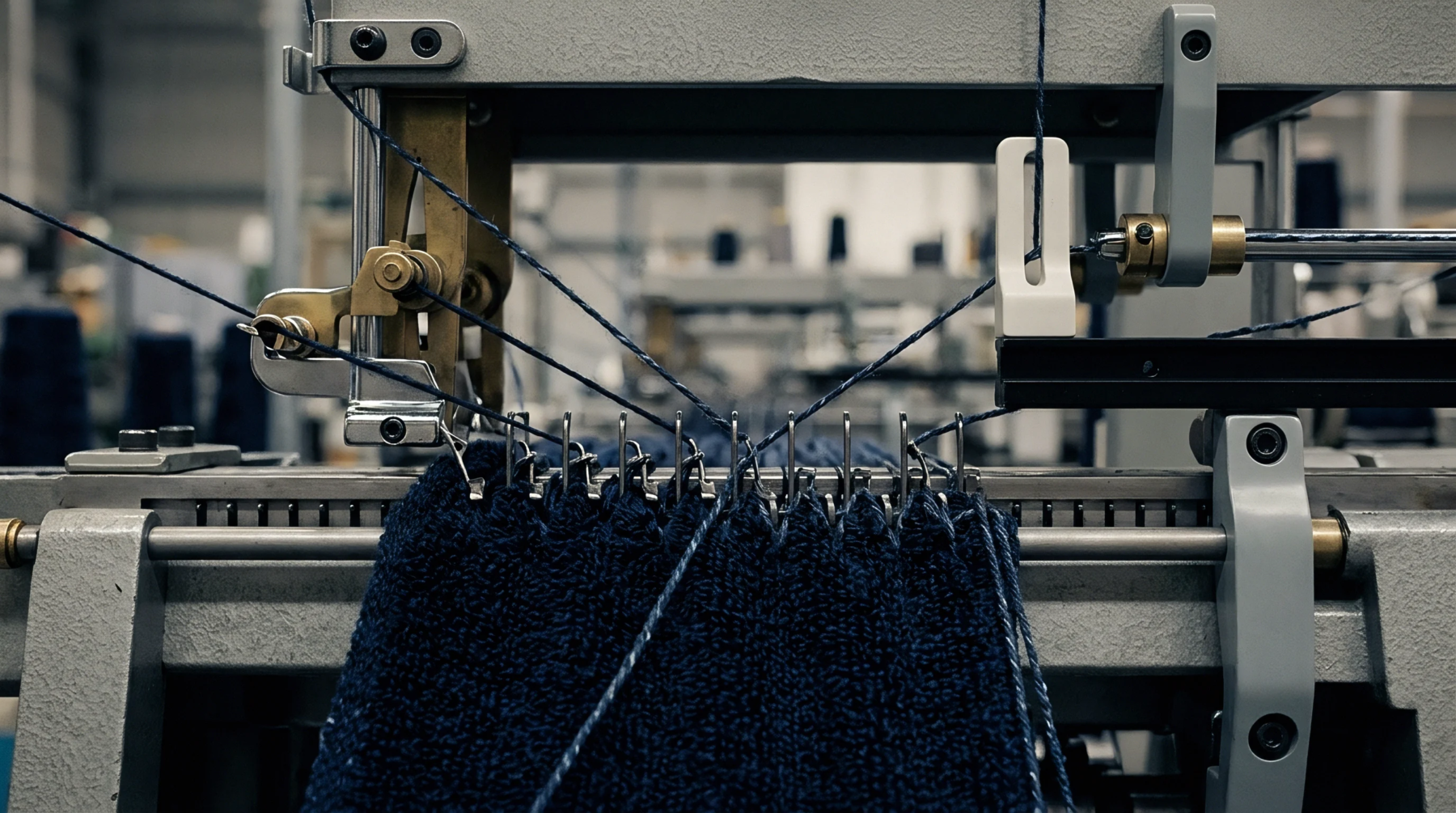
Dimensional Regulation
Mechanical and automated management of individual stitch loop perimeters governs fabric density, yield, and recovery dynamics across all knitting systems. Accurate loop length control coordinates needle draw-depth settings with synchronized yarn feeding velocities to secure repeatable stitch dimensions. Machine gauges, cam positions, and active yarn delivery speeds determine the exact linear millimetres of yarn locked within each structural knit loop.
The metric dictates fabric areal weight, air permeability, and dimensional stability through subsequent wet processing. The boundary isolates loop dimension stabilization mechanisms, excluding downstream stenter overfeed adjustments and garment cut-and-sew sizing protocols.
Control Mechanics
Stitch cam displacement down the needle trick regulates the physical length of drawn yarn. In dynamic loop length control systems, motorized cams reposition vertically in response to digital fabric weight sensors or continuous yarn consumption signals. Positive feeding units meter fixed yarn lengths per needle cylinder revolution, preventing yarn tension spikes from starving needle hooks.
Variations in yarn package winding density or friction waxes alter running tension, requiring instant cam adjustments to preserve target stitch sizes. Needle travel distances must align precisely with yarn elasticity to prevent filament deformation.
Physical Outcomes
Stitch dimensions govern how finished goods behave under stress and wet processing. Oversized loops reduce fabric bursting strength, elevate air porosity, and increase shrinkage potential during industrial laundries. Undersized loops yield dense, rigid fabrics prone to needle cutting defects and excessive structural stiffness.
Uniform loop perimeters guarantee flat, torque-free textile structures capable of passing stringent dimensional stability audits.
Quality Verification
Laboratory validation relies on de-knitting methods, where technician teams unravel marked wale sections from dry-relaxed fabric swatches to measure unravelled yarn lengths under controlled tension. Comparing de-knitted yarn lengths against course counts establishes the true mean loop length per stitch. Discrepancies between targeted and unknitted lengths expose stitch cam drift or faulty feeder tape tensions.
Modern factories employ digital course counters to inspect stitch consistency continuously throughout full production rolls. Stable stitch dimensions ensure that downstream dyeing lots hold consistent target weights.