Standardizing Cut Length Specimen Tensioning for Ring Spun Density Audit
Standardizing specimen pretensioning at 0.5 cN per tex during cut length density audits eliminates crimp skew and ensures accurate fabric weight verification.


Crimp
Ring spun cotton yarns follow a helical geometry that contracts the moment tension drops during cutting. When a technician snips a strand from a fabric roll or reeling frame without applying longitudinal pull, internal torsional stresses release instantly, causing the loose yarn to recoil and reducing end-to-end length while driving up effective mass per unit length. Evaluating linear density or fabric areal mass under un-tensioned conditions introduces systematic errors that skew density audit figures.

Viscoelastic Deformation in Ring Spun Structures
Staple fibers bundled under mechanical twist store residual energy. Ring spinning inserts real twist through the strand profile, forcing outer fibers into longer helical paths than those in the core. Once woven or knitted into cloth, these yarns take on structural crimp as warp and weft threads curve around each other at every pick and end intersection.
Releasing a strand from this matrix triggers both structural crimp relaxation and viscoelastic recovery across the spun assembly.
Un-tensioned cut length specimens exhibit contraction rates between two percent and five percent depending on twist factor, yarn count, and fiber length. A specimen cut to an un-tensioned length of one hundred millimeters on a cutting table expands when straightened under standardized load. Measuring yarn weight directly from an un-tensioned template cut makes the calculated linear density in tex or Ne appear heavier than the true yarn value, shifting calculated fabric mass per unit area upward and triggering false rejections during quality verification.
Mechanical tensioning removes structural waviness before elastic yarn elongation begins.
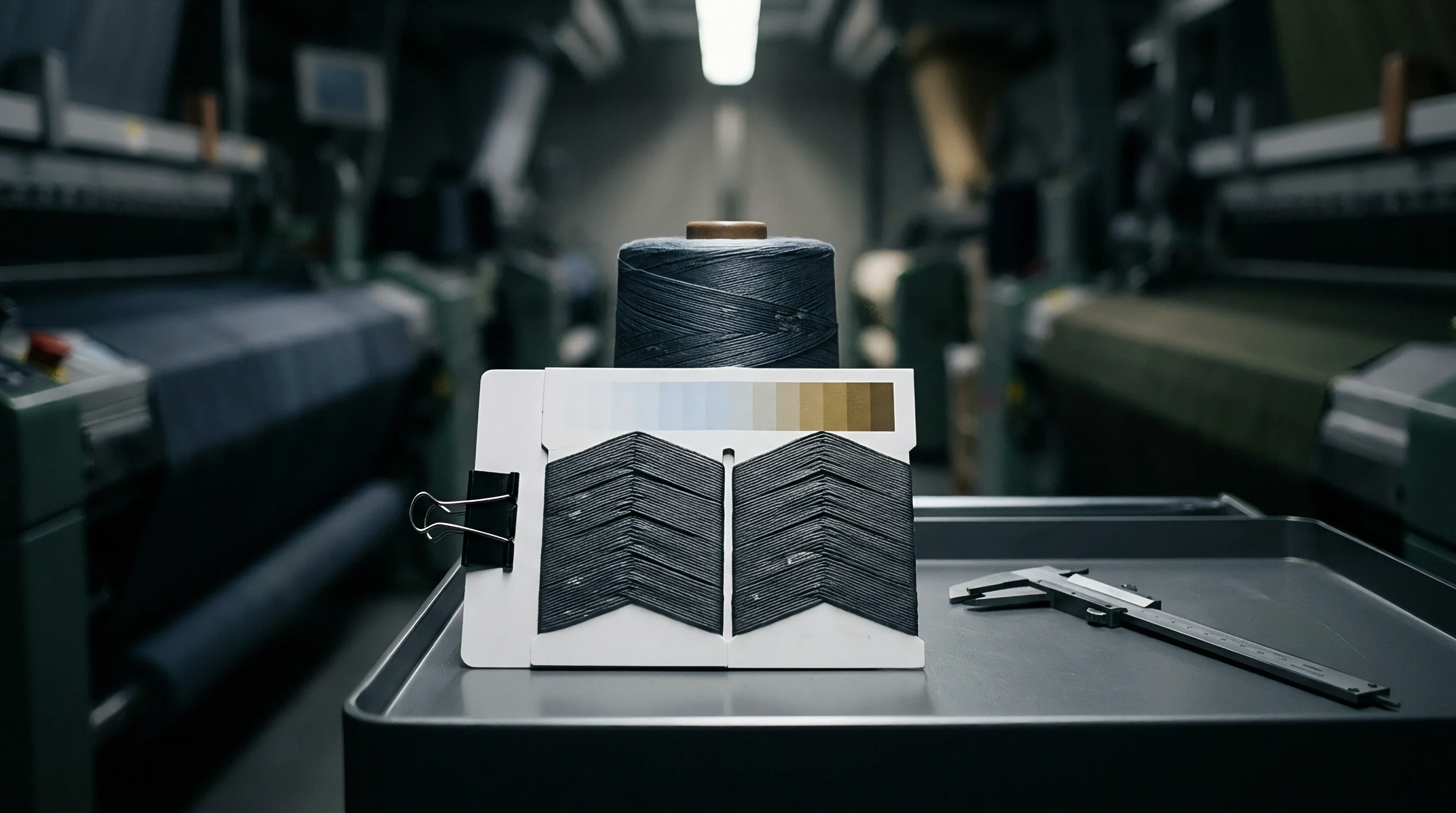
Geometric Slack versus Structural Extension
Unconstrained yarn segments exhibit macro-level bending when freed from fabric interlacings. Tensioning cut length specimens isolates true strand length by removing two distinct phases of extension. The initial phase takes out geometric slack ~ the physical wave pattern set by weaving or knitting ~ straightening the strand without stretching staple fibers or pulling fiber ends past one another inside the yarn matrix.
The second phase begins when applied force exceeds the yield point of the twist structure, causing inter-fiber slip and elastic elongation of individual cotton fibers. Standardizing specimen tensioning requires operating strictly within the linear region between slack removal and elastic deformation, applying steady load until structural waves disappear without stretching the strand.


Load
Applying a precise gravitational load to cut strands establishes a reproducible baseline length. Laboratory testing protocols define specific pretension force calculated against nominal yarn linear density, and applying a fixed centinewton load per tex standardizes specimen length across varying yarn sizes, mill sources, and fiber blends.
Standardized Mass Calibration for Extracted Strands
International testing framework ISO 2060 mandates calibrated tension weights during linear mass determinations. For ring spun short-staple cotton yarns, standard practice establishes a pretension load of zero point five centinewtons per tex, with an allowable tolerance of plus or minus zero point zero five centinewtons per tex. Coarser ring spun yarns and plied structures require higher load thresholds to overcome flexural rigidity, whereas fine combed strands require lighter loads to prevent permanent elongation.
| Fiber Type and Structure | Nominal Count Range (tex) | Standard Pretension (cN/tex) | Un-tensioned Contraction (%) | Over-tension Elongation (%) |
|---|---|---|---|---|
| Combed Ring Spun Cotton | 10 to 20 tex | 0.50 ± 0.05 | 2.1 to 3.2 | 0.8 to 1.4 |
| Carded Ring Spun Cotton | 21 to 40 tex | 0.50 ± 0.05 | 2.8 to 4.1 | 1.1 to 1.9 |
| Polyester / Cotton Ring Spun Blend | 15 to 30 tex | 0.45 ± 0.05 | 1.8 to 2.9 | 0.6 to 1.2 |
| Plied Ring Spun Cotton (2-ply) | 30 to 60 tex | 0.75 ± 0.08 | 3.5 to 4.8 | 0.4 to 0.9 |
| Data derived under standard atmosphere ISO 139 conditions at 20°C ± 2°C and 65% ± 4% relative humidity. | ||||

When Is Pretensioning Mandatory during Cut Length Inspection?
Strands removed from woven or knitted matrices require mechanical straightening before length measurement, because fabric density audits derived from extracted thread counts rely directly on true straightened yarn length per unit area. Pulling threads from a ten-centimeter square cut specimen without applying pretension introduces length variations that corrupt the calculated yarn mass balance.
Failing to standardize tensioning during incoming material inspection creates structural discrepancies across laboratory shifts and testing locations.
- Slack specimen mounting introduces geometric contraction that overstates yarn linear density by three to five percent during balance weighing.
- Excessive dead-weight loading permanently draws out carded staple fibers, artificially inflating the calculated single yarn length and yield.
- Inconsistent clamp placement causes uneven force distribution along the cut length, creating wide variance across replicate tests.
- Uncalibrated tension springs exert variable load across multiple testing stations, compromising cross-mill audit reliability.
Applied loads exceeding 0.75 centinewtons per tex induce permanent extension in carded ring spun cotton yarns.
Cut length contraction represents natural fiber relaxation rather than an intrinsic sampling defect.
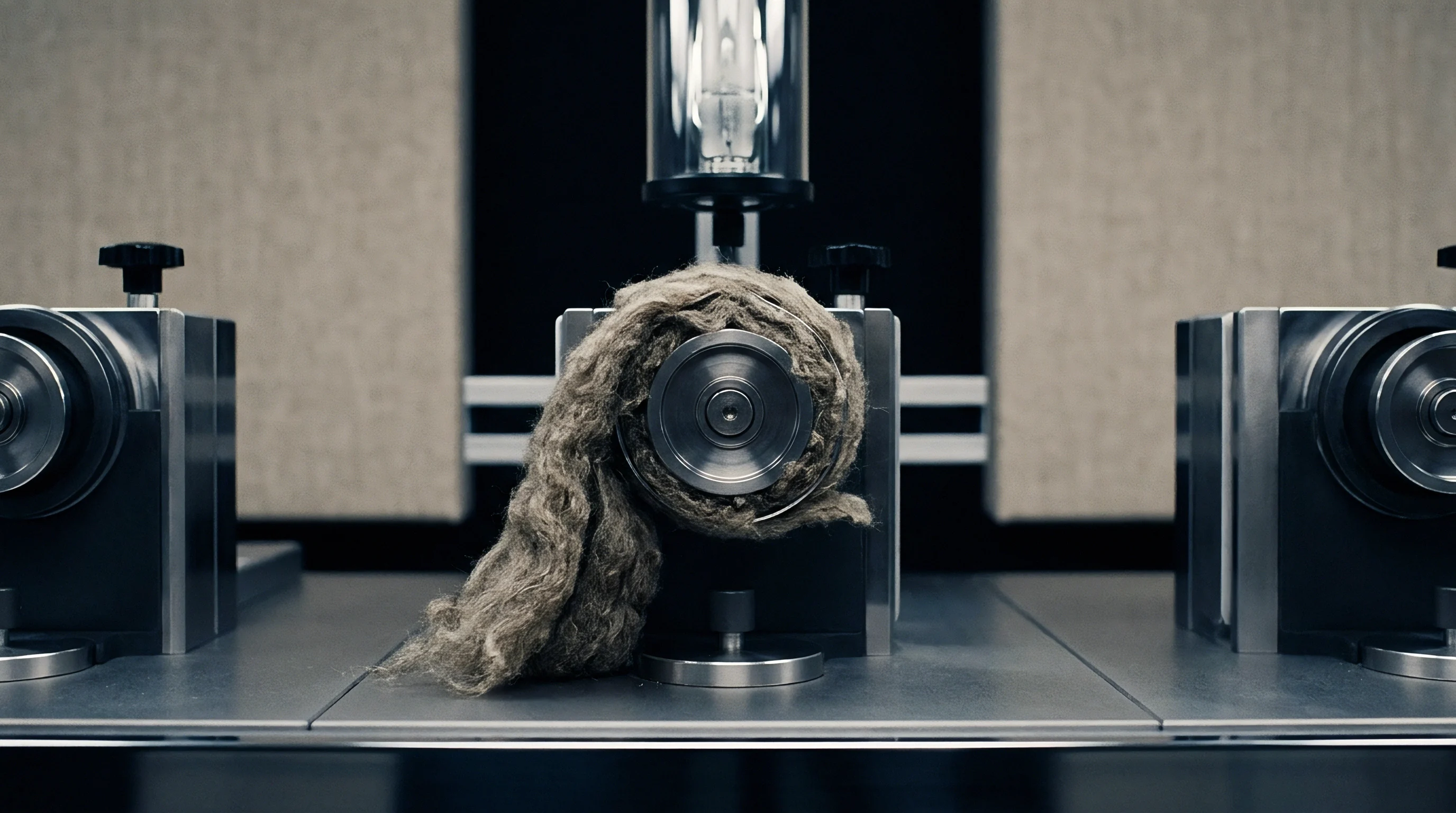
Bench
Conversions from cut length mass to yarn count rely on true straightened dimensions. Even minor errors in specimen length measurement propagate through density calculations, altering reported grams per square meter and yarn count values. Standardized bench fixtures utilize dead-weight clamping arms or calibrated digital load cells to eliminate manual operator bias during cut length mounting.

Density Audit Calculation and Error Propagation
Laboratory technicians measure specimen mass using micro-balances sensitive to four decimal places. When evaluating a nominal thirty tex ring spun yarn extracted from a woven construction, the baseline specimen cut target is exactly one hundred millimeters. If tensioning is omitted, relaxed strand recoil yields an actual measured physical length of ninety-seven point two millimeters while maintaining the target mass, producing an erroneous linear density figure of thirty-point-eight6 tex.
| Tensioning Condition | Applied Load (cN/tex) | Measured Specimen Length (mm) | Calculated Yarn Count (tex) | Derived Fabric Weight (g/m²) | Audit Variance (%) |
|---|---|---|---|---|---|
| Un-tensioned (Slack) | 0.00 | 97.20 | 30.86 | 154.30 | +2.87% |
| Standard Calibration | 0.50 | 100.00 | 30.00 | 150.00 | 0.00% |
| Over-tensioned (Stretching) | 1.20 | 102.40 | 29.30 | 146.50 | -2.33% |
Converting inflated yarn linear density from slack specimens into fabric weight calculations overstates total areal mass by four point three grams per square meter on a one hundred fifty gram fabric specification. The shipment then appears out of specification solely because of improper bench tensioning during cut length preparation.
- Verify specimen ambient conditioning inside standard atmosphere test chambers for twenty-four hours before cutting.
- Select baseline pretensioning load matching nominal yarn linear density per standardized fiber tables.
- Align specimen strands straight within mounting clamps without introducing manual pre-stretch or hand twist.
- Inspect clamping faces for wear, lint accumulation, or surface slippage before applying dead weights.
- Record specimen mass immediately after tension stabilization to prevent environmental humidity drift.
Standard ASTM D3776 Option C mandates tensioned strand extraction to prevent weight claim rejections during port clearance.
Standard ISO 3801 Clause 6 changes the acceptance threshold by enforcing forced strand straightening during weight verification.


Finish
Chemical and thermal wet operations alter the structural dimensions of spun yarns. Mercerization, dyeing, and resin finishing modify yarn flexural rigidity and internal strain energy, changing the tension required to achieve complete strand straightening without stretching fibers. Auditing finished cloth therefore requires adjusting specimen pretension values relative to grey state standards.

Wet Processing Relaxation and Resin Crosslinking Effects
Cellulosic yarns subjected to caustic swelling undergo irreversible structural compacting. Mercerization increases fiber cross-sectional roundness while reducing longitudinal crimp stability. Subsequent resin finishing with dimethyloldihydroxyethyleneurea creates durable crosslinks inside the fiber amorphous regions that fix the spatial geometry of the yarn helix, increasing the force needed to pull out structural wave patterns during cut length preparation.
Applying standard grey-yarn pretension to a resin-finished fabric specimen fails to fully extend the crosslinked strand, leaving the length measurement short and artificially increasing calculated fabric weight. Conversely, fabrics treated with heavy silicone softeners exhibit lower inter-fiber friction; applying standard pretensioning to these soft-finished strands can induce slippage, overestimating cut length and understating fabric density.

Stenter Overfeed and Thermal Fixation Impact on Tension Calibration
Drying frames drive mechanical shrinkage along warp strands while setting weft spacing. Stenters operating at high overfeed rates insert substantial relaxed crimp into warp yarns to hit target fabric weight specifications, meaning unconditioned cloth tested without full relaxation yields inaccurate weights.
- Conditioning the cloth specimen takes place inside an atmosphere maintained at twenty degrees Celsius and sixty-five percent relative humidity for twenty-four hours.
- Cutting precise template strips along warp and weft directions eliminates edge fraying and defines baseline specimen boundaries.
- Mounting strands in tension clamps applies designated pretensioning mass based on the nominal yarn linear density.
- Recording relaxed and straightened lengths under calibrated balance fixtures establishes the precise crimp factor.
- Calculating dry mass per unit area combines conditioned yarn mass with true straightened strand dimensions.
| Processing State | Dominant Structural Effect | Friction Modifier | Recommended Pretension (cN/tex) |
|---|---|---|---|
| Grey State (Unfinished) | High natural wax content, unfixed twist | Baseline friction | 0.50 ± 0.05 |
| Scoured and Bleached | Wax removed, increased inter-fiber friction | High friction | 0.55 ± 0.05 |
| Resin Finished (DMDHEU) | Crosslinked matrix, stiff wave geometry | Rigid matrix | 0.65 ± 0.05 |
| Silicone Softened | Low friction coefficient, easy inter-fiber slip | Low friction | 0.40 ± 0.04 |
Heat setting fixes fiber crimp and raises the force threshold required to achieve full straightness.
Inaccurate specimen tensioning during finished weight audits leads to rejected shipments and unrecoverable air freight expenses.


Ledger
Commercial contracts define acceptable limits for yarn count and fabric mass per unit area. When buyers and mills audit fabric weight, differences in specimen cut length tensioning routinely account for two to three percent apparent mass variance, easily exceeding standard delivery tolerances.
Sourcing Tolerances and Commercial Dispute Mitigation
Buyers and converters evaluate incoming rolls against agreed physical thresholds. Most international fabric purchasing agreements permit a weight tolerance of plus or minus three percent relative to the approved master sample docket. When an importing brand audits fabric using un-tensioned cut lengths while the supplying mill tests under calibrated dead-weight tensioning, that procedural difference consumes the entire contractual allowance.
Resolving weight disputes requires aligning laboratory test methods across both entities. Specifying the exact specimen preparation technique, including clamping apparatus and pretension mass in centinewtons per tex, prevents unnecessary shipment rejections and debit notes.

Standardizing Cut Length Verification in Mill Agreements
Enforcing density compliance requires identical specimen preparation protocols across testing laboratories. Fabric technical specification sheets must stipulate the testing standard, sample conditioning time, cutting template dimensions, and strand pretensioning load. Incorporating standardized tension parameters into quality dossiers establishes clear inspection terms that hold up under third-party audit challenge.
Standardized clamp fixtures and written pretension guidelines in purchase orders protect both buyer and supplier from unnecessary weight disputes.