Yarn Linear Density Conversion to Fabric Mass and Landed Costs
Yarn count, crimp, and moisture regain fix fabric square-metre mass, controlling garment cutting yields and preventing costly customs tariff misclassifications.

Gauge

Mass per Unit Area from Count
A buyer calculating finished yield begins with yarn linear density and ends on the customs declaration. Fabric mass per unit area, expressed as grams per square metre, derives directly from the yarn count, thread density, and crimp percentage induced during interlacing. The calculation converts indirect systems such as English cotton count, or direct metrics such as tex and denier, into total yarn weight per square unit of finished cloth.
Thread density measurements follow ISO 7211-2, requiring counting threads under magnification across a minimum fifty-millimetre window. Yarn linear density from fabric swatches follows ISO 7211-5, which extracts threads under specified pretension to remove crimp before gravimetric measurement on an analytical balance reading to 0.1 milligrams.
Direct yarn number in tex equals grams per kilometre of yarn. A cloth construction carrying warp density of ends per centimetre and weft density of picks per centimetre converts to loom-state mass through direct summation. The warp mass per square metre equals the warp density multiplied by the yarn linear density in tex, adjusted by the warp crimp factor.
The weft mass follows identical arithmetic using pick density, weft tex, and weft crimp factor. The sum of warp and weft yields total grey weight per square metre. Total dry mass without non-fibrous additions fixes the raw material draw per square metre of woven production.
A twenty-tex cotton yarn spun at four percent moisture regain delivers twelve percent lower dry substance per linear kilometre than polyester at identical nominal linear density.
Direct yarn systems simplify this computation. Indirect systems invert the denominator. English cotton count defines how many 840-yard hanks weigh one avoirdupois pound.
Converting English cotton count to tex uses the constant 590.54 divided by the nominal count. Denier divides mass in grams per 9,000 metres; multiplying denier by 0.1111 yields equivalent tex. In knitted substrates, course and wale density per centimetre combine with stitch length in millimetres to establish mass per unit area.
Stitch length divided by ten, multiplied by stitch density per square centimetre and yarn tex, divided by one hundred, gives nominal grams per square metre before finishing contraction.

Count Systems across Regional Sourcing Desks
Conversion errors compound across cross-border technical packs when regional mills operate under legacy numbering systems. Spinners in the Indian subcontinent and North America quote ring-spun cotton in English cotton count. Continental European mills and woollen houses quote metric count, defining metres of yarn per single gram of mass.
Filament weavers in East Asia quote polyester, polyamide, and regenerated cellulose in denier or direct decitex. An importer receiving a specification calling for 30s Ne cotton warp and 150 denier polyester weft reconciles an indirect English measure with a direct metric measure. Conversions must occur before calculating yarn procurement masses.
| Initial Yarn System | Target Direct Tex | Conversion Formula | Standard Regain Baseline |
|---|---|---|---|
| English Cotton Ne | Tex | Tex = 590.54 / Ne | 8.5 percent |
| Metric Count Nm | Tex | Tex = 1000 / Nm | Varies by fibre type |
| Denier den | Tex | Tex = den / 9 | Polyester 0.4 percent |
| Decitex dtex | Tex | Tex = dtex / 10 | Fibre specific |
| Worsted Count NeK | Tex | Tex = 885.8 / NeK | 18.25 percent |
Converting yarn linear density to accurate cloth mass requires adjusting for chemical finishes, sizing agents, and desizing weight losses. Starch or polyvinyl alcohol size applied to warp sheets adds six to twelve percent to loom-state grey mass. Scouring and scouring-bleaching sequences eliminate natural fats, pectins, and sizing agents, causing five to eight percent substrate mass reduction in raw cotton.
Dye uptake and subsequent resin finishing for wrinkle resistance add back two to four percent dry mass. Calculating landed yield on raw yarn purchases requires accounting for these wet processing mass variances, rather than assuming loom-state weight tracks finished roll weight.
The contract specifies whether linear mass applies to oven-dry fibre or conditioned mass under ISO 139 standard atmosphere.
Shrinkage
Crimp Take-Up and Loom Contraction
Woven cloth mass per square metre exceeds the flat sum of straight yarn lengths laid across a square metre. Crimp represents the wavy path yarn takes passing over and under opposing threads during interlacing. Weave structure dictates the degree of crimp take-up.
A plain weave one-by-one structure forces maximal yarn deflection around adjacent threads, producing warp crimp percentages between eight and fourteen percent. A three-by-one twill or four-by-one satin provides longer yarn floats, reducing thread deflection and holding crimp values between three and seven percent. Higher crimp directly increases the weight of yarn packed into each square metre of finished textile.
Accurate determination follows ISO 7211-3. Thread strands pulled from the fabric undergo extension until straight under a tension specified by the yarn count, without stretching the core fibre. The ratio between the straightened length and the unraveled wavy length establishes the crimp percentage.
When yarn crimp increases, the mill uses more metres of yarn per metre of cloth woven. A fabric with thirty ends per centimetre woven with thirty-tex warp yarn at ten percent crimp consumes thirty-three tex-equivalents of mass per linear centimetre. Miscalculating crimp percentage produces underweight deliveries that fail customer specifications, or overweight fabrics that inflate yarn consumption beyond planned purchase margins.
A standard commercial contract rejects deliveries showing mass deviations exceeding plus or minus five percent from specified square-metre weights under ISO 3801.
Finishing shrinkage compounds mechanical loom contraction. Finishing relaxation, scouring, high-temperature jet dyeing, and stentering alter picks and ends per centimetre. Cotton fabrics shrink along the warp during wet relaxation while expanding or pulling narrow in the width, altering the finished area density.
Synthetic fibres contract under heat during thermosol dye fixation or tentering, increasing decitex through molecular relaxation. Calculating final mass from raw yarn count requires tracking both mechanical crimp from the loom and dimensional change from wet finishing.
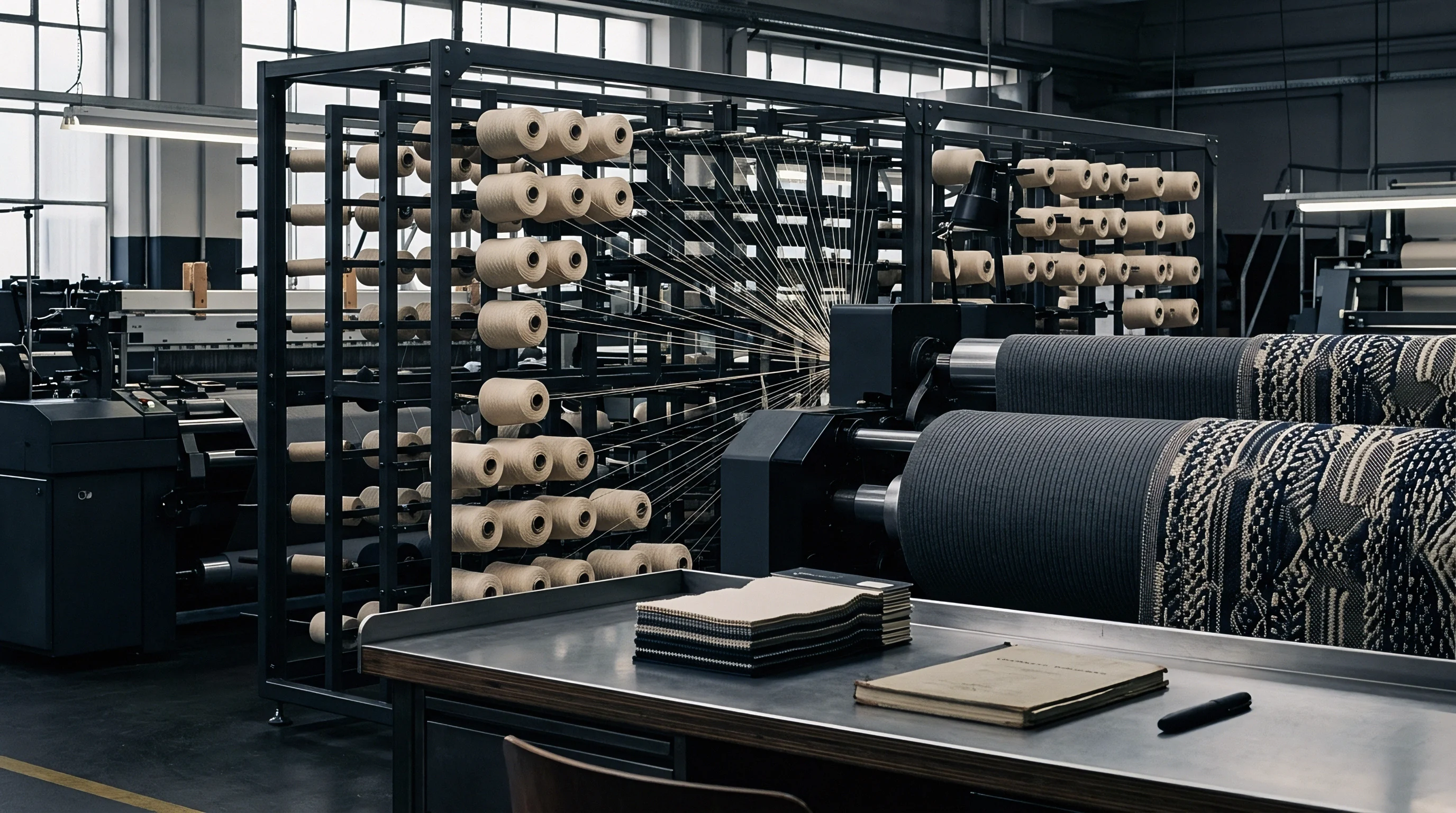
Knitted Loop Geometry and Course Density
Knitted structures follow different geometrical relationships than woven intersections. Loop length remains the foundational variable governing knitted mass per unit area. In single jersey knits, the loop length describes the millimetres of yarn consumed in one knitted stitch.
Knitted loops pull tighter or relax based on yarn torque, feed tension, and cylinder speed. When finished, relaxation allows internal elastic recovery to bring loop heads closer together, driving up courses per centimetre and finished mass. A knitter who knits looser loops to save raw material yields an unstable fabric that collapses during domestic laundering, exceeding allowable shrinkage limits.
- Take-up contraction reduces nominal warp yield by drawing three to twelve percent more yarn mass into woven structures than open-width geometry predicts.
- Off-loom relaxation changes loop dimensions immediately upon tension release from the takedown rollers, destabilizing grey knit density.
- Finishing shrinkage concentrates yarn density per square metre during wet processing and heat-setting operations.
- Sizing desize differential strips non-fibrous protective coatings from warp yarns, producing four to nine percent net mass drop before final finishing chemistry.
Relaxation states follow testing standards ISO 6330 for domestic laundering and ISO 3801 for area density. Measuring mass on fabric straight off the shearing or compacting line produces non-reproducible readings. Fabric must equilibrate in standard test atmosphere at twenty degrees Celsius and sixty-five percent relative humidity for a minimum of twenty-four hours.
Measuring rolls directly off the stenter frames reads false low weights due to moisture loss from heating chambers. The mass rebounds as the fibre absorbs ambient humidity in storage warehouses.
Failure to reconcile finished shrinkage against nominal yarn consumption inflates landed roll costs through unrecovered raw material loss.


Regain

Commercial Regain Adjustments in Bulk Mass
Fibre trade calculates weight on commercial mass rather than bone-dry or variable ambient mass. Commercial moisture regain represents an agreed, standardized percentage of water mass added to the oven-dry mass of clean fibre. Different fibres absorb water vapor from ambient air based on polymer morphology and hydrophilic functional groups.
Hydrophobic synthetics like polyester hold standard commercial regain of 0.4 percent under ISO 6741-1. Natural cellulose fibres like cotton carry standard commercial moisture regain of 8.5 percent. Regenerated lyocell holds eleven percent, while scoured wool commands eighteen and a quarter percent.
When an invoice bills yarn by the kilogram, the buyer pays for moisture within the standard allowance. If yarn ships with ten percent water content when the contract permits 8.5 percent, the buyer pays raw fibre prices for excess water. In a forty-tonne shipment of ring-spun cotton yarn, an unverified 1.5 percent excess moisture shift represents six hundred kilograms of paid moisture delivered as fibre weight.
The commercial mass calculation scales the gross shipment weight back to oven-dry mass plus standard moisture allowance. Testing laboratories establish oven-dry mass using conditioning ovens with forced airflow operating at 105 degrees Celsius until mass reaches equilibrium.
| Fibre Classification | Chemical Basis | Standard Regain Percentage | Commercial Allowance Factor |
|---|---|---|---|
| Upland Cotton | Natural Cellulose | 8.50% | 1.0850 |
| Viscose Rayon | Regenerated Cellulose | 11.00% | 1.1100 |
| Polyester PET | Polyethylene Terephthalate | 0.40% | 1.0040 |
| Polyamide 6,6 | Polyhexamethylene Adipamide | 5.75% | 1.0575 |
| Combed Wool | Keratin Protein | 18.25% | 1.1825 |
Commercial moisture regain also controls finished fabric area density. If fabric area mass is determined without preconditioning under standard laboratory conditions, fluctuating warehouse relative humidity distorts the calculated yield. An exporter shipping cotton poplin from high-humidity coastal ports risks customs penalties or buyer rejections if cloth weighed dry on arrival tests below specified grams per square metre.
Fabric mass contracts must cite ISO 3801 method five, standardizing samples under controlled atmosphere prior to gravimetric assessment.

Blend Ratios under Differential Moisture Uptake
Quantitative blend analysis requires adjusting chemical separation data for differential moisture regain. When analyzing a 60 percent cotton and 40 percent polyester fabric according to ISO 1833-1, solvent dissolution removes cotton using seventy-five percent sulphuric acid, leaving behind the polyester residue. The dried residue weight does not represent raw composition directly.
Technologists must correct the dry weight of each extracted fibre fraction using their respective commercial moisture allowances. Polyester dry residue scales by 1.004, whereas dissolved cotton dry mass scales by 1.085. Skipping this calculation distorts the declared blend ratio by more than one full percentage point.
A calculated 59.2 percent cotton and 40.8 percent polyester blend that omitted moisture regain adjustments might be labeled 60/40 cotton-poly. In jurisdictions enforcing rigid labeling tolerances, that gap risks compliance penalties. Furthermore, customs classification shifts when a natural fibre falls below fifty percent by weight.
If differential regain calculations reduce a declared 50/50 blend to 49.3 percent cotton and 50.7 percent polyester, the fabric transfers out of Chapter 52 into Chapter 54 or 55 of the Harmonized Tariff Schedule, frequently triggering higher ad valorem import tariffs.
Commercial invoices that fail to specify moisture regain clauses default to gross weight settlements under the supplier’s warehouse conditions.


Yield

Linear Metres against Mass Yield Calculations
Garment cutting rooms consume fabrics by linear metres while mills quote production runs by weight or mass per square metre. The conversion from yarn count to total fabric yield governs raw material purchasing volume. Linear yield per kilogram depends on finished width and area density.
A fabric weighing 200 grams per square metre with a cuttable width of 150 centimetres yields 3.33 square metres per kilogram. Converting to linear length: 3.33 divided by 1.5 metres width delivers 2.22 linear metres of cuttable cloth per kilogram of finished fabric. Any shift in yarn linear density alters linear metre output per processed batch.
A worked example demonstrates the conversion mechanism. Consider an industrial order requiring 10,000 linear metres of twill fabric at 1.50 metres cuttable width, specifying 240 grams per square metre finished mass. The finished surface area equals 15,000 square metres.
Multiplying 15,000 square metres by 0.240 kilograms yields 3,600 kilograms of finished fabric mass. To supply this finished weight, procurement teams apply operational scrap rates across processing steps: warp preparation, weaving waste, seam cutoffs, and edge trimming. Factoring a combined eight percent manufacturing loss requires 3,913 kilograms of raw yarn.
A three percent drift in delivered yarn count shifts the finished linear yield by three hundred metres across a ten-thousand-metre production run.
Calculating the raw yarn split between warp and weft relies on construction metrics. Assume the fabric uses 20 tex cotton warp at 36 ends per centimetre and 30 tex cotton weft at 22 picks per centimetre. Warp crimp runs at eight percent, while weft crimp measures five percent.
Across one square metre, warp mass consumes 36 ends multiplied by 100 centimetres, yielding 3,600 metres of yarn. Multiplied by 0.020 grams per metre and scaled by 1.08 crimp factor, warp yarn mass equals 77.76 grams per square metre. Weft consumes 22 picks multiplied by 100 centimetres, yielding 2,200 metres of yarn.
Multiplied by 0.030 grams per metre and scaled by 1.05 crimp factor, weft mass equals 69.30 grams per square metre. Total base yarn mass equals 147.06 grams per square metre. Finishing add-on, starch residue, and dyes make up the balance to reach specified target weight.

Can Width Variation Destabilize Yield Economics?
Width variation directly alters unit cost efficiency. If the weaving mill allows reed spread or stentering pins to drift, cuttable width narrows while weight per square metre rises. The cutting room loses pattern markers across the narrower width, forcing longer markers and increasing linear yardage consumption.
An increase in mass per square metre caused by over-compacting or under-stretching fabric width does not add value to the garment manufacturer. The buyer pays for excess yarn per square metre while cutting fewer pattern parts per linear roll.
- Greige inspection establishes baseline width and area mass against nominal machine settings before wet processing tensions distort loop and thread geometries.
- Scour bath monitoring tracks extraction of processing waxes, verifying that mass losses do not drop the ground fabric below target grams per square metre.
- Pin stenter settings dictate the finished cuttable width by locking crosswise thread dimensions under hot airflow before chemical fixation.
- Sanforization control regulates longitudinal compaction to achieve target dimensional stability while matching linear weight expectations.
When mass per square metre shifts heavier due to excessive width compaction, the linear metres produced per metric tonne of purchased yarn fall proportionally. The cost per linear metre climbs because fewer metres emerge from the baseline yarn inventory. Mill managers claim compliance with nominal specifications based on area density, while the buyer absorbs an unbudgeted increase in linear metre consumption.
Raw material purchase specifications must therefore tie area weight strictly to minimum cuttable width tolerances.
A supplier will argue that extra weight represents surplus value whenever narrower widths pass through inspection unchecked.
Duty

Tariff Line Shifts Based on Weight Predominance
Customs agencies classify textile fabrics through Chapter 50 to Chapter 60 of the Harmonized Tariff Schedule, where classification turns decisively on yarn linear density and fibre mass predominance. General Note 2 to Section XI dictates that goods composed of two or more textile materials classify as if consisting wholly of that single material which predominates by weight over every other single textile material. A difference of two percent yarn mass can alter the commercial heading entirely.
In a fabric composed of forty-nine percent combed cotton and fifty-one percent polyester, the fabric falls under Chapter 55 as man-made woven cloth. Reversing the mass percentages to fifty-one percent cotton shifts the goods into Chapter 52.
The import duty differential between these chapters creates immediate margin exposure. In many jurisdictions, cotton woven fabrics under Chapter 52 carry moderate tariff rates, often between six and eight percent ad valorem. Polyester staple woven fabrics under Chapter 55 or filament fabrics under Chapter 54 often carry rates between twelve and sixteen percent.
A sourcing manager buying a nominal 50/50 blend faces a critical customs issue: if spinning tolerances or finishing steps cause synthetic fibre mass to rise to 50.5 percent on an import laboratory analysis, customs customs authorities reclassify the shipment under the higher tariff line. This incurs supplemental duty demands, retroactive audits, and potential misdeclaration penalties.
| HTS Heading | Construction Description | Predominant Weight Criterion | Base Ad Valorem Rate |
|---|---|---|---|
| 5208.32 | Dyed Cotton Plain Weave, 100-200 g/m² | Cotton > 85% by weight | 7.0% |
| 5210.31 | Dyed Plain Weave Cotton/Synthetics, | Cotton | 7.8% |
| 5407.52 | Dyed Woven Textured Polyester Filament | Polyester Filament >= 85% | 14.9% |
| 5512.19 | Dyed Polyester Staple Woven Fabric | Polyester Staple >= 85% | 12.0% |
| 5513.21 | Dyed Polyester/Cotton Plain, | Polyester Staple Chief Weight | 14.9% |
HTS subheadings also differentiate directly by yarn count intervals. Cotton yarn classifications separate tariff categories at thresholds of 14, 43, 52, and 80 metric count. Under subheading 5205.12, single combed cotton yarns measuring between 14 and 43 metric count attract lower duty rates than counts exceeding 43 metric count under 5205.13.
Fabric categories mirror these breaks, classifying goods by average yarn number. Imprecise yarn conversions in technical packs lead to incorrect customs classification declarations before the goods arrive at the border.
Average Yarn Number and Border Verification
Customs authorities verify declared construction through quantitative testing of port samples using national customs laboratory methods aligned with ASTM D1059 or ISO 7211-5. For woven cotton fabrics entered under subheadings specifying average yarn number, customs officers unravel the weave, weigh known lengths of warp and weft yarns, and compute the average yarn number across the fabric. Average yarn number equals total threads per square centimetre divided by fabric weight per square centimetre in grams, multiplied by a conversion constant.
Under US Customs and Border Protection General Note statistical notes for Chapter 52, Average Yarn Number (AYN) is calculated through a statutory formula: ends per centimetre plus picks per centimetre, divided by grams per square metre, multiplied by 100, multiplied by 0.05905 in English cotton numbering. If a fabric is declared as an AYN 45 cotton cloth under an entry threshold permitting preferential access, and laboratory verification uncovers heavy sizing residues that artificially depress the AYN down to 41, customs liquidates the entry under a non-qualifying tariff line. Importers must confirm that mill test dossiers report desized, clean yarn counts matching legal tariff formulas rather than unwashed loom-state counts.
Customs broker declarations based solely on mill sales invoices fail border compliance audits when laboratory unravel tests reveal divergent counts.
Cargo
Landed Cost Models per Finished Metre
A landed cost model translates linear density, yarn price, manufacturing scrap, ocean freight, port charges, insurance, and duty into a unit cost per linear metre of cuttable fabric. Yarn pricing trades on a per-kilogram basis, yet garment assembly budgets allocate cost per garment from linear fabric yield. Calculating total landed cost requires layering cost burdens onto the raw material draw.
The baseline begins with the yarn price per kilo divided by fabric yield in metres per kilo. Operational conversion markups covering weaving, dyeing, finishing, and testing add to this base.
Logistical and customs expenses apply sequentially. Freight forwarders bill container shipments based on either cubic measurement or weight. Heavy fabrics, such as 400 grams per square metre canvas, max out container weight payloads before utilizing interior volume.
For air freight, chargeable weight bases itself on a volumetric ratio of one to six thousand: volume in cubic centimetres divided by six thousand equals volumetric kilograms. If the volumetric weight exceeds actual gross weight, the airline bills on the volumetric mass. Area density conversions determine whether a consignment travels as dense deadweight cargo or volumetric lightweight cargo.
The duty assessment follows free-on-board valuation or cost-insurance-freight valuation depending on the importing nation’s tariff code. In the United States, ad valorem rates apply to FOB port of export value. In the European Union, import duty applies to CIF value, incorporating ocean freight and transit insurance into the taxable base.
A buyer must build landed cost models showing the cascading impact of duty rates across distinct yarn composition scenarios.
Worked Financial Models across Competing Blends
The financial model below compares three blend configurations evaluated for an operational production contract requiring 50,000 linear metres of woven shirting. Fabric specification sets 115 grams per square metre finished mass at 1.50 metres width. Finished cuttable yield equals 5.79 linear metres per kilogram of finished fabric.
The total required finished fabric mass equals 8,635 kilograms. Applying a seven percent combined processing scrap loss requires 9,285 kilograms of total yarn input. Freight is set at an average container cost of 0.45 dollars per finished linear metre.
Port clearance, drayage, and terminal handling total 0.12 dollars per linear metre.
- Configuration One: Pure Cotton consumes 100 percent combed cotton ring-spun yarn at 3.90 dollars per kilogram. Yarn cost equals 36,211 dollars. Adding finishing and conversion costs at 1.20 dollars per linear metre yields 60,000 dollars. Freight and local clearance add 28,500 dollars. Subtotal equals 124,711 dollars. Applying Chapter 52 import duty at 7.0 percent against FOB value yields 6,734 dollars. Total landed cost reaches 131,445 dollars, delivering a finished cost of 2.63 dollars per linear metre.
- Configuration Two: 60/40 Cotton/Poly consumes blended yarn at 3.10 dollars per kilogram. Total yarn cost equals 28,783 dollars. Adding finishing costs at 1.15 dollars per linear metre adds 57,500 dollars. Freight and clearance remain 28,500 dollars. Cotton remains chief weight, attracting Chapter 52 import duty at 7.8 percent against FOB value, yielding 6,730 dollars. Total landed cost reaches 121,513 dollars, or 2.43 dollars per linear metre.
- Configuration Three: 45/55 Cotton/Poly uses blended yarn priced at 2.80 dollars per kilogram. Total yarn cost falls to 25,998 dollars. Finishing conversion equals 1.15 dollars per linear metre, adding 57,500 dollars. Logistics add 28,500 dollars. Polyester predominates by weight, reclassifying the shipment to Chapter 55 with an import duty of 14.9 percent against FOB value, generating 12,441 dollars in customs liability. Total landed cost reaches 124,439 dollars, or 2.49 dollars per linear metre.
The worked comparison illustrates the tariff risk inherent in synthetic conversions. Moving from Configuration Two to Configuration Three saves 2,785 dollars in raw yarn procurement. However, crossing the fifty percent weight threshold triggers a customs reclassification from cotton chief weight to synthetic chief weight.
The duty liability spikes from 6,730 dollars to 12,441 dollars. The customs penalty completely wipes out the upstream raw material savings, leaving the lower-spec 45/55 fabric six cents per linear metre more expensive on a landed basis than the superior 60/40 blend. Sourcing desks must balance raw mill quotations against customs classifications before executing blend changes.
The standard customs broker clause assigning full tariff classification liability to the importer of record leaves the buyer responsible for covering sudden duty disparities.


Audit

Batch Sampling and Mass Verification Protocols
A sound landed cost system requires a physical audit protocol to verify received roll parameters against purchase orders and entry declarations. Mill production runs drift over time. Sizing buildup, stenter speed, atmospheric humidity variations, and yarn lot variations shift fabric mass per unit area off specification.
Quality teams verify incoming shipments through structured physical testing of rolled goods, testing whether weight variations indicate billing errors, compliance risks, or substandard construction.
The verification sequence follows ASTM D3776 for mass per unit area and ISO 5084 for thickness determination under pressure. Inspectors draw sample swatches across different production rolls, rejecting fabric ends and selvages. Circular cutting dies punch out exactly 100-square-centimetre test specimens from the left, centre, and right zones across the width.
These swatches are conditioned under standard atmospheric conditions before gravimetric measurement on an analytical balance. Taking the mean of multiple die-cut measurements across ten percent of delivered rolls defines the lot mean weight per square metre.
- Gross roll weighing flags bulk roll deviations exceeding two percent against packing list manifests prior to offloading from shipping containers.
- Die-cut round sampling extracts specimens from the inner roll body to prevent edge tension variations from distorting square metre readings.
- Oven conditioning check strips ambient moisture to verify actual commercial regain percentages before resolving mass payment disputes.
- Chemical blend extraction validates yarn ratio percentages under ISO 1833 prior to customs declaration lodgement.
If average measured mass drops below five percent of contracted weight, the buyer risks structural garment failure, seam slippage, and tearing. If measured mass rises above contracted weight, the supplier has over-compacted the fabric, shrinking the linear yield and increasing per-garment production costs. If the excess weight derives from residual sizing chemicals or poor scouring, dyeing quality and colorfastness will degrade during downstream garment processing.
The audit documentation serves as the evidentiary basis for supplier chargebacks or customs corrections.

Contractual Tolerance Clauses for Settlement Protection
Disputes over linear density conversions, mass variations, and landed cost reconciliation require precise protective clauses in raw material supply agreements. Standard trade guidelines often permit broad variations that favor mills unless explicit constraints are written into contracts. Purchase contracts must define clear numerical limits for yarn linear density deviation, fabric mass tolerance, cuttable width variations, and blend ratio thresholds.
Contracts must also specify the testing methods and authoritative referee laboratories that will resolve commercial claims.
A protective specification sets yarn count tolerance at plus or minus 2.5 percent under ISO 2060. Finished fabric mass tolerance must not exceed plus or minus 3.0 percent under ISO 3801, measured on conditioned swatches after full desizing. Cuttable width tolerances must mandate zero negative tolerance, ensuring patterns fit cutting layouts.
Blend tolerances must be constrained to plus or minus 1.0 percent around declared percentages under ISO 1833, eliminating the broad plus or minus 3.0 percent variations permitted by generic labeling laws. Stricter blend control prevents unintentional shifts across customs tariff lines.
A critical contract line dictates: “Should the fabric yield fall below the specified linear metres per kilogram by more than two percent due to density deviations, the seller will credit the buyer the pro-rata cost of the missing metres, including absorbed freight and custom duties.” This clause aligns production incentives across the supply chain. It prevents mills from delivering heavy, narrowed goods that inflate raw yarn consumption while shrinking garment marker efficiency. The buyer anchors procurement safety to physical test data and landed cost economics.
A question remains whether future digital customs audits will track chemical tracers in synthetic filaments to assess tariff compliance before fabric hits the inspection floor.