Standardizing Solvent Selection Protocols for Recovered Fiber Analysis
Standardized solvent protocols require degradation-adjusted d-values and strict thermal boundaries to prevent non-target dissolution errors in complex blends.


Solvation

Selectivity Limits in Secondary Feedstocks
Quantitative separation of mechanical and chemical recycling streams requires solvent systems that distinguish polymer classes without cleaving degraded chains. Recovered textiles introduce cross-linked finishes, pigment binders, and thermal history that disrupt standard dissolution behavior. Virgin polyester dissolves cleanly in o-dichlorobenzene or phenol-tetrachloroethane mixtures at 140 degrees Celsius.
Recovered polyethylene terephthalate bearing residual polyacrylate sizing or polyurethane elastomeric content exhibits incomplete phase transfer, leaving crosslinked skins that bias gravimetric yields. Bench trials show mass measurement errors reach 4.5 percent when unreacted elastane residues remain trapped in the crystalline polyester sediment.
Solvent polarity and thermodynamic affinity parameters guide the selective extraction sequence. ISO 1833-1 sets the baseline for binary mixtures using chemical dissolution, yet post-consumer blends frequently present ternary or quaternary assemblies of cotton, polyester, polyamide 6,6, and elastane. Standard 75 percent mass fraction sulfuric acid dissolves cellulosic fractions rapidly.
When cotton fibers contain severe oxidative chain scission from post-consumer laundering cycles, acidic degradation occurs faster, accelerating the conversion of crystalline cellulose into water-soluble oligosaccharides. Over-dissolution distorts the mass balance.
ISO 1833-1 gravimetric mass balances skew by up to 3.8 percent when degraded cellulosic chains solubilize during room-temperature acid treatment.
A standardized protocol pairs solvent Hildebrand solubility parameters directly against specific thermal and mechanical degradation markers. Solvents must solubilize target domains while maintaining non-target phase integrity below 0.5 percent mass leaching. Achieving this discrimination demands strict thermal boundaries and regulated bath liquor ratios during every bench extraction step.
The operational cost of false positive fiber identification settles on the buyer at customs import declarations. If post-industrial reclaimed wool containing unlisted polyamide structural cores is misidentified through crude formic acid washing, commercial invoices face border holds and regulatory mislabeling reclassifications.


Fractions

Thermodynamic Partitioning across Complex Blends
Selective chemical digestion relies on targeting the crystalline and amorphous morphology of post-consumer polymers. Recovered polyamide 6 demonstrates high solubility in 80 percent formic acid at 20 degrees Celsius. Heavily drawn high-tenacity nylon 6,6 yarns recovered from industrial webbing exhibit tight crystalline packaging, requiring elevated thermal input or extended dwell times to enter solution.
Heating formic acid past 25 degrees Celsius initiates non-target chain hydrolysis in adjacent silk or regenerated cellulosic components within blended waste streams. Precision temperature controls avoid these secondary digestion artifacts.
Recovered acrylic components demand distinct organic selectors. Dimethylformamide acts swiftly on polyacrylonitrile matrices at 60 degrees Celsius. That thermal threshold presents minimal swelling risks to virgin polyester substrates.
Post-consumer polyester containing recycled polyolefin contaminants behaves unpredictably. Recycled polypropylene fractions swell significantly in hot dimethylformamide, trapping free solvent molecules within its amorphous gaps. Trapped solvents inflate residual mass measurements by 1.2 to 2.8 percent following vacuum desiccation.
Separation efficiency hinges on sequential extraction orders. Sorting protocols fail when volatile components are stripped prior to removing finish-line crosslinkers. Fluorocarbon oil-and-water repellents shield synthetic surfaces against polar solvent penetration.
Running a primary scouring stage with petroleum ether or dichloromethane at 40 degrees Celsius strips paraffin waxes and fluoropolymer treatments, restoring fiber surface energy to its baseline state.

Which Dissolution Sequence Arbitrates Unknown Blends?
Establishing the correct extraction pathway prevents premature decomposition of minor components. When characterization runs begin without knowing blend ratios, an aggressive first-stage solvent can alter or destroy fragile companion fibers. The following sequence establishes strict operational boundaries for complex mechanical waste fractions.
- Pre-extraction wash removes surface resins, wax residues, and processing softeners using light petroleum ether in a Soxhlet apparatus over sixteen siphon cycles.
- Formic acid exposure dissolves polyamide 6 and polyamide 6,6 variants at 20 degrees Celsius without hydrolyzing accompanying wool keratin structures.
- Dimethylformamide treatment extracts acrylic and modacrylic fibers at 60 degrees Celsius under continuous mechanical agitation for thirty minutes.
- Sulfuric acid digestion breaks down standard and mercerized cellulosic fractions at 20 degrees Celsius while leaving polyester cores intact.
- M-cresol dissolution eliminates remaining polyethylene terephthalate structural filaments at 100 degrees Celsius, leaving inorganic fillers or glass reinforcement.
Each dissolution stage generates a residue requiring washing with deionized water followed by mild alkaline neutralization. Skipping the post-acid wash allows lingering hydronium ions to char cellulosic residues inside the drying oven. Charred fiber fragments turn to dust on the balance plate, destroying sample integrity.
A single incorrect temperature setting during the polyamide extraction stage dissolves delicate wool fibers, shifting the apparent synthetic blend ratio by several percentage points on the final inspection sheet.

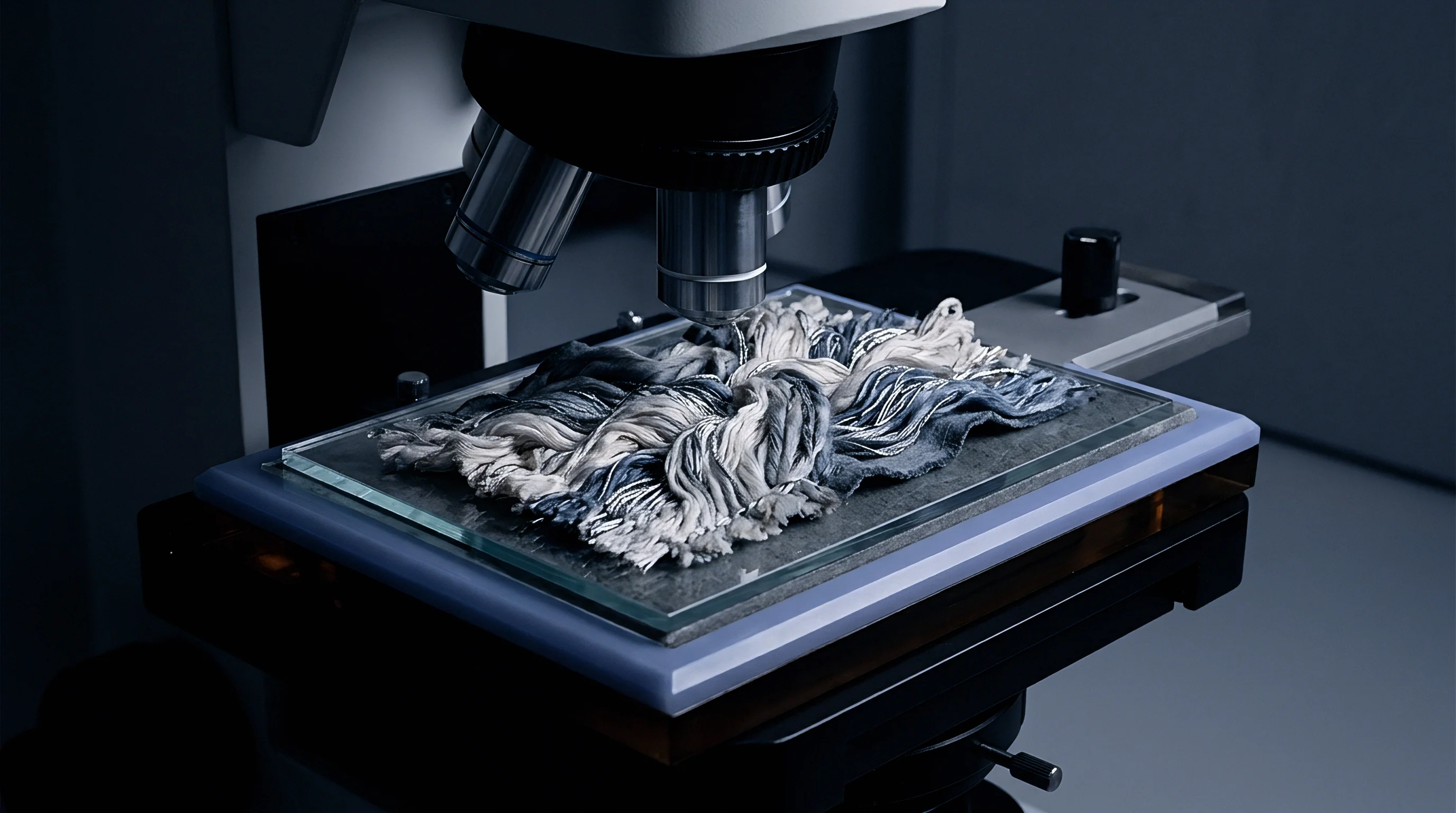
Bench

Gravimetric Washing and Crucible Handling
Sintered glass crucibles with porosity grade 3 or 4 collect insoluble residues after chemical exposure. Recovered post-consumer stock generates high volumes of micro-fibrillar debris during mechanical disintegrations. Porosity grade 3 crucibles occasionally permit short cellulosic fibrils to pass through the filter disc, falsely depressing measured natural fiber yields.
Porosity grade 4 discs prevent mass loss but clog rapidly when handling highly gelatinous cellulosic gels created by degraded lyocell fractions.
Vacuum pressure during filtration requires continuous monitoring. Drawing excessive vacuum through a clogged crucible disc creates channeling along the glass wall. Channeling allows unwashed chemical reagents to bypass filter cake solids.
Residual zinc chloride or sodium hydroxide dries into solid crystalline matrices during subsequent oven conditioning, artificially inflating the weight of the recovered specimen.
| Fiber Component | Prescribed Reagent | Operating Temperature | Contact Duration | Filtration Porosity |
|---|---|---|---|---|
| Polyamide 6 / 6,6 | Formic acid 80% m/m | 20 to 22 deg C | 15 minutes | Grade 3 sinter disc |
| Polyacrylonitrile | Dimethylformamide | 58 to 60 deg C | 30 minutes | Grade 4 sinter disc |
| Cellulose / Cotton | Sulfuric acid 75% m/m | 18 to 20 deg C | 30 minutes | Grade 3 sinter disc |
| Polyethylene terephthalate | M-cresol or Phenol | 98 to 100 deg C | 20 minutes | Grade 4 sinter disc |
| Polyurethane / Elastane | Dimethylacetamide | 80 to 85 deg C | 45 minutes | Grade 3 sinter disc |
Weighing consistency depends on strict moisture stabilization. Recovered cellulosic fractions hold moisture hysteretically; conditioning to equilibrium must occur inside a desiccator containing freshly activated silica gel. Weighings must occur inside stoppered weighing bottles to prevent airborne ambient moisture absorption during the thirty seconds a technician spends zeroing an analytical balance.
Failure to standardize analytical crucible tare cycles between solvent extraction runs invalidates gravimetric data across commercial verification certificates.

Residue

Extracting Polyurethane and Processing Elastomers
Elastane presents significant challenges during quantitative fiber recycling characterization. The block copolymer structure consists of alternating hard and soft segments that resist clean dissolution in conventional weak polar solvents. Dimethylacetamide strips polyurethane elastomers from woven stretch fabrics at 80 degrees Celsius.
When fabrics contain cross-linked elastomeric blends or have undergone repeated high-heat tenter treatments, crosslink density escalates, limiting total polymer solvation.
Unextracted polyurethane manifests as sticky, transparent stringers within the crucible cake. These remnants adhere to synthetic yarn bundles, interfering with subsequent solvent-polymer interactions. When treating polyester and elastane blends, incomplete elastane removal shifts mass into the polyester gravimetric residue.
Commercial specifications often stipulate elastane content below two percent. A two percent elastane inclusion escaping extraction registers as polyester, altering yarn counts and fabric mass targets.
Complete elastane stripping requires a 1 to 100 liquor-to-goods ratio in boiling dimethylacetamide to prevent polymer re-precipitation on cooling.
Pigment printing resins and acrylic coat backings alter mass balances through comparable interference mechanisms. Post-consumer waste often features back-coatings applied to balance fabric drape or control unraveling. The standard extraction route must deploy cyclohexanone at 90 degrees Celsius to isolate polyvinyl chloride coatings, followed by acetone washes to dissolve secondary plasticizers.
Omitting cyclohexanone digestion traps inorganic flame retardants within the fiber mass, distorting the organic analysis entirely.
A simple rule of thumb links mechanical swelling behavior to structural failure: a polymer that swells without clarifying into solution within fifteen minutes has formed an insoluble cross-linked gel that must be quantified separately.


Leach

Dye Transfer and Non-Polymer Weight Distortions
Colorants and finishing chemicals skew quantitative separation yields by leaching into solvents intended only for polymer extraction. Disperse dyes dissolve rapidly in organic media like dimethylformamide and hot trichloroethylene, imparting deep hues to the liquor. Heavy disperse dye loads in dark navy or black post-consumer polyesters account for up to 3.5 percent of total fabric mass.
If dye extraction occurs simultaneously with synthetic polymer dissolution, that lost mass is falsely attributed to the fiber fraction.
Sulfur and vat dyes on cellulosic components resist solvent dissolution, remaining pinned to the cellulosic matrix. This preservation maintains mass integrity during neutral solvent rinses. Severe chemical bleaching applied to reclaimed denim breaks down the indigo dye rings, allowing oxidized colorant fragments to wash into the liquor.
Technicians record this mass loss as dissolved fiber unless correction factors are applied.
- Dye extraction correction factors adjust measured dry weights by subtracting the mass fraction of known dye classes established via spectrophotometric analysis.
- Finishing chemistry adjustments account for durable press melamine-formaldehyde resins that strip unpredictably in warm acidic liquors.
- Inorganic ash determinations utilize muffle furnace combustion at 750 degrees Celsius to quantify non-combustible pigment additives like titanium dioxide.
- Spin finish corrections incorporate standard percentage deductions for process oils reintroduced during yarn mechanical garnetting.
The calculation of clean dry mass demands applying these correction values sequentially. Standard test procedures prescribe fixed correction factors, designated as d-values, to account for non-target fiber weight lost during solvent digestion. Virgin polyester carries a d-value of 1.00 in 75 percent sulfuric acid.
Recovered post-consumer polyester, degraded by solar exposure and repeated washing, carries a lower d-value near 0.98. Ignoring this shift introduces systematic errors across high-volume sorting lines.
Commercial suppliers routinely claim that colorant weight loss falls well within standard testing error margins, masking substantial discrepancies in true recycled composition.


Cleave

Chain Scission and Molecular Degradation Tracking
Mechanical shredding and thermal garnetting cleave covalent polymer backbones, lowering the average molecular weight of recovered fibers. Virgin cotton cellulose features a degree of polymerization between 2,000 and 3,000 glucose units. Recovered post-consumer denim typically displays a degree of polymerization between 600 and 900 units.
Shorter chain lengths alter dissolution kinetics, shifting the temperature and time thresholds required for selective digestion.
Viscometric evaluation reveals hidden fiber degradation before solvent selection begins. Dissolving cellulosic materials in cupriethylenediamine hydroxide solution, per ISO 5351, yields intrinsic viscosity values directly proportional to molecular weight. Low intrinsic viscosity fibers dissolve rapidly, expanding the dissolution window into regimes that risk attacking neighboring fiber types.
For polyamide 6,6, relative viscosity determinations in 90 percent formic acid establish whether previous thermal exposure has embrittled the yarns.
| Polymer Base | Virgin Intrinsic Viscosity | Degraded Recovered Threshold | Standard Test Solvent | Degradation Limit State |
|---|---|---|---|---|
| Cellulose (Cotton) | 900 to 1200 mL/g | Below 350 mL/g | Cupriethylenediamine | Rapid alkaline hydrolysis |
| Polyester (PET) | 0.65 to 0.85 dL/g | Below 0.52 dL/g | Phenol/1,1,2,2-tetrachloroethane | Thermal transesterification |
| Polyamide 6,6 | 2.4 to 2.8 RV | Below 1.9 RV | Formic acid 90% m/m | Oxidative end-group cleavage |
| Polyacrylonitrile | 1.2 to 1.6 dL/g | Below 0.95 dL/g | Dimethylformamide | Amorphous phase collapse |
Gel permeation chromatography provides complete molecular weight distributions when viscometric averages prove insufficient. Bimodal distributions in recycled polyester stocks reveal blends of unworked post-industrial scrap combined with degraded post-consumer bottles or garments. Solvents penetrate the low molecular weight fractions first, generating uneven phase dissolution that skews intermediate mass determinations.
The standard procurement specification must establish explicit viscosity rejection floors to prevent low-integrity, short-chain polymer fractions from entering the spinning stream unnoticed.

Tally
Mass Balance Reconciliation and Invoicing Criteria
Reconciling raw test results into commercial composition guarantees requires rigorous balance accounting across all solvent extraction phases. A typical characterization workflow begins with a conditioned specimen weighing exactly 5.000 grams. Every fraction removed by solvent dissolution must appear on the balance ledger as a physical dry residue or a verified extraction difference.
Discrepancies exceeding 1.0 percent across the mass tally invalidate the run.
Consider a post-consumer circular knit batch specified as 60 percent recovered cotton, 35 percent polyester, and 5 percent elastane. A 5.000 gram analytical specimen contains 3.000 grams of cellulosic fiber, 1.750 grams of polyester, and 0.250 grams of elastane. After petroleum ether pre-washing, the dry specimen weighs 4.910 grams, revealing 0.090 grams of spinning oils and surface waxes.
The subsequent dimethylacetamide extraction for elastane leaves 4.670 grams of dry residue, indicating an elastane mass of 0.240 grams.
Applying 75 percent sulfuric acid dissolves the 60 percent cellulosic core, leaving an insoluble polyester residue on the filter. The oven-dried polyester residue weighs 1.715 grams. Applying the standard historical d-value correction factor of 1.00 suggests a polyester content of 1.715 grams, while the remaining 2.955 grams reflects the degraded cotton fraction.
The final mass distribution calculates to 4.89 percent elastane, 34.93 percent polyester, and 60.18 percent cotton based on the dry desized mass.
If the cotton component had suffered severe photo-oxidation, leading to uncorrected dissolution losses of 2.5 percent within the preliminary solvent steps, the final reported cotton fraction would drop to 57.68 percent. This deviation pushes the fabric outside commercial delivery tolerances, exposing the mill to contract defaults.
A delivery tolerance clause restricting fiber variance to plus or minus 3.0 percent absolute margin protects the buyer from paying natural fiber prices for synthetic surplus.
Commercial contracts hinge on verifiable, clean gravimetric balances. If a test report lacks documented d-value corrections for the specific degradation tier of the feedstock, the declared fiber percentages remain open to legal dispute.
Do standard chemical solvent tables accommodate the structural variations introduced by post-consumer hydrothermal processing cycles without skewing the commercial valuation of recycled yarns?