Warp Cover Factor Calculation Methods in High Density Woven Fabrics
Warp cover factor calculations require correcting direct yarn counts for polymer density and cross-sectional flattening to predict barrier performance accurately.

Reed
Loom setups for downproof and high-tenacity filament goods establish warp density through wire spacing and sley displacement. When calculating the theoretical yarn coverage across the cloth width, technicians define the warp cover factor as the ratio of yarn diameter to the center-to-center distance between adjacent warp ends. The classical relation developed by Frederick Peirce relies on cotton yarn counts, where the diameter in inches equals one divided by twenty-eight times the square root of the indirect cotton count.
Multiplying the ends per inch by this diameter yields the fractional coverage, or Peirce warp cover factor, which reaches a theoretical value of twenty-eight in a jammed square construction. Modern continuous filament weaving relies on direct metric counts, where denier or decitex defines linear mass rather than indirect length. Using denier, the calculation converts linear density and polymer specific gravity into equivalent yarn diameter before establishing spacing across the sley.
Polymer specific gravity governs the volumetric envelope of the yarn. Polyethylene terephthalate holds a nominal density of 1.38 grams per cubic centimeter, while polyamide 6.6 measures 1.14 grams per cubic centimeter. A 50-denier polyester yarn occupies a smaller cross-sectional volume than a 50-denier nylon yarn under identical spinning tensions.
Calculating the warp cover factor across high-sett continuous filament weaves requires normalizing the direct count to an equivalent yarn diameter in millimeters through the relation where diameter equals 0.0357 multiplied by the square root of decitex divided by fiber density. In imperial calculations, the direct denier cover factor often drops the fiber density component, multiplying ends per inch by the square root of denier and dividing by twenty-eight. That simplification introduces systematic errors when comparing polyester goods against nylon or ultra-high-molecular-weight polyethylene.
Classical Warp Sett Calculations across Industrial Looms
Denting arrangements determine whether ends enter the cloth plane uniformly or arrive in pairs that split under finishing tension. In dense constructions exceeding forty ends per centimeter, the mechanical width of the wire blade physically restricts the approach angle of adjacent ends. An operator drawing four ends per dent through a ten-dent reed produces cyclic reed marks that distort the local cover factor across the cloth face.
The local warp cover factor within the dent space surpasses the calculated average by twelve to twenty percent during beatup. This local concentration increases warp abrasion against the drop wires and heald eyes. Greige analysis isolates whether optical stripiness originates from reed wire unevenness or uneven yarn shrinkage during wet processing.
Direct calculation of the warp cover factor across metric industrial records uses the formula where the metric warp cover factor equals ends per centimeter multiplied by the square root of tex divided by ten. British and American mills maintain the imperial cover factor where ends per inch are divided by the square root of cotton count. Converting between these systems requires explicit mathematical translation rather than direct substitution.
Multiplying the British cover factor by 0.957 yields the metric equivalent cover factor. Converting a metric decitex cover value back into the classical Peirce coefficient requires dividing ends per centimeter by the fiber density term before taking the square root. Without this adjustment, comparative evaluations between European filament mills and Asian texturizing plants create misaligned density specifications on the technical data sheet.
Direct Count Formulations for High Tenacity Synthetics
Synthetic yarns with flat, zero-twist filament bundles spread across the cloth plane under minimal lateral constraint. In contrast, high-twist filament yarns maintain a tight, circular cross section that decreases projected coverage. Calculating warp coverage for a 20-denier zero-twist polyamide 6.6 warp running at fifty-five ends per centimeter requires accounting for the air volume inside the filament bundle.
Packing density values for zero-twist continuous filament yarns vary between 0.65 in loose bundles and 0.88 under high warp line tension. Filament count directly alters this packing density: a 20-denier yarn composed of thirty-six filaments deforms under lower lateral forces than a 20-denier yarn composed of six heavy filaments. The finer bundle flattens into an elliptical profile that yields greater physical surface obstruction than rigid geometry indicates.
Loom settings dictate raw density. Drop wires register broken filaments when warp cover exceeds eighty percent of theoretical maximum density. Tension on the warp beam during insertion directly limits how closely adjacent ends pack.
High warp tension holds the ends rigid, forcing the weft picks to take all crimp during beatup. Low warp tension allows ends to yield around the weft, increasing crimp amplitude in the warp direction and pulling ends closer together in the width. Greige goods inspected on the loom perch display open inter-yarn gaps that close during wet processing when relaxation removes longitudinal tension.

Flattening
Circular cross-section geometry fails when warp cover factor values exceed twenty-two in imperial Peirce units or 0.75 in fractional terms. Under mechanical compression between the crossing picks and the beatup reed, synthetic filament bundles deform into flattened ellipses or racetrack configurations. Frederick Peirce acknowledged this phenomenon by proposing an elliptical model where the major axis runs parallel to the cloth plane and the minor axis aligns with the cloth thickness.
The ratio of the major axis to the minor axis, termed the degree of flattening, ranges from 1.10 in low-density apparel linings to 1.85 in dense parachute and downproof textiles. Neglecting yarn flattening leads technicians to underestimate the actual surface area covered by the warp ends.
Kemp introduced the racetrack section model to correct the mathematical limitations of pure ellipses in contact calculations. In the racetrack model, a central rectangle of yarn material is bounded by two semicircular edges. The horizontal dimension increases while the thickness decreases, allowing the warp ends to touch along their lateral borders at a lower picks-per-centimeter threshold than a rigid cylinder permits.
When warp ends achieve lateral contact, further beatup force causes vertical displacement where alternate ends shift into two distinct planes. This displacement produces a two-layer warp structure that alters fluid flow through the interstitial pores.
The measured warp cover factor on 20-denier nylon ripstop rises from 0.72 in the greige state to 0.88 after hot-air pin tentering at 190 degrees Celsius.
Filament mobility inside the bundle controls the extent of cross-sectional flattening. Textured yarns composed of microfilaments deform easily because individual filaments slip into empty interstitial voids within the strand. High-tenacity zero-twist yarns undergo flattening through filament redistribution across the sley face.
Applying high beatup pressure against an incompressible yarn core generates filament cleavage, yarn chafing, and broken filament fuzz balls along the reed cap. Calculating warp cover in these constructions requires incorporating Walmsley empirical corrections or direct optical measurements taken from cured cross-sectional resin mounts under a scanning electron microscope.
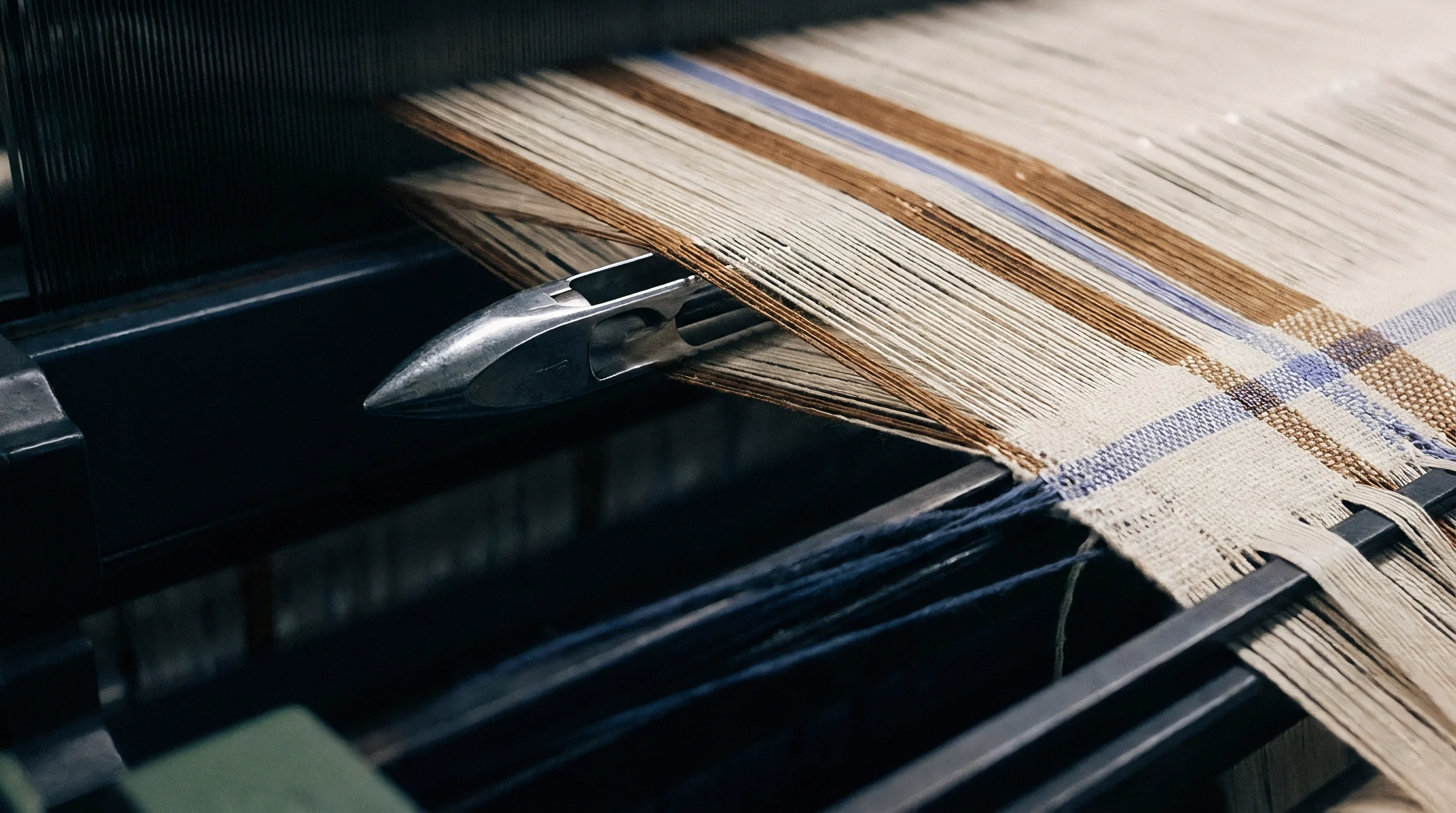
Elliptical Yarn Mechanics under Heavy Beatup Resistance
Calculating the true contact area between adjacent ends requires defining the major axis diameter. When a round yarn of diameter d flattens into an ellipse of major axis a and minor axis b, conservation of cross-sectional area dictates that the product of a and b equals the square of d, assuming yarn bulk density remains constant. The degree of flattening e equals a divided by b.
Substituting this relation reveals that the effective width covered by the warp yarn increases by the square root of the flattening ratio e. A flattening ratio of 1.44 increases the effective horizontal yarn cover by twenty percent over the rigid circular projection. This geometrical change explains why high-density downproof fabrics achieve hydrostatic resistance without exceeding loom jam limits.
Micro-grooving along the filament boundary creates non-uniform capillary channels between adjacent ends. Tension flattens the polyester core. Ends displace sideways.
The major axis expansion reaches a physical boundary when the lateral edge of one warp end presses against the adjacent end. At this contact limit, the effective warp cover factor reaches 1.0, representing complete optical closure in the warp sheet. Any additional ends drawn into the reed force the yarns to buckle out of the cloth plane, generating high surface waviness, uneven crimp distribution, and warp-direction streaking that remains visible after dyeing.
| Yarn Type | Count (Dtex) | Warp Sett (Ends/cm) | Circular Cover | Flattening Ratio | Flattened Cover |
|---|---|---|---|---|---|
| Polyamide 6.6 Flat | 22 | 58.0 | 0.68 | 1.45 | 0.82 |
| Polyester Microfiber | 33 | 52.0 | 0.73 | 1.60 | 0.92 |
| Polyester High Tenacity | 55 | 44.0 | 0.78 | 1.30 | 0.89 |
| Polyamide 6.6 Ripstop | 78 | 38.0 | 0.81 | 1.35 | 0.94 |
| Polyester Intermingled | 110 | 32.0 | 0.82 | 1.25 | 0.92 |

Which Models Predict Filament Distortion under Tension?
Predictive accuracy requires modeling the mechanical forces acting at the cloth fell during weft beatup. The classic Peirce geometry assumes inflexible circular threads that bend purely according to elastica theory. Galuszynski developed modified equations that introduce a cloth tightness parameter, linking loom warp let-off tension directly to yarn flattening coefficients.
Under elevated warp tension, the warp ends resist bending around the weft picks, forcing the softer weft picks to take deep crimp waves while the warp ends remain nearly straight. This structural asymmetry widens the horizontal profile of the warp ends, causing the calculated warp cover factor to surge while the weft cover factor declines.
Mathematical calculations must account for the specific failure modes that occur when structural density exceeds the deformation limits of the synthetic polymer:
- Filament shearing along reed dents occurs when excessive warp sett leaves zero clearance between the reed wire and the flattened yarn bundle during lateral sley oscillation.
- Longitudinal striping from uneven tension develops when individual warp ends experience unequal friction across the heald eyes, creating alternating bands of high and low flattening ratios.
- Crimp locking at the cloth fell prevents the reed from advancing the inserted pick to its calculated position, creating density waves across consecutive picks.
- Secondary pick ejection happens when extreme warp density forces the weft yarn out of its equilibrium position during shed change, resulting in local structural voids.
Whether modern numerical simulations using finite element cross-sectional modeling will replace empirical racetrack equations on mill specification sheets remains an unsettled topic among textile research groups.
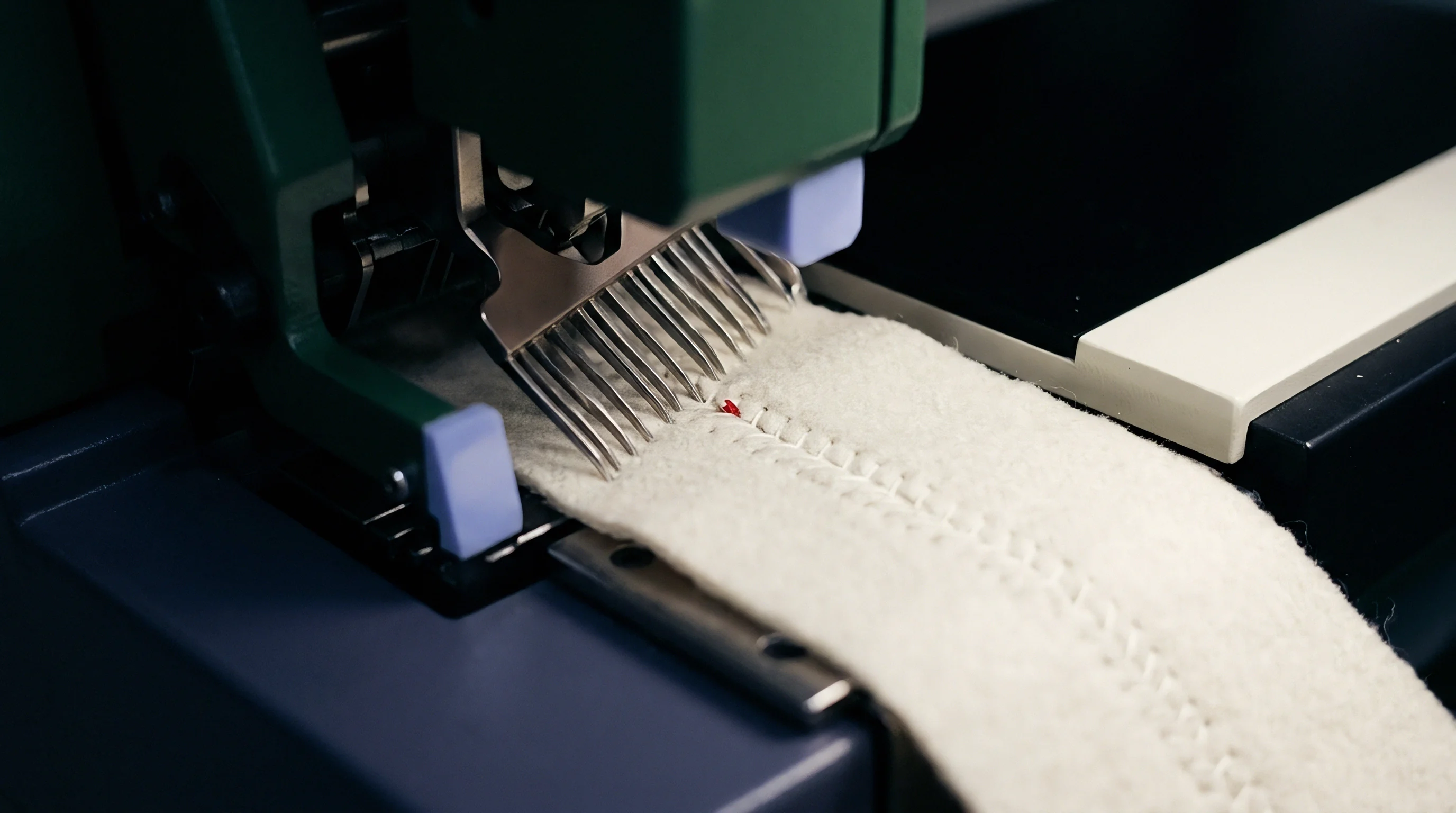

Contraction
Loom state ends-per-centimeter counts never equal the structural sett of finished goods delivered to the cutting table. The mechanical tension applied to the warp sheet during weaving stretches synthetic yarns elastically by two to five percent, while holding the structure at a fixed reed width. Once the greige roll drops from the take-up motion and enters the wet processing line, tension release allows longitudinal relaxation.
Simultaneously, aqueous scouring at elevated temperatures dissolves sizing agents and relieves internal drawing stresses in the synthetic filaments. This release produces thermal and aqueous shrinkage that pulls the warp ends closer together, elevating the finished warp cover factor well above the initial greige calculation.
A continuous filament polyester fabric woven at forty ends per centimeter on the loom often measures forty-four ends per centimeter following scouring and drying. That ten percent increase in linear warp density raises the calculated warp cover factor by an equivalent ten percent margin. Crimp interchange complicates this transition: as the weft yarns shrink across the boiling scour bath, they crimp deeply around the warp ends, pulling the selvages inward and increasing the warp density.
If the wet processing plant runs the fabric through continuous open-width washers under high longitudinal tension, the warp ends stretch instead of relaxing, suppressing finished warp cover while narrowing the fabric width.
Standard testing under ISO 3801 requires conditioning samples for twenty-four hours before weighing, ensuring moisture equilibrium does not bias structural sett calculations.
Stenter frame settings during thermal fixation freeze the final geometry of the warp and weft yarns. Feeding fabric into the stenter with five percent overfeed allows the warp to contract freely, creating high yarn crimp and a higher warp cover factor. Running zero overfeed under high pin-chain tension stretches the warp, decreasing ends per unit length and lowering the finished cover factor.
Dyehouse technicians often stretch goods longitudinally to maximize finished linear yield, inadvertently dropping the warp cover factor below the technical specification required for downproof or waterproof performance.

Greige Density Shifts across the Wet Scour Line
Aqueous immersion alters the cross-sectional geometry of synthetic fibers through plasticization and thermal relaxation. Nylon 6.6 absorbs between 3.5 and 4.5 percent moisture by weight under standard conditions, resulting in transverse fiber swelling of approximately two to three percent. Polyester exhibits minimal water swelling, but its amorphous polymer regions reorganize when subjected to aqueous baths above its glass transition temperature of 75 degrees Celsius.
This reorganization causes axial filament shrinkage that draws adjacent ends into closer physical contact. Greige inspection data cannot predict finished barrier performance unless corrected by historical contraction factors established for each specific wet-processing line.
Finished picks outnumber loom picks. The physical shrinkage of the warp yarn increases warp crimp percentage, measured by unraveling a conditioned yarn and comparing its straightened length to its length in the cloth according to ISO 7211-3. High warp crimp forces the warp ends to traverse a longer serpentine path through the structure, altering the angle at which the yarn presents its surface to the viewer.
This angular displacement modifies the projected optical cover factor, making the cloth appear denser than a two-dimensional mathematical equation predicts.

Crimp Interchange Dynamics during High Temperature Stentering
Heat-setting synthetic textiles between 180 and 210 degrees Celsius fixes yarn crimp into a permanent state. During this stage, the stenter width controls weft tension while the overfeed rollers govern warp tension. Increasing weft tension straightens the weft picks, which pulls the warp ends into deep crimp bends.
This crimp interchange mechanism decreases the apparent width of the weft yarn while allowing the warp ends to pack closer together across the fabric face. If the stenter operator over-tensions the width to achieve a wider finished yield, the warp ends are pulled apart, reducing the warp cover factor and exposing the inter-yarn pores to air and water penetration.
Verifying true warp cover factor across finished shipments requires an exact laboratory procedure applied to finished production rolls:
- Cut full-width swatches across three distinct production rolls, excluding the first five meters of each roll to eliminate end-of-roll tension artifacts.
- Condition all specimens for twenty-four hours at twenty degrees Celsius and sixty-five percent relative humidity in compliance with ISO 139.
- Count the ends across five separate zones across the usable width using an optical counting glass under ISO 7211-2, avoiding the five centimeters adjacent to the selvage.
- Ravel twenty warp ends from each conditioned specimen, recording their extended lengths on a standard crimp balance under a preset tension of 0.5 centinewtons per tex to calculate crimp ratio.
- Measure yarn decitex from the raveled warp ends following chemical de-sizing according to ISO 2060, establishing mass per unit length without residual chemical finishes.
Finishing mills frequently maintain that structural porosity variations stem from greige yarn titer fluctuations rather than unequal tension profiles across the stenter rails.

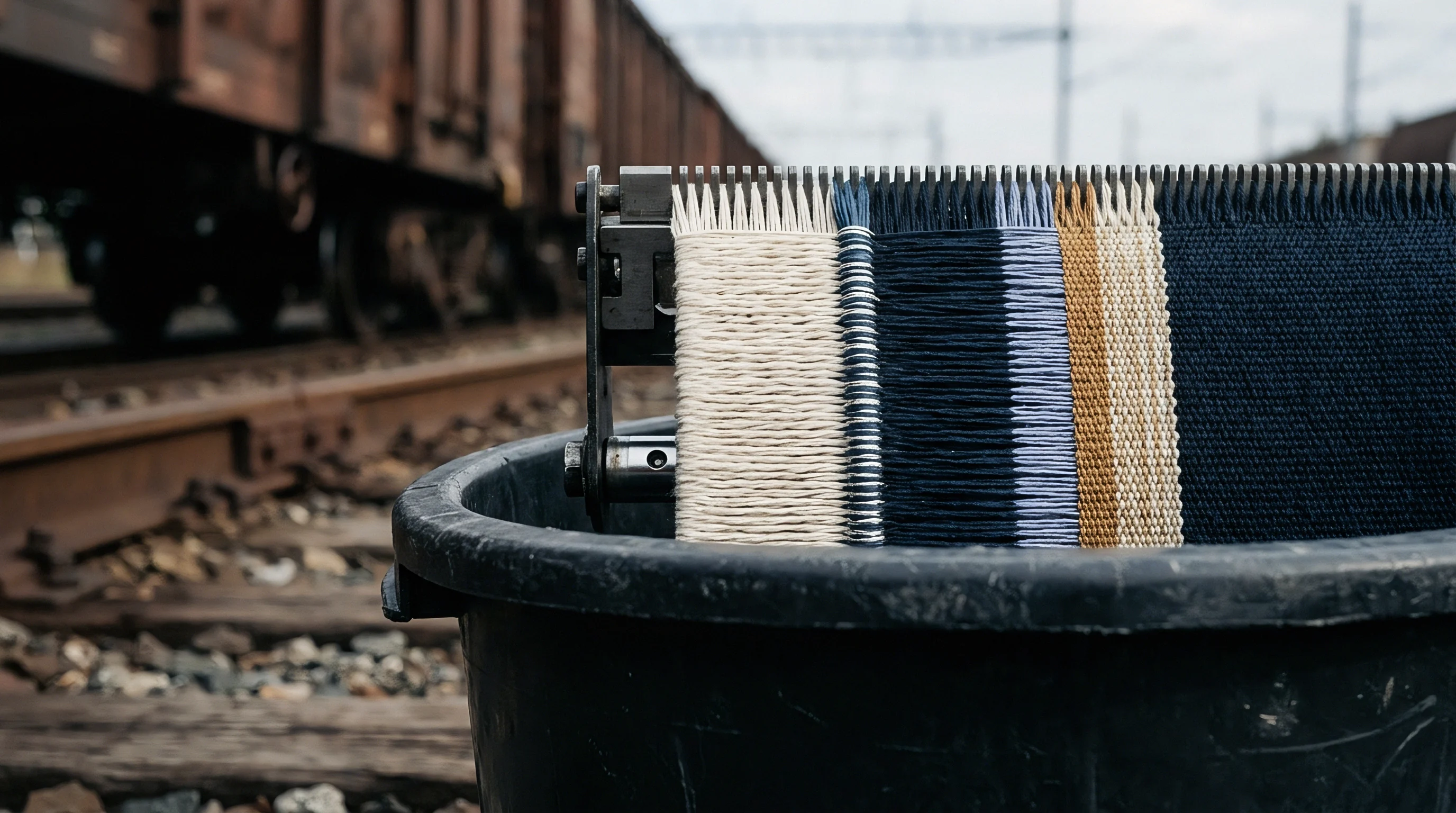
Threshold
Structural jam conditions define the theoretical upper boundary of fabric density. Beyond this limit, no additional yarns can enter the interlacing matrix without causing yarn distortion, structural cockling, or loom mechanical failure. Frederick Peirce established the maximum cover limits for plain woven fabrics based on circular threads, defining a jammed plain cloth as one where both warp and weft yarns are compressed into complete lateral contact with zero free clearance.
For balanced square constructions, the maximum theoretical Peirce cover factor for a plain weave reaches 28.0 in both directions. In high-density warp-faced structures, such as poplins, taffetas, and gabardines, the warp cover factor can rise above thirty if the weft cover factor remains low.
Galuszynski demonstrated that the maximum attainable cover factor depends directly on weave architecture. Plain weaves present the highest number of interlacing points per unit area, creating maximum friction that limits the warp cover factor to lower values than twill or satin weaves permit. In a 2/1 twill or a 2/2 twill, the reduced frequency of yarn crossings allows the warp ends to slide over one another, forming an overlapping or shingled structure.
Satin weaves reduce interlacing intersections further, permitting warp cover factors to exceed thirty-two in imperial units. In these satin structures, the warp ends touch laterally and overlap vertically, achieving total optical opacity and extreme wind resistance.
Plain interlacing structures jam at lower warp cover values than twill constructions because frequent crossing points restrict lateral yarn displacement during beatup.
Micro-filament synthetic constructions designed for downproof shell fabrics push warp cover factors toward physical jam points. These goods require air permeability values below five millimeters per second under a test pressure of 100 Pascals according to ISO 9237. Achieving this barrier performance through yarn density alone requires a fractional warp cover factor above 0.85 combined with a weft cover factor above 0.75.
When loom limitations prevent achieving these values in the greige loom state, converters rely on heavy downstream calendering. Calendering compresses the yarn crown, flattening the synthetic filaments into an impervious plastic sheet that simulates a higher cover factor without requiring impossible loom beatup tensions.
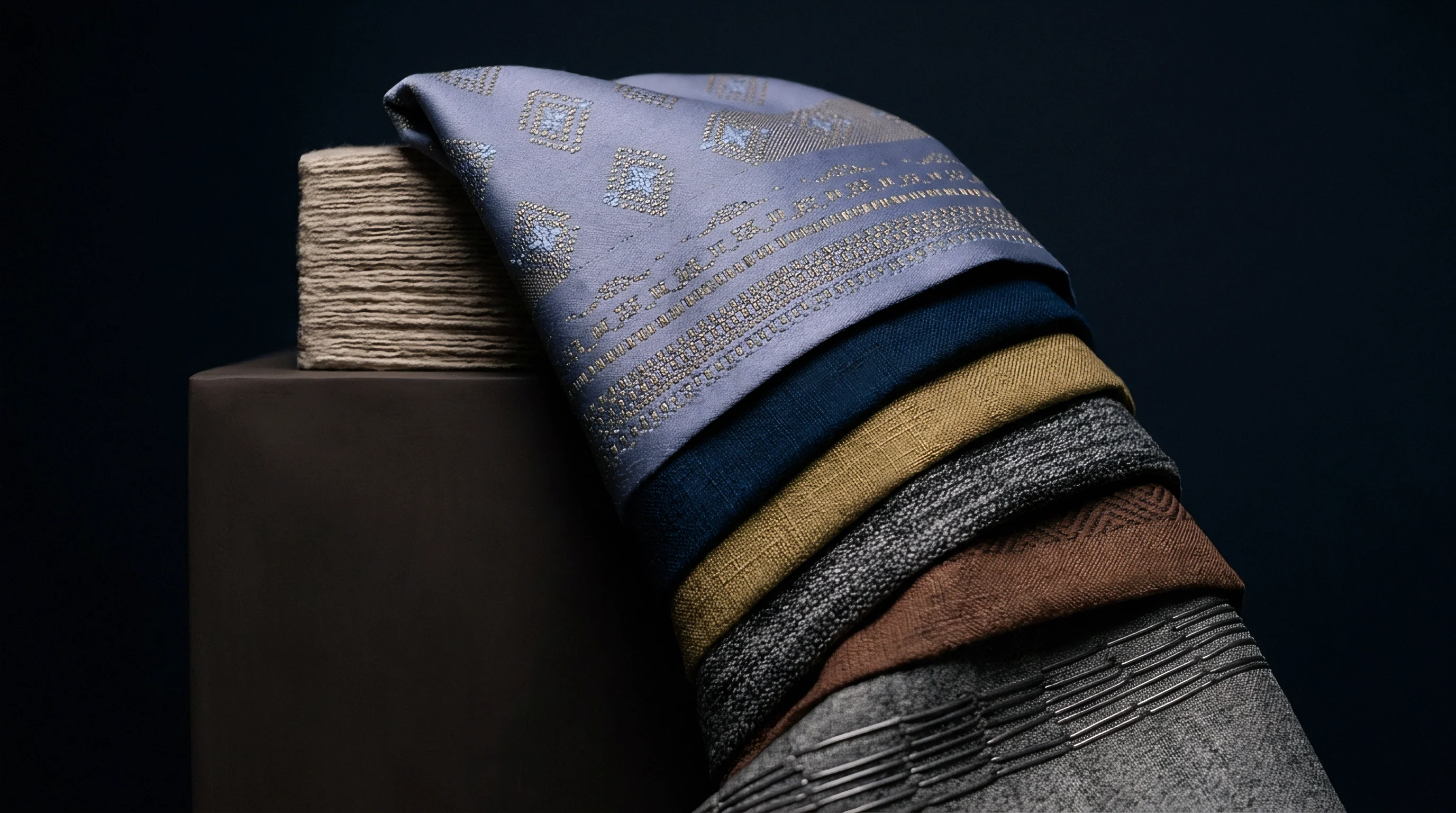
Theoretical Jamming Conditions in Downproof Barrier Cloth
Calculating the jam condition across high-density synthetic taffetas requires calculating the maximum warp sett n1_max. When weft yarns are spaced widely, the warp ends pack until their horizontal axes touch. The mathematical limit for warp sett in a plain structure where the weft yarn remains circular follows the formula where n1_max equals one divided by the sum of warp diameter d1 and weft diameter d2 multiplied by the sine of the warp crimp angle.
As the warp ends flatten, d1 decreases along the vertical axis while increasing along the horizontal axis, shifting the theoretical jam point upward. A fabric with a calculated circular cover factor of twenty-six may function as an open mesh, whereas the same construction with flattened yarns behaves as a fully jammed sheet.
Air permeability drops toward zero. Water entry requires pressure. When the combined cover factor, calculated as warp cover factor plus weft cover factor minus their product, exceeds 0.94, the fabric enters the barrier class.
At this point, the interstitial pores between the yarns measure less than ten micrometers across. Achieving downproofness without polymeric coatings requires maintaining this tight interstitial threshold uniformly across the entire roll. Even a three percent drop in warp sett across a local section of the reed creates pore diameters exceeding thirty micrometers, allowing down plumules and feather quills to penetrate under mechanical handling.
| Fabric Style | Weave | Warp Sett (cm⁻¹) | Warp Tex | Fractional Warp Cover | Air Perm (mm/s) | Hydrostatic Head (mm) |
|---|---|---|---|---|---|---|
| Downproof Ultralight | Plain | 62.0 | 2.2 | 0.89 | 3.8 | 450 |
| Typewriter Poplin | Plain | 54.0 | 4.4 | 0.86 | 7.2 | 320 |
| Micro-Ripstop Shell | Ripstop | 48.0 | 5.5 | 0.84 | 12.5 | 280 |
| Tactical Gabardine | 2/1 Twill | 58.0 | 8.8 | 0.92 | 8.4 | 380 |
| Ballistic Oxford | 2/2 Basket | 34.0 | 33.0 | 0.88 | 24.0 | 190 |
| Note: Air permeability measured under ISO 9237 at 100 Pa pressure drop; hydrostatic head measured under ISO 811 using a rate of 60 cm H2O per minute on uncalendered finished goods. | ||||||
Hydrostatic Resistance versus Air Permeability Crossover Points
Interdependence between warp cover factor and physical barrier metrics exhibits a non-linear crossover region. Below a fractional warp cover factor of 0.80, air permeability scales directly with open pore area, showing rapid drops with every additional end per centimeter added to the reed. Once warp cover factor crosses 0.85, the interstitial pores become tortuous capillary channels rather than direct optical holes.
In this regime, air permeability diminishes asymptotically toward zero, while hydrostatic head resistance begins to climb. The fabric transitions from an open porous medium to a capillary barrier whose water entry pressure obeys the Young-Laplace relationship, where entry pressure varies inversely with effective pore radius.
Procurement teams evaluating technical specifications review these parameters before approving production runs:
- Yarn diameter verification under compression confirms whether the specified yarn decitex produces the required horizontal coverage under normal weaving tensions.
- Crimp distribution ratio between systems indicates whether the warp ends remain straight enough to prevent tear strength degradation along the load axis.
- Loom reed density margins ensure the weaver operates at least five percent below the absolute mechanical jam point to prevent yarn chafing.
- Thermal shrinkage allowance in finishing provides sufficient dimensional contraction to close interstitial pores during scouring without narrowing the cuttable width.
A construction that balances warp and weft cover factors uniformly across both yarn directions resists hydrostatic penetration better than an unbalanced construction carrying equivalent total yarn mass.


Dispute
Settlement conflicts between commercial buyers and weaving mills frequently arise from discrepancies between greige specifications and finished fabric properties. Technical data sheets attached to purchase orders routinely specify yarn count and sett without explicitly identifying whether the values apply on the loom, in the greige roll off the loom, or on the finished and inspected fabric. A mill weaving a downproof nylon shell may establish forty-eight ends per centimeter in the reed, knowing the fabric will contract to fifty-three ends per centimeter after jet scouring and stentering.
If the buyer inspects the greige goods against a finished specification sheet, the shipment fails for low density. Conversely, if the buyer specifies loom-state sett but tests the finished calendered goods, the count appears to exceed specifications, concealing underlying defects such as yarn over-stretching or poor tear strength.
Tear strength degradation is a commercial consequence of excessive warp cover factors. As the warp cover factor increases and ends pack tightly together, the mobility of individual yarns becomes severely constrained. Under tear loading according to ISO 13937-1 (Elmendorf) or ISO 13937-2 (trouser tear), yarns in a loose structure bunch together to form a load-bearing del group that resists the propagating rip.
In an over-sett fabric where the warp cover factor exceeds 0.88, the warp ends are locked rigidly into place by friction against the weft. Yarns snap individually rather than collectively, causing tear strength to plummet by forty to sixty percent compared to a slightly looser construction. Sourcing teams demanding higher cover factors to achieve water repellency often ruin the tear strength of the garment, triggering retail product returns.
Commercial claims over air permeability failure trace back to the absence of a stated tolerance on finished warp ends per centimeter within the purchasing contract.
Cost calculations across high-density weaving chains reflect the severe productivity penalties imposed by elevated warp cover factors. Running a loom with a warp cover factor above twenty-four in Peirce units requires lowering loom running speeds by fifteen to twenty-five percent to minimize warp breaks and prevent mispicks. On air-jet looms, dense warp sheets impede shed opening and restrict the passage of the main nozzle air stream, requiring higher air tank pressures that escalate electrical consumption per woven meter.
Sourcing executives paying for premium high-density micro-ripstop fabrics pay not only for the additional mass of synthetic yarn, but also for the lower efficiency of the weaving floor and the elevated inspection reject rates caused by broken filaments.

Procurement Discrepancies between Loom and Calendered State
Calendering introduces a deceptive shortcut that obscures deficient warp cover factors. When a mill weaves an under-sett fabric with a fractional warp cover of only 0.76, the fabric fails downproof testing because the inter-yarn pores measure fifteen to twenty micrometers across. Rather than adjusting the reed to increase the true warp sett, an unethical or poorly supervised mill runs the fabric through a high-pressure heated calender at three hundred kilonewtons of nip force and 190 degrees Celsius.
The calender crushes the synthetic fibers, melting their surfaces slightly and smearing the polymer across the open pores. The fabric passes the downproof air permeability test on the day of delivery.
Greige figures misstate barrier performance. Calendering compresses the yarn crown. Once the consumer washes the garment three times in domestic laundering according to ISO 6330, the flattened polymer chains relax, the thermal bond breaks, and the crushed filaments snap back toward their original positions.
The inter-yarn pores reopen, down feathers leak through the shell, and the buyer faces catastrophic brand damage. Sourcing managers prevent this failure by measuring the warp cover factor on washed and conditioned swatches rather than accepting initial calendered roll certificates. True barrier performance resides in physical thread count and calculated geometrical coverage, not in transient mechanical finishes.
Should Procurement Contracts Reference Loom or Finished State?
Technical purchase contracts must stipulate whether physical sett values govern at the reed, in the unwashed greige state, or as finished goods ready for the cutting table. A rigorous purchasing agreement specifies the testing protocol, citing ISO 7211-2 for end and pick counts, and ISO 2060 for linear density determination after the removal of non-fibrous materials. Specifying finished sett alone leaves the door open for mills to achieve density through artificial width shrinkage on the stenter, which compromises the usable cuttable width and inflates the cost per linear meter for the cutting room.
Specifying loom state alone leaves the buyer unprotected against poor wet-processing control that fails to contract the goods into their dense barrier state.
The buyer deducts finishing costs. Clear specifications eliminate ambiguity by stating nominal targets and strict bilateral tolerances for both greige and finished states:
- Target warp sett on finished cloth requires a tolerance band of plus or minus two percent, measured after twenty-four hours of conditioning under standard atmospheric conditions.
- Yarn linear density in decitex must be verified after solvent extraction of spinning oils, paraffin waxes, and water-repellent chemical treatments.
- Maximum allowable air permeability on uncalendered finished goods defines the baseline mechanical tightness before any physical rolling operations take place.
- Dimensional stability upon commercial washing establishes whether post-finishing relaxation will cause excessive garment shrinkage or open up interstitial pores.
Under standard commercial terms governed by the International Federation of Buying Agents, incorporating an explicit clause stating that all warp and weft cover factors are calculated from de-sized, conditioned finished samples using true yarn specific gravity protects the buyer against paying for transient calender consolidation that washes out in consumer hands.